CA Intermediate Subjects January 2027: Complete Syllabus, Papers, Marks & Preparation Guide
CA Intermediate Subjects January 2027: What Should Students Study?
If you are preparing for the CA Intermediate January 2027 examination, one of the first things you should get absolutely clear is the list of subjects you need to study.
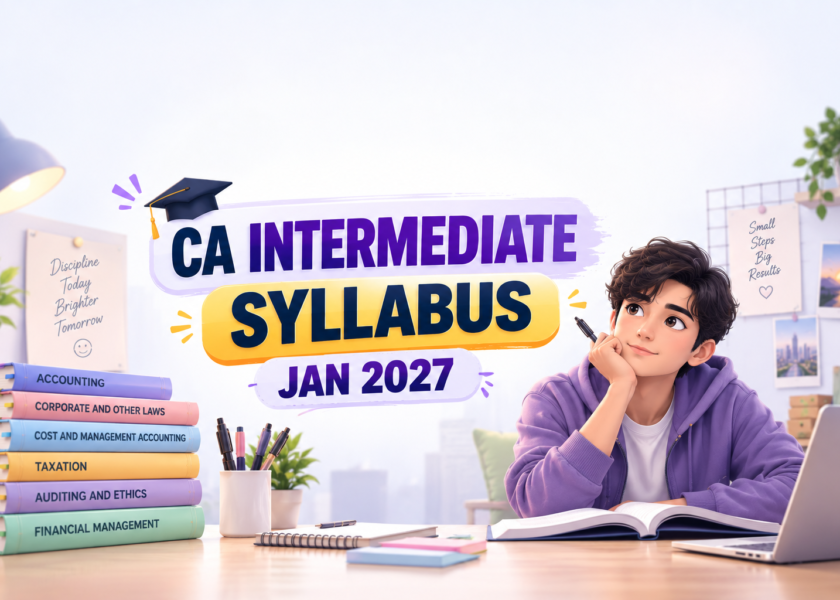
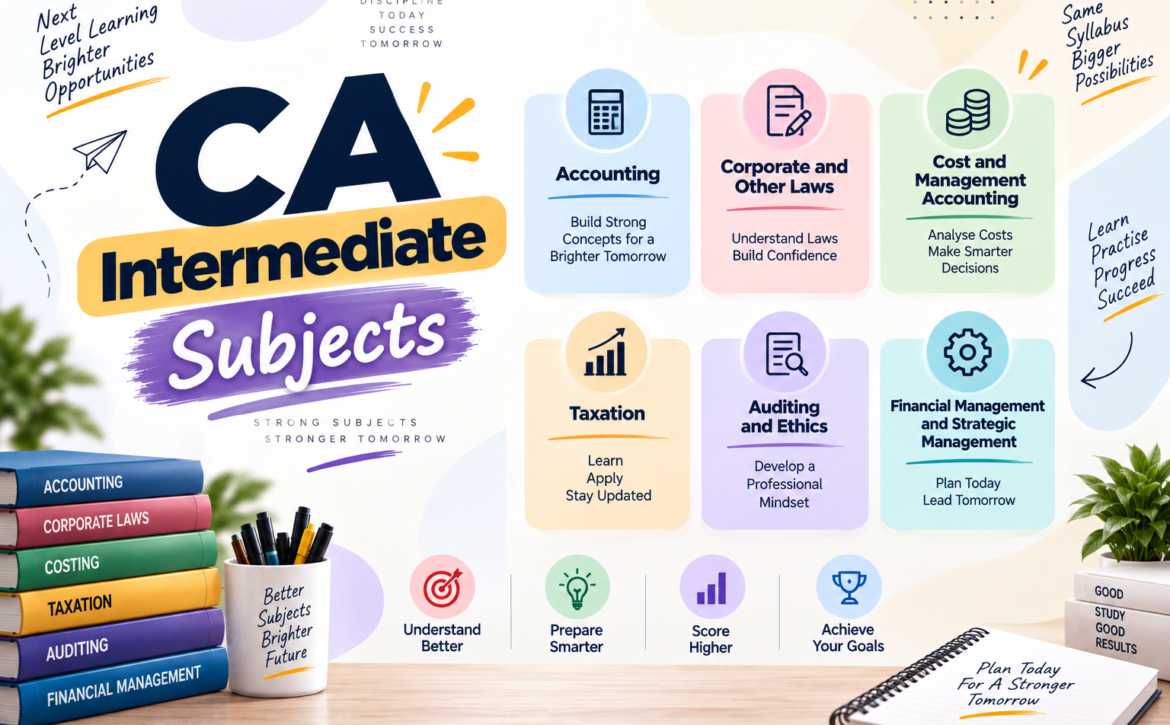
CA Intermediate under the New Scheme has six papers divided into two groups. Group 1 contains Advanced Accounting, Corporate and Other Laws, and Taxation, while Group 2 consists of Cost and Management Accounting, Auditing and Ethics, and Financial Management and Strategic Management. ICAI’s official syllabus page confirms this six-paper structure.
But simply knowing the names of the six papers is not enough.
A common mistake students make is downloading random old PDFs, watching old lectures, or following preparation plans designed for a different examination attempt. For January 2027, students should pay attention to the applicable study material and amendments, especially in Taxation.
The good news is that ICAI’s current Last Mile Referencer specifically identifies the Income-tax and GST portions of Taxation as relevant for January 2027.
This guide explains the complete CA Intermediate Subjects January 2027, the group-wise structure, marks, what each paper covers, the examination pattern, and how you can plan your preparation without making it unnecessarily complicated.
CA Intermediate Subjects January 2027 – Quick Overview
There are six papers in CA Intermediate under the New Scheme of Education and Training.
| Group | Paper | Subject | Marks |
| Group 1 | Paper 1 | Advanced Accounting | 100 |
| Group 1 | Paper 2 | Corporate and Other Laws | 100 |
| Group 1 | Paper 3 | Taxation | 100 |
| Group 2 | Paper 4 | Cost and Management Accounting | 100 |
| Group 2 | Paper 5 | Auditing and Ethics | 100 |
| Group 2 | Paper 6 | Financial Management and Strategic Management | 100 |
| Total | 6 Papers | Both Groups | 600 |
Each paper carries 100 marks, making the total for both groups 600 marks.
Paper 3, Taxation, has two sections: Income-tax Law and Goods and Services Tax (GST). Paper 6 also has two sections: Financial Management and Strategic Management.
CA Intermediate Group 1 Subjects January 2027
Group 1 contains three papers:
- Advanced Accounting
- Corporate and Other Laws
- Taxation
Let’s understand what students can expect from each subject.
1. Advanced Accounting
Paper 1 – Advanced Accounting is the first paper of CA Intermediate Group 1.
This subject takes your accounting knowledge to a higher level. At Foundation, students generally learn the fundamentals. At Intermediate, the expectation changes: you need to understand accounting treatments, standards, adjustments and practical problems in much greater depth.
Advanced Accounting requires regular question practice.
Simply reading the study material multiple times is unlikely to be enough. You should solve questions after understanding the underlying accounting treatment.
Important areas generally covered include:
- Accounting Standards
- Company Accounts
- Financial Statements
- Partnership-related accounting
- Branch accounts
- Amalgamation and reconstruction-related concepts
- Accounting for different business situations
- Other advanced accounting topics prescribed by ICAI
The exact applicable study material should always be checked from ICAI because syllabus applicability can change between examination cycles.
For January 2027 preparation, do not blindly rely on material marked for May 2027 onwards. ICAI’s search results currently distinguish the Advanced Accounting material applicable from May 2027 onwards from earlier applicable material.
How to prepare Advanced Accounting
A practical approach is:
Concept → Illustration → Question Practice → Revision → Mock Test
If a chapter takes you two hours to understand, don’t spend another three hours simply rereading it. Start solving questions.
That is where you discover whether you actually understood the concept.
2. Corporate and Other Laws
Paper 2 – Corporate and Other Laws is a theory-heavy paper, but treating it as a pure memorisation subject can make preparation much harder.
The objective should be to understand:
- What the provision says
- Why the provision exists
- What conditions apply
- What exceptions exist
- How the provision is applied to a practical situation
Corporate law can become confusing because several provisions may look similar at first.
The best way to deal with this is to create short revision notes.
For example, instead of writing an entire chapter again, maintain a notebook containing:
- Definitions
- Important provisions
- Time limits
- Penalties
- Exceptions
- Important keywords
- Practical case-based points
This becomes extremely useful during the final revision.
One important change students should watch
ICAI’s current search results show that the Corporate and Other Laws study material marked applicable from May 2027 onwards is a later applicability, so January 2027 candidates should use the material applicable to their examination attempt rather than automatically downloading the newest version.
3. Taxation
Taxation is Paper 3 of Group 1 and is divided into:
- Section A – Income-tax Law
- Section B – Goods and Services Tax
Both sections are important.
For many students, Taxation feels difficult because the subject combines concepts, provisions, calculations and amendments.
Income-tax Law
Income-tax preparation requires students to understand the provisions and then apply them to practical situations.
A good preparation strategy involves:
- Understanding the provision.
- Learning the conditions and exceptions.
- Solving illustrations.
- Practising examination questions.
- Revising amendments.
- Taking timed tests.
GST
GST also requires conceptual clarity.
Instead of memorising every provision separately, try to understand the overall structure:
Supply → Levy → Time → Value → Input Tax Credit → Compliance
This helps you connect different chapters.
Most important January 2027 point
Students preparing for January 2027 should be particularly careful about taxation material.
ICAI’s official Last Mile Referencer states that the Income-tax Law and GST portions listed there are relevant for May 2026, September 2026 and January 2027 examinations.
At the same time, ICAI’s search results indicate that the Income-tax Act, 2025 becomes applicable from May 2027 CA examinations onwards, meaning January 2027 students should not casually shift to material intended for May 2027.
This is one of the most important things to remember when preparing for CA Intermediate January 2027.
CA Intermediate Group 2 Subjects January 2027
Group 2 contains:
- Cost and Management Accounting
- Auditing and Ethics
- Financial Management and Strategic Management
These three papers are quite different from one another, which means students should avoid using the same study technique for all three.
4. Cost and Management Accounting
Paper 4 – Cost and Management Accounting is a practical subject that becomes easier once you start solving questions regularly.
Students often make one mistake here: they watch lectures but don’t solve enough questions.
That creates a false feeling of preparation.
You may understand a teacher’s solution while watching the lecture, but the real test comes when you get a new question and have to solve it yourself.
Focus areas should include:
- Cost concepts
- Material cost
- Labour
- Overheads
- Methods of costing
- Cost sheet
- Marginal costing
- Standard costing
- Budgeting
- Decision-making areas
- Other topics included in the applicable ICAI study material
The exact chapter list and applicable material should be verified from ICAI for your attempt.
Best approach
Try this simple routine:
Learn the formula → Understand the logic → Solve basic questions → Solve exam-level questions → Revise mistakes
Maintain a separate mistake book.
Every time you make an error, write down:
- What the question asked
- Where you went wrong
- Correct treatment
- Formula or concept involved
Before the exam, this small notebook can become more useful than another round of reading the entire textbook.
5. Auditing and Ethics
Auditing and Ethics is Paper 5.
This subject is often underestimated because students assume that it only requires memorisation.
In reality, understanding the purpose behind an auditing procedure makes revision much easier.
For example, instead of memorising a procedure mechanically, ask:
What risk is the auditor trying to address?
Once you understand the logic, many provisions become easier to remember.
For Auditing preparation, focus on:
- Important definitions
- Audit procedures
- Standards and principles
- Auditor responsibilities
- Professional ethics
- Practical situations
- Important keywords
- Case-based questions
Writing practice is particularly important.
You may know the answer, but if you cannot present it in a structured way under exam pressure, converting that knowledge into marks becomes difficult.
A good answer generally has:
Relevant provision → Explanation → Application/conclusion
6. Financial Management and Strategic Management
Paper 6 is divided into:
- Section A – Financial Management
- Section B – Strategic Management
This combination makes Paper 6 unique because it includes both practical and theoretical components.
ICAI’s current material lists Financial Management and Strategic Management as the two sections of Paper 6.
Financial Management
Financial Management involves numerical and conceptual preparation.
Topics include areas such as:
- Financial management objectives
- Financial analysis
- Ratio analysis
- Cost of capital
- Capital structure
- Leverages
- Investment decisions
- Dividend decisions
- Working capital management
ICAI’s official study material currently lists these areas across the Financial Management modules.
The best way to prepare FM is to solve questions consistently.
Don’t leave all numerical practice for the last month.
Strategic Management
Strategic Management is more theory-oriented.
The current ICAI material includes areas such as:
- Introduction to Strategic Management
- External environment
- Internal environment
- Strategic choices
- Strategy implementation and evaluation
The biggest mistake students make in SM is trying to memorise paragraphs word-for-word.
Instead, understand the concept first and then remember the keywords.
During revision, create one-page chapter summaries containing:
- Definitions
- Models
- Key points
- Advantages/disadvantages
- Keywords
- Examples
This makes repeated revision much faster.
CA Intermediate January 2027 Exam Pattern
Understanding the subjects is only half the preparation.
You should also understand how ICAI expects you to answer the papers.
According to ICAI’s examination FAQ for the New Scheme, Intermediate examinations have 30% case scenario/case-study-based MCQs and 70% descriptive questions across the six papers. ICAI also states that there is no negative marking for the MCQ portion.
| Component | Weightage |
| Case Scenario / Case Study Based MCQs | 30% |
| Descriptive Questions | 70% |
| Total | 100% |
| Negative Marking in MCQs | No |
This means your preparation should not be limited to solving descriptive questions.
You should also practise MCQs regularly.
CA Intermediate January 2027 Passing Criteria
The passing requirement is another area students should understand before planning their attempt.
Under the New Scheme, a student generally needs:
- At least 40% marks in each paper, and
- At least 50% aggregate in the relevant group.
Students can also pass the two groups in separate attempts, subject to the applicable examination rules. ICAI’s examination FAQ explains the group-wise and both-group passing criteria.
So don’t prepare with a mindset of simply scoring 40 marks.
If your target is to comfortably clear a group, your preparation should aim substantially higher.
Should You Prepare One Group or Both Groups?
This depends on your preparation time, academic background and ability to manage six subjects simultaneously.
| Situation | Suggested Approach |
| Strong preparation time | Consider both groups |
| Limited daily study hours | One group may be more practical |
| First attempt with strong Foundation base | Evaluate both groups |
| Working/student with limited time | Consider one group strategically |
| Repeater | Analyse previous attempt before deciding |
| Strong in practical subjects | Balance theory subjects carefully |
There is no universal answer.
Some students perform better when they focus on one group. Others prefer studying both groups because it gives them more flexibility.
The important thing is to choose a strategy before your preparation becomes chaotic.
How to Prepare for CA Intermediate January 2027
A practical preparation plan can be divided into four stages.
Stage 1: Understand the Syllabus
Before watching lectures or buying multiple books, download the applicable ICAI study material.
Create a chapter checklist for all six papers.
Mark every chapter as:
- Not Started
- In Progress
- Completed
- Revised
- Tested
This simple system can prevent a lot of last-minute panic.
Stage 2: Complete the First Reading
Your first target should be conceptual understanding.
Don’t try to memorise everything during the first reading.
For practical subjects, solve questions alongside your classes.
For theory subjects, create short notes and revise them periodically.
Stage 3: Revision and Question Practice
Once the syllabus is completed, shift your focus from learning to testing.
Solve:
- ICAI module questions
- Previous examination questions
- Revision Test Papers
- Mock Test Papers
- Case-based MCQs
The aim is to identify weak areas before the actual examination.
Stage 4: Final Revision
During the final revision period, avoid starting ten new resources.
Use a controlled set of material.
Your priority should be:
ICAI Study Material → Amendments → RTP/MTP → Previous Questions → Personal Revision Notes
This keeps preparation focused.
A Simple Daily Study Strategy
You don’t necessarily need to study every subject every day.
For example:
| Time | Activity |
| Morning | Practical subject / numerical practice |
| Afternoon | Lecture or concept building |
| Evening | Theory subject |
| Night | 30–45 minute revision |
| Weekly | Mock/test + mistake analysis |
Even if you cannot follow these exact timings, the principle remains the same:
Learn → Practise → Revise → Test
That cycle matters more than simply counting study hours.
Common Mistakes to Avoid for January 2027
1. Studying from outdated material
This is particularly risky in Taxation and other subjects where applicable material changes.
2. Collecting too many books
More resources don’t automatically mean better preparation.
3. Ignoring ICAI material
Your preparation should remain closely aligned with the material and examination resources prescribed by ICAI.
4. Leaving revision for the end
Revision should start while you are completing the syllabus.
5. Avoiding mock tests
A mock test is not just for checking marks. It tells you whether you can manage time, presentation and pressure.
6. Memorising without understanding
This is especially risky for Law, Audit and Strategic Management.
7. Ignoring MCQs
With 30% of the paper based on case scenario/case-study-based MCQs, objective practice deserves proper attention.
Why the Right Guidance Matters for CA Intermediate
CA Intermediate is not difficult simply because there are six subjects.
The real challenge is managing different types of subjects at the same time.
You may be solving Advanced Accounting questions in one session, studying Corporate Law in another, and then switching to GST or Strategic Management.
That constant switching can become tiring.
This is where a structured approach helps.
At CA Mentoring Program, students can use guidance and structured preparation to avoid studying blindly. The objective should not be to study for the sake of completing hours. It should be to understand where you stand, identify weak areas and improve them consistently.
A good preparation system should answer three questions:
- What should I study?
- How should I study it?
- How do I know whether I am actually ready?
If your preparation system can answer these three questions, you are already ahead of many students who simply keep consuming lectures and notes without measuring progress.
Final Takeaway: CA Intermediate Subjects January 2027
The CA Intermediate January 2027 syllabus consists of six papers under the New Scheme:
Group 1
- Advanced Accounting
- Corporate and Other Laws
- Taxation
Group 2
- Cost and Management Accounting
- Auditing and Ethics
- Financial Management and Strategic Management
Each paper carries 100 marks. Paper 3 contains Income-tax Law and GST, while Paper 6 combines Financial Management and Strategic Management.
For January 2027 candidates, the most important thing is to study from the correct attempt-specific ICAI material. ICAI’s current Last Mile Referencer specifically identifies the relevant Taxation material for January 2027, while some newer study materials are marked for May 2027 onwards.
Don’t make your preparation complicated.
Pick the correct material, understand the concepts, practise questions, revise repeatedly and test yourself honestly.
And remember one thing: completing the syllabus is not the same as being exam-ready.
You become exam-ready when you can sit with a fresh question paper, manage your time, understand the questions and confidently reproduce what you have studied.
That is the level you should target for CA Intermediate January 2027.