CA Final Subjects November 2026: Complete Paper-Wise Syllabus, Groups & Preparation Strategy
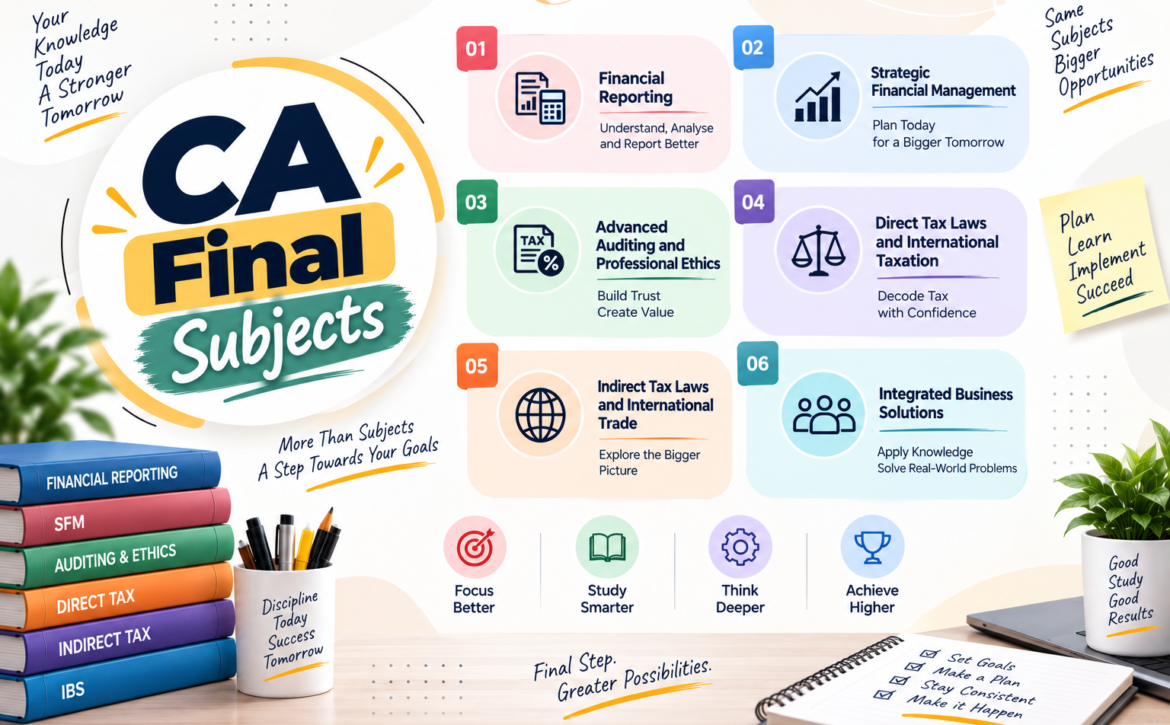
If you are preparing for the CA Final November 2026 examination, one of the first things you need to get absolutely clear is the complete list of CA Final subjects, their group-wise structure, and the nature of each paper.
Under the current ICAI scheme, the CA Final course consists of six papers divided into two groups. Group 1 contains Financial Reporting, Advanced Financial Management, and Advanced Auditing, Assurance and Professional Ethics. Group 2 consists of Direct Tax Laws & International Taxation, Indirect Tax Laws, and Integrated Business Solutions.
But knowing the names of the six subjects is only the beginning.
CA Final is not an examination where simply completing lectures guarantees good marks. The syllabus is extensive, the questions require conceptual application, and your preparation needs to include revision, question practice, mock tests, and answer-writing. This becomes even more important when you are targeting the November 2026 attempt and have limited time to convert your preparation into exam-ready performance.
In this guide, we will cover the CA Final subjects for November 2026, paper-wise details, group structure, preparation strategy, important areas to focus on, and practical tips that can help you prepare more effectively.
CA Final Subjects November 2026 – Quick Overview
The CA Final examination under the current scheme has six papers.
| Group | Paper | Subject | Paper Type |
| Group 1 | Paper 1 | Financial Reporting | Core Technical Paper |
| Group 1 | Paper 2 | Advanced Financial Management | Numerical + Conceptual |
| Group 1 | Paper 3 | Advanced Auditing, Assurance and Professional Ethics | Theory + Application |
| Group 2 | Paper 4 | Direct Tax Laws & International Taxation | Technical + Practical |
| Group 2 | Paper 5 | Indirect Tax Laws | Technical + Practical |
| Group 2 | Paper 6 | Integrated Business Solutions – Multidisciplinary Case Study with Strategic Management | Case Study / Integrated Paper |
These six papers constitute the current CA Final examination structure. ICAI’s official Career Counselling Committee also lists the same Group 1 and Group 2 subjects for the Final course.
CA Final Group 1 Subjects November 2026
Group 1 consists of three papers:
- Financial Reporting
- Advanced Financial Management
- Advanced Auditing, Assurance and Professional Ethics
Group 1 is often considered a demanding combination because it requires students to switch between accounting, numerical finance, and audit-oriented conceptual application.
Let’s understand each paper separately.
Paper 1 – Financial Reporting
Financial Reporting (FR) is the first paper of CA Final Group 1.
This subject builds on the accounting concepts studied at the earlier stages of the CA course and takes them to a much more advanced level.
At CA Final, you are expected not merely to know accounting standards but also to understand how they operate in practical financial reporting situations.
What makes Financial Reporting important?
FR can become a high-scoring paper for students who develop strong conceptual clarity and practice enough practical questions.
The subject generally demands:
- Strong understanding of accounting standards
- Conceptual clarity
- Practical application
- Proper working notes
- Accurate calculations
- Presentation skills
- Regular revision
One common mistake students make is treating FR as a subject that can be completed by watching lectures alone. It cannot.
You need to solve questions yourself.
A good FR preparation cycle should look like:
Concept → Illustration → ICAI Questions → Revision → Mock Test → Error Analysis
The more comfortable you become with applying accounting principles to unfamiliar situations, the better prepared you will be for the actual examination.
Paper 2 – Advanced Financial Management
Advanced Financial Management (AFM) is the second paper of Group 1.
For students who enjoy practical subjects, AFM can become one of the most rewarding papers in CA Final. However, it can also become frustrating if your basics are weak or you postpone question practice.
AFM requires a combination of:
- Conceptual understanding
- Formula retention
- Numerical practice
- Interpretation
- Speed
- Accuracy
Simply memorising formulas is not enough.
You should understand why and where a particular formula is used.
How should you prepare for AFM?
Start by building a formula notebook or digital revision sheet.
For every chapter, maintain three things:
- Important formulas
- Typical question patterns
- Mistakes made while solving questions
This small habit can make revision significantly faster during the final weeks.
A practical AFM strategy
Instead of solving 50 questions randomly, solve questions chapter-wise first.
Once you become comfortable, move towards mixed practice.
For example:
Chapter-wise practice → Mixed questions → Past examination questions → Mock paper
This gradually develops the ability to identify the correct concept without being told which chapter the question belongs to.
Paper 3 – Advanced Auditing, Assurance and Professional Ethics
The third paper of Group 1 is Advanced Auditing, Assurance and Professional Ethics.
For many students, Audit is less about difficulty and more about how effectively they study and reproduce the concepts.
The challenge is that simply reading the material multiple times does not necessarily translate into marks.
You need to learn how to present an answer in a structured manner.
What should you focus on in Audit?
Your preparation should include:
- Understanding concepts
- Learning important provisions
- Developing answer-writing skills
- Practising case-based questions
- Revising repeatedly
- Understanding professional ethics
- Solving ICAI study material and examination questions
A useful approach is to create short revision notes containing:
Keyword → Provision → Explanation → Practical application
During revision, these notes can save considerable time.
Don’t make this mistake in Audit
One of the biggest mistakes is waiting until the end to start writing answers.
Start answer-writing practice well before the examination.
Even if you know the answer mentally, writing it within a limited time is a different skill.
CA Final Group 2 Subjects November 2026
Group 2 contains:
- Direct Tax Laws & International Taxation
- Indirect Tax Laws
- Integrated Business Solutions – Multidisciplinary Case Study with Strategic Management
These subjects require a different preparation approach compared with Group 1.
Taxation requires conceptual and practical application, while Paper 6 tests your ability to analyse integrated business situations.
Paper 4 – Direct Tax Laws & International Taxation
Direct Tax Laws & International Taxation (DT) is the fourth paper of CA Final.
This is a subject where students often make the mistake of trying to memorise everything without understanding the underlying provisions.
Direct Tax requires a balance between:
- Conceptual clarity
- Provision-based learning
- Practical application
- Question practice
- Regular revision
Tax is also highly sensitive to the applicable provisions for a particular examination attempt.
Therefore, students appearing in November 2026 should always study according to the ICAI material and applicability relevant to the November 2026 examination, rather than blindly using old notes or outdated content.
This is particularly important because ICAI has already stated that the Income-tax Act, 2025 becomes applicable from the May 2027 CA examinations onwards, which means students preparing for November 2026 should carefully follow the applicable law and study material for their own attempt.
How to study Direct Tax
Break the subject into smaller revision units.
For each topic, identify:
- Important provisions
- Conditions
- Exceptions
- Computation methodology
- Practical questions
- Frequently tested concepts
Then revise the same topics multiple times instead of trying to cover everything once.
Paper 5 – Indirect Tax Laws
The fifth paper is Indirect Tax Laws, which primarily requires strong understanding of GST-related concepts along with the applicable syllabus for the examination attempt.
Students often find GST confusing because several provisions appear interconnected.
The solution is not to memorise isolated sections.
Instead, understand the flow.
For example:
Supply → Time of Supply → Place of Supply → Value → ITC → Payment → Returns
When concepts are connected logically, revision becomes much easier.
How to prepare for IDT
A practical approach is:
| Preparation Stage | What to Do |
| First Reading | Understand concepts |
| Second Reading | Mark important provisions |
| Practice | Solve ICAI questions |
| Revision 1 | Revise chapter-wise |
| Revision 2 | Solve mixed questions |
| Final Revision | Focus on amendments + important areas |
Always ensure that your notes and study material are aligned with the November 2026 applicability.
Paper 6 – Integrated Business Solutions
The sixth paper is Integrated Business Solutions – Multidisciplinary Case Study with Strategic Management.
This paper is different from the traditional standalone theory or numerical papers.
Instead of approaching every chapter as an isolated topic, you need to develop the ability to read a business situation, identify relevant issues, connect multiple concepts, and arrive at an appropriate solution.
The official ICAI description lists Paper 6 as an Integrated Business Solution (Multidisciplinary Case Study with Strategic Management).
Why is Paper 6 different?
Imagine receiving a case about a company that has:
- Financial problems
- Tax implications
- Business risks
- Governance concerns
- Strategic decisions
- Financing requirements
The question may require you to connect different areas rather than simply reproduce one chapter.
Therefore, Paper 6 preparation should focus heavily on case-study practice.
What should students practise?
Do not limit yourself to reading theoretical material.
Practise:
- Case studies
- Integrated questions
- Mock examinations
- Time-bound case analysis
- Strategic decision-making questions
- ICAI material and practice resources
The ability to identify what the question is actually asking becomes extremely important.
CA Final Subjects November 2026 – Group-Wise Comparison
| Subject | Group | Major Skill Required | Best Preparation Method |
| Financial Reporting | Group 1 | Accounting application | Concepts + Practical Questions |
| Advanced Financial Management | Group 1 | Numerical problem-solving | Formula + Practice |
| Advanced Auditing | Group 1 | Conceptual application | Reading + Answer Writing |
| Direct Tax Laws & International Taxation | Group 2 | Tax application | Concepts + Computation |
| Indirect Tax Laws | Group 2 | Provision application | Concepts + Practical Questions |
| Integrated Business Solutions | Group 2 | Case analysis | Case Studies + Mock Practice |
Which CA Final Group Should You Prepare First?
There is no universal answer.
Your decision should depend on your preparation level, exemptions, previous attempts, available time, and personal strengths.
If you are appearing for both groups, avoid studying all six subjects simultaneously from day one.
Instead, create a rotation.
For example:
Phase 1 – Concept Building
Focus on two or three subjects at a time.
Phase 2 – First Revision
Start solving questions immediately after completing major portions of the syllabus.
Phase 3 – Intensive Revision
Move towards mixed questions and examination-oriented practice.
Phase 4 – Mock Tests
Attempt full-length papers under actual examination conditions.
How to Prepare for CA Final November 2026
Knowing the subjects is easy.
Finishing them properly is where the real challenge begins.
A practical preparation plan can be divided into five stages.
1. Understand the Applicable Syllabus
Before starting preparation, verify the syllabus and applicability for the November 2026 examination from ICAI.
Don’t depend entirely on old YouTube videos, previous attempt notes, Telegram PDFs, or random websites.
The CA Final syllabus is attempt-specific, especially for law and taxation-related subjects.
2. Complete Your First Reading
Your first reading should focus on understanding.
Do not try to memorise every line.
Ask yourself:
- Do I understand the concept?
- Can I solve a basic question?
- Can I explain the concept in my own words?
- Have I marked difficult areas?
This creates the foundation for your subsequent revisions.
3. Start Question Practice Early
Don’t wait until the syllabus is 100% complete.
Suppose you finish a chapter today.
Solve relevant questions tomorrow.
This immediately exposes gaps in your understanding.
For practical papers, question practice is especially important.
4. Follow a Revision Cycle
A useful revision structure is:
| Revision | Main Objective |
| Revision 1 | Understand and recall |
| Revision 2 | Improve speed |
| Revision 3 | Strengthen weak areas |
| Revision 4 | Exam-oriented revision |
You don’t necessarily need to read every page during every revision.
The objective of revision should gradually shift from learning to recall and application.
The Importance of ICAI Material for CA Final November 2026
CA Final students should keep ICAI resources at the centre of their preparation.
ICAI has also been conducting examination-oriented programmes and mock-test initiatives for students appearing in the November 2026 Final examination. Its official search listings include Mock Test Paper Series I and II for CA Final November 2026 students and Success at CA Exam sessions scheduled for October 2026.
This is why your preparation should not stop at coaching notes.
A strong preparation stack should ideally include:
Classes + ICAI Study Material + RTP/MTP/Past Questions + Revision + Mock Tests
Each resource has a different purpose.
How CA Mentoring Program Can Help CA Final Students
Preparing for CA Final can sometimes become overwhelming.
You may know what to study but still struggle with questions such as:
- Which subject should I study today?
- How much should I revise?
- Why am I completing lectures but not improving my marks?
- How many questions should I practise?
- When should I take mock tests?
- What should I do if I fall behind my study plan?
- How do I remain consistent after a failed attempt?
This is where structured mentorship can add value.
CA Mentoring Program focuses on providing students with guidance, daily accountability, study planning, regular evaluation, and exam-oriented preparation support. The program’s website highlights customized study plans, daily guidance, activity tracking, one-to-one accountability, mentorship kits, chapter-wise tests, unit-wise tests, full-syllabus tests, and ABC analysis.
For a student preparing for November 2026, this type of structured support can be particularly useful when the problem is not lack of resources but lack of consistency.
The goal should not be to study for 15 hours one day and then struggle to study for three days.
Consistency beats occasional intensity.
CA Final November 2026 Preparation: What Students Should Avoid
While preparing for CA Final, avoid these common mistakes.
1. Collecting Too Many Resources
You don’t need five different books for every subject.
Too many resources often create confusion.
2. Ignoring ICAI Questions
Coaching material is useful, but ICAI material should not be ignored.
3. Delaying Revision
Finishing lectures is not the same as completing preparation.
4. Avoiding Mock Tests
You need to know how you perform under time pressure before the actual examination.
5. Studying Only Your Favourite Subjects
It is tempting to spend extra time on subjects you enjoy.
Your weak subjects need attention too.
6. Ignoring Presentation
In theory-heavy papers, knowing the answer and presenting it properly are two different things.
A Simple Daily Study Framework for CA Final
If you are struggling to structure your day, try dividing your study time into three blocks.
Block 1 – New Learning
Study a new chapter or topic.
Block 2 – Question Practice
Solve practical or case-based questions related to what you studied.
Block 3 – Revision
Revise yesterday’s topics.
This creates a continuous loop:
Learn → Practise → Revise → Repeat
Even if your available study hours vary, maintaining this cycle can help prevent the common problem of forgetting older chapters while completing new ones.
Final Thoughts on CA Final Subjects November 2026
The six CA Final subjects for November 2026 are not equally demanding for every student.
One student may find FR difficult but enjoy AFM.
Another may be comfortable with Tax but struggle with Audit.
Someone else may understand concepts quickly but lose marks because of poor time management.
Therefore, don’t blindly copy another student’s timetable.
Instead, identify:
Your strong subjects + weak subjects + available time + revision requirements + mock-test performance.
Then build your preparation plan around those factors.
The CA Final examination is not won by completing the syllabus once.
It is won by being able to recall, apply, present, and manage time when the paper is actually in front of you.
If you are preparing for the November 2026 attempt, start treating every completed chapter as only the first step. Your real preparation begins when you revise it, solve questions from it, analyse your mistakes, and eventually reproduce the answer under exam conditions.
And if you feel that your preparation is becoming directionless, don’t hesitate to seek structured guidance. A proper mentoring system can help bring accountability and consistency into the preparation process.
For students looking for structured CA preparation support, CA Mentoring Program offers mentorship and exam-oriented resources designed around planning, accountability, revision, and testing.
Remember: CA Final is not about studying everything every day. It is about studying the right things consistently and revising them enough times to perform confidently on exam day.
CA Final Subjects November 2026 – Quick Revision Table
| Group | Paper No. | CA Final Subject |
| Group 1 | Paper 1 | Financial Reporting |
| Group 1 | Paper 2 | Advanced Financial Management |
| Group 1 | Paper 3 | Advanced Auditing, Assurance and Professional Ethics |
| Group 2 | Paper 4 | Direct Tax Laws & International Taxation |
| Group 2 | Paper 5 | Indirect Tax Laws |
| Group 2 | Paper 6 | Integrated Business Solutions – Multidisciplinary Case Study with Strategic Management |