
CA Notes: The Complete Guide to Making Effective Notes for CA Exam Preparation
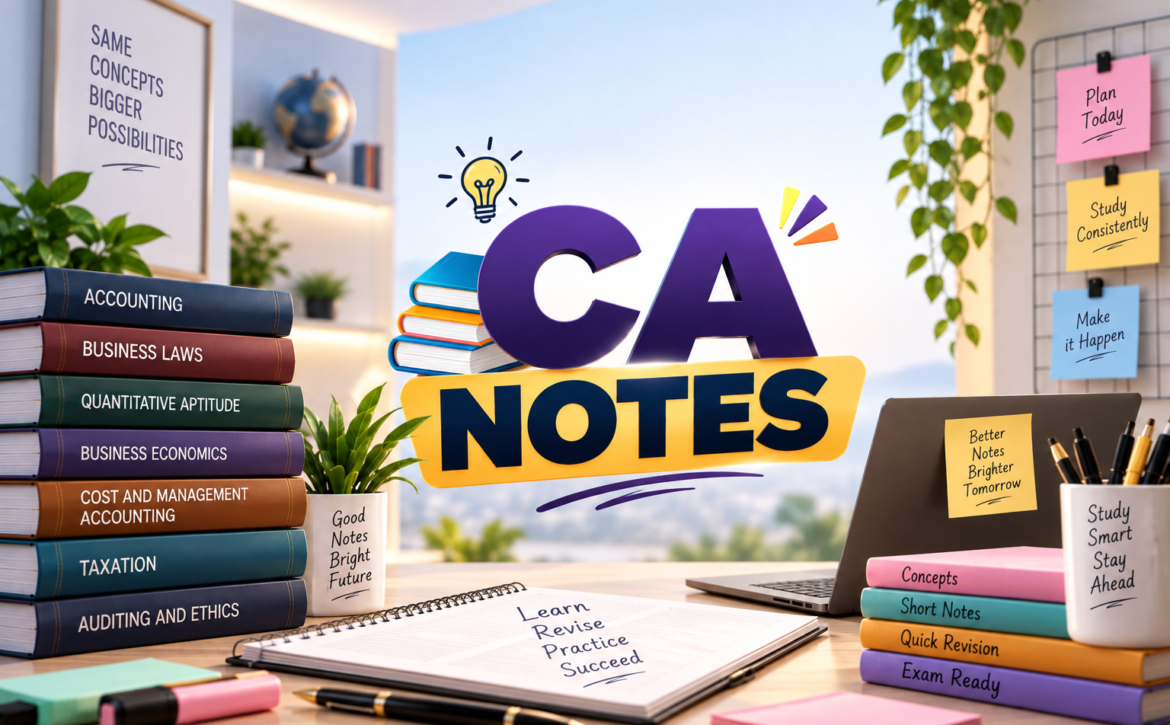
Preparing for the Chartered Accountancy exam is not just about studying more hours. It is about remembering the right concepts at the right time, revising efficiently, and being able to reproduce what you have learned in the examination hall.
This is where CA Notes become extremely useful.
Whether you are preparing for CA Foundation, CA Intermediate or CA Final, well-organised notes can make revision faster and help you identify the concepts, formulas, provisions and practical points that deserve another look.
However, there is one common mistake students make: collecting too many notes.
You may have ICAI study material, faculty notes, PDFs, handwritten notes, highlighted textbooks, revision notes and screenshots saved on your phone—and still feel that you have nothing useful to revise from.
The solution is not more material. The solution is better-organised CA notes.
In this guide, we will discuss what CA notes are, why they matter, how to make subject-wise notes, how to use them with ICAI study material, and how to turn them into a practical revision tool.
For students looking for structured guidance, resources and mentoring support, the CA Mentoring Program can also be explored alongside your regular CA preparation.
What Are CA Notes?
CA Notes are concise and organised study resources prepared to help CA students understand, revise and recall important concepts.
They may include:
- Important concepts
- Definitions
- Accounting treatments
- Formulas
- Tax provisions
- Legal provisions
- Audit points
- Practical questions
- Important adjustments
- Short tricks and memory techniques
- Important amendments
- Frequently tested concepts
- Personal mistakes and corrections
- Revision points
Good notes are not supposed to reproduce an entire textbook.
Their purpose is to reduce the time required for revision.
For example, reading an entire chapter of 100 pages before every revision may not be practical. A well-prepared 8–15 page revision document can help you quickly revisit the most important concepts before moving to question practice.
That is the real value of CA notes.
Why Are CA Notes Important for CA Students?
CA preparation involves a huge amount of information. The challenge is not simply learning something once; it is retaining it until the examination.
A good set of notes can help you in five major ways.
1. Faster Revision
During the first study cycle, you may need detailed explanations.
During the third or fourth revision, you usually need the important points—not the complete lecture again.
Well-made notes allow you to revise a chapter much faster.
2. Better Concept Recall
Writing a concept in your own words forces you to process it.
Instead of passively reading a paragraph, you have to decide:
What is the actual concept?
What should I remember?
What can be asked in the examination?
That process itself improves learning.
3. Easy Last-Minute Revision
The final days before an examination are extremely valuable.
You cannot realistically revise every book from the beginning.
Short notes, formula sheets, charts and marked questions can become your final revision toolkit.
4. Identifying Weak Areas
Your notes can contain a separate section for:
“Mistakes I Keep Making.”
This is surprisingly powerful.
If you repeatedly make the same mistake in a particular adjustment, section, formula or accounting treatment, write it down.
Your notes then become personalised rather than generic.
5. Reduced Study Stress
When everything is scattered across multiple books and PDFs, revision can feel overwhelming.
A structured note-making system gives you one clear revision path.
CA Notes vs ICAI Study Material: Are They the Same?
No.
This distinction is important.
ICAI provides official study material for Foundation, Intermediate and Final courses, along with other learning resources.
Your personal or faculty-prepared CA notes serve a different purpose.
| ICAI Study Material | CA Notes |
| Detailed and comprehensive | Concise and revision-focused |
| Official course resource | Personal/faculty-created resource |
| Useful for detailed study | Useful for quick revision |
| Covers concepts systematically | Highlights important concepts |
| May require more time to revise | Faster to revise |
| Primary reference for many students | Supporting revision tool |
The smartest approach is generally not to choose one over the other.
Instead:
Understand from your primary study source → make/organise notes → practise questions → revise notes → test yourself.
This approach helps prevent another common problem: depending entirely on short notes without understanding the underlying concept.
How to Make Effective CA Notes
Making notes does not mean copying everything your teacher says.
In fact, copying everything can make notes almost as lengthy as the original study material.
Follow a simple rule:
If a point does not help you understand, remember, solve or revise the topic, think twice before adding it to your notes.
Here is a practical process.
Step 1: Understand the Chapter First
Do not start note-making before understanding the concept.
Attend your lecture, read the chapter or study the relevant material first.
Only after understanding the topic should you start creating your short notes.
Step 2: Identify the Core Concepts
Ask yourself:
- What is the main concept?
- What are the important rules?
- What formulas are involved?
- What exceptions should I remember?
- What practical questions can be asked?
- Which areas did I find difficult?
These points deserve space in your notes.
Step 3: Use Your Own Language
This is one of the biggest differences between useful notes and useless notes.
Suppose you understand a complicated concept only after your teacher explains it with an example.
Write that explanation in simple language.
You are not preparing notes for a textbook publisher.
You are preparing them for your future self.
Step 4: Add Practical Questions
For numerical subjects, concepts alone are not enough.
Your notes should include selected practical questions.
For example:
Chapter: Depreciation
Your notes might contain:
- Key formula
- Important accounting treatment
- Common adjustments
- One basic illustration
- One exam-level illustration
- Common mistake
- Important question to practise again
This makes your notes much more useful during revision.
Step 5: Maintain a Mistake Book
Create a separate section titled:
“My CA Mistakes”
Whenever you make a mistake in a test or practice question, record:
- What was the question?
- What did I do wrong?
- Why did I make the mistake?
- What is the correct approach?
- How can I avoid repeating it?
This can become one of the most valuable parts of your CA preparation.
Subject-Wise CA Notes: What Should You Include?
Different CA subjects require different note-making techniques.
You should not prepare notes for Accounting in exactly the same way as Law or Taxation.
| Subject Type | What Your Notes Should Focus On |
| Accounting | Formats, adjustments, concepts and practical problems |
| Taxation | Sections, provisions, conditions, exceptions and amendments |
| Law | Provisions, keywords, exceptions and case-based understanding |
| Costing | Formulas, concepts, formats and practical questions |
| FM | Formulas, concepts, shortcuts and problem-solving steps |
| Audit | Keywords, provisions, procedures and answer presentation |
| Strategic Management | Concepts, headings, keywords and answer structure |
| Financial Reporting | Standards, treatments, adjustments and illustrations |
| AFM | Formulas, concepts and practical applications |
| Theory-heavy papers | Keywords, headings, exceptions and concise explanations |
The objective is to make every page useful for revision.
CA Foundation Notes: How Beginners Should Prepare
CA Foundation students are often tempted to download every PDF they find online.
This usually creates more confusion than clarity.
At the Foundation level, your notes should focus on concept clarity and basic revision.
For example:
Accounting Notes
Include:
- Accounting concepts
- Important formats
- Journal entries
- Adjustments
- Important formulas
- Practical examples
- Common errors
Business Laws Notes
Focus on:
- Definitions
- Important provisions
- Exceptions
- Keywords
- Practical examples
- Answer-writing points
Quantitative Aptitude Notes
Create:
- Formula sheets
- Short methods
- Important concepts
- Question types
- Mistakes
Business Economics Notes
Focus on:
- Definitions
- Concepts
- Differences
- Important theories
- Graphs where applicable
- Keywords
Do not try to make your notes excessively detailed at Foundation level.
The objective is clarity first.
CA Intermediate Notes: What Changes?
CA Intermediate requires a more exam-oriented approach.
At this stage, your notes should connect concepts with practical application.
For example, the applicable ICAI material for September 2026 lists subjects such as Advanced Accounting, Corporate and Other Laws, Taxation, Cost and Management Accounting, Auditing and Ethics, Financial Management and Strategic Management.
Your notes should therefore be organised paper-wise and chapter-wise.
A useful Intermediate notes structure can be:
Chapter → Concept → Important Rule → Illustration → Exam Question → Mistake
For Taxation and Law, remember that applicable amendments and exam-specific updates matter. The ICAI September 2026 material, for example, specifically identifies RTPs and statutory updates alongside the applicable study material for Taxation.
That means old notes should never automatically be treated as sufficient for a new attempt.
CA Final Notes: Why Short Notes Become Even More Important
CA Final preparation can involve a significant volume of technical information.
At this level, your notes should be extremely selective.
Instead of creating a 50-page summary for every chapter, try to create a revision resource that answers:
“What do I need to remember before I enter the examination hall?”
For example, your CA Final notes can contain:
- Important standards
- Key provisions
- Important formulas
- Important exceptions
- Frequently confused concepts
- Amendment points
- Important case-based areas
- Selected practical questions
- Past mistakes
- Difficult questions
- Final revision points
CA Final students should also keep exam-specific updates separate from static concepts wherever appropriate.
This makes updating your notes much easier.
Digital CA Notes vs Handwritten Notes
Both can work.
The better choice depends on your learning style.
| Handwritten Notes | Digital Notes |
| Better for active writing | Faster to edit |
| Easy to annotate | Easy to organise |
| Useful for memory | Easy to search |
| No screen required | Easy to access anywhere |
| Can become bulky | Can become too detailed |
If writing helps you remember concepts, handwritten notes may work better.
If you frequently update provisions, amendments or revision points, digital notes may be more convenient.
There is no rule that says successful CA students must use one particular method.
Use the method that helps you revise better.
Should You Buy CA Notes or Make Your Own?
This is another question many students ask.
The answer is: you can use both, but for different purposes.
Faculty or professionally prepared notes can save time and provide structure.
Your own notes can capture:
- Your weak topics
- Your mistakes
- Your preferred explanations
- Questions you got wrong
- Important reminders
- Personal shortcuts
A practical combination is:
Professional/Faulty Notes + ICAI Material + Personal Revision Notes
This avoids wasting hours rewriting everything while still giving you a personalised revision system.
How to Use CA Notes During Revision
Do not simply read your notes repeatedly.
Use active revision.
First Revision
Read the notes carefully and identify gaps.
Second Revision
Try to recall the concept before looking at the answer.
Third Revision
Use questions along with the notes.
Final Revision
Focus on:
- Formulas
- Keywords
- Amendments
- Important provisions
- Mistakes
- Difficult questions
- Frequently forgotten concepts
A useful revision cycle is:
Read → Close the Notes → Recall → Solve → Check → Correct
This is much more effective than repeatedly highlighting the same page.
How to Make CA Notes That Actually Help in the Exam
Your notes should be designed with the examination in mind.
Ask these questions while preparing them:
Can I revise this page in two minutes?
If not, it may be too detailed.
Does this page contain the important keywords?
For theory subjects, keywords matter.
Does it include my common mistakes?
If not, add them.
Does it cover the latest applicable changes?
Check the applicable examination resources before relying on old notes.
Can I understand this after three months?
Write clearly enough that your future self can understand it quickly.
Common Mistakes Students Make While Preparing CA Notes
1. Making Notes Too Long
If your notes are almost as long as the textbook, you have created another textbook.
The purpose is revision.
2. Copying Faculty Notes Word-for-Word
You do not need to reproduce every sentence.
Understand first. Summarise second.
3. Ignoring ICAI Material
Short notes are useful, but they should not make you completely ignore the applicable official study resources.
4. Using Outdated Notes
This is particularly important for subjects affected by amendments and updates.
Always verify applicability for your examination attempt.
5. Making Beautiful Notes Instead of Useful Notes
Colour coding and formatting can be helpful.
But spending 30 minutes decorating one page does not improve your preparation if the actual revision is incomplete.
6. Never Updating Notes
Your notes should evolve.
After every test, add important mistakes.
After every revision, add forgotten concepts.
After every relevant update, update the affected portion.
A Simple CA Notes-Making Strategy for Every Student
If you want a simple system, use the following five-part structure:
Part 1: Concept Notes
Write the concept in simple language.
Part 2: Exam Points
Add important provisions, formulas, keywords or rules.
Part 3: Questions
Add selected questions that represent the chapter.
Part 4: Mistakes
Record errors you personally make.
Part 5: Final Revision
At the end, create a one-page summary.
This creates three levels of revision:
Detailed Notes → Short Notes → One-Page Revision
That is much easier to manage before examinations.
How CA Notes Can Fit Into Your Complete Preparation Strategy
Notes alone will not clear CA.
They are one component of a bigger preparation system.
A balanced CA preparation cycle can look like this:
| Stage | Main Activity |
| 1 | Understand the concept |
| 2 | Study the applicable material |
| 3 | Prepare concise notes |
| 4 | Solve practical/theory questions |
| 5 | Attempt tests |
| 6 | Analyse mistakes |
| 7 | Update notes |
| 8 | Revise repeatedly |
| 9 | Practise exam-style questions |
| 10 | Final revision |
The ICAI ecosystem also includes resources such as study material, revision test papers, mock tests and other student resources, making it important to use your notes as part of a broader preparation plan rather than treating them as the only resource.
Final Thoughts: The Best CA Notes Are the Ones You Can Revise
There is no magical PDF that can replace preparation.
There is no single set of notes that can guarantee a CA student success.
The best CA notes are the ones that help you answer three questions quickly:
What do I need to know?
What do I usually forget?
What do I need to practise again?
That is why students should stop thinking about notes as another study material and start treating them as a revision system.
Use detailed resources to understand.
Use questions to practise.
Use tests to measure performance.
And use concise CA notes to remember and revise.
If you are preparing for CA Foundation, Intermediate or Final and want a more structured approach to preparation and mentoring, you can explore the CA Mentoring Program as an additional learning resource.
Remember one simple principle:
Do not make notes to feel productive. Make notes that make your next revision easier.
That small difference can save you hours when the examination gets closer.