30 Days CA Intermediate Study Plan 2026: Daily Timetable & Strategy
30 Days CA Intermediate Study Plan: A Practical Day-Wise Strategy to Prepare Smarter
Thirty days before the CA Intermediate examination can feel very different from the first few months of preparation.
At the beginning, you have enough time to watch lectures, read chapters slowly and solve questions without worrying too much about the clock. But when only 30 days are left, the approach has to change.
You cannot study everything from the beginning again. You cannot spend three days perfecting one chapter. And you certainly cannot keep collecting new notes, PDFs and revision videos without actually revising what you already studied.
The final 30 days should be about revision, question practice, retention, testing and improving exam performance.
This 30 Days CA Intermediate Study Plan is designed for students who have completed most of their syllabus and now want a structured last-month strategy. It can also be adjusted by students who are slightly behind and need to prioritise important areas.
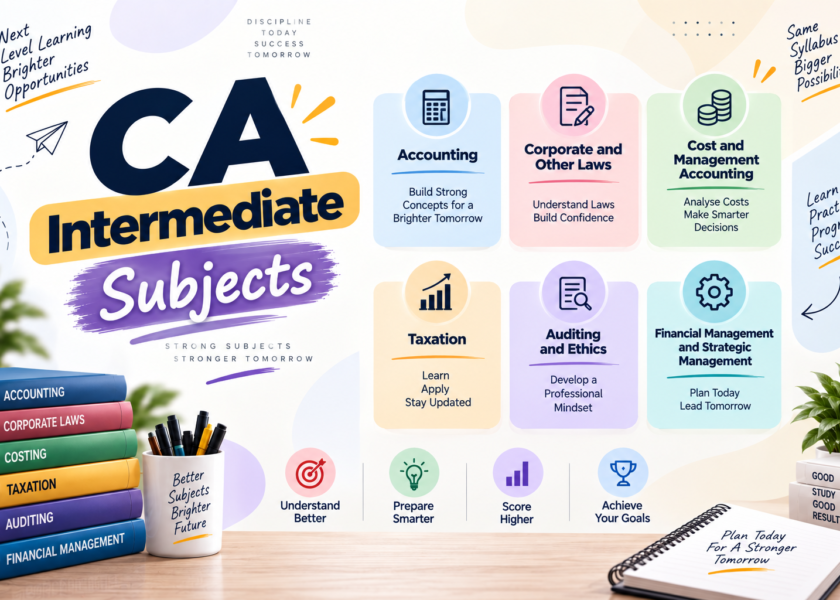
The Institute of Chartered Accountants of India (ICAI) currently has six papers at the Intermediate level: Advanced Accounting, Corporate and Other Laws, Taxation, Cost and Management Accounting, Auditing and Ethics, and Financial Management and Strategic Management.
The objective of this plan is simple:
Study less randomly, revise more intelligently and practise enough questions to enter the examination hall with confidence.
Why the Last 30 Days Are So Important for CA Intermediate
The last month is not necessarily about learning the maximum number of new topics.
It is about converting whatever you have already studied into exam-ready knowledge.
A student may have watched every lecture but still struggle in the examination because of poor revision or lack of written practice. Another student may have studied fewer resources but revised the ICAI material properly, solved questions and attempted mocks.
That difference matters.
ICAI itself recommends structured planning, familiarity with the syllabus and proper use of Board of Studies resources. Its preparation guidance also stresses revision and practice instead of relying only on passive reading.
Therefore, your 30-day preparation should focus on five things:
- Completing pending high-priority topics.
- Revising already completed chapters.
- Practising practical and theoretical questions.
- Solving RTPs, MTPs and relevant past questions.
- Taking full-length mock tests and analysing mistakes.
CA Intermediate 30 Days Study Plan at a Glance
Before going into the daily schedule, divide your 30 days into four phases.
| Phase | Days | Main Objective |
| Phase 1 | Day 1–7 | First intensive revision |
| Phase 2 | Day 8–15 | Complete revision + question practice |
| Phase 3 | Day 16–23 | Second revision + exam-oriented practice |
| Phase 4 | Day 24–30 | Mock tests + final revision |
This structure prevents one of the biggest mistakes students make: spending all 30 days revising and leaving no time for testing themselves.
30 Days CA Intermediate Study Plan: Day-Wise Timetable
Days 1–7: Build Your Revision Base
The first seven days should establish momentum.
Do not try to read every line of every book. Instead, revise concepts and immediately connect them with questions.
Day 1
Advanced Accounting: Revise major concepts and important practical chapters.
Corporate and Other Laws: Revise important provisions and chapter summaries.
Night: Solve selected Accounting questions and recall Law provisions without looking at your notes.
Day 2
Taxation: Revise Income-tax concepts and important provisions.
Cost and Management Accounting: Revise formulas, concepts and standard problem types.
Night: Practise numerical questions from both subjects.
Day 3
Advanced Accounting: Continue revision and focus on chapters where you make calculation mistakes.
Auditing and Ethics: Revise important concepts, keywords and answer-writing points.
Night: Write selected Audit answers instead of only reading them.
Day 4
Taxation: Continue Income-tax revision and practise application-based questions.
Financial Management: Revise formulas and solve practical questions without referring to the solution initially.
Strategic Management: Revise key concepts and prepare short recall points.
Day 5
Corporate and Other Laws: Focus on important provisions, case-based understanding and answer presentation.
Costing: Practise numerical questions with a timer.
Night: Review errors made during the day.
Day 6
Advanced Accounting: Complete another major revision block.
Auditing: Revise important chapters and practise writing answers using proper headings and keywords.
Night: Attempt a short mixed test.
Day 7
Keep this day slightly lighter.
Revise the topics covered during Days 1–6 and identify:
- Chapters you remember well
- Chapters requiring another revision
- Chapters where you make repeated mistakes
- Questions you are unable to solve independently
Do not ignore this analysis.
Your weak-topic list will become one of the most useful documents for the remaining 23 days.
Days 8–15: Strengthen Concepts Through Practice
The second phase should have more question-solving than passive reading.
A useful rule is:
Read → Recall → Solve → Check → Correct
If you simply read a chapter for two hours, you may feel productive without actually testing your memory.
Instead, after revising a concept, close your material and ask yourself:
“Can I explain this without looking?”
If the answer is no, revise it again.
Suggested Days 8–15 Focus
| Day | Primary Focus | Secondary Focus |
| 8 | Advanced Accounting | Law |
| 9 | Taxation | Costing |
| 10 | Auditing | FM |
| 11 | Advanced Accounting | SM |
| 12 | Taxation | Law |
| 13 | Costing | Auditing |
| 14 | FM + SM | Accounting |
| 15 | Mixed Revision Test | Weak Topics |
During this phase, give more time to questions.
For practical subjects, avoid looking at the solution before making a genuine attempt.
For theory subjects, practise writing answers with:
- Proper headings
- Relevant provisions
- Keywords
- Logical explanation
- Clear conclusion
ICAI’s preparation guidance specifically highlights written practice for both numerical and theoretical questions because it helps students improve analytical ability, speed and answer presentation.
Days 16–23: Start Thinking Like an Examiner
By Day 16, your preparation should become more exam-oriented.
You should no longer ask:
“How much have I read?”
Instead ask:
“How much can I reproduce correctly under exam pressure?”
This is a major shift.
ICAI’s BoS ecosystem includes study material, Revision Test Papers, Mock Test Papers, Suggested Answers, previous examination papers and other resources.
Use these resources strategically rather than downloading everything and creating another pile of material.
Days 16–18: Revision + Question Practice
Choose two subjects per day.
Spend approximately:
- 2–2.5 hours on Subject 1 revision
- 2 hours on Subject 1 questions
- 2 hours on Subject 2 revision
- 1.5–2 hours on Subject 2 questions
- 30–45 minutes on quick recall
Adjust the hours according to your individual capacity.
Days 19–20: RTP and MTP Practice
Now start giving greater importance to examination-style questions.
Do not merely read RTP/MTP solutions.
Attempt the questions first.
Then compare your answer with the suggested solution and mark:
- Concept mistake
- Calculation mistake
- Presentation mistake
- Time-management issue
- Silly mistake
This classification is extremely useful.
If you repeatedly lose marks because of calculation errors, reading another chapter will not solve the problem.
You need more written practice.
Days 21–23: Weak Area Revision
Now return to the weak-topic list created during the first week.
Divide weak areas into three categories:
| Category | Meaning | Action |
| A | Strong | Quick revision |
| B | Average | Detailed revision + questions |
| C | Weak | Concept revision + repeated practice |
Spend the majority of your time on Categories B and C.
Do not waste half a day revising a chapter you already know simply because it feels comfortable.
Days 24–30: Mock Tests and Final Revision
This is the most important stage of the 30-day CA Intermediate study plan.
Now you should simulate the actual examination environment.
Keep your phone away.
Sit for the required duration.
Use proper answer sheets if possible.
Follow the same writing conditions you expect in the actual examination.
After every mock test, spend sufficient time analysing it.
Recommended Final Week Structure
| Day | Activity |
| Day 24 | Full-length Paper 1 mock |
| Day 25 | Analyse Paper 1 + revise weak areas |
| Day 26 | Full-length Paper 2 mock |
| Day 27 | Analyse Paper 2 + targeted revision |
| Day 28 | Full-length Paper 3/4 mock |
| Day 29 | Weak-topic revision + important questions |
| Day 30 | Quick revision + formulas + provisions + short notes |
If you are preparing for both groups, divide mock tests according to your actual examination schedule and available time.
The purpose of mock tests is not simply to obtain a high score.
A mock test should answer questions such as:
- Did I complete the paper on time?
- Which questions consumed too much time?
- Did I understand the question correctly?
- Did I make avoidable mistakes?
- Was my presentation clear?
- Which topics still need revision?
Ideal Daily Timetable for CA Intermediate Last 30 Days
There is no magical number of study hours that guarantees success.
A consistent 8 focused hours can be more productive than sitting at your desk for 14 hours while checking your phone every few minutes.
Here is a practical structure:
| Time | Activity |
| 6:30–7:00 AM | Wake up + freshen up |
| 7:00–9:00 AM | Practical Subject |
| 9:00–10:00 AM | Breakfast + break |
| 10:00–12:00 PM | Theory Subject |
| 12:00–1:00 PM | Revision / MCQs |
| 1:00–2:00 PM | Lunch |
| 2:00–4:00 PM | Practical Questions |
| 4:00–5:00 PM | Break |
| 5:00–7:00 PM | Second Subject |
| 7:00–8:00 PM | Dinner / rest |
| 8:00–10:00 PM | Revision + Test Practice |
| 10:00–10:20 PM | Plan next day |
You do not have to follow these exact timings.
The important thing is to maintain focused study blocks and daily revision.
How Many Hours Should You Study in the Last 30 Days?
The answer depends on your preparation level.
If 80–100% syllabus is completed
Aim for around 7–10 focused study hours depending on your capacity and other commitments.
Your focus should be revision, practice and mocks.
If 60–80% syllabus is completed
You may need around 8–10 focused hours, with careful prioritisation of chapters.
Avoid spending excessive time trying to make every chapter perfect.
If less than 60% syllabus is completed
Do not panic.
Make a realistic list of:
- Important chapters
- Chapters you already understand
- Chapters requiring minimum conceptual preparation
- Topics where question practice can generate marks
Your strategy should be selective and practical rather than attempting to complete everything superficially.
Subject-Wise Strategy for CA Intermediate
1. Advanced Accounting
Accounting requires written practice.
Do not rely only on watching solved questions.
Revise the concept, solve the question yourself and then compare your answer.
Maintain a small list of:
- Common adjustments
- Accounting treatment
- Formats
- Repeated mistakes
- Important standards
2. Corporate and Other Laws
Law demands retention and presentation.
Instead of reading the same chapter five times, use active recall.
After completing a topic, close the book and write the major provisions from memory.
During answer writing, focus on logical structure and relevant keywords.
3. Taxation
Tax preparation should combine conceptual clarity with repeated question practice.
Create quick-reference sheets for:
- Important provisions
- Rates where applicable
- Conditions
- Exceptions
- Common adjustments
- Frequently confused concepts
Also keep your preparation aligned with the applicability of the study material and updates for your examination attempt. ICAI publishes attempt-specific applicability information for Intermediate study material.
4. Cost and Management Accounting
Costing improves through practice.
Do not spend the entire day reading formulas.
Understand the formula, solve a basic question and then move towards examination-level questions.
Keep one formula sheet for quick revision during the final week.
5. Auditing and Ethics
Audit is a subject where presentation matters significantly.
Practise answers using:
Meaning → Explanation → Relevant point/provision → Conclusion
Do not write unnecessarily long answers.
Focus on clarity, keywords and proper structure.
6. Financial Management and Strategic Management
For FM, focus heavily on formulas and question practice.
For SM, focus on understanding concepts and recalling important points.
A combined FM + SM study session can work well because the subjects require different kinds of mental effort.
What Should You Study in the Last 30 Days?
Your priority should be:
ICAI Study Material → RTPs → MTPs → Previous Examination Questions → Your Class Notes/Revision Notes
ICAI’s BoS Knowledge Portal provides students access to multiple official learning resources, including study material, RTPs, mock papers, suggested answers and previous papers.
Do not make the common mistake of switching between five teachers, ten Telegram channels and multiple revision PDFs during the last month.
More material does not automatically mean better preparation.
Better revision of fewer reliable resources usually beats uncontrolled resource collection.
30-Day CA Intermediate Revision Rules
Follow these rules throughout the month:
Rule 1: Do Not Start From Zero Every Morning
Spend 20–30 minutes revising what you studied previously.
Rule 2: Write, Don’t Just Read
Especially for Accounting, Costing, FM, Law and Audit.
Rule 3: Maintain an Error Notebook
Write down mistakes you repeatedly make.
Rule 4: Revise Difficult Topics More Frequently
Easy chapters naturally remain in your memory longer.
Rule 5: Keep One Source of Truth
Do not create five different sets of notes.
Rule 6: Practise Under Time Pressure
Knowing an answer and writing it within examination time are two different skills.
Rule 7: Analyse Every Mock
A test without analysis is only half useful.
Common Mistakes Students Make During the Last 30 Days
1. Starting New Classes
Unless absolutely necessary, avoid starting lengthy new lecture series during the final month.
2. Making Beautiful Notes
This is not the time to spend hours decorating notebooks.
Make short, useful revision sheets.
3. Ignoring Theory Subjects
Many students over-focus on practical subjects and leave theory for the end.
This can create unnecessary pressure.
4. Avoiding Mock Tests
Students sometimes fear low mock scores.
But a low score before the examination is useful if it tells you what needs fixing.
5. Studying Without Tracking
At the end of each day, record:
Planned → Completed → Missed → Reason → Tomorrow’s correction
This takes only a few minutes but keeps the plan realistic.
How CA Mentoring Program Can Support Your Preparation
A study timetable tells you what to do, but many students struggle with another question:
“Am I doing the right thing?”
This is where structured academic guidance can help.
CA Mentoring Program focuses on helping CA students bring more structure and direction to their preparation.
A mentor-oriented approach can be useful for identifying weak areas, improving consistency, planning revisions and avoiding unnecessary resource switching.
The goal is not to study for an unrealistic number of hours.
The goal is to make the hours you actually study more productive.
A Simple Daily Checklist for the Final Month
At the end of every day, ask yourself:
| Question | Done? |
| Did I complete today’s planned topics? | ☐ |
| Did I revise yesterday’s topics? | ☐ |
| Did I solve questions without seeing solutions first? | ☐ |
| Did I revise my weak areas? | ☐ |
| Did I spend too much time on my phone? | ☐ |
| Did I analyse my mistakes? | ☐ |
| Have I planned tomorrow? | ☐ |
This simple habit can make the 30-day plan much easier to follow.
Final 7-Day Strategy: What Not to Do
During the last seven days, avoid:
- Starting completely new books
- Watching random strategy videos for hours
- Comparing your preparation with other students
- Changing your entire timetable every day
- Ignoring sleep
- Studying continuously without breaks
- Attempting questions only mentally
- Leaving mock-test analysis for the final day
Your final week should feel controlled, not chaotic.
Final Thoughts
Thirty days is not a huge amount of time, but it is also not too little if you use it properly.
The biggest mistake is thinking that every remaining day must be used to learn something new.
Instead, use the final month to make your existing preparation stronger.
Revise.
Recall.
Practise.
Test.
Analyse.
Repeat.
A good CA Intermediate study plan is not the timetable that looks the most difficult on paper. It is the plan you can realistically follow for 30 consecutive days.
If your syllabus is substantially complete, use these 30 days to convert knowledge into exam performance. If you are behind, don’t waste time feeling guilty about the days already gone. Start with today’s available time, prioritise intelligently and keep moving.
And remember one important thing: one productive day does not make a CA student, and one bad day does not break one either. Consistency over the entire preparation period is what matters.
Use the next 30 days with discipline, keep your resources limited, practise actual questions and enter the examination hall knowing that you have tested yourself—not merely read the syllabus.
Your target for the next 30 days should not be “study everything.”
Your target should be “revise what matters, practise what gets tested and perform when it counts.”