CA Foundation Accounting Question Paper: Previous Year PDFs
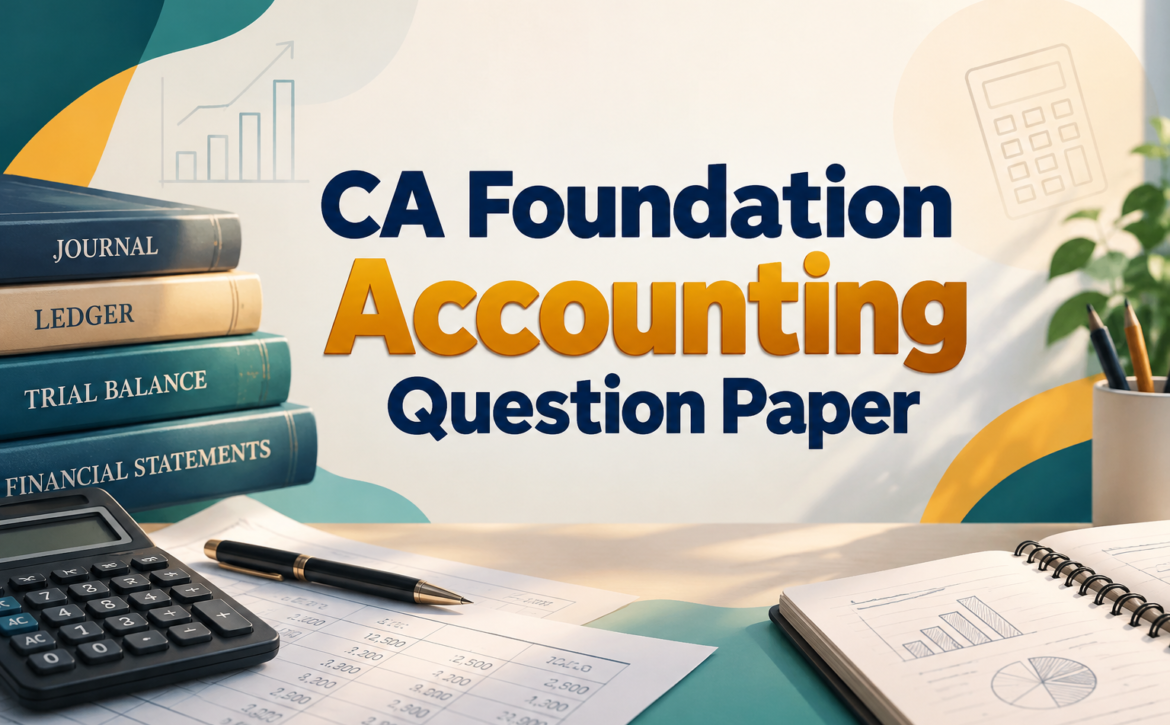
CA Foundation Accounting Question Paper: Previous Year PDFs, Exam Pattern, Important Topics & Preparation Strategy
Preparing for CA Foundation Accounting becomes much easier when you stop treating the subject as something that has to be memorised and start practising it the way it is actually tested. One of the most useful resources for this is the CA Foundation Accounting Question Paper.
Paper 1 of the CA Foundation course is Accounting, and ICAI provides previous examination papers through its official website. Solving these papers helps students understand the style of questions, practical adjustments, presentation requirements, and the level of calculation expected in the examination. ICAI currently lists Foundation Paper 1: Accounting under its official question-paper archive.
For students preparing through self-study, coaching, or revision batches, previous year papers can become a bridge between “I have completed the syllabus” and “I can actually write the examination.”
At CA Mentoring Program, the focus is not just on completing chapters but on helping students understand how preparation translates into actual exam performance.
CA Foundation Accounting Question Paper PDF – Last 5 Available Papers
The following are the latest five available CA Foundation Accounting question papers listed by ICAI. These links are from the official ICAI question-paper archive and are provided only for Paper 1: Accounting.
| Examination | Paper | Official ICAI PDF |
| May 2026 | Paper 1: Accounting | Download May 2026 Accounting Question Paper |
| January 2026 | Paper 1: Accounting | Download January 2026 Accounting Question Paper |
| September 2025 | Paper 1: Accounting | Download September 2025 Accounting Question Paper |
| May 2025 | Paper 1: Accounting | Download May 2025 Accounting Question Paper |
| January 2025 | Paper 1: Accounting | Download January 2025 Accounting Question Paper |
Important: These are the latest five available examination sessions listed in the ICAI archive, rather than one paper from each of five calendar years.
Why CA Foundation Accounting Question Papers Are So Important
Many students make the same mistake: they finish the study material, watch lectures, revise their notes, and then directly sit for a mock test.
The problem is that understanding a chapter and solving an examination paper are two different skills.
A previous year question paper shows you what happens when different concepts are combined in one question. You may know the rules of depreciation, for example, but an examination question can combine depreciation with disposal of an asset, a change in method, or another adjustment.
That is where question-paper practice becomes valuable.
1. You understand the actual question style
The ICAI paper gives you an idea of how questions are framed and how much information is provided before you are expected to calculate or explain something.
2. You identify your weak chapters
Sometimes a student believes that the entire syllabus is difficult when the actual problem is limited to two or three chapters.
Solving a full paper makes those weak areas visible.
3. You improve calculation speed
Accounting is not only about knowing the formula or accounting treatment. You need to reach the correct answer within the available examination time.
4. You learn presentation
Working notes, journal entries, formats, calculations and final answers need to be presented clearly. Practising complete papers helps develop this habit.
5. You reduce examination-day surprises
When you have already solved several complete papers, a new paper feels less unfamiliar. You have seen different ways in which the same concept can be tested.
CA Foundation Accounting Paper: What Should You Prepare?
The current ICAI Foundation Paper 1: Accounting study-material structure covers the core accounting concepts and practical areas required at Foundation level. ICAI provides Paper 1 study material under the New Scheme of Education and Training.
Broadly, students should prepare areas such as:
| Area | What Students Should Practise |
| Theoretical Framework | Concepts, principles, conventions and accounting basics |
| Accounting Process | Journal, ledger, trial balance and subsidiary books |
| Bank Reconciliation Statement | Preparation and adjustment-based questions |
| Inventories | Valuation and related calculations |
| Depreciation & Amortisation | Methods, adjustments and asset-related problems |
| Bills of Exchange | Entries, dishonour, renewal and related treatment |
| Final Accounts | Trading, Profit & Loss Account and Balance Sheet |
| Not-for-Profit Organisations | Receipts & Payments, Income & Expenditure and Balance Sheet |
| Incomplete Records | Statement of Affairs and missing figures |
| Partnership & LLP Accounts | Admission, retirement, goodwill and dissolution |
| Company Accounts | Shares, debentures and related accounting treatment |
ICAI has also emphasised the importance of practising practical questions and using previous year papers or mock papers under examination conditions as part of Foundation Accounting preparation.
How to Use CA Foundation Accounting Previous Year Papers Properly
Downloading five PDFs is easy.
Using them properly is where the real benefit comes from.
Do not solve all five papers randomly one after another. Create a system.
Step 1: Complete the Relevant Syllabus First
Before starting full-length papers, make sure you have studied the major chapters at least once.
If you start solving papers without knowing the basic concepts, you may spend most of your time searching for solutions instead of identifying your actual preparation level.
Step 2: Start With Chapter-Wise Practice
Take questions from previous papers and classify them chapter-wise.
For example:
- Accounting Process
- BRS
- Inventory
- Depreciation
- Bills of Exchange
- Final Accounts
- NPO
- Incomplete Records
- Partnership
- Company Accounts
This helps you understand which areas repeatedly require practice.
Step 3: Move to Full Papers
Once your basic preparation is complete, solve the complete CA Foundation Accounting Question Paper in one sitting.
Keep your books and mobile phone away.
Treat it like an actual examination.
Step 4: Check More Than Just the Final Answer
This is one of the most important points.
If your final answer is wrong, do not simply look at the correct answer and move ahead.
Find where the mistake happened.
Was it:
- A conceptual mistake?
- A calculation mistake?
- A missed adjustment?
- A wrong journal entry?
- A classification error?
- A presentation issue?
- A time-management problem?
Your mistake log can become one of your most useful revision tools.
A Simple 5-Paper Practice Strategy
You can use the five latest papers in a structured way.
| Paper | Recommended Use |
| May 2026 | Final-stage full-paper practice |
| January 2026 | Full-paper practice |
| September 2025 | Timed practice |
| May 2025 | Chapter and mixed-question practice |
| January 2025 | Concept revision + exam simulation |
Do not worry about simply counting how many questions you solved.
Focus on whether you are improving.
For example, if you scored 54 in your first timed paper and 63 in your next paper, that improvement is more meaningful than simply saying that you solved two papers.
Which Chapters Need More Practice in CA Foundation Accounting?
Every chapter should be studied according to the applicable ICAI syllabus. However, students generally need more calculation practice in chapters where multiple adjustments or accounting treatments are involved.
Final Accounts
Final Accounts questions require you to understand several adjustments together. A student may know each individual adjustment but still make mistakes when several adjustments appear in the same question.
Practise:
- Closing stock
- Outstanding expenses
- Prepaid expenses
- Accrued income
- Depreciation
- Bad debts
- Provision-related adjustments
- Capital and revenue items
Partnership Accounts
Partnership questions require careful treatment of goodwill, admission, retirement and dissolution.
Do not learn only formats. Understand why each adjustment is being passed.
Company Accounts
Company Accounts can become scoring when the basic entries are clear.
Practise:
- Issue of shares
- Calls
- Forfeiture
- Reissue
- Issue of debentures
- Redemption-related accounting
Depreciation
Students often lose marks here because of small calculation mistakes.
Always write the working clearly before reaching the final figure.
Bills of Exchange
The chapter becomes much easier once you understand the sequence of events.
Instead of memorising isolated journal entries, understand what happens when the bill is:
- Drawn
- Accepted
- Discounted
- Endorsed
- Retained
- Dishonoured
- Renewed
How to Analyse a CA Foundation Accounting Question Paper
After solving a paper, prepare a small analysis sheet.
| Checkpoint | Your Result |
| Total Marks Attempted | ___ |
| Marks Expected | ___ |
| Calculation Errors | ___ |
| Conceptual Errors | ___ |
| Questions Left Unattempted | ___ |
| Time Remaining | ___ |
| Weakest Chapter | ___ |
| Presentation Issues | ___ |
This looks simple, but it changes the way you revise.
Suppose you score 65 but discover that 12 marks were lost because of calculation errors. In that case, reading another chapter may not be the most useful next step. More timed numerical practice could address the actual problem.
Similarly, if your calculations are correct but you repeatedly struggle with Partnership Accounts, your next revision should target that chapter.
Common Mistakes Students Make While Solving Accounting Papers
1. Looking at the Solution Too Quickly
Getting stuck for five minutes and immediately opening the solution is tempting.
Try the question again first.
Give yourself enough time to identify the approach.
2. Ignoring Working Notes
Working notes are not just rough work.
They make your solution easier to check and help you track calculations.
3. Practising Only Easy Questions
Easy questions make you feel confident, but examination preparation requires exposure to different levels of difficulty.
Mix straightforward, moderate and lengthy questions.
4. Not Practising Full Papers
Chapter-wise practice is useful during learning.
Full-paper practice is necessary during revision.
Both have different purposes.
5. Repeating the Same Mistake
If you make the same error three times and never record it, you are wasting an opportunity.
Maintain a “mistake notebook” containing only the errors you repeatedly make.
How Many CA Foundation Accounting Papers Should You Solve?
There is no universal number that guarantees good performance.
Quality matters more than quantity.
For example, solving three papers carefully, analysing mistakes and revising weak concepts can be more useful than downloading fifteen papers and checking only the final marks.
A practical approach is:
Learn → Practise Chapter-Wise → Solve Previous Paper → Analyse → Revise Weak Area → Solve Again
This cycle should continue until your mistakes start reducing.
CA Foundation Accounting Question Paper vs Mock Test Paper
Both resources are useful, but they serve slightly different purposes.
| Previous Year Question Paper | Mock Test Paper |
| Shows actual past examination questions | Simulates an examination |
| Helps understand past question styles | Helps test current preparation |
| Useful for trend and concept analysis | Useful for time management |
| Shows how concepts were actually tested | Gives additional practice |
| Best for understanding examination history | Best for final revision |
Students should ideally use both.
ICAI also provides revision and mock-test resources through its student resources, while the official question-paper archive provides previous examination papers.
How to Improve Your Score Through Question Paper Practice
If you want your question-paper practice to produce measurable improvement, follow these five habits.
Habit 1: Write Instead of Reading
Reading a solution feels easy.
Writing the solution exposes whether you can actually solve the question.
Habit 2: Use a Timer
A complete paper should be attempted under realistic examination conditions.
Habit 3: Mark Doubtful Questions
Put a small mark beside questions where you were uncertain.
Review those questions later, even if your final answer was correct.
Habit 4: Revise Your Mistake Book
Before starting another paper, spend a few minutes reviewing previous mistakes.
Habit 5: Repeat Difficult Topics
If one chapter repeatedly causes problems, do not avoid it.
Return to the concept, solve basic questions, then move to examination-level questions.
A 7-Day CA Foundation Accounting Revision Plan
If your examination is approaching and you need a practical revision structure, the following plan can help.
| Day | Main Focus |
| Day 1 | Accounting Process, BRS, Inventories |
| Day 2 | Depreciation, Bills of Exchange |
| Day 3 | Final Accounts |
| Day 4 | NPO and Incomplete Records |
| Day 5 | Partnership and LLP Accounts |
| Day 6 | Company Accounts + weak areas |
| Day 7 | Full Question Paper + complete analysis |
This plan should be adjusted according to your preparation level.
If your Partnership preparation is already strong but Final Accounts is weak, shift more time toward Final Accounts.
The goal is not to follow a timetable blindly. The goal is to use your available time where it can improve your preparation the most.
How CA Mentoring Program Can Help With Accounting Preparation
Accounting preparation becomes easier when you have a clear study structure.
At CA Mentoring Program, students can use structured CA preparation resources to improve conceptual understanding, revision and examination practice.
The important thing is to avoid studying only for completion.
Finishing ten chapters does not automatically mean you are examination-ready.
A better question is:
Can I solve questions from those ten chapters without looking at the solution?
That is the level of preparation you should aim for.
Final Takeaway
The CA Foundation Accounting Question Paper is much more than a collection of old questions.
It is a practical tool for understanding the examination, testing your preparation, improving calculation speed and identifying weak areas.
Use the latest ICAI papers systematically. Solve them under timed conditions. Check your working, not just your final answer. Maintain a record of mistakes and revisit the chapters where those mistakes occur.
Most importantly, do not wait until the final few days to start solving previous papers.
Start early enough that the first paper becomes a learning experience, the second becomes a correction exercise, and the later papers become genuine examination simulations.
ICAI’s official archive currently provides Foundation Paper 1: Accounting question papers for multiple recent examination sessions, making it easier for students to practise directly from the Institute’s own papers.
The right approach is simple:
Study the concept → Solve the question → Analyse the mistake → Revise → Solve again.
That is how previous year papers turn into actual exam preparation.