
CA Final Preparation Strategy: A Complete Guide to Study Smarter and Score Better

Preparing for the CA Final examination is a different experience from preparing for Foundation or Intermediate. By this stage, most students understand the importance of discipline, but maintaining consistency across six demanding subjects can still be challenging.
You may have completed several lectures, purchased study material and even created a timetable. However, as the examination approaches, questions start coming up. Have you revised enough? Are you practising sufficient questions? Which subjects need more attention? How will you manage preparation alongside articleship or work?
These are genuine concerns, and the solution is not necessarily to study for more hours. It is to make better use of the hours you already have.
A well-planned CA Final preparation strategy should bring together conceptual understanding, syllabus completion, regular revision, question practice and mock test analysis. Instead of changing your timetable every few days, you need a system that helps you track progress and identify weaknesses before the examination.
In this guide, we will cover how to prepare for CA Final, create a realistic study timetable, approach each subject, revise effectively and make your preparation more examination-oriented with support from CA Mentoring Program.
1. Understand the CA Final Examination Before Starting
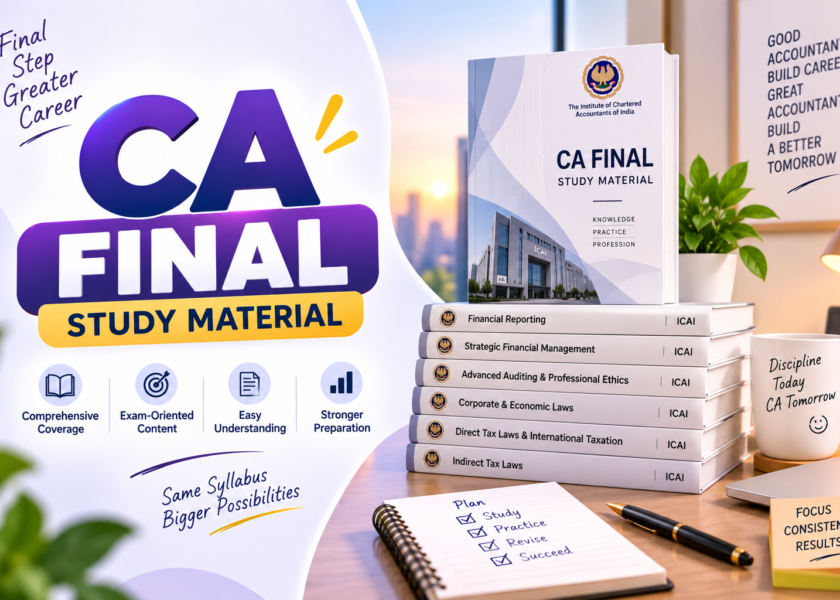
Before preparing a timetable, understand the structure of the examination you are targeting. Under ICAI’s New Scheme of Education and Training, the CA Final course consists of six papers divided into two groups.
| Group | Paper | Subject |
| Group I | Paper 1 | Financial Reporting |
| Group I | Paper 2 | Advanced Financial Management |
| Group I | Paper 3 | Advanced Auditing, Assurance and Professional Ethics |
| Group II | Paper 4 | Direct Tax Laws & International Taxation |
| Group II | Paper 5 | Indirect Tax Laws |
| Group II | Paper 6 | Integrated Business Solutions |
Before beginning your final preparation, check the latest applicable syllabus, examination announcements and study material on the official ICAI website. The applicability of amendments and study material can vary by examination attempt.
Your first task is to assess where you stand in each subject.
Create a chapter-wise tracker and classify every chapter into three categories:
- Strong: You understand the concepts and can solve questions independently.
- Needs Revision: You have studied the chapter but struggle to recall concepts or apply them.
- Weak: Important concepts are unclear, or you cannot solve questions without referring to solutions.
This simple exercise gives you a realistic picture of your preparation and helps you allocate time according to your actual needs.
2. Create a Realistic CA Final Study Plan
One of the most common preparation mistakes is following a timetable designed for someone else. A full-time student and a student completing articleship may have very different schedules.
Your timetable should be based on your available hours, syllabus completion and target examination attempt.
Start by dividing your preparation into the following stages.
| Preparation Stage | Main Objective | What to Do |
| Stage 1: Planning | Understand your current position | Map the syllabus and identify weak areas |
| Stage 2: Learning | Build conceptual clarity | Study concepts and solve basic questions |
| Stage 3: Completion | Cover pending chapters | Finish remaining syllabus and practise questions |
| Stage 4: First Revision | Strengthen understanding | Recall concepts and solve selected questions |
| Stage 5: Second Revision | Improve speed and accuracy | Revise short notes and practise exam-level questions |
| Stage 6: Testing | Evaluate performance | Attempt mock tests and previous examination papers |
| Stage 7: Final Revision | Improve recall | Revise mistakes, formulas, provisions and important concepts |
These stages are a framework, not fixed deadlines. You can adjust them according to your progress and examination date.
The important thing is to avoid leaving all revision and testing until the final few weeks.
Set Weekly Targets Instead of Only Daily Targets
Daily targets provide direction, but weekly targets give you flexibility when a difficult chapter takes longer than expected.
For example, your weekly plan could include completing selected chapters, revising two previously studied topics, solving practical questions, practising a case-based question and attempting one timed test.
At the end of the week, compare your actual progress with your plan. If you missed a target, identify the reason and adjust the following week rather than abandoning the timetable.
3. Follow a Subject-Wise CA Final Preparation Strategy
Every CA Final subject requires a different preparation approach. Practical subjects need regular problem-solving, while theory-oriented subjects require conceptual clarity, recall and effective answer presentation.
Financial Reporting (FR)
Financial Reporting requires a strong understanding of accounting concepts and the ability to apply them to practical questions.
Merely reading solved illustrations is not enough. You need to solve questions independently and understand why a particular accounting treatment is appropriate.
Preparation tips for FR:
- Study concepts and relevant accounting standards systematically.
- Practise illustrations before moving to advanced questions.
- Maintain a record of adjustments and recurring calculation mistakes.
- Revise formats, important treatments and working notes.
- Solve questions under time limits to improve speed.
- Revisit difficult questions instead of repeatedly solving only familiar ones.
Whenever you get a question wrong, identify whether the problem was conceptual understanding, calculation, question interpretation or presentation. This helps you correct the actual weakness.
Advanced Financial Management (AFM)
AFM preparation should combine conceptual understanding with regular numerical practice.
A formula may look simple while studying, but applying it correctly in a lengthy question requires familiarity with the concept and the ability to identify the information relevant to the problem.
Preparation tips for AFM:
- Create a concise formula and concept notebook.
- Practise questions topic by topic.
- Understand the assumptions behind formulas instead of memorising them blindly.
- Show calculations and working notes clearly.
- Practise selecting the correct approach for unfamiliar questions.
- Reattempt difficult questions after a gap to test retention.
Do not judge your preparation only by the number of questions completed. Focus on whether you can solve them without assistance.
Advanced Auditing, Assurance and Professional Ethics
Audit requires understanding, revision and the ability to present relevant points clearly.
Students sometimes read the same chapter several times but struggle to recall important keywords during the examination. Active recall and answer-writing practice can help address this issue.
Preparation tips for Audit:
- Understand the purpose and application of important auditing standards.
- Prepare short revision notes for key concepts and provisions.
- Practise writing answers using relevant technical terminology.
- Revise Professional Ethics regularly.
- Solve previous examination questions to understand how concepts are tested.
- Check whether your answers directly address the question asked.
Avoid writing unnecessarily long answers. A clear, relevant and well-structured response is more useful than a lengthy answer that misses the requirement.
Direct Tax Laws & International Taxation
Direct Tax preparation requires conceptual clarity, regular problem-solving and attention to applicable amendments.
Since tax provisions and amendments can be attempt-specific, always verify that your material is relevant to your target examination.
Preparation tips for Direct Tax:
- Understand the provisions before memorising their application.
- Practise practical questions after completing each topic.
- Maintain separate notes for important provisions, exceptions and amendments.
- Revise calculation-based topics regularly.
- Practise questions that combine multiple provisions.
- Use the latest applicable ICAI material and revision resources.
When reviewing a wrong answer, identify whether the mistake occurred because you misunderstood a provision, missed an adjustment or applied the wrong treatment.
Indirect Tax Laws (IDT)
IDT preparation should balance conceptual understanding, provisions and practical application.
Students should not postpone revision until the syllabus is complete. Regular revision makes it easier to recall provisions and apply them correctly in examination questions.
Preparation tips for IDT:
- Understand the logic behind important GST provisions.
- Practise numerical questions and case-based scenarios.
- Prepare concise notes for key provisions and exceptions.
- Revise applicable amendments and updates.
- Solve questions without referring to the solution first.
- Practise explaining the basis of your answer clearly.
Give additional attention to areas where you repeatedly make mistakes, rather than revising familiar topics simply because they feel comfortable.
Integrated Business Solutions (IBS)
Integrated Business Solutions requires you to apply knowledge across subjects to multidisciplinary case studies.
The open-book nature of this paper should not be mistaken for an easy examination. Finding relevant information quickly and applying it correctly requires preparation.
Preparation tips for IBS:
- Practise case studies regularly throughout your preparation.
- Connect relevant concepts from different subjects.
- Learn to identify the central issue in a case before answering.
- Organise permitted reference material for quick navigation.
- Practise making relevant, structured and concise recommendations.
- Follow ICAI’s applicable examination instructions for permitted material.
The objective is not to search through reference books during the examination without a plan. It is to understand the concepts well enough to locate and apply relevant information efficiently.
4. Build a Daily CA Final Study Timetable
A practical timetable should include new learning, revision and question practice. If your entire day is spent watching lectures, you may finish the classes without developing sufficient examination-writing skills.
Here is an illustrative timetable for a student who has a reasonably flexible study day.
| Time | Activity | Purpose |
| 7:00 AM – 9:00 AM | Difficult subject or new concepts | Use fresh hours for demanding topics |
| 9:30 AM – 11:30 AM | Practical question practice | Apply concepts independently |
| 12:00 PM – 1:00 PM | Theory subject | Study concepts and prepare recall notes |
| 2:00 PM – 4:00 PM | Second subject or pending syllabus | Maintain progress across subjects |
| 4:30 PM – 5:30 PM | Revision of previous topics | Improve retention |
| 6:00 PM – 7:00 PM | Timed questions or test practice | Develop examination skills |
| 8:00 PM – 8:20 PM | Daily progress review | Plan the next day’s targets |
This is only an example. Adjust the timing according to your routine, classes, articleship and personal responsibilities.
If you have fewer available hours, preserve the important components rather than copying the entire schedule. A shorter timetable that includes focused study, revision and practice is more useful than a long timetable you cannot follow consistently.
5. How to Revise for CA Final Effectively
Revision is not simply reading the same material again. It should help you recall information, identify gaps and apply concepts without depending on your notes.
A useful revision method has three steps.
Step 1: Recall before reading.
Close your book and try to remember the main concepts, formulas or provisions from the chapter. Then open your notes and check what you missed.
Step 2: Solve questions independently.
Attempt relevant questions before checking the solution. This reveals whether you can actually apply what you have studied.
Step 3: Record mistakes and revisit them.
Maintain a mistake notebook containing the question, the reason for the mistake and the correct approach. Review it during subsequent revision sessions.
For example, if you repeatedly forget a particular adjustment in FR, write down the specific adjustment and the reason you missed it. This is more useful than writing only the chapter name.
Use a Revision Tracker
| Revision Round | Main Focus | Expected Outcome |
| First Revision | Concepts and important questions | Improve understanding |
| Second Revision | Recall and question practice | Strengthen retention |
| Final Revision | Short notes, formulas and mistakes | Improve exam readiness |
The exact duration of each round depends on your syllabus completion and target attempt. Do not force yourself to follow a fixed number of revision days if your preparation requires a different schedule.
6. Practise ICAI Mock Tests and Previous Examination Papers
Mock tests help you discover problems that may not be obvious during regular study.
You may understand a chapter but take too long to solve its questions. You may remember a provision but fail to explain its application. You may also lose marks because of incomplete workings or poor time management.
These issues become visible when you attempt a paper under examination conditions.
Use the ICAI Board of Studies resources to check relevant study material, revision test papers, mock test papers and other official learning resources.
Follow this approach:
- Attempt the test within the prescribed time.
- Avoid referring to solutions while solving questions.
- Evaluate your answers honestly.
- Identify conceptual, calculation and presentation errors.
- List the topics that need further revision.
- Reattempt selected incorrect questions after revising them.
Do not focus only on your mock test score. The purpose is to understand why you lost marks and what you can change before the actual examination.
How Often Should You Attempt Mock Tests?
The frequency depends on your preparation stage.
| Preparation Stage | Recommended Practice |
| During syllabus completion | Chapter-wise and topic-wise tests |
| After completing a substantial portion | Longer tests covering multiple topics |
| During revision | Timed subject-wise papers |
| Near the examination | Full-length papers and focused error correction |
Do not wait for perfect preparation before attempting your first test. Early testing can help you discover weaknesses while there is still time to correct them.
7. How to Prepare for CA Final Alongside Articleship
Balancing articleship and CA Final preparation can be difficult. After a long working day, it is natural to feel tired or struggle to concentrate.
The answer is to build a realistic routine rather than comparing your schedule with that of a full-time student.
Consider the following approach:
- Study a difficult topic during the hours when you concentrate best.
- Set smaller weekday targets that fit around your work.
- Use short revision sessions to revisit previously studied concepts.
- Reserve longer sessions for question practice and mock tests when possible.
- Track weekly progress instead of expecting every day to go perfectly.
- Protect adequate sleep and recovery time.
For example, a working student might use weekday evenings for focused study and revision, then use available weekend sessions for longer practical questions and tests.
The exact number of hours matters less than whether your routine consistently moves your preparation forward.
If your work schedule changes frequently, create a weekly plan with a few flexible study slots. This allows you to recover missed targets without disrupting the entire preparation schedule.
8. Common CA Final Preparation Mistakes to Avoid
Even hardworking students can lose valuable preparation time by following ineffective habits.
Studying Without a Clear Plan
Starting whichever subject feels convenient can leave important topics unfinished. Map your syllabus and decide your weekly priorities before beginning.
Postponing Revision
Completing a chapter once does not mean you will remember it during the examination. Schedule revision while studying new topics.
Ignoring Question Practice
Understanding a solution while reading it is different from solving the question independently. Write answers and solve numerical questions regularly.
Collecting Too Many Resources
Repeatedly switching between teachers, notes and reference books can create confusion. Select reliable resources and use them consistently, while checking the latest applicable ICAI material.
Studying Only High-Priority Chapters
Weightage and past trends can help you allocate time, but they cannot guarantee which questions will appear. Do not treat lower-priority topics as automatically safe to skip.
Ignoring Mock Test Analysis
Attempting several tests without analysing mistakes may repeat the same errors. Spend time reviewing each test and correcting the underlying problem.
Following an Unrealistic Timetable
A timetable that assumes perfect concentration every day can quickly become difficult to maintain. Plan for your actual routine and review progress regularly.
9. What Should You Do in the Final 30 Days?
The final month should focus on revision, examination practice and correcting important weaknesses. The right balance depends on how much of your syllabus is already complete.
| Period | Primary Focus | Suggested Activities |
| Days 30–21 | Consolidation | Revise major topics and address pending areas |
| Days 20–11 | Practice | Attempt timed papers and revise mistakes |
| Days 10–6 | Focused revision | Review short notes, formulas and key provisions |
| Days 5–2 | Recall and confidence | Revisit important errors and selected questions |
| Final Day | Light revision | Review concise notes and maintain your routine |
This is a flexible framework, not a rigid rule. If you have substantial syllabus left, adjust the plan according to your actual position rather than trying to complete every activity listed above.
During the final days, avoid making unnecessary changes to your resources or starting several new study plans. Focus on the material you can realistically revise and apply.
Also, verify the examination timetable, permitted items and other instructions through ICAI’s official announcements.
10. How CA Mentoring Program Can Support Your Preparation
A study plan becomes more effective when you can measure your progress and identify where you need help.
Students often know what they should do but struggle to maintain consistency, decide which topics to revisit or understand why their mock test performance is not improving.
A structured mentoring approach can help bring clarity to these areas by encouraging realistic target-setting, progress reviews and focused improvement.
Through CA Mentoring Program, students can explore CA preparation resources and guidance relevant to their learning needs.
Before selecting any mentoring or preparation support, consider whether it addresses your actual challenges. Look for clear study targets, a practical revision approach, useful performance feedback and guidance that fits your examination attempt.
Remember that mentorship is not a substitute for your own preparation. Its value lies in helping you use your time more effectively, remain accountable and work systematically towards your goals.
Final Thoughts
A successful CA Final preparation strategy is not built around one perfect timetable or an unrealistic number of study hours. It develops through consistent effort, regular revision, independent question practice and honest performance analysis.
Start by understanding your syllabus and identifying your weak areas. Build a timetable around your real availability, give every subject an appropriate preparation method and practise under examination conditions.
When you make a mistake, understand why it happened. When you miss a target, adjust your plan. When a chapter feels familiar, test whether you can actually solve its questions without assistance.
Most importantly, do not measure your preparation only by the number of lectures completed or hours spent studying. Measure it by what you can recall, understand and apply independently.
With a realistic plan, disciplined revision and the right academic support, you can make your CA Final preparation more focused and approach the examination with greater confidence.