90 Days CA Foundation Study Plan: Complete 3-Month Preparation Strategy

90 Days CA Foundation Study Plan: Can You Really Prepare in 3 Months?
Yes, you can prepare for CA Foundation in 90 days—but only if you stop treating the three months as one long study period.
A 90-day preparation plan works best when you divide your time into concept building, question practice, revision and mock tests.
The biggest mistake students make is spending the first 60–70 days simply watching lectures or reading chapters and then trying to revise the entire syllabus in the last few weeks.
That approach creates unnecessary pressure.
A better strategy is simple:
Learn → Practise → Revise → Test → Analyse → Improve
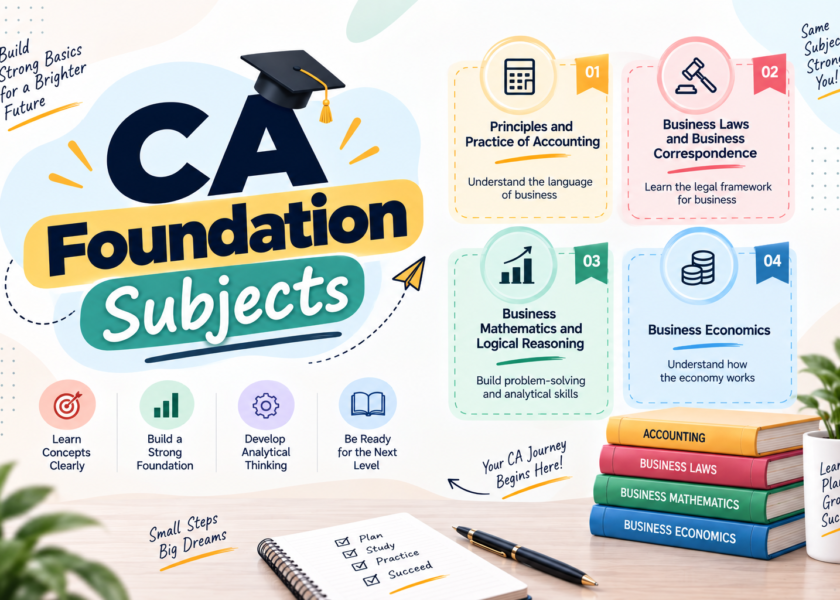
The CA Foundation course currently consists of four papers:
- Accounting
- Business Laws
- Quantitative Aptitude
- Business Economics
The latest applicable ICAI study material should remain the primary source for preparation. Students should also make proper use of practice questions, Revision Test Papers (RTPs), Mock Test Papers (MTPs), previous examination questions and suggested answers where applicable.
This 90-day CA Foundation study plan is designed for students who want a realistic and exam-oriented preparation schedule, whether they are starting from zero or have already completed some portion of the syllabus.
Why a 90-Day Study Plan Is Better Than Random Preparation
Imagine studying Accounting on Monday, Economics on Tuesday, watching three lectures on Wednesday and then spending the next two days making notes.
You may feel busy, but there is no clear measurement of progress.
A proper 90-day plan answers four questions:
- What should I study today?
- How much syllabus should I complete this week?
- When should I revise?
- When should I start testing myself?
The objective is not to create a timetable that looks impressive.
The objective is to create a schedule that you can actually follow for 90 consecutive days.
As CA preparation gets closer to the examination, consistency becomes more valuable than occasional 12-hour study sessions.
CA Foundation 90 Days Study Plan at a Glance
The complete 90 days can be divided into three major phases.
| Phase | Days | Main Objective |
| Phase 1 | Day 1–45 | Concept Building + Syllabus Completion |
| Phase 2 | Day 46–70 | Question Practice + First Revision |
| Phase 3 | Day 71–90 | Final Revision + Mock Tests |
| Final Focus | Last 7–10 Days | Exam-oriented revision and error correction |
This division is flexible.
If you have already completed 40–50% of the syllabus, you can move faster into practice and revision. If you are starting completely from scratch, the first phase should receive more attention.
Phase 1: Day 1 to Day 45 – Complete the Syllabus
The first 45 days are the foundation of your 90-day preparation.
Your main target should be understanding and completing the syllabus, not memorising everything perfectly.
During this phase, avoid spending an entire day making beautiful notes.
Your time should mainly go into:
- Understanding concepts
- Reading ICAI study material
- Solving basic questions
- Making short revision notes
- Marking difficult topics
- Clearing doubts
- Revising what you studied earlier
Suggested Priority
| Subject | Main Focus |
| Accounting | Concepts + practical questions |
| Business Laws | Concepts + provisions + answer writing |
| Quantitative Aptitude | Concepts + regular problem solving |
| Business Economics | Concepts + MCQ practice + revision |
Do not completely finish one subject and ignore the other three for several weeks.
A better approach is subject rotation.
45-Day Subject Completion Strategy
You can divide the first 45 days broadly like this:
| Days | Focus |
| 1–10 | Accounting + Law + QA + Economics basics |
| 11–20 | Continue syllabus + daily question practice |
| 21–30 | Complete major chapters + strengthen weak topics |
| 31–40 | Finish remaining syllabus |
| 41–45 | Backlog completion + first quick revision |
This is not a rigid chapter-by-chapter prescription because students start at different levels.
Someone with a commerce background may move faster through Accounting, while another student may need additional time for basic concepts.
The important thing is to track actual completion, not hours spent.
Phase 2: Day 46 to Day 70 – Practice and First Revision
Once you have covered most of the syllabus, your preparation should change.
This is where many students make a mistake.
They continue watching lectures at the same pace instead of increasing question practice.
From Day 46 onwards, start asking:
“Can I solve this without looking at the answer?”
For Accounting and Quantitative Aptitude, question practice should become a daily habit.
For Business Laws, practise writing answers and recalling provisions.
For Business Economics, increase MCQ practice and revise concepts regularly.
Phase 2 Focus
| Activity | Priority |
| First revision | High |
| Question practice | Very High |
| RTPs | High |
| MTPs | High |
| Previous questions | High |
| Short notes | Medium |
| New resources | Low |
Your preparation should gradually move from learning-heavy to practice-heavy.
Phase 3: Day 71 to Day 90 – Final Revision and Mock Tests
The final 20 days are not meant for starting five new books.
They are meant to convert your preparation into examination performance.
By this point, you should have:
- Completed the majority of the syllabus
- Identified weak chapters
- Prepared short revision notes
- Practised important questions
- Started solving examination-oriented material
- Taken mock tests
- Created an error list
Now your focus should be:
Revision → Test → Analysis → Correction → Revision
A mock test is useful only when you analyse it properly.
Getting 52 marks is not the end of the exercise.
You need to know:
- Which questions were wrong?
- Why were they wrong?
- Was the concept unclear?
- Was it a calculation mistake?
- Did you forget a provision?
- Did you misread the question?
- Did you run out of time?
Your mistakes are your personalised revision syllabus.
90 Days CA Foundation Subject-Wise Study Strategy
1. Accounting
Accounting generally requires regular practice rather than passive reading.
Do not spend several days only watching Accounting lectures.
After understanding a concept, solve questions immediately.
Accounting Strategy
Concept → Illustration → Practice Questions → Revision → Timed Practice
Maintain a separate list of:
- Formulas
- Accounting treatments
- Common adjustments
- Questions you repeatedly get wrong
- Difficult concepts
Try to solve questions without checking the solution halfway through.
If you get stuck, identify exactly where your approach went wrong.
2. Business Laws
Business Laws requires a different preparation style.
Reading the chapter once does not mean you can reproduce the answer in the examination.
Focus on:
- Understanding provisions
- Remembering key concepts
- Learning how to structure answers
- Practising case-based questions
- Revising repeatedly
Create short notes containing important provisions and keywords.
During revision, ask yourself:
“Can I explain this provision without opening the book?”
If the answer is no, revise it again.
3. Quantitative Aptitude
The biggest enemy in QA is irregular practice.
You cannot study QA for ten hours on Sunday and then ignore it for the next six days.
Even 45–60 minutes of daily problem solving can be more useful than occasional marathon sessions.
Your focus should include:
- Concept clarity
- Formula revision
- Question practice
- Calculation speed
- Accuracy
- Timed tests
Maintain a formula sheet and revise it frequently.
4. Business Economics
Economics can become a scoring opportunity when concepts are revised consistently.
Instead of reading the same chapter repeatedly, combine reading with MCQ practice.
A useful cycle is:
Read → Recall → Solve MCQs → Analyse mistakes → Revise
Make short comparison notes wherever concepts look similar.
Do not underestimate Economics simply because it may appear easier during the first reading.
Ideal Daily Timetable for CA Foundation
You do not necessarily need to study 12–14 hours every day.
A focused 7–9 hour schedule can be more sustainable for many students.
Here is an example:
| Time | Activity |
| 7:00–9:00 AM | Accounting / QA |
| 9:00–9:30 AM | Break |
| 9:30–11:30 AM | Second subject |
| 11:30–12:00 PM | Break |
| 12:00–1:30 PM | Practice questions |
| 1:30–3:00 PM | Lunch + rest |
| 3:00–5:00 PM | Lecture / Concept learning |
| 5:00–5:30 PM | Break |
| 5:30–7:00 PM | Law / Economics |
| 8:00–9:00 PM | Revision + MCQs |
| 9:00–9:15 PM | Plan next day |
You can shift these timings according to your college, coaching or personal routine.
Do not copy someone else’s timetable blindly.
Copy the structure, not necessarily the clock.
Weekly Study Pattern for 90-Day CA Foundation Preparation
A weekly routine prevents one subject from disappearing from your schedule.
| Day | Main Focus | Secondary Focus |
| Monday | Accounting | Economics |
| Tuesday | Law | QA |
| Wednesday | Accounting | Law |
| Thursday | QA | Economics |
| Friday | Accounting | Law |
| Saturday | QA | Economics |
| Sunday | Revision + Test | Error Analysis |
Sunday should not become a completely free day.
Use it for:
- Weekly revision
- Backlog completion
- Chapter tests
- MCQs
- Mock tests
- Error analysis
A weekly review can tell you whether your 90-day plan is actually working.
How Many Hours Should You Study for CA Foundation in 90 Days?
There is no universal number.
Your required study time depends on your starting point.
| Student Type | Suggested Focus |
| Starting from zero | 7–9 focused hours/day |
| 25–50% syllabus completed | 6–8 focused hours/day |
| Syllabus mostly completed | 5–7 hours/day + intensive practice |
| College student | 4–7 focused hours/day |
| Strong preparation | More time for tests and revision |
These are practical ranges, not guarantees.
The quality of study matters.
Four distraction-free hours are not the same as four hours with your phone beside you, social media open and multiple tabs running.
90-Day CA Foundation Revision Strategy
Revision should not be postponed until the end.
Use three levels of revision.
Revision 1 – Within 24–48 Hours
Quickly revisit what you studied.
This helps you identify whether you actually understood the topic.
Revision 2 – Weekly
At the end of every week, revise important concepts and questions studied during that week.
Revision 3 – Final Revision
During the last 20 days, revise your condensed notes, marked questions, formulas, provisions, MCQs and mistakes.
This three-level approach is much more manageable than trying to remember three months of preparation in one week.
Mock Test Strategy for the Last 20 Days
Mock tests should not be treated as just another task to tick off.
Create an analysis sheet.
| Test | Score | Major Mistake | Action |
| Test 1 | 56% | Weak chapter | Revise chapter |
| Test 2 | 62% | Calculation errors | Timed practice |
| Test 3 | 68% | Law presentation | Practise answers |
| Test 4 | 72% | MCQ mistakes | Revise concepts |
The purpose of the mock test is not merely to see your marks.
It is to discover what you still need to improve.
ICAI itself provides examination-oriented resources, including mock tests and revision resources, making these an important part of a structured preparation strategy.
What Should You Study in the Last 7 Days?
The last week should be controlled and focused.
Do not suddenly decide to study a completely new book.
Your final-week priority should look like this:
- Important concepts
- Short notes
- Formulas
- Important provisions
- Marked questions
- RTPs
- MTPs
- Previous examination questions
- Mock-test mistakes
- Frequently forgotten topics
A simple seven-day revision structure can be:
| Day | Focus |
| Day 1 | Accounting |
| Day 2 | Business Laws |
| Day 3 | Quantitative Aptitude |
| Day 4 | Business Economics |
| Day 5 | Mixed revision + weak areas |
| Day 6 | Full/major mock test + analysis |
| Day 7 | Final revision + error notebook |
Adjust this based on your examination schedule and preparation level.
Common Mistakes to Avoid During 90-Day Preparation
1. Changing Teachers Repeatedly
If your current resource is working, do not change it every two weeks because someone on social media recommended another faculty.
2. Collecting Too Many PDFs
More material does not automatically mean better preparation.
Keep your resource list controlled.
3. Ignoring Question Practice
Understanding a solution is not the same as solving the question yourself.
4. Leaving Revision for the End
Revision should start from the first week.
5. Avoiding Mock Tests
A mock test may expose weaknesses that studying alone does not reveal.
6. Creating an Impossible Timetable
A timetable of 14 hours that survives for two days is less useful than an 8-hour schedule you follow for 90 days.
7. Ignoring Weak Subjects
Students naturally spend more time on subjects they enjoy.
Your weak subject deserves planned attention.
Best Resource Strategy for CA Foundation
Keep your preparation simple.
A useful hierarchy is:
| Level | Resource |
| 1 | Latest ICAI Study Material |
| 2 | Reliable Classes / Faculty |
| 3 | Practice Questions |
| 4 | RTPs and MTPs |
| 5 | Previous Examination Questions |
| 6 | Personal Short Notes |
| 7 | Mock Tests |
The objective is not to consume as much content as possible.
The objective is to convert content into marks.
For students preparing for the current attempt, checking the latest applicable ICAI material is particularly important because study material can be updated for different examination cycles.
How CA Mentoring Program Can Help in a 90-Day Preparation Journey
A three-month preparation journey can become difficult when students are unsure about what to do next.
That is where structured guidance can add value.
CA Mentoring Program can help students approach preparation with a more organised mindset around study planning, revision, accountability and identifying areas that need attention.
Mentoring should not replace your own effort.
Instead, it should help answer questions such as:
- Am I following a realistic schedule?
- Which subject needs more attention?
- Why am I repeatedly making the same mistakes?
- Is my revision on track?
- When should I start mock tests?
- How should I manage my backlog?
- What should I prioritise in the final weeks?
The goal is simple: less confusion, better planning and more purposeful preparation.
A 90-Day CA Foundation Preparation Checklist
Use this checklist every week.
| Preparation Area | Target |
| Syllabus Progress | Track weekly |
| Daily Study Hours | Track honestly |
| Questions Solved | Track subject-wise |
| Revision | At least weekly |
| Weak Chapters | Maintain separate list |
| RTP/MTP Practice | Schedule in advance |
| Mock Tests | Increase near exam |
| Mistake Analysis | After every test |
| Formula Revision | Regular |
| Final Notes | Keep concise |
At the end of every Sunday, ask yourself:
What did I actually complete this week?
Not:
How many hours did I sit at my desk?
That small change in thinking can make your preparation much more effective.
Final 90-Day CA Foundation Strategy
If you have only 90 days left, do not panic.
You do not need a perfect beginning.
You need a disciplined next 90 days.
Follow this simple roadmap:
Days 1–45: Complete concepts and cover the syllabus.
Days 46–70: Increase question practice and complete your first serious revision.
Days 71–90: Focus heavily on revision, RTPs, MTPs, previous questions, mock tests and mistakes.
And throughout these 90 days, remember five rules:
- Keep the latest ICAI material at the centre of preparation.
- Study all four subjects consistently.
- Practise questions instead of only watching lectures.
- Revise before you forget.
- Analyse your mistakes instead of simply counting your marks.
You do not need to make your CA Foundation preparation complicated.
You need a plan that fits your life, a routine you can maintain, and the discipline to follow it even on days when motivation is low.
90 days is enough time to make a serious difference—but only if you start using those 90 days properly.