CA Intermediate Exam Pattern January 2027: Complete Paper Pattern, Marks, Passing Criteria & Preparation Strategy
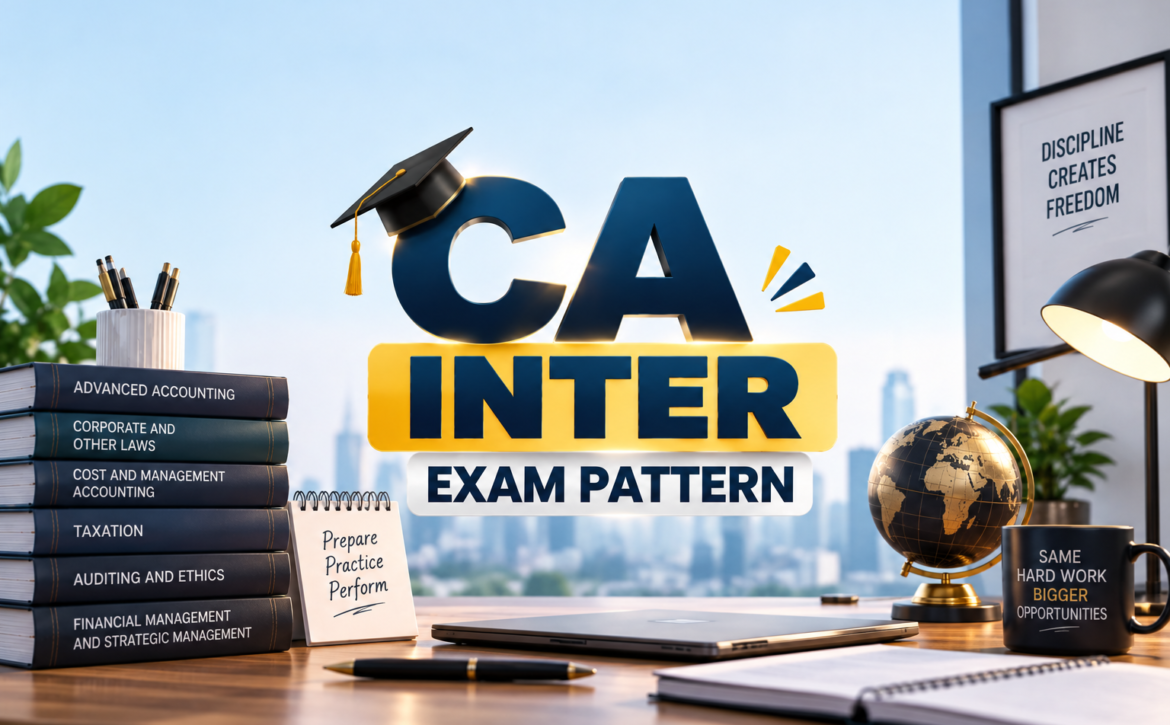
CA Intermediate Exam Pattern January 2027: An Overview
If you are preparing for the CA Intermediate January 2027 examination, understanding the exam pattern should be one of the first things on your preparation checklist.
Many students make the mistake of starting their preparation by simply collecting books, watching lectures and making a timetable. But before doing all that, you should know exactly how ICAI will assess you.
Under the current New Scheme of Education and Training, CA Intermediate has six papers divided into two groups. Each paper carries 100 marks. The examination pattern includes both case-scenario/case-study based MCQs and descriptive questions. ICAI’s official guidance states that 30% of the examination comprises case-scenario/case-study based MCQs and 70% comprises descriptive questions. There is no negative marking for the MCQ portion.
This combination makes the CA Intermediate examination different from a purely theoretical or purely objective exam. You need conceptual clarity, numerical practice, answer-writing skills and the ability to understand a question quickly.
So, let’s break down the CA Intermediate Exam Pattern January 2027 in a simple and practical way.
CA Intermediate Exam Pattern January 2027 at a Glance
| Particular | Details |
| Examination | CA Intermediate January 2027 |
| Scheme | New Scheme of Education and Training |
| Total Papers | 6 |
| Total Groups | 2 |
| Papers in Each Group | 3 |
| Marks per Paper | 100 |
| Total Marks | 600 |
| Question Types | MCQs/Case Scenarios + Descriptive Questions |
| MCQ/Case Scenario Component | 30% |
| Descriptive Component | 70% |
| Negative Marking in MCQs | No |
| Passing Marks | Minimum 40% in each paper |
| Group Aggregate | Minimum 50% |
| Exam Frequency | January, May and September under the current cycle |
ICAI’s current Intermediate resources list three papers under Group I and three papers under Group II.
CA Intermediate January 2027: Subject-Wise Paper Structure
The six papers are divided into two groups.
Group 1
- Advanced Accounting
- Corporate and Other Laws
- Taxation
Group 2
- Cost and Management Accounting
- Auditing and Ethics
- Financial Management and Strategic Management
The paper structure currently published by ICAI confirms this six-paper arrangement.
Here’s a quick overview:
| Group | Paper | Subject | Marks |
| Group 1 | Paper 1 | Advanced Accounting | 100 |
| Group 1 | Paper 2 | Corporate and Other Laws | 100 |
| Group 1 | Paper 3 | Taxation | 100 |
| Group 2 | Paper 4 | Cost and Management Accounting | 100 |
| Group 2 | Paper 5 | Auditing and Ethics | 100 |
| Group 2 | Paper 6 | Financial Management and Strategic Management | 100 |
| Total | 6 Papers | 2 Groups | 600 |
This means that students attempting both groups are dealing with a total of 600 marks.
But don’t let the number 600 scare you. You don’t have to approach all six subjects in exactly the same way. Each paper demands a different preparation strategy.
CA Intermediate Question Paper Pattern January 2027
One of the most important things students should understand is that the current Intermediate examination is not purely descriptive.
ICAI’s official FAQ states that 30% of the marks are based on case-scenario/case-study based MCQs and 70% are descriptive questions in all six Intermediate papers. It also confirms that there is no negative marking in the MCQ-based questions.
Broad Pattern
| Component | Approximate Weightage |
| Case Scenario/Case Study Based MCQs | 30% |
| Descriptive Questions | 70% |
| Total | 100% |
This has an important implication for your preparation.
You cannot prepare only by memorising theory.
At the same time, you cannot prepare only by solving objective questions.
You need both.
For example, in Law and Audit, you need to understand provisions and apply them to situations. In Accounting, Costing and FM, you need numerical practice. In Taxation, you need both conceptual understanding and application.
Is There Negative Marking in CA Intermediate January 2027?
No. There is no negative marking in the MCQ portion of the CA Intermediate examination.
This is an important advantage for students.
According to ICAI’s official guidance, wrong answers in the MCQ-based questions do not attract negative marks.
However, “no negative marking” does not mean that you should randomly select answers.
The better strategy is:
Read → Eliminate → Analyse → Select → Move On
Don’t spend five minutes on one MCQ when you have several other questions to attempt.
CA Intermediate Passing Criteria January 2027
Understanding the passing criteria is just as important as understanding the paper pattern.
As per ICAI’s official guidance, a student generally needs to secure:
- At least 40% marks in each paper, and
- At least 50% aggregate marks in the group being attempted.
If a student attempts both groups, the aggregate requirement can also be considered across both groups subject to ICAI’s applicable passing provisions.
Example
Suppose a student scores:
| Paper | Marks |
| Paper 1 | 58 |
| Paper 2 | 52 |
| Paper 3 | 43 |
| Total | 153/300 |
The student has scored more than 40 marks in every paper and has crossed the 50% aggregate requirement.
Now consider another situation:
| Paper | Marks |
| Paper 1 | 70 |
| Paper 2 | 68 |
| Paper 3 | 35 |
Even though the overall marks are strong, scoring below 40 in one paper creates a problem for passing that group.
This is why you should never completely ignore your weaker subject.
CA Intermediate Group 1 Exam Pattern January 2027
Paper 1: Advanced Accounting
Advanced Accounting is the first paper of Group 1 and carries 100 marks.
This is a subject where consistent question practice can make a significant difference.
You should focus on:
- Accounting principles and concepts
- Accounting Standards
- Company accounts
- Partnership-related accounting
- Amalgamation and reconstruction
- Branch and departmental accounting
- Other topics included in the applicable ICAI study material
The biggest mistake students make in Accounting is reading solutions without solving the questions themselves.
Don’t just think:
“I understood the solution, so I can solve it.”
Close the book and solve it yourself.
That’s when you actually find out whether you know the concept.
Paper 2: Corporate and Other Laws
Corporate and Other Laws is another 100-mark paper.
This paper tests your understanding of legal provisions and your ability to apply them appropriately.
Your preparation should include:
- Important definitions
- Legal provisions
- Conditions and requirements
- Exceptions
- Practical situations
- Penalties and consequences
- Important legal terminology
- Answer presentation
For Law, don’t try to memorise every sentence word-for-word.
Instead, understand the provision first.
Then remember the important keywords.
A good Law answer should make it clear that you know:
What the law says + How it applies + What the conclusion is.
Paper 3: Taxation
Taxation is Paper 3 of Group 1 and contains two sections:
Section A – Income-tax Law
Section B – Goods and Services Tax
Each area requires a different style of preparation.
For January 2027 aspirants, this subject needs special attention because ICAI has separately identified study material applicable to the January 2027 examination. ICAI’s current resources distinguish material applicable to May 2026, September 2026 and January 2027 from newer material applicable from May 2027 onwards.
Important Taxation Tip
Don’t download a random “latest tax notes” PDF from the internet and assume it is applicable to January 2027.
Always check the attempt applicability.
This one habit can save you from preparing provisions that are not relevant to your examination.
CA Intermediate Group 2 Exam Pattern January 2027
Paper 4: Cost and Management Accounting
Cost and Management Accounting carries 100 marks.
This is a practice-heavy paper.
Important preparation areas include:
- Cost concepts
- Material cost
- Employee cost
- Overheads
- Cost sheet
- Activity Based Costing
- Cost accounting systems
- Job and batch costing
- Process costing
- Service costing
- Standard costing
- Marginal costing
- Budgetary control
For Costing, your preparation should follow:
Concept → Formula → Illustration → Practice → Test
If you only watch lectures, you may feel prepared.
The real test comes when you have to solve a question without looking at the teacher’s solution.
Paper 5: Auditing and Ethics
Auditing and Ethics is Paper 5 and carries 100 marks.
Audit is one of those subjects where repeated revision becomes extremely important.
Students often struggle because they try to memorise everything in one go.
Instead, understand the reasoning behind the concepts.
Ask yourself:
- Why is the auditor performing this procedure?
- What risk is being addressed?
- What evidence is required?
- What conclusion should be reached?
- What professional responsibility is involved?
Once you understand the logic, revision becomes much easier.
Also, don’t ignore answer writing.
A technically correct idea can lose its impact if it is presented in a confusing manner.
Paper 6: Financial Management and Strategic Management
Paper 6 combines:
- Section A – Financial Management
- Section B – Strategic Management
This makes Paper 6 particularly interesting because you need two different preparation approaches.
Financial Management
FM requires regular numerical practice.
Focus on understanding:
- Financial decisions
- Cost of capital
- Capital structure
- Leverage
- Investment decisions
- Working capital
- Financial analysis
- Other applicable FM concepts
Strategic Management
SM is more theory-oriented.
You should focus on:
- Strategic concepts
- Business environment
- Strategic analysis
- Strategy formulation
- Strategy implementation
- Competitive strategies
- Functional strategies
- Strategic evaluation
For SM, repeated short revisions are generally more useful than reading the complete book again and again.
CA Intermediate Exam Pattern January 2027: Paper-Wise Summary
| Paper | Subject | Marks | Main Preparation Style |
| Paper 1 | Advanced Accounting | 100 | Concepts + Numerical Practice |
| Paper 2 | Corporate & Other Laws | 100 | Concepts + Revision + Answer Writing |
| Paper 3 | Taxation | 100 | Concepts + Application + Updates |
| Paper 4 | Cost & Management Accounting | 100 | Numerical Practice |
| Paper 5 | Auditing & Ethics | 100 | Understanding + Revision |
| Paper 6 | FM & SM | 100 | Numericals + Theory Revision |
The key point is simple: don’t use one preparation strategy for all six papers.
How to Prepare According to the CA Intermediate Exam Pattern
The 30% objective and 70% descriptive structure should directly influence your preparation.
Step 1: Complete the Concepts
Before solving questions, make sure you understand the chapter.
Step 2: Solve ICAI Illustrations
Don’t simply read them.
Attempt them yourself.
Step 3: Practise MCQs
MCQs test whether you can identify the correct answer quickly.
Step 4: Practise Descriptive Questions
Write answers within a time limit.
Step 5: Attempt Mock Tests
A mock test tells you whether your preparation works under exam pressure.
Step 6: Analyse Your Mistakes
This is the part students often skip.
After every test, categorise your mistakes:
| Mistake Type | What It Means |
| Conceptual Error | Topic needs revision |
| Calculation Error | More practice required |
| Presentation Error | Improve answer writing |
| Time Management | Practise timed papers |
| Silly Mistake | Slow down and read carefully |
| Memory Gap | Add to revision list |
This analysis is more valuable than simply checking your score.
Should You Attempt One Group or Both Groups?
There is no universal answer.
It depends on your preparation level, available time and confidence.
If you have enough preparation time and can maintain quality across six subjects, attempting both groups can be considered.
But don’t choose both groups simply because you feel that “more papers means faster progress.”
CA Intermediate requires depth.
If six subjects are causing your preparation to become superficial, you need to rethink your strategy.
A good decision should be based on:
- Syllabus completion
- Revision status
- Mock test performance
- Daily study hours
- Strong and weak subjects
- Previous attempt experience, if applicable
Common Mistakes to Avoid for January 2027
1. Studying Without Knowing the Pattern
You should know the 30% objective and 70% descriptive structure before starting serious preparation.
2. Ignoring MCQ Practice
MCQs are not something you should start practising only a week before the exam.
3. Avoiding Descriptive Writing
Knowing the answer mentally is not enough.
You must be able to put it on paper.
4. Using Material for the Wrong Attempt
This is particularly important for Taxation and other subjects where ICAI specifies applicability.
5. Leaving Revision Until the Last Month
Revision should happen throughout the preparation cycle.
6. Taking Mock Tests Too Late
Tests should be used as a learning tool, not just as a final formality.
How CA Mentoring Program Can Support Your Preparation
Preparing for CA Intermediate can sometimes feel overwhelming because there are too many things to manage at once—classes, ICAI study material, revisions, questions, tests, amendments and daily targets.
That is where structured guidance can be useful.
CA Mentoring Program can be explored by students looking for a more organised approach to their CA preparation.
The important thing is not simply to study for more hours.
It is to make those hours productive.
A good preparation system should help you understand:
What to study → When to study → How to practise → How to test → How to improve
That mindset can make preparation much more manageable.
Final Preparation Checklist for CA Intermediate January 2027
Before entering the final phase of preparation, ask yourself:
- Have I completed all applicable chapters?
- Am I following the correct ICAI study material?
- Have I checked the January 2027 applicability?
- Have I practised MCQs?
- Have I practised descriptive questions?
- Have I solved ICAI illustrations?
- Have I attempted mock tests?
- Have I analysed my mistakes?
- Have I revised every subject at least twice?
- Can I complete a paper within the required time?
- Am I comfortable with numerical papers?
- Can I present Law and Audit answers properly?
- Have I revised important formulas and provisions?
- Have I prepared a short final-revision list?
If you can answer “yes” to most of these questions, your preparation is moving in the right direction.
Conclusion
The CA Intermediate Exam Pattern January 2027 is built around six papers divided into two groups, with each paper carrying 100 marks. The current pattern combines 30% case-scenario/case-study based MCQs and 70% descriptive questions, with no negative marking for the MCQ component.
For students, this means preparation cannot be limited to reading textbooks or watching lectures.
You need a combination of:
Conceptual clarity + MCQ practice + Descriptive answer writing + Numerical practice + Revision + Mock tests.
Also remember that January 2027 aspirants should be careful about study-material applicability. ICAI’s current resources specifically identify materials relevant to the January 2027 attempt, while several newer materials are marked for May 2027 onwards.
Most importantly, don’t compare your preparation with someone else’s timetable.
One student may complete six chapters in a week but remember very little. Another may complete four chapters and retain almost everything.
Your target should not be “How much did I study today?”
Your target should be:
“How much can I reproduce correctly in the examination?”
That is the real difference between studying for CA Intermediate and preparing to clear CA Intermediate.