CA Final Exam Pattern Nov 2026: Paper Pattern, Marks, Duration, Syllabus & Passing Criteria
CA Final Exam Pattern Nov 2026: An Overview
The CA Final examination is the last major academic stage of the Chartered Accountancy journey, and by the time students reach this level, preparation is no longer about simply completing chapters. The real challenge is understanding how ICAI expects you to apply concepts in the examination hall.
For students appearing in CA Final November 2026, knowing the exact exam pattern is particularly important because the New Scheme has changed the structure of the Final course. The current CA Final course consists of six papers divided into two groups, with three papers in each group. ICAI’s current New Scheme lists Financial Reporting, Advanced Financial Management, Advanced Auditing, Assurance and Professional Ethics, Direct Tax Laws & International Taxation, Indirect Tax Laws, and Integrated Business Solutions as the Final papers.
The November 2026 attempt will be conducted in two groups:
- Group I: Paper 1, Paper 2 and Paper 3
- Group II: Paper 4, Paper 5 and Paper 6
The biggest thing students should notice is that Paper 6 – Integrated Business Solutions (IBS) is different from the other papers because it is designed around multidisciplinary case studies and has a longer examination duration.
So, before you make your final revision timetable, understand the pattern first. A good strategy built around the wrong paper pattern can waste several weeks of preparation.
CA Final Exam Pattern Nov 2026: Quick Highlights
Here is the complete pattern at a glance:
| Particular | CA Final November 2026 |
| Conducting Body | Institute of Chartered Accountants of India (ICAI) |
| Course Scheme | New Scheme |
| Total Papers | 6 |
| Number of Groups | 2 |
| Papers in Each Group | 3 |
| Total Marks | 600 |
| Marks per Paper | 100 |
| Group I Papers | Paper 1, 2 & 3 |
| Group II Papers | Paper 4, 5 & 6 |
| Paper 6 | Integrated Business Solutions |
| Paper 6 Duration | 4 Hours |
| Other Papers | 3 Hours |
| Passing Requirement | 40% in each paper + 50% aggregate in a group |
The six-paper structure is confirmed by ICAI’s Final Course syllabus under the New Scheme.
CA Final November 2026 Exam Dates
The November 2026 CA Final examination is scheduled across two groups. The exams are conducted on alternate dates, giving students a short preparation gap between papers.
| Group | Paper | Subject | Exam Date | Duration |
| Group I | Paper 1 | Financial Reporting | 2 November 2026 | 3 Hours |
| Group I | Paper 2 | Advanced Financial Management | 4 November 2026 | 3 Hours |
| Group I | Paper 3 | Advanced Auditing, Assurance & Professional Ethics | 6 November 2026 | 3 Hours |
| Group II | Paper 4 | Direct Tax Laws & International Taxation | 9 November 2026 | 3 Hours |
| Group II | Paper 5 | Indirect Tax Laws | 11 November 2026 | 3 Hours |
| Group II | Paper 6 | Integrated Business Solutions | 13 November 2026 | 4 Hours |
The November 2026 schedule reported from the ICAI examination announcement places Group I on 2, 4 and 6 November and Group II on 9, 11 and 13 November.
For students, this schedule has one important implication: you cannot afford to leave revision until the night before an exam. Your preparation should be designed so that each subject has already been revised at least once before the first paper.
CA Final Group 1 Exam Pattern Nov 2026
Group 1 consists of three papers:
- Financial Reporting
- Advanced Financial Management
- Advanced Auditing, Assurance and Professional Ethics
Each paper carries 100 marks.
Group 1 Paper Pattern
| Paper | Subject | Maximum Marks | Duration |
| Paper 1 | Financial Reporting | 100 | 3 Hours |
| Paper 2 | Advanced Financial Management | 100 | 3 Hours |
| Paper 3 | Advanced Auditing, Assurance & Professional Ethics | 100 | 3 Hours |
| Total | 300 | — |
Paper 1: Financial Reporting
Financial Reporting tests much more than your ability to remember accounting standards. At the Final level, students are expected to understand Ind AS concepts and apply them to practical situations.
Important areas include:
- Ind AS framework
- Presentation of financial statements
- Revenue recognition
- Assets and liabilities
- Financial instruments
- Business combinations
- Consolidated financial statements
- Analysis of financial statements
- Disclosures
- Professional and ethical aspects
The best approach for FR is to combine concept revision with extensive question practice. Reading the chapter repeatedly without solving questions can create a false sense of preparation.
Paper 2: Advanced Financial Management
AFM is generally considered a calculation-heavy paper. However, simply memorising formulas is not enough.
Your preparation should include:
- Financial strategy
- Investment decisions
- Financing decisions
- Risk management
- Security valuation
- Portfolio management
- Derivatives
- Foreign exchange
- Mergers and acquisitions
- Financial restructuring
- Other advanced financial decision-making areas
For AFM, your formula revision should be accompanied by timed practice. The objective is not only to know the formula but also to identify which formula or concept the question is actually testing.
Paper 3: Advanced Auditing, Assurance & Professional Ethics
Audit preparation requires a different approach from FR or AFM.
Students need to develop:
- Conceptual clarity
- Understanding of auditing procedures
- Ability to identify relevant standards
- Professional judgement
- Proper presentation
- Revision of important provisions and requirements
At Final level, Audit answers should not look like random points copied from memory. Your answer should directly address the requirement of the question.
CA Final Group 2 Exam Pattern Nov 2026
Group 2 includes:
- Direct Tax Laws & International Taxation
- Indirect Tax Laws
- Integrated Business Solutions
| Paper | Subject | Maximum Marks | Duration |
| Paper 4 | Direct Tax Laws & International Taxation | 100 | 3 Hours |
| Paper 5 | Indirect Tax Laws | 100 | 3 Hours |
| Paper 6 | Integrated Business Solutions | 100 | 4 Hours |
| Total | 300 | — |
Paper 4: Direct Tax Laws & International Taxation
Direct Tax at CA Final level requires students to connect provisions with practical tax situations.
Preparation should cover the applicable syllabus areas, including:
- Computation of taxable income
- Tax provisions
- Assessment procedures
- Appeals and related procedures
- Tax planning
- International taxation
- Transfer pricing
- Double taxation concepts
- Relevant amendments applicable to the examination
For November 2026, students should be particularly careful about the applicable Finance Act, notifications, circulars and amendments prescribed by ICAI for the attempt.
Don’t rely on an old amendment compilation just because it was useful for an earlier attempt.
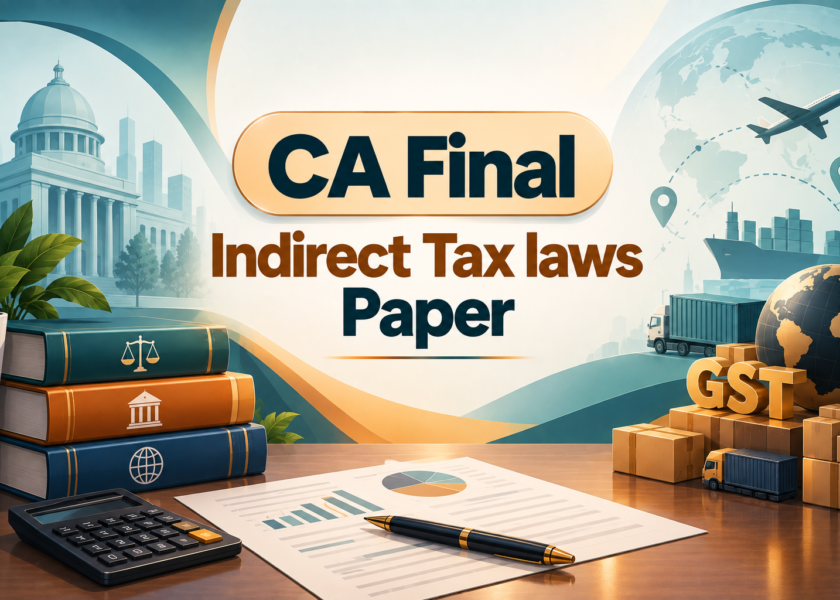
Paper 5: Indirect Tax Laws
Indirect Tax Laws covers GST and customs-related areas under the applicable Final syllabus.
Major preparation areas include:
- Supply
- Input Tax Credit
- Registration
- Tax invoice
- Returns
- Payment of tax
- Assessment
- Refund
- Audit
- E-way bill
- Inspection and enforcement
- Appeals and penalties
- Customs law
- Foreign Trade Policy-related provisions
One of the most common mistakes students make in IDT is studying provisions in isolation.
Try to understand the practical flow:
Transaction → Supply → Taxability → ITC → Compliance → Payment → Return → Assessment/Refund
This approach makes revision much easier.
Paper 6: Integrated Business Solutions – The Paper You Should Not Ignore
Paper 6 is arguably the most distinctive paper under the current CA Final structure.
It is titled:
Integrated Business Solutions (Multidisciplinary Case Study with Strategic Management).
Unlike a conventional subject paper, IBS requires you to look at a business situation from multiple professional perspectives.
The paper can require integration of concepts across areas such as:
- Financial Reporting
- Financial Management
- Auditing
- Direct Tax
- Indirect Tax
- Strategic Management
- Professional and business considerations
The objective is not simply to test whether you remember individual chapters. It is designed to assess how effectively you can analyse a business situation and apply multiple concepts together.
Paper 6 at a Glance
| Particular | Details |
| Paper | Paper 6 |
| Name | Integrated Business Solutions |
| Nature | Multidisciplinary Case Study |
| Maximum Marks | 100 |
| Duration | 4 Hours |
| Major Skill Tested | Application & Analysis |
| Strategic Management | Integrated |
The four-hour duration makes time management especially important.
Students who prepare IBS only after completing every other subject may find it difficult to adjust to case-based thinking. It is better to practise case scenarios throughout the preparation period.
ICAI’s Board of Studies specifically provides case-study resources and identifies Paper 6 as Integrated Business Solutions in its Final Course resources.
CA Final Nov 2026 Marks Distribution and Question Pattern
Under the current New Scheme, CA Final papers follow a combination of objective and descriptive assessment, while Paper 6 has its own case-study-oriented structure.
For Papers 1 to 5, the commonly followed pattern is:
| Component | Marks |
| Objective Questions / MCQs | 30 |
| Descriptive Questions | 70 |
| Total | 100 |
This means students cannot prepare exclusively for long-form questions.
The objective component can test whether you can quickly identify the correct concept, treatment, provision or calculation.
The descriptive component, on the other hand, tests your ability to explain, calculate, analyse and present the answer properly.
Important: Students should always verify the latest ICAI question-paper instructions and attempt-specific announcements before the examination because ICAI’s instructions and paper-specific requirements take precedence over coaching summaries.
Is There Negative Marking in CA Final Nov 2026?
Students often search for this immediately before the examination.
The objective component has its own instructions, and candidates should carefully read the instructions printed on the question paper and follow the applicable ICAI guidelines.
Do not carry assumptions from another CA level or an older examination pattern into your Final examination.
ICAI maintains specific guidelines for MCQ responses for Intermediate and Final examinations on its student portal.
CA Final Passing Criteria Nov 2026
Understanding the passing criteria is just as important as understanding the paper pattern.
A student generally needs:
- At least 40% marks in each paper, and
- At least 50% aggregate marks in the group
For a 300-mark group, 50% means 150 marks.
Example
Suppose a student scores:
| Paper | Marks |
| Paper 1 | 52 |
| Paper 2 | 48 |
| Paper 3 | 55 |
| Total | 155 |
The student has crossed the 50% aggregate requirement and has also scored at least 40 marks in every paper.
Therefore, the group requirement is satisfied.
But consider another example:
| Paper | Marks |
| Paper 1 | 65 |
| Paper 2 | 70 |
| Paper 3 | 35 |
| Total | 170 |
Although the aggregate is above 50%, the student has not achieved 40 marks in Paper 3.
This is why students should not prepare only for an aggregate score. Every individual paper matters.
How Should You Prepare for CA Final Nov 2026 Based on the Exam Pattern?
Knowing the pattern is useful only when you convert it into a preparation strategy.
1. Start With ICAI Study Material
Your preparation should revolve around the latest applicable ICAI material.
ICAI provides New Scheme study material and Final Course resources through its official student and Board of Studies platforms.
Use coaching notes for explanation and revision, but don’t completely disconnect yourself from ICAI material.
2. Practise MCQs Separately
The objective portion can be lost through careless reading.
During revision, practise questions where you have to make a decision quickly.
Train yourself to identify:
- What is being asked?
- Which provision applies?
- What information is relevant?
- What information is irrelevant?
- What is the most appropriate answer?
Speed matters.
3. Write Full-Length Descriptive Answers
Many CA Final students spend months studying but very little time actually writing.
That becomes a problem in the examination.
Try writing full-length papers under exam conditions.
A test is useful only when you analyse it afterwards.
Ask yourself:
- Did I understand the question correctly?
- Did I answer exactly what was asked?
- Did I manage time?
- Were my workings clear?
- Did I leave questions incomplete?
- Could my answer presentation be improved?
Why Test Practice Matters for CA Final Nov 2026
At Final level, mock tests are not just for checking marks.
They help you understand your exam behaviour.
For example, you may know AFM concepts but spend too much time on one difficult question. You may know Audit provisions but write excessively long answers. You may understand DT but make avoidable calculation mistakes.
These problems usually become visible only when you attempt full-length papers.
This is where a structured preparation ecosystem can help. Students preparing through CA Mentoring Program can use the exam pattern as a framework for planning revision, practice and performance analysis.
The goal should not be to simply attempt more tests. The goal should be to learn something from every test you attempt.
CA Final Nov 2026 Preparation Strategy: A Practical Approach
If your syllabus is substantially complete, divide your remaining preparation into three stages.
Stage 1: Revision
Focus on:
- Concept revision
- ICAI material
- Amendments
- Important questions
- Formula revision
- Case studies
Stage 2: Testing
Start with:
- Chapter-wise tests
- Topic-wise questions
- MCQ practice
- Case-study practice
- Full-length papers
Stage 3: Final Revision
During the last phase:
- Avoid starting too many new resources.
- Revise short notes.
- Revise formulas.
- Revisit mistakes from mock tests.
- Practise important case scenarios.
- Review amendments.
- Work on presentation and time management.
A simple rule works well:
Study → Practise → Test → Analyse → Improve → Repeat.
Common Mistakes Students Make in CA Final Preparation
Mistake 1: Collecting too many resources
Five different books do not automatically mean five times better preparation.
Pick your primary source and revise it multiple times.
Mistake 2: Ignoring Paper 6
IBS should not be treated as a last-week subject.
The paper requires application and integration, which takes practice.
Mistake 3: Not practising under time pressure
Knowing an answer and writing it within the available time are two different skills.
Mistake 4: Ignoring amendments
Especially for tax-related papers, applicable amendments can be crucial.
Mistake 5: Focusing only on difficult questions
You need a balanced strategy.
The goal is not to solve the toughest question in the room. The goal is to maximise your score across the entire paper.
How to Use the Exam Gap Between CA Final Papers
The November 2026 schedule gives students limited gaps between papers.
Therefore, your final revision should ideally be completed before the first paper.
For example:
Before 2 November: FR should already be revised.
After FR, don’t try to learn the entire AFM syllabus from scratch. Use the gap for:
- Formula revision
- Important questions
- Mock-test mistakes
- High-priority chapters
- Quick concept revision
The same approach should continue for the remaining papers.
The gap between examinations is for targeted revision, not for complete preparation.
CA Final Exam Pattern Nov 2026: What Students Should Remember
If you remember only a few points from this article, remember these:
- CA Final under the New Scheme has 6 papers.
- The papers are divided into 2 groups.
- Each paper carries 100 marks.
- Group I contains Papers 1–3.
- Group II contains Papers 4–6.
- Papers 1–5 are generally 3-hour papers.
- Paper 6 IBS has a 4-hour duration.
- The examination combines objective and descriptive assessment where applicable.
- Passing requires 40% in each paper and 50% aggregate in a group.
- ICAI study material, RTPs, MTPs, amendments and previous examination questions should form the core of preparation.
ICAI has also announced Mock Test Paper Series I and II for Final students appearing in November 2026, showing the importance of structured practice before the attempt.
Final Thoughts
The CA Final Exam Pattern Nov 2026 is not difficult to understand, but understanding it early can make your preparation much more organised.
The biggest change students need to adapt to is not simply the number of papers. It is the increasing importance of application, objective questions, case-based thinking and integrated problem-solving.
If you are preparing for November 2026, don’t measure your preparation only by the number of chapters you have completed.
Instead, ask yourself:
Can I solve a question without looking at the solution?
Can I complete a paper within the time limit?
Can I explain my answer clearly?
Can I apply multiple concepts to a case study?
Do I know where I lose marks?
Those answers will tell you much more about your actual preparation level than your study hours will.
CA Final is ultimately an examination of professional-level understanding. The students who combine concept clarity + ICAI material + revision + question practice + mock tests + proper time management put themselves in a much stronger position.
For November 2026, prepare with the mindset that every revision should make your next attempt at a question faster, clearer and more accurate.