60 Days CA Final Study Plan: Complete 60-Day Strategy to Prepare Smarter and Score Better
60 Days CA Final Study Plan
When only 60 days are left for your CA Final examination, it is very easy to feel that there is too much to study and too little time.
You may have completed your classes, made notes, watched revision lectures, or even studied some chapters multiple times. Still, when you sit down to make a final timetable, everything starts looking unfinished.
This is where a 60 Days CA Final Study Plan becomes important.
The last 60 days should not be treated as another opportunity to start your preparation from zero. Instead, this period should help you convert your existing knowledge into strong revision, better recall, question-solving ability and exam confidence.
A good plan is not about studying for 15–16 hours every day. It is about knowing what to study, when to revise it, what questions to solve and how to identify your weak areas.
ICAI’s own preparation guidance emphasises understanding the syllabus, using Board of Studies resources, planning according to available time and keeping sufficient time for revision.
This 60-day plan is therefore designed around one simple idea:
Study → Revise → Practice → Test → Analyse → Revise Again.
Can You Prepare for CA Final in 60 Days?
Yes, but your starting point matters.
If you have already completed your classes and have a basic understanding of the syllabus, 60 days can be used very effectively for revision and exam preparation.
However, if you are starting completely from scratch, following the same timetable may not be realistic.
The objective of these 60 days should be to maximise your score from the preparation you already have rather than trying to make every chapter perfect.
Your 60-day priorities should be:
- Complete a structured revision of all important topics.
- Strengthen weak chapters.
- Practise practical questions regularly.
- Revise theory using active recall.
- Solve ICAI questions and relevant exam-oriented material.
- Attempt mock tests under exam conditions.
- Analyse every major mistake.
- Keep short notes ready for final revision.
The most important change during these 60 days is that your preparation should gradually move from learning mode to performance mode.
60 Days CA Final Study Plan at a Glance
Instead of making one complicated timetable, divide the 60 days into four phases.
| Phase | Days | Main Objective |
| Phase 1 | Day 1–15 | First revision + identify weak areas |
| Phase 2 | Day 16–30 | Complete major revision + question practice |
| Phase 3 | Day 31–45 | Second revision + intensive answer writing |
| Phase 4 | Day 46–60 | Mock tests + final revision + exam readiness |
This structure gives you enough flexibility to adjust the plan according to your preparation level.
Phase 1: Days 1–15 – Start With Strong Revision
The first 15 days are not about reading everything slowly.
Your objective is to quickly revisit the syllabus and determine where you actually stand.
Start with subjects or chapters where you already have a reasonable understanding. This gives you momentum and allows you to identify the areas that need more attention.
During Days 1–15, focus on:
- Revision of concepts
- Important questions
- ICAI study material
- Previous examination questions
- RTPs and MTPs
- Formula revision
- Important provisions and keywords
- Identification of weak chapters
Do not spend an entire day making beautiful notes.
Your notes should be short enough to revise quickly later.
The 15-Day Target
By the end of Day 15, you should have:
- Revised a significant portion of every subject.
- Identified your strong and weak areas.
- Created a list of chapters requiring additional revision.
- Started regular question practice.
- Started maintaining an error notebook.
Phase 2: Days 16–30 – Complete the First Serious Revision
The next 15 days are about building momentum.
By this stage, you should not be spending most of your time passively reading books.
For practical subjects, solving questions should become a major part of your study routine.
For theory-oriented subjects, focus on understanding + recall + writing.
A useful approach is to revise a topic and then close your material and ask yourself:
“What can I actually remember without looking?”
This small habit can make your revision much more effective.
What to Do in Days 16–30
| Activity | Recommended Focus |
| Concept revision | High-priority chapters |
| Practical questions | Daily |
| Theory revision | Active recall |
| ICAI questions | Regular practice |
| MCQs | Topic-wise practice |
| Answer writing | 2–4 answers regularly |
| Error notebook | Update daily |
| Short notes | Keep them concise |
By Day 30, your first major revision should be substantially complete.
You should now know exactly which chapters are helping your preparation and which ones are still creating problems.
Phase 3: Days 31–45 – Shift From Revision to Performance
This is where your CA Final preparation starts feeling different.
You have already seen most of the syllabus. Now your job is to improve speed, accuracy, recall and presentation.
Do not spend the entire day reading.
Instead, divide your time between:
- Revision
- Question practice
- Timed answer writing
- Mock/sectional tests
- Mistake analysis
- Weak-area revision
For example, after revising a practical topic, immediately solve selected questions without looking at the solution.
For theory subjects, write answers within a fixed time limit.
This is particularly important because knowing the answer and writing a complete answer within the examination time are two different skills.
Phase 4: Days 46–60 – Final Revision and Mock-Test Mode
The final 15 days should be treated as your exam simulation phase.
At this stage, your preparation should become highly selective.
Avoid continuously adding new books, new teachers, new notes and new strategies.
Use the material you have already prepared.
Your final phase should focus on:
- Short notes
- Important questions
- Formula sheets
- Keywords
- Amendments applicable to your attempt
- Weak chapters
- Mock tests
- Previous mistakes
- Fast revision
- Exam-time management
The purpose of mock tests is not simply to obtain a score.
The real value comes from analysing why you lost marks.
Subject-Wise CA Final Preparation Strategy
Different subjects require different approaches. Trying to prepare every CA Final subject in exactly the same way is one of the biggest mistakes students make.
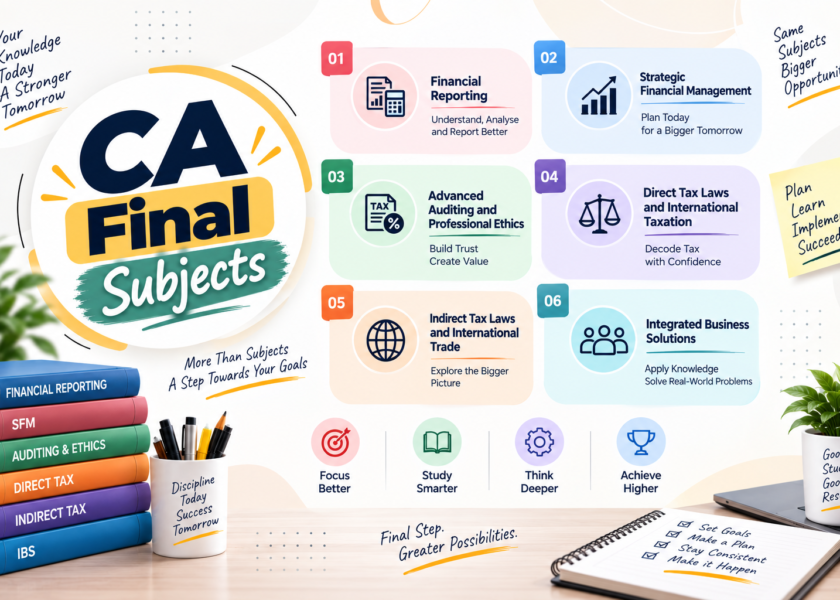
1. Financial Reporting
FR requires regular problem-solving.
During your 60-day preparation:
- Revise concepts and standards systematically.
- Practise important practical questions.
- Focus on adjustments and common question patterns.
- Revise formats and presentation.
- Solve questions under time pressure.
- Maintain a list of recurring mistakes.
Do not simply read solutions.
Try solving the question first and then compare your approach with the suggested solution.
2. Advanced Financial Management
AFM improves through practice.
Your preparation should include:
- Formula revision
- Concept clarity
- Daily numerical practice
- Repeated practice of difficult areas
- Timed question-solving
- Revision of mistakes
Create a compact formula sheet and revise it regularly.
ICAI’s current study material structure includes areas such as financial policy, risk management, capital budgeting, security valuation, portfolio management, derivatives, foreign exchange and business valuation, among others.
The important thing is not to memorise formulas blindly.
Understand when and why a formula is used.
3. Auditing
Audit requires a different preparation style.
Reading the same pages repeatedly does not automatically mean better retention.
Try this method:
Read → Understand → Identify keywords → Close the book → Recall → Write.
Pay attention to:
- Important concepts
- Standards on Auditing
- Professional terminology
- Important keywords
- Answer structure
- Case-based questions
During revision, practise writing answers instead of only reading them.
Your answer should demonstrate that you understand the requirement of the question.
4. Direct Tax
Tax preparation requires both conceptual clarity and repeated practice.
Focus on:
- Important provisions
- Computation-based questions
- Amendments applicable to your attempt
- Practical application
- Case-based questions
- Revision of frequently tested areas
Maintain a separate sheet for provisions, rates, limits and important changes applicable to your examination attempt.
Do not leave the entire tax revision for the final week.
5. Indirect Tax
For IDT, combine conceptual revision with question practice.
Give special attention to:
- Important concepts
- GST provisions
- Practical questions
- Case-based application
- Amendments
- Important exceptions
- Revision of mistakes
A short revision sheet can be extremely useful during the last few days.
6. Integrated Business Solutions
IBS requires more than simply remembering isolated points.
Try to understand the connection between:
- Business situations
- Concepts
- Case studies
- Strategic thinking
- Risk and governance
- Practical application
Practise case-based questions and learn how to structure your response logically.
The objective should be to demonstrate application rather than reproduce memorised paragraphs.
A Practical Daily Routine for 60 Days
You do not need to copy someone else’s exact routine.
Instead, create a routine that you can follow consistently.
A practical 9–10 hour focused-study structure could look like this:
| Time | Activity |
| 7:00–9:30 AM | Practical subject / difficult topic |
| 9:30–10:00 AM | Break |
| 10:00 AM–12:30 PM | Second subject |
| 12:30–1:30 PM | Lunch & rest |
| 1:30–3:30 PM | Theory/revision |
| 3:30–4:00 PM | Break |
| 4:00–6:00 PM | Question practice |
| 6:00–7:00 PM | Break/exercise |
| 7:00–9:00 PM | Revision + test practice |
| 9:00–9:30 PM | Error review + next-day planning |
The exact timings can change.
What matters is that your day contains revision, practice and recall, rather than eight or ten hours of passive reading.
Sample 7-Day Rotation
If you are preparing for both groups, you can rotate subjects to prevent fatigue.
| Day | Main Focus | Secondary Focus |
| Day 1 | FR | Audit |
| Day 2 | AFM | Tax |
| Day 3 | Audit | FR |
| Day 4 | Tax | AFM |
| Day 5 | IDT | IBS |
| Day 6 | FR/AFM Practice | Theory Revision |
| Day 7 | Mock Test | Test Analysis |
Repeat the pattern while adjusting the number of days according to your strengths and weaknesses.
If one subject is significantly weaker, give it additional slots instead of following a rigid timetable.
How Many Hours Should You Study for CA Final in 60 Days?
There is no magic number.
For most students, 8–10 effective hours can be more valuable than sitting for 14 hours while constantly checking the phone or taking long breaks.
During the final phase, some students may be able to handle more hours, but quality should remain the priority.
Your daily target should therefore be based on productive study hours, not simply desk time.
A good day should include:
- Concept revision
- Question solving
- Answer writing
- Short revision
- Error analysis
Mock Tests: The Most Important Part of the Last 30 Days
A common mistake is postponing mock tests because students feel they first need to “complete everything.”
That approach can hurt your performance.
You need to know how your preparation behaves under exam conditions.
After every mock test, analyse:
| Checkpoint | Question to Ask |
| Knowledge | Did I know the concept? |
| Recall | Could I remember it during the test? |
| Speed | Did I finish on time? |
| Accuracy | Were calculations correct? |
| Presentation | Was my answer structured properly? |
| Questions left | Why did I leave them? |
| Mistakes | What caused the error? |
A mock test without analysis is only half the exercise.
Maintain an Error Book throughout your 60 days.
Whenever you make an avoidable mistake, record it.
Before the examination, this notebook can become one of your most valuable revision resources.
The 3-Revision Rule for CA Final
A useful approach for the final 60 days is to avoid treating every revision as if it were your first reading.
Revision 1 – Detailed
Understand concepts and solve important questions.
Revision 2 – Faster
Use short notes, marked material and important questions.
Revision 3 – Rapid
Focus on formulas, keywords, provisions, adjustments, mistakes and high-priority topics.
This approach saves time because every subsequent revision becomes faster.
ICAI’s preparation guidance also stresses the importance of planning for multiple revisions rather than leaving everything to the end.
Common Mistakes to Avoid During the 60 Days
1. Changing Your Study Material
Do not keep moving from one source to another.
2. Watching Too Many Revision Lectures
A lecture is useful when it solves a genuine preparation problem. It should not replace self-study and question practice.
3. Ignoring Weak Subjects
Your timetable should give extra attention to your weaker areas.
4. Reading Without Testing Yourself
Close the book and recall what you studied.
5. Avoiding Writing Practice
CA Final is not just about knowing the answer. You must be able to present it within the available time.
6. Ignoring Amendments
Always verify the material applicable to your specific examination attempt.
7. Studying Until Exhaustion
Sleep and breaks are part of preparation.
8. Comparing Your Progress With Others
Someone else’s 12-hour timetable does not determine your result.
Your consistency does.
Final 10-Day CA Final Strategy
The last 10 days should be about confidence, not panic.
Avoid starting large new topics unless they are genuinely important and realistically manageable.
Focus on:
- Short notes
- Formula revision
- Important questions
- Mistake notebook
- Key provisions
- Audit keywords
- Tax amendments
- Important practical adjustments
- Case-based practice
- Selected mock analysis
Most importantly, keep your sleep cycle stable.
A tired student with ten extra hours of reading is not necessarily better prepared than a rested student who can recall and apply what they studied.
How CA Mentoring Program Can Help in Your CA Final Preparation
A structured preparation plan becomes more useful when you have the right academic guidance and a clear way to measure your progress.
If you are looking for structured CA preparation support, you can explore CA Mentoring Program for guidance and preparation resources.
The idea should be simple:
You study with a plan. You practise with purpose. You analyse your mistakes. Then you improve.
A mentor or structured preparation system can help you avoid wasting your limited preparation time on unnecessary resources and constantly changing strategies.
60 Days CA Final Study Plan: Quick Checklist
Before you start, save this checklist:
Days 1–15
- First revision
- Identify weak areas
- Start error notebook
- Begin question practice
Days 16–30
- Complete major revision
- Practise important questions
- Start timed writing
- Revise weak chapters
Days 31–45
- Second revision
- Regular tests
- Answer writing
- Mock-test analysis
Days 46–60
- Rapid revision
- Full-length mocks
- Formula/keyword revision
- Mistake correction
- Final exam strategy
Final Thoughts
The last 60 days before CA Final can feel stressful, but they can also become the most productive part of your preparation.
You do not need a perfect timetable.
You need a timetable that you can actually follow.
Do not spend these 60 days trying to study everything again from the beginning. Use them to revise intelligently, practise consistently and eliminate repeated mistakes.
Remember:
First revision builds familiarity.
Second revision builds confidence.
Question practice builds application.
Mock tests build exam temperament.
Final revision builds recall.
If you stay consistent for these 60 days and keep measuring your preparation honestly, you can make a significant difference to your CA Final performance.
The goal is not to study more simply for the sake of studying more.
The goal is to turn the knowledge you already have into marks on the answer sheet.