CA Final Chapter Wise Weightage Nov 2026: Subject-Wise Marks, Important Chapters & Preparation Strategy
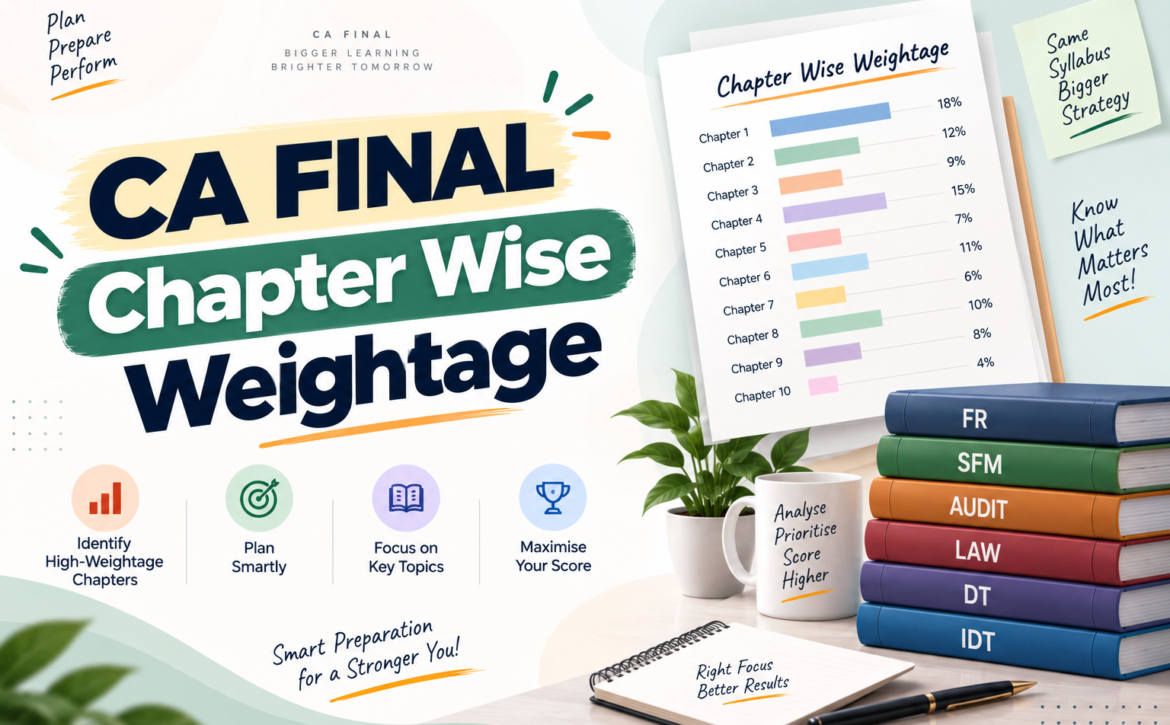
CA Final Chapter Wise Weightage Nov 2026
Preparing for the CA Final November 2026 examination is not simply about completing the syllabus once. At the Final level, the syllabus is extensive, questions are application-oriented, and students have to balance conceptual understanding with revision and exam practice.
One question that naturally comes to every CA Final student is:
“Which chapters should I study first, and how much weightage can I expect from each topic?”
This is where chapter-wise and section-wise weightage becomes useful.
However, there is an important point students should understand before using any weightage table: ICAI does not guarantee fixed marks for individual chapters in the CA Final paper. ICAI provides section-wise weightage ranges for the syllabus, while chapter-level priorities are generally derived from the syllabus structure, previous examination trends, RTPs, MTPs and repeated areas of testing.
Therefore, the weightage given in this article should be treated as a study-priority guide, not a prediction of the November 2026 question paper.
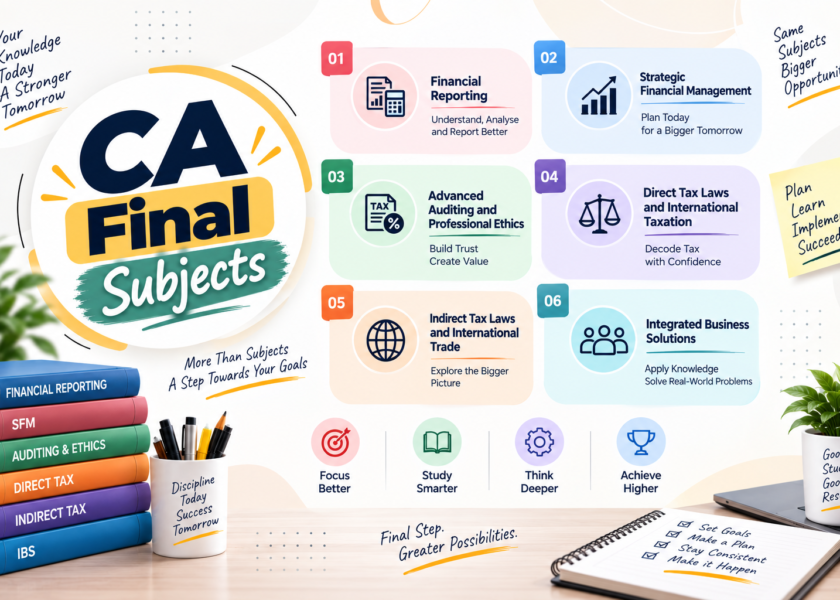
The CA Final New Scheme currently consists of six papers:
| Paper | Subject | Marks | Group |
| Paper 1 | Financial Reporting | 100 | Group 1 |
| Paper 2 | Advanced Financial Management | 100 | Group 1 |
| Paper 3 | Advanced Auditing, Assurance & Professional Ethics | 100 | Group 1 |
| Paper 4 | Direct Tax Laws & International Taxation | 100 | Group 2 |
| Paper 5 | Indirect Tax Laws | 100 | Group 2 |
| Paper 6 | Integrated Business Solutions | 100 | Group 2 |
ICAI’s current examination resources confirm these six papers under the New Scheme.
Is CA Final Chapter Wise Weightage Nov 2026 Official?
This is probably the most important clarification for students.
There is no fixed official chapter-wise marks guarantee from ICAI.
For example, if a website says:
“Chapter X will definitely carry 15 marks in CA Final Nov 2026”
you should not treat that statement as an ICAI prediction.
ICAI’s framework provides section-wise weightage ranges, while actual marks can move from one chapter or area to another depending on the paper.
That is why the best approach is to combine:
- ICAI’s prescribed section-wise weightage
- Previous CA Final question papers
- RTPs
- MTPs
- ICAI study material
- Amendments and applicable updates
- Recent examination trends
- Your own strengths and weaknesses
ICAI itself encourages students to use the specified weightages to allocate study time efficiently rather than treating weightage as a substitute for complete preparation.
CA Final Paper 1: Financial Reporting Weightage Nov 2026
Financial Reporting is one of the most concept-intensive papers in CA Final. Instead of trying to memorize every Ind AS independently, students should understand how different standards interact with financial statements.
Indicative Section-Wise Weightage
| Area | Indicative Weightage | Priority |
| Financial Reporting Framework & Conceptual Framework | 10–15% | High |
| Ind AS 115 – Revenue | 5–10% | High |
| Assets & Liabilities | 15–25% | Very High |
| Presentation & Disclosure-related Ind AS | 15–20% | High |
| Financial Instruments | 10–15% | Very High |
| Group Accounting & Consolidation | 10–20% | Very High |
| Other reporting areas | Balance | Medium |
The exact paper can vary within these ranges.
High-Priority FR Chapters
Students should give special attention to:
- Conceptual Framework
- Ind AS 1, 7 and 34
- Ind AS 115
- Ind AS 2
- Ind AS 16
- Ind AS 23
- Ind AS 36
- Ind AS 38
- Ind AS 40
- Ind AS 105
- Ind AS 116
- Ind AS 19
- Ind AS 37
- Financial Instruments
- Ind AS 32, 109 and 107
- Consolidation
- Business Combinations
- Analysis of Financial Statements
- Share-Based Payments
Recent chapter-trend analyses also place assets, financial instruments, consolidation and financial statement analysis among the areas deserving particularly strong preparation.
FR Preparation Tip
Do not prepare FR by reading standards repeatedly without solving questions.
A better sequence is:
Concept → ICAI illustration → Past question → RTP/MTP → Timed practice.
CA Final Paper 2: Advanced Financial Management Weightage Nov 2026
AFM rewards students who can apply financial concepts to numerical situations.
Some students make the mistake of preparing only the chapters they find easy. That can become risky because ICAI can combine concepts in a single question.
High-Priority AFM Areas
| Topic | Priority |
| Financial Policy & Corporate Strategy | Medium |
| Risk Management | High |
| Security Analysis | High |
| Security Valuation | Very High |
| Portfolio Management | Very High |
| Mutual Funds | High |
| International Financial Management | High |
| Foreign Exchange & Risk Management | Very High |
| Interest Rate Risk Management | High |
| Derivatives Analysis & Valuation | Very High |
| Corporate Valuation | Very High |
| Mergers, Acquisitions & Corporate Restructuring | Very High |
| Startup Finance | Medium |
| Securitization | Medium |
Recent trend-based analyses consistently identify foreign exchange, security valuation, mergers and acquisitions, derivatives and portfolio management as important preparation areas.
How to Prepare AFM
AFM is not a subject where simply watching lectures guarantees marks.
After completing a concept, solve enough questions to become comfortable with:
- Formula selection
- Calculation speed
- Interpretation
- Presentation
- Working notes
- Calculator usage
- Time management
Maintain a formula and mistake notebook. Before every revision, revise the mistakes rather than rereading the entire chapter.
CA Final Paper 3: Advanced Auditing, Assurance & Professional Ethics
Audit can become a high-scoring paper when preparation is structured correctly.
The biggest mistake students make is treating Audit as a purely theoretical subject and trying to memorize every line.
Instead, focus on concept + keywords + application + answer presentation.
Important Audit Areas for Nov 2026
| Area | Priority |
| Quality Control & Engagement Standards | Very High |
| Professional Ethics | Very High |
| Audit Planning, Strategy & Execution | Medium |
| Risk Assessment & Internal Control | High |
| Audit in Automated Environment | High |
| Audit Reports | High |
| Company Audit | High |
| Audit Committee & Corporate Governance | High |
| Consolidated Financial Statements Audit | High |
| Audit of Banks | Very High |
| Audit of Insurance Companies | High |
| Audit of PSU | High |
| Internal Audit | Medium |
| Due Diligence, Investigation & Forensic Audit | High |
| ESG / Sustainability Assurance | High |
| Professional Ethics | Very High |
Recent CA Final Audit analyses identify Quality Control/Engagement Standards and Professional Ethics as particularly important areas, with company audit, governance, fiscal-law audit, forensic audit and sector-specific audits also requiring serious attention.
Audit Answer-Writing Strategy
For every major question, train yourself to write:
Provision → Explanation → Application → Conclusion
Use appropriate technical terms from ICAI study material.
Do not fill pages just to increase the length of your answer. In CA Final Audit, relevant points and proper presentation matter more than unnecessary repetition.
CA Final Paper 4: Direct Tax Laws & International Taxation
Direct Tax is one of the papers where understanding the overall structure of the syllabus makes preparation significantly easier.
For November 2026, the broad official section-wise structure is particularly useful.
| Section | Area | Indicative Weightage |
| Section I | Computation of Tax Liability | 40–45% |
| Section II | Tax Administration | 20–30% |
| Section III | International Taxation | 30–35% |
These ranges mean that Computation of Tax Liability and International Taxation together can account for a substantial portion of the paper, making both areas important for serious preparation.
Important Direct Tax Topics
Computation of Tax Liability
Focus strongly on:
- Computation of total income
- Heads of income
- Set-off and carry-forward of losses
- Deductions
- Special provisions for companies
- Tax planning
- Charitable and religious trusts
- Political parties
- Business trusts
- GAAR
- Taxation of digital transactions
Tax Administration
Give attention to:
- TDS and TCS
- Assessment procedures
- Income-tax authorities
- Appeals and revision
- Dispute resolution
- Penalties
- Offences and prosecution
- Tax audit
- Undisclosed income
International Taxation
Important areas include:
- Transfer Pricing
- Non-resident taxation
- Double Taxation Relief
- Tax treaties
- OECD Model Convention
- UN Model Convention
- BEPS
- Treaty interpretation
- Advance Rulings
DT Preparation Tip
Do not postpone amendments until the last few days.
For tax papers, the applicable statutory amendments, notifications, circulars and examination-specific material should be checked carefully before the examination.
CA Final Paper 5: Indirect Tax Laws Weightage Nov 2026
Indirect Tax Laws covers two major areas:
- GST
- Customs & Foreign Trade Policy
The GST portion requires a strong understanding of both substantive and procedural provisions.
High-Priority GST Areas
| GST Area | Priority |
| Supply | Very High |
| Charge of GST & Reverse Charge | Very High |
| Exemptions | High |
| Place of Supply | Very High |
| Time of Supply | High |
| Value of Supply | Very High |
| Input Tax Credit | Very High |
| Computation of GST Liability | Very High |
| Registration | Medium |
| Tax Invoice & Documentation | Medium |
| Returns & Payment | High |
| Refund | High |
| Assessment & Audit | High |
| Demand & Recovery | High |
| Appeals | High |
| Offences & Penalties | High |
ICAI’s own study guidance emphasizes beginning GST preparation with substantive provisions such as supply, charge, classification, exemptions, place/time/value of supply and input tax credit before moving into procedural and enforcement provisions.
Customs & FTP
Students should particularly focus on:
- Levy and exemptions
- Classification
- Valuation
- Types of customs duties
- Import and export procedures
- Warehousing
- Refund
- Foreign Trade Policy
- Export promotion schemes
IDT Strategy
Keep the Bare Act and relevant rules accessible while studying.
After completing each major topic, solve practical questions instead of only reading provisions.
CA Final Paper 6: Integrated Business Solutions
IBS is different from the traditional CA Final papers.
It is an open-book, case-study-based paper designed to test multidisciplinary application rather than isolated chapter memory.
ICAI has specified that Paper 6 is assessed through five case studies of 25 marks each, of which students attempt four. The assessment comprises 40% MCQs and 60% descriptive questions within the case studies, and the examination duration is four hours.
Major IBS Knowledge Areas
IBS can integrate knowledge from:
- Financial Reporting
- Advanced Financial Management
- Audit
- Direct Tax
- Indirect Tax
- Corporate and Economic Laws
- Strategic Cost and Performance Management
- Strategic Management
How to Prepare IBS
The biggest mistake would be to leave IBS entirely for the last week.
Instead:
- Understand the case-study format.
- Practice identifying the issue.
- Identify which subject concepts are involved.
- Read the facts carefully.
- Apply the relevant provisions.
- Practice answering under time pressure.
The goal is not merely to “find the answer in the book.”
The real skill is knowing where to look, what to apply and how to present the conclusion.
CA Final Nov 2026: Overall Chapter Priority
If you want a quick revision framework, use the following classification.
| Priority | What It Means | Study Approach |
| A – Very High | Frequently tested / conceptually important | Complete + revise + multiple questions |
| B – High | Strong scoring potential | Complete + practice |
| C – Medium | Can contribute marks | Complete once + revise |
| D – Lower Priority | Smaller/less predictable areas | Do not completely skip; revise selectively |
A student preparing for November 2026 should not interpret “lower priority” as “skip this chapter.”
CA Final is unpredictable enough that selective study can backfire.
How to Use CA Final Chapter Wise Weightage Correctly
Weightage should answer one question:
“Where should I spend more of my limited preparation time?”
It should not answer:
“Which chapters can I leave?”
Suppose you have 10 hours available for FR.
Instead of spending 1 hour on every chapter, you can allocate additional time to areas such as financial instruments, assets, consolidation and business combinations while still covering the remaining syllabus.
The same principle applies to Audit, AFM, DT and IDT.
A Practical 3-Level Preparation Model
Level 1 – Coverage
Complete the entire syllabus at least once.
Level 2 – Priority Revision
Spend additional time on high-priority areas identified through official weightage and past-paper analysis.
Level 3 – Exam Simulation
Solve RTPs, MTPs and previous papers under actual time constraints.
This three-step system is much safer than trying to predict the exact questions.
CA Final Nov 2026 Preparation Strategy for the Last Few Weeks
If you are approaching the November 2026 examination with limited time, follow this approach.
Step 1: Finish the Remaining Syllabus
Do not wait for “perfect preparation.”
Complete pending chapters quickly and move into revision.
Step 2: Build a Priority List
Mark every chapter as:
- Strong
- Average
- Weak
Then combine this with weightage.
Your first revision should focus on high-weightage + weak areas.
Step 3: Solve ICAI Material
Do not rely only on coaching notes.
ICAI study material, RTPs, MTPs and previous examination papers should form the core of your final revision.
ICAI’s Board of Studies provides study material, revision test papers, mock tests, lectures and other examination resources through its student resources.
Step 4: Practice Full-Length Papers
At least several full papers should be attempted before the examination.
This helps identify:
- Slow calculation speed
- Poor answer presentation
- Lack of revision
- Weak chapters
- Time-management problems
Step 5: Track Your Mistakes
After every mock test, maintain a simple table:
| Mistake | Reason | Solution |
| Concept error | Concept unclear | Revise theory |
| Calculation error | Carelessness | Slow down |
| Forgot provision | Poor revision | Add to revision list |
| Time shortage | Poor planning | Practice timed papers |
| Presentation issue | Lack of answer practice | Improve format |
This small habit can make your final revision much more effective.
Why You Should Not Rely Only on Weightage
Imagine a student studies only the “top 5 chapters” and ignores everything else.
What happens if ICAI changes the distribution of questions?
That student immediately loses flexibility.
A much stronger strategy is:
100% syllabus coverage + weightage-based priority + repeated practice.
This is especially important because CA Final questions are increasingly designed to test application, analysis and integration, rather than straightforward recall.
The May 2026 result also demonstrates how demanding the Final examination remains: ICAI reported a 12% pass rate for Group I, 20.49% for Group II and 14.07% for candidates appearing for both groups.
The takeaway is simple: there is no safe shortcut based only on predicted weightage.
CA Final Chapter Wise Weightage Nov 2026: Quick Revision Table
| Paper | Highest-Priority Areas |
| Financial Reporting | Assets, Financial Instruments, Consolidation, Business Combinations, Analysis of FS |
| Advanced Financial Management | Forex, Security Valuation, Derivatives, Portfolio, M&A, Corporate Valuation |
| Advanced Audit | Quality Control, Professional Ethics, Reporting, Company Audit, Bank Audit, Forensic Audit |
| Direct Tax | Computation, Tax Administration, Transfer Pricing, International Taxation, DTAA |
| Indirect Tax | Supply, ITC, Valuation, Place of Supply, GST Liability, Customs |
| Integrated Business Solutions | Multidisciplinary Case Studies, Strategic Management, Integrated application |
Remember: these are preparation priorities, not guaranteed marks.
Final Words for CA Final Students
The November 2026 CA Final attempt should not be approached with a “guess the paper” mindset.
Weightage can help you decide where to spend more time, but concept clarity, complete syllabus coverage, ICAI material, amendments, question practice and revision are what ultimately build exam readiness.
If you are preparing with limited time, do not panic after seeing the size of the syllabus. Break it into manageable targets.
Finish one topic.
Solve questions.
Revise it.
Move to the next.
And when you return for your second and third revisions, the syllabus will feel much smaller than it did at the beginning.
For additional guidance, study planning and CA preparation support, students can explore CA Mentoring Program.
The goal should not be to predict exactly what ICAI will ask in November 2026.
The goal should be to become prepared enough that whatever ICAI asks from the syllabus, you can attempt it confidently.