CA Course Details After 12th: Eligibility, Subjects, Fees, Duration and Career Scope

Choosing a professional course after Class 12 can feel like a big decision. You may be comparing different qualifications, thinking about future earning opportunities or trying to understand which career will suit your interests.
If accounting, taxation, business and finance interest you, the Chartered Accountancy (CA) course is worth exploring.
In India, the CA profession is regulated by the Institute of Chartered Accountants of India (ICAI). The course develops knowledge in accounting, auditing, taxation, financial management, business law and other areas that are important for organisations and financial decision-making.
However, becoming a Chartered Accountant requires more than clearing examinations. Students must complete the prescribed practical training and other course requirements, develop professional skills and remain committed throughout the journey.
This guide explains CA course details after 12th, including eligibility, registration, subjects, fees, duration, examinations, preparation strategies and career opportunities, so you can make an informed decision before starting.
What Is the CA Course?
The Chartered Accountancy course is a professional qualification designed to prepare students for careers in accounting, auditing, taxation, financial management and related fields.
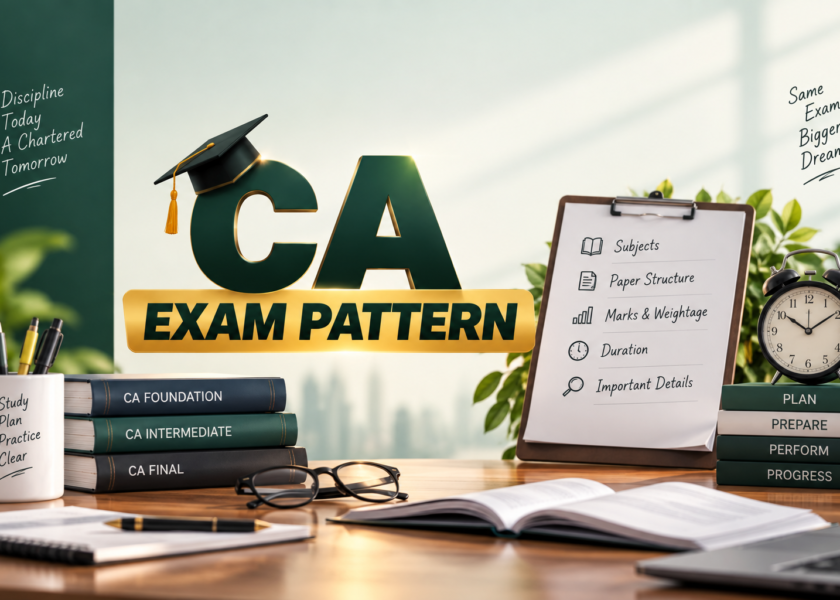
ICAI administers the course through a structured education and training framework. Under the scheme introduced on 1 July 2023, the course has three main examination levels:
- CA Foundation
- CA Intermediate
- CA Final
Students must also fulfil the applicable practical training, information technology and soft skills training, self-paced online module and other requirements.
A CA qualification can lead to opportunities in professional services firms, corporate finance departments, consulting organisations, financial institutions and independent practice, subject to applicable professional rules.
The course is open to students from different academic streams. You do not have to be a commerce student in Class 12 to pursue CA, although a commerce background can make some introductory accounting and business concepts more familiar.
CA Course Eligibility After 12th
Students who have appeared for their Class 12 examinations can pursue the CA Foundation route, subject to ICAI’s prescribed conditions.
An important feature of the course is that students may provisionally register for CA Foundation after passing Class 10. This allows them to begin planning their preparation while studying in Classes 11 and 12.
Eligibility criteria
| Requirement | Details |
| Class 10 | Students can register provisionally for CA Foundation after passing Class 10 |
| Class 12 | Candidates must satisfy the applicable Class 12 examination requirements before appearing for Foundation |
| Academic stream | Commerce, Science and Arts students can pursue CA |
| Minimum Class 12 percentage | There is no separate general minimum percentage requirement for CA Foundation registration, but the prescribed examination eligibility conditions apply |
| Foundation study period | At least four months of registration-based study period before the eligible examination |
| Registration authority | Institute of Chartered Accountants of India (ICAI) |
The Foundation route does not require students to obtain a specific Class 12 percentage merely to enter the course. However, candidates must satisfy ICAI’s requirements concerning registration, appearing for the Class 12 examination and examination eligibility.
Official reference: ICAI — CA Foundation registration information.
Can Science students pursue CA?
Yes. Students from Science and Arts backgrounds can pursue CA after Class 12.
If you have studied Mathematics, Physics, Chemistry or other non-commerce subjects, you may need additional time to become comfortable with accounting and business concepts. That does not mean you cannot succeed.
Start with the prescribed syllabus, identify unfamiliar concepts early and build your understanding gradually.
CA Foundation Subjects After 12th
CA Foundation is the entry-level examination. It introduces students to important concepts in accounting, business law, quantitative methods and economics.
Under the scheme introduced in 2023, Foundation includes four papers.
| Paper | Subject | Main areas |
| Paper 1 | Accounting | Accounting principles, transactions and financial statements |
| Paper 2 | Business Laws | Legal concepts relevant to business |
| Paper 3 | Quantitative Aptitude | Business mathematics, logical reasoning and statistics |
| Paper 4 | Business Economics | Economic concepts and their business applications |
Refer to ICAI’s current syllabus and study material for the exact coverage of each paper.
Is CA Foundation difficult?
The difficulty depends on your academic background, preparation and understanding of the subjects.
Students who are comfortable with accounting may find some topics familiar. Others may need more time to understand the basics.
A common mistake is to rely only on reading. Foundation preparation should include concept learning, question practice, revision and timed mock tests.
Try to understand why an answer is correct rather than memorising every solution. This approach can also help when you move to the more advanced levels.
CA Intermediate Subjects
After passing Foundation, students can register for CA Intermediate. Under ICAI’s current scheme, Intermediate has six papers.
| Paper | Subject |
| Paper 1 | Advanced Accounting |
| Paper 2 | Corporate and Other Laws |
| Paper 3 | Taxation |
| Paper 4 | Cost and Management Accounting |
| Paper 5 | Auditing and Ethics |
| Paper 6 | Financial Management and Strategic Management |
Intermediate involves more detailed technical study than Foundation. Students need to develop strong conceptual understanding and practise applying accounting, legal and financial principles to questions.
You should plan revision well in advance because the syllabus includes different types of subjects and requires both conceptual clarity and examination practice.
CA Final Course Details
CA Final is the advanced examination stage of the qualification. It builds on the technical knowledge developed during Foundation and Intermediate and tests the candidate’s understanding of professional subjects.
Under the scheme introduced in 2023, CA Final includes six papers.
| Paper | Subject |
| Paper 1 | Financial Reporting |
| Paper 2 | Advanced Financial Management |
| Paper 3 | Advanced Auditing, Assurance and Professional Ethics |
| Paper 4 | Direct Tax Laws and International Taxation |
| Paper 5 | Indirect Tax Laws |
| Paper 6 | Integrated Business Solutions |
Students must also satisfy the prescribed training, self-paced online module and examination eligibility requirements.
CA Final preparation requires a disciplined approach. Candidates should focus on understanding the concepts, solving questions, practising case-based applications and keeping their knowledge aligned with the syllabus applicable to their examination attempt.
CA Course Fees After 12th
Fees are an important consideration when selecting a professional qualification. Your total expenditure may include ICAI registration and examination fees, optional coaching, books, mock tests, travel and other personal costs.
ICAI’s published course FAQs list the Foundation registration fee as ₹9,000 under the referenced scheme information. However, students should verify the latest fee schedule before paying because official charges and instructions may be revised.
Expenses to consider
| Expense | What to check |
| CA Foundation registration | Current ICAI registration fee |
| CA Intermediate registration | Official registration fee for the applicable course |
| CA Final registration | Current fee and eligibility requirements |
| Examination forms | Fees for the relevant examination and groups |
| Coaching classes | Subject coverage, teaching quality and doubt support |
| Books and mock tests | Official study material and any additional resources |
| Practical training | Travel or other expenses associated with training |
Visit the ICAI official website and its student services portal for the latest registration and examination fees.
Is coaching compulsory for CA?
Coaching is not a universal requirement for registering for the CA course. Students can use ICAI’s study materials and available learning resources to prepare independently.
Some students prefer classes because they benefit from structured lectures, regular tests and doubt-solving support. Others study independently or combine self-study with selected classes.
Choose the approach that suits your learning style, budget and schedule rather than assuming that one method works for everyone.
How Long Does It Take to Become a CA After 12th?
The total duration depends on when you register, how quickly you pass the examinations and whether you complete every training requirement on schedule.
The Foundation stage requires a minimum four-month study period before an eligible examination. Intermediate has its own prescribed study and examination requirements. Under the newer scheme, practical training generally lasts two years.
Indicative timeline
| Stage | Duration or planning requirement |
| CA Foundation | Minimum four-month study period before an eligible examination |
| CA Intermediate | Prescribed study period and examination preparation |
| Practical training | Two years under the applicable scheme |
| CA Final | Preparation and completion of examination eligibility |
| Overall course | Often around 4.5–5 years or longer, depending on progress |
The overall timeline is an estimate, not a guarantee. Examination results, registration dates and the completion of training and other requirements can affect your qualification date.
Students should avoid comparing their progress too closely with others. A realistic plan, consistent preparation and early identification of weak subjects are more useful than trying to finish the course according to someone else’s timeline.
CA Exams and Preparation Strategy
ICAI has scheduled Foundation and Intermediate examinations three times a year under its examination framework, while CA Final has historically been conducted twice a year under the relevant schedule. Always verify the latest examination calendar and cut-off dates before registering for a particular attempt.
A structured study plan can help you use your available time more effectively.
Understand the syllabus first
Download the relevant syllabus and study material from ICAI. Make a subject-wise plan and identify the topics that require the most attention.
Study consistently
A manageable daily routine is more sustainable than studying for long hours only when an examination is approaching.
Set weekly targets, revise previously studied topics and reserve time for question practice.
Practise previous questions and mock tests
Timed practice helps you improve speed, answer presentation and time management. Review your mistakes after every test and identify the concepts that need further work.
Focus on revision
Do not leave revision until the final few days. Revisit important concepts regularly and practise the questions that you previously found difficult.
Seek guidance when needed
If you are struggling to maintain consistency or understand particular subjects, consider speaking with a teacher or mentor.
The CA Mentoring Program is one resource students can explore for preparation guidance. Review its available services to decide whether they match your needs. Mentoring can provide structure and support, but it cannot guarantee examination success.
Career Opportunities After Becoming a CA
A CA qualification can provide access to a variety of professional roles. The best option depends on your interests, practical experience, technical skills and career goals.
| Career option | Typical responsibilities |
| Audit and assurance | Reviewing financial statements and controls |
| Taxation | Tax compliance, planning and advisory |
| Corporate finance | Financial planning and business decisions |
| Financial planning and analysis | Budgeting, forecasting and performance analysis |
| Risk management | Assessing financial and operational risks |
| Consulting | Supporting business and financial decisions |
| Banking and financial services | Finance, compliance and risk-related roles |
| Independent practice | Providing eligible professional services to clients |
| Finance leadership | Managing reporting, controls and financial strategy |
What salary can a CA earn?
Salary varies by employer, role, location, experience and specialisation. Newly qualified CAs may encounter packages in a broad range, while experienced professionals in specialised or leadership positions may earn considerably more.
It is better to evaluate career growth, learning opportunities and the responsibilities attached to a role instead of focusing only on the first salary package.
Is CA the Right Career Choice After 12th?
CA can be a strong option for students who enjoy accounting, business, finance, taxation or analytical work.
Before enrolling, ask yourself whether you are comfortable with a long-term study commitment, regular revision and challenging examinations.
Also consider your financial circumstances, available study time and alternative career interests. Speak to qualified professionals or current CA students if you need a clearer picture of the journey.
You do not have to know every detail of your future career on the day you register. However, understanding the course structure and requirements can help you begin with realistic expectations.
Conclusion
The CA course after 12th offers students a structured path towards a professional career in accounting, auditing, taxation and finance.
The journey begins with Foundation and continues through Intermediate, practical training and Final, along with other prescribed requirements. Students from Commerce, Science and Arts backgrounds can pursue the qualification if they satisfy ICAI’s eligibility conditions.
Before registering, check the official syllabus, fee schedule and examination calendar. Then build a preparation plan that fits your routine, allows enough time for revision and includes regular practice.
CA is a demanding qualification, but approaching it with realistic expectations, consistency and the right learning resources can make the journey more manageable.
If you need additional preparation support, explore the CA Mentoring Program and assess whether its guidance suits your learning needs.