CA Final Advanced Auditing, Assurance and Professional Ethics Notes: Complete Guide for Exam Preparation
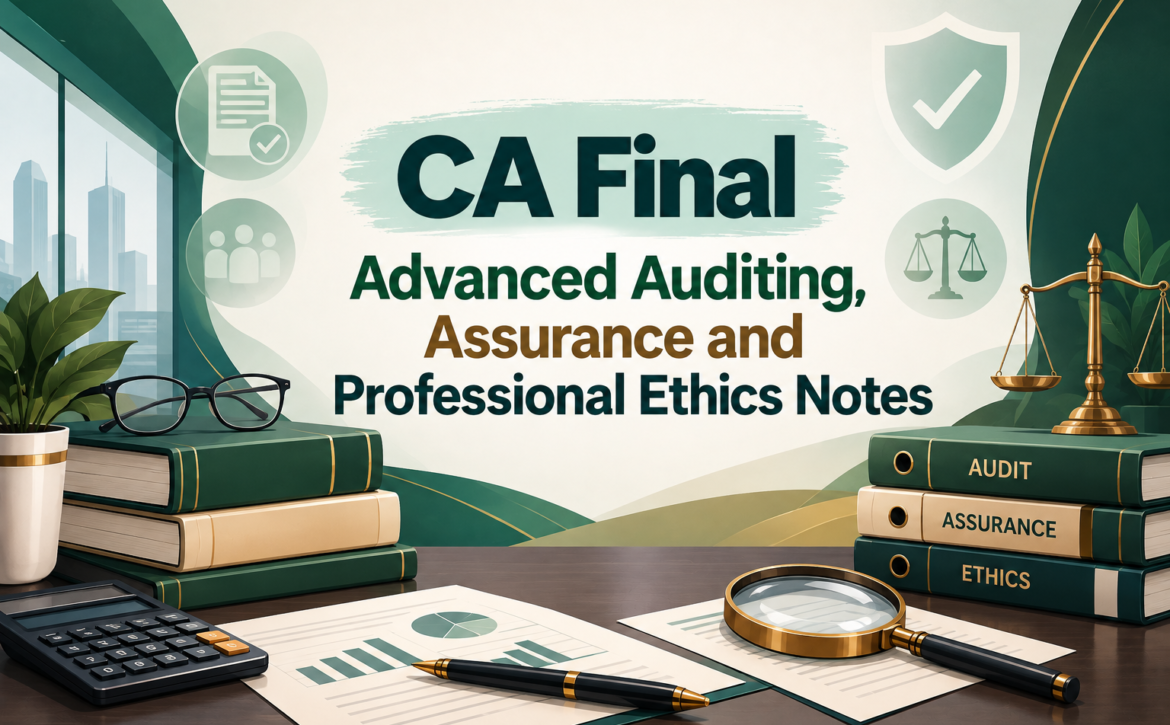
CA Final Advanced Auditing, Assurance and Professional Ethics Notes
Advanced Auditing, Assurance and Professional Ethics is one of the core papers of CA Final Paper 3. It is not a subject that can be handled effectively by simply reading the chapters once and trying to remember everything before the examination.
The subject has concepts, auditing requirements, professional responsibilities, reporting aspects, specialised audits, case-based situations and professional ethics. That is why good notes can make a real difference during revision.
For students preparing for CA Final, the purpose of notes should not be to replace the ICAI Study Material. Instead, notes should make the study material easier to revise, help you identify important concepts and improve the way you present answers in the examination.
The current ICAI Paper 3 structure covers three modules and 19 chapters, beginning with Quality Control and general auditing principles and moving through audit planning, evidence, reporting, specialised areas, digital auditing, group audits, bank and NBFC audits, PSU audit, internal audit, forensic accounting, ESG assurance and professional ethics.
Students can also refer to the resources available on the official ICAI website and the Board of Studies portal while preparing their own revision notes.
Why Are CA Final Audit Notes Important?
A common problem with Audit preparation is that students spend a lot of time reading but comparatively less time revising.
Suppose you have studied a chapter two months ago. When you open it again before the examination, you may remember the broad concept but forget the specific requirements, keywords, exceptions or reporting points.
This is where well-prepared notes become useful.
Good CA Final Audit notes should help you quickly revise:
- The meaning and objective of a concept
- Important auditing requirements
- Relevant standards and principles
- Auditor’s responsibilities
- Key procedures
- Reporting requirements
- Important exceptions
- Professional and ethical considerations
- Practical application
- Keywords required in examination answers
The best approach is to create notes that are shorter than the original study material but detailed enough to retain the logic of the topic.
CA Final Advanced Auditing, Assurance and Professional Ethics Syllabus
For the current Paper 3 structure, ICAI divides the subject into three modules.
| Module | Major Areas Covered |
| Module 1 | Quality Control, General Auditing Principles, Audit Planning, Risk Assessment, Internal Control, Audit Evidence, Completion, Review and Reporting |
| Module 2 | Specialised Areas, Related Services, Review of Financial Information, Prospective Financial Information, Digital Auditing & Assurance, Group Audits, Banks and NBFCs |
| Module 3 | Public Sector Undertakings, Internal Audit, Due Diligence, Investigation, Forensic Accounting, SDG & ESG Assurance, Professional Ethics and Auditor Liabilities |
ICAI’s current study material specifically lists Chapters 1 to 19 across these three modules.
This structure is important because students sometimes prepare Audit as one huge theoretical subject. A chapter-wise approach makes preparation much more manageable.
Module 1: Build Your Audit Foundation
Module 1 develops the core understanding required for the subject.
Chapter 1: Quality Control
Quality control is important because audit quality does not depend only on the final audit report. It also involves the systems, policies and procedures followed during the engagement.
While making notes, focus on:
- Quality management concepts
- Engagement-related responsibilities
- Leadership responsibilities
- Ethical requirements
- Acceptance and continuance
- Resources
- Documentation
- Monitoring and review
Create separate headings for requirement, responsibility and implementation wherever applicable.
Chapter 2: General Auditing Principles and Auditor’s Responsibilities
This chapter forms an important conceptual base.
Your notes should clearly distinguish between:
Principle → Auditor’s responsibility → Practical application
Do not try to memorise every sentence. Understand what the auditor is expected to do and why.
Chapter 3: Audit Planning, Strategy and Execution
Planning is not merely about preparing an audit programme.
Your revision notes should cover:
- Audit strategy
- Audit plan
- Nature, timing and extent
- Direction and supervision
- Documentation
- Changes during the audit
- Overall audit approach
A comparison table between audit strategy and audit plan can be particularly useful for quick revision.
Chapter 4: Materiality, Risk Assessment and Internal Control
This is an area where conceptual clarity matters.
While preparing notes, connect:
Materiality → Risk → Internal Control → Audit Response
Instead of studying these concepts independently, understand how one affects the other.
Chapter 5: Audit Evidence
Audit evidence becomes easier when you understand the purpose behind obtaining evidence.
Your notes should include:
- Sufficiency
- Appropriateness
- Reliability
- Sources of evidence
- Audit procedures
- External confirmations
- Analytical procedures
- Relevant documentation
Chapter 6: Completion and Review
At the completion stage, the auditor evaluates whether the audit has been properly completed and whether sufficient appropriate evidence has been obtained.
Make short revision points for:
- Completion procedures
- Review procedures
- Subsequent events
- Going concern
- Final analytical review
- Audit documentation
Chapter 7: Reporting
Audit reporting deserves focused preparation because students need to understand both the reporting structure and the circumstances affecting the report.
Your notes should contain clear distinctions between different reporting situations rather than long paragraphs.
Module 2: Specialised Audits and Modern Assurance
Module 2 moves from basic audit concepts to specialised and increasingly practical areas.
The current ICAI structure includes specialised areas, related services, review engagements, prospective financial information, digital auditing and assurance, group audits, and special features of audits of banks and NBFCs.
Digital Auditing and Assurance
This is particularly relevant in an environment where businesses increasingly rely on technology and automated systems.
When revising this portion, don’t just memorise terminology. Understand how technology can affect:
- Audit evidence
- Internal controls
- Data processing
- Risk assessment
- Audit procedures
- Documentation
- Use of automated tools
Group Audits
Group audits require a clear understanding of the relationship between the group auditor and component auditors.
Create a one-page chart covering:
Group Auditor → Component Auditor → Component → Consolidated Financial Statements
This can make revision considerably faster.
Audit of Banks and NBFCs
Students should prepare these chapters separately because sector-specific audits involve their own features, risks and procedures.
For quick revision, use tables rather than writing the entire chapter again.
Module 3: PSU, Internal Audit, Forensic Accounting, ESG and Ethics
Module 3 contains several areas that students should not leave for the last few days.
The current ICAI syllabus includes PSU audit, internal audit, due diligence, investigation and forensic accounting, SDG/ESG assurance, and professional ethics and liabilities of auditors.
Public Sector Undertakings
Prepare the chapter with emphasis on the distinctive features of PSU audits and the role of the relevant authorities.
Internal Audit
For internal audit, understand the difference between internal audit and statutory audit.
| Basis | Internal Audit | Statutory Audit |
| Primary focus | Internal processes, controls and improvement | Independent audit and reporting |
| Nature | Internal assurance function | Statutory requirement where applicable |
| Main users | Management and those charged with governance | Members/stakeholders and other prescribed users |
| Approach | Risk, control and operational perspective | Financial reporting and applicable auditing requirements |
The table should be used for revision, while detailed requirements should be studied from the applicable ICAI material.
Due Diligence, Investigation and Forensic Accounting
These topics become easier when you understand their practical purpose.
Think of them through questions:
What happened?
Why did it happen?
What evidence exists?
What financial or legal implications may arise?
This approach helps you remember the difference between investigation, due diligence and forensic work.
Professional Ethics: A Section You Should Not Ignore
Professional Ethics is an essential part of Paper 3.
Students sometimes postpone it because they believe it can be memorised at the end. That approach can make revision stressful.
Professional ethics should instead be revised regularly.
A useful method is:
Situation → Relevant requirement → Ethical issue → Auditor’s responsibility → Conclusion
The ICAI Ethical Standards Board has published the 2026 Code of Ethics in three volumes. ICAI announced that the revised 13th edition is applicable from April 1, 2026, subject to the specific effective-date clarification mentioned in the announcement.
Therefore, students appearing under the applicable 2026 syllabus should make sure that their professional ethics notes are updated instead of relying blindly on older notes.
Official ICAI Code of Ethics Resources
Students can refer to the latest official resources:
- ICAI Revised Code of Ethics – 13th Edition Announcement
- Code of Ethics 2026 – Ethical Standards Board
Always check the applicability for your particular examination attempt.
How to Make Effective CA Final Audit Notes
There is no benefit in creating notes that are almost as long as the original book.
Your notes should be designed for revision.
A useful note-making format is:
| Note Section | What to Include |
| Meaning | One or two clear lines |
| Objective | Why the requirement exists |
| Key Requirements | Main provisions |
| Procedure | What the auditor does |
| Exceptions | Important exceptions |
| Reporting | Relevant reporting implications |
| Keywords | Words that should appear in answers |
| Example | Practical situation where useful |
| Revision Box | 4–6 points for last-minute revision |
This format works particularly well for Audit because it forces you to identify what actually needs to be remembered.
CA Final Audit Notes: How to Revise Before the Examination
A practical revision cycle can look like this:
First Reading: Understand
Read the ICAI Study Material properly. Do not worry about memorising every line.
Second Reading: Condense
Convert the chapter into structured notes.
Third Reading: Apply
Solve illustrations, case scenarios and examination-oriented questions.
Fourth Reading: Recall
Close the book and try to reproduce the important concepts.
Final Revision: Keywords
At this stage, focus on headings, keywords, exceptions, procedures and answer structure.
This is much more effective than repeatedly reading the same chapter without testing recall.
ICAI Study Material and Official PDF Resources
For CA Final Paper 3, students should treat ICAI material as the primary academic source.
ICAI’s Board of Studies material applicable for the May 2026 examination lists Paper 3 as Advanced Auditing, Assurance and Professional Ethics, Modules 1, 2 and 3, based on the November 2024 edition with the applicable academic update/RTP.
Here are useful official resources:
- ICAI Paper 3 Study Material – Advanced Auditing, Assurance and Professional Ethics
- ICAI Study Material Archive – Final Paper 3
- ICAI Saransh – Last Mile Referencer for Paper 3 PDF
- ICAI Code of Ethics 2026
- ICAI May 2026 Suggested Answers – Final Course
The ICAI Saransh booklet is particularly useful for quick revision because it presents significant concepts through tables, diagrams and flow charts. However, ICAI itself states that Saransh should not be treated as a replacement for the complete Study Material.
Should You Use CA Final Audit Notes or ICAI Study Material?
The answer should not be treated as either-or.
Use them for different purposes.
| Resource | Best Use |
| ICAI Study Material | Detailed conceptual study |
| ICAI RTP | Exam-oriented revision |
| ICAI Suggested Answers | Understanding answer presentation |
| ICAI Case Scenarios | Application-based preparation |
| Personal Revision Notes | Fast revision |
| Saransh | Last-mile revision |
| Mock Tests | Time management and answer writing |
The strongest preparation usually comes from combining these resources instead of depending on one source.
ICAI has also provided Case Scenarios Booklets for Final Course Paper 3, which are relevant for examination preparation.
How to Write Better Answers in CA Final Audit
Knowing the concept is only one part of the preparation.
You also need to communicate the answer properly.
A simple structure can be:
1. State the relevant concept
Start directly with the applicable principle or requirement.
2. Explain the provision
Use clear and precise language.
3. Apply it to the situation
If the question provides a case, connect the provision with the facts.
4. Give the conclusion
End with a clear conclusion rather than leaving the answer open-ended.
A useful mental framework is:
Provision → Explanation → Application → Conclusion
This keeps the answer organised and helps prevent unnecessary storytelling.
Common Mistakes Students Make While Preparing CA Final Audit
Studying Only From Short Notes
Short notes are useful for revision but may not provide enough detail for first-time learning.
Ignoring Case-Based Questions
Understanding a definition is different from applying it to a practical situation.
Starting Ethics at the Last Moment
Professional Ethics requires repeated revision because many situations can look similar.
Not Updating Notes
This is especially important when amendments, academic updates or revised ethical requirements become applicable.
Avoiding Answer Writing
Reading answers and writing answers are two different skills.
Making Notes Too Long
If your “short notes” take several hours to revise, they are not really short notes.
A Practical 30-Day Revision Plan for CA Final Audit
If you have approximately one month, divide the preparation into phases.
| Days | Focus |
| Days 1–10 | Module 1 + concept revision |
| Days 11–18 | Module 2 + specialised areas |
| Days 19–24 | Module 3 + Professional Ethics |
| Days 25–27 | Case-based questions + weak areas |
| Days 28–29 | Full revision from notes |
| Day 30 | Rapid revision + important keywords |
This is only a framework. Your actual plan should depend on how much of the syllabus you have already completed.
If you are starting from zero, allocate more time to first reading and conceptual understanding.
CA Final Audit Notes by CA Mentoring Program
Students preparing for CA Final can also explore the dedicated study resources available on CA Mentoring Program.
The goal of good study notes should be simple: reduce revision time without reducing conceptual clarity.
For Audit especially, students should avoid collecting too many different PDFs, books and handwritten notes. Choose a reliable primary source, keep your revision notes updated and practise questions regularly.
You can also explore the CA Final Notes section on CA Mentoring Program for subject-wise preparation resources.
Final Takeaway
CA Final Advanced Auditing, Assurance and Professional Ethics becomes much easier to manage when you stop treating it as a subject that requires blind memorisation.
Understand the concept first.
Then identify the important requirements.
Convert them into short revision notes.
Practise applying those requirements to practical situations.
Finally, revise the same concepts repeatedly.
For Paper 3, your preparation should ideally combine ICAI Study Material + applicable updates + RTPs + case scenarios + suggested answers + your own revision notes.
Most importantly, make sure your material is relevant to your examination attempt. The applicable syllabus, academic updates and professional ethics requirements can change, so old notes should never be treated as automatically valid for a new attempt.
Use short notes for revision, but keep the official ICAI material as your primary reference.