
CA Final Indirect Tax Laws Notes | GST and Customs Notes
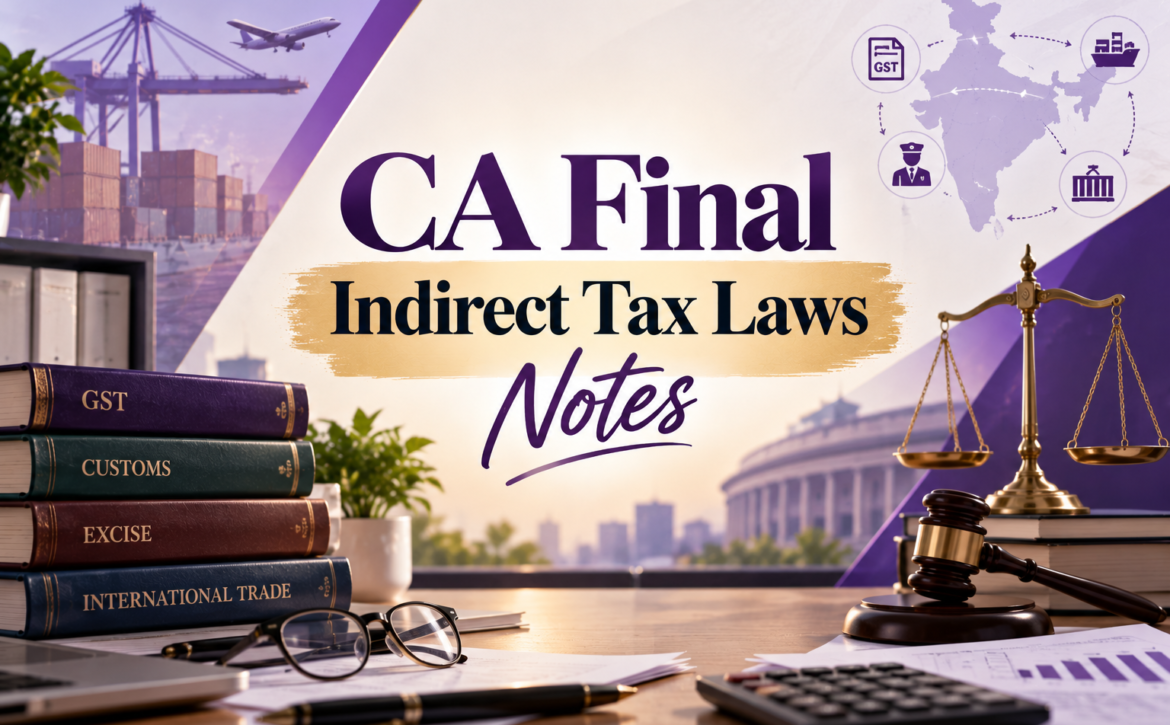
CA Final Indirect Tax Laws Notes: Complete Study & Revision Guide
CA Final Indirect Tax Laws is one of those subjects where simply reading the provisions again and again does not always make preparation easier. The real challenge is understanding how different provisions work together in a practical situation.
For many CA Final students, GST is familiar because they have already studied it at earlier levels. But at the Final level, the questions demand a deeper understanding of the law, exceptions, conditions, practical application and interconnection between provisions. Customs and Foreign Trade Policy (FTP) add another layer because students have to understand transactions involving imports, exports, valuation, duties and compliance.
Under the current CA Final New Scheme, Paper 5 is Indirect Tax Laws, consisting of Part I: Goods and Services Tax (GST) and Part II: Customs & FTP.
This is where well-organised CA Final Indirect Tax Laws Notes become useful. The purpose of good notes is not to replace the ICAI study material. Instead, they should make revision faster, help you connect provisions and give you a clear framework for solving practical questions.
Official ICAI Study Material for CA Final Indirect Tax Laws
Before starting your preparation, always check the latest ICAI material applicable to your examination attempt. ICAI publishes Paper 5 study material and updates it according to the relevant examination cycle. The official ICAI search results currently identify Final Course – Paper 5: Indirect Tax Laws as applicable for May 2027 and November 2027 examinations.
Important ICAI Resources
- ICAI Final Course – Paper 5: Indirect Tax Laws
- ICAI Final Course – New Scheme of Education and Training
- ICAI BoS Study Material & Announcements
- ICAI Board of Studies – Paper 5 Contact & Academic Information
Important: Tax laws, GST provisions, customs rules, notifications, circulars and examination applicability can change. Therefore, students should always verify the material and updates applicable to their particular attempt from ICAI before finalising their notes.
What Are CA Final Indirect Tax Laws Notes?
CA Final Indirect Tax Laws Notes are concise study and revision resources that cover the important concepts of GST, Customs and Foreign Trade Policy required for CA Final Paper 5.
But good notes should do more than simply reproduce the textbook.
For every important provision, your notes should ideally help you understand:
- What the provision says
- When it applies
- What conditions need to be satisfied
- What exceptions are available
- How the provision affects a transaction
- What documents or compliance requirements may arise
- How the provision is applied in a practical question
A simple approach is:
Provision → Conditions → Exception → Application → Computation → Conclusion
This format can be extremely useful during revision.
CA Final Indirect Tax Laws Syllabus: Broad Structure
Paper 5 broadly covers two major areas:
| Part | Area |
| Part I | Goods and Services Tax |
| Part II | Customs & Foreign Trade Policy |
The GST portion covers areas ranging from supply and levy to input tax credit, registration, invoices, returns, assessment, refunds, appeals and other compliance provisions. ICAI’s published Paper 5 material lists chapters such as Supply, Charge of GST, Place of Supply, Exemptions, Time of Supply, Value of Supply, Input Tax Credit, Registration, Tax Invoice, Accounts and Records, Payment of Tax, E-commerce Transactions and Returns.
The later portion covers areas such as imports and exports, refunds, job work, assessment and audit, inspection/search/seizure/arrest, demands and recovery, offences and penalties, appeals, advance ruling and miscellaneous provisions.
For Customs and FTP, students should follow the exact syllabus and material prescribed by ICAI for their examination attempt.
Why CA Final Indirect Tax Laws Can Feel Difficult
The difficulty is usually not because every individual concept is impossible.
The bigger problem is that several provisions can apply to the same transaction.
Take a simple example.
A company purchases goods from another state.
You may have to think about:
- Whether the transaction qualifies as a supply
- Whether it is an intra-State or inter-State supply
- The applicable tax
- Time of supply
- Value of supply
- Input tax credit
- Documentation
- Place of supply
- Compliance requirements
One transaction can therefore require knowledge of several chapters.
That is why your preparation should focus on connecting provisions, not memorising chapters independently.
CA Final GST Notes: Important Areas
GST forms the largest practical part of indirect taxation preparation.
Your notes should cover the following major areas:
| GST Area | What to Focus On |
| Supply | Meaning, scope and relevant conditions |
| Charge of GST | Levy and applicability |
| Place of Supply | Determining location and tax treatment |
| Exemptions | Exempt supplies and conditions |
| Time of Supply | Determining the relevant tax point |
| Value of Supply | Valuation rules |
| Input Tax Credit | Eligibility, restrictions and utilisation |
| Registration | Liability, procedure and compliance |
| Tax Invoice | Invoicing requirements |
| E-Way Bill | Movement and documentation |
| Returns | Filing and compliance |
| Refunds | Eligibility and procedure |
| Assessment | Relevant assessment provisions |
| Audit | GST audit-related provisions |
| Demand & Recovery | Tax recovery mechanism |
| Appeals | Remedies available to taxpayers |
| Advance Ruling | Applicability and procedure |
| Offences & Penalties | Consequences of non-compliance |
These topics should not be studied only as separate chapters.
Try to understand how they interact.
How to Make GST Notes That Are Actually Useful
Suppose you are revising Input Tax Credit.
Instead of writing several pages of paragraphs, make your notes answer five questions:
1. Who can claim ITC?
Identify the eligibility conditions.
2. What can be claimed?
Understand the scope of eligible input tax credit.
3. What cannot be claimed?
Keep blocked or restricted credits in a separate section.
4. When can it be claimed?
Understand the relevant timing and conditions.
5. How is it utilised?
Revise the applicable utilisation framework.
This makes revision much easier than reading the entire chapter repeatedly.
CA Final Notes for Supply Under GST
Supply is the starting point of GST.
If you cannot correctly identify whether a transaction is a supply, the later analysis can become difficult.
While preparing notes, create a simple decision framework:
Transaction
↓
Is there a supply?
↓
Goods / Services / Both
↓
Consideration?
↓
Business Activity?
↓
Relevant statutory provisions
↓
Taxability
↓
Place of Supply
↓
Rate / Exemption
↓
Time & Value
This approach helps you understand the sequence in which a practical GST question can be analysed.
Place of Supply: How to Prepare Notes
Place of Supply can become confusing because the applicable rule depends on the nature of the transaction.
Your notes should therefore be divided into separate categories.
| Transaction Type | Revision Approach |
| Goods | Identify the applicable place-of-supply rule |
| Services | Identify the relevant service category |
| Import | Check the applicable import rule |
| Export | Check the applicable export rule |
| Special cases | Revise separately |
Don’t try to memorise all place-of-supply provisions together.
Group similar provisions.
This reduces confusion during revision.
Time of Supply Notes
Time of Supply is another area where a fixed framework helps.
When solving a question, first identify:
Nature of Supply
↓
Relevant statutory provision
↓
Invoice / payment / other relevant event
↓
Applicable rule
↓
Time of Supply
The exact treatment should always be checked against the law applicable to the examination attempt.
For notes, use tables instead of lengthy explanations.
Value of Supply Notes for CA Final
Valuation questions require careful reading.
Your notes should distinguish between:
- Basic transaction value
- Inclusions
- Exclusions
- Discounts
- Related-party situations
- Special valuation rules
- Other relevant statutory adjustments
A useful revision table can be:
| Question | What to Check |
| Is transaction value acceptable? | Check statutory conditions |
| Is there any additional amount? | Determine whether it needs inclusion |
| Is discount involved? | Check applicable conditions |
| Are parties related? | Examine valuation implications |
| Is a special rule applicable? | Apply the relevant provision |
This approach helps you solve questions logically instead of relying on guesswork.
CA Final Input Tax Credit Notes
ITC is one of the areas where students should focus on both concepts and practical questions.
Create separate headings for:
Eligibility
Who can claim the credit?
Conditions
What conditions must be satisfied?
Restrictions
Which credits are restricted or unavailable?
Timing
When can credit be claimed?
Documentation
Which documents and records are relevant?
Utilisation
How can eligible credit be used according to the applicable framework?
When revising, don’t mix all these areas into one paragraph.
Keep them separate.
Registration Under GST
Registration is often easier to revise if you create a checklist.
Your notes should cover:
- Persons liable for registration
- Relevant threshold and statutory provisions
- Compulsory registration situations
- Registration procedure
- Amendment
- Cancellation
- Revocation
- Special situations
Always verify the latest applicable thresholds, exceptions and notifications for your examination attempt.
Tax Invoice, E-Way Bill and Records
These are highly practical topics.
When making notes, focus on what the taxpayer needs to do.
For example:
| Compliance Area | What to Remember |
| Tax Invoice | Required particulars |
| Credit Note | Circumstances and treatment |
| Debit Note | Circumstances and treatment |
| E-Way Bill | Applicable movement requirements |
| Accounts | Record-keeping requirements |
| Returns | Filing and reporting requirements |
This practical approach makes the chapter much easier to revise.
GST Returns and Compliance
Don’t prepare returns as a list of form numbers alone.
Understand:
- Who files the return
- What information is reported
- Due date or applicable timeline
- Relevant details
- Amendment/correction mechanism
- Consequences of non-compliance
Where the law has been amended, always follow the material applicable to your attempt.
GST Refunds
Refund questions become easier when you identify the reason first.
For example:
Why is refund being claimed?
↓
Identify relevant category
↓
Check eligibility
↓
Check conditions
↓
Check documentation
↓
Apply computation
↓
Determine admissibility
This method is more reliable than trying to remember the entire refund chapter word-for-word.
GST Assessment, Audit and Demand
For these chapters, students should build a timeline-based understanding.
A practical question may involve:
Transaction
→
Tax liability
→
Non-compliance / discrepancy
→
Assessment / proceedings
→
Demand
→
Recovery / remedy
Your notes should therefore contain flowcharts showing the sequence of events.
Appeals and Advance Ruling
These topics are primarily about understanding the mechanism.
For revision, create comparison tables.
| Area | What to Revise |
| Appeal | Who can appeal and against what |
| Authority | Relevant appellate forum |
| Time limit | Applicable statutory period |
| Procedure | Basic filing requirements |
| Advance Ruling | Scope and applicability |
| Further Remedy | Available options under law |
The exact statutory position should be verified from the material applicable to your examination attempt.
Customs: CA Final Indirect Tax Laws Notes
The Customs portion requires a different style of preparation compared with GST.
Students should focus on:
- Import and export concepts
- Customs duties
- Classification
- Valuation
- Exemptions
- Procedures
- Warehousing
- Refunds
- Compliance
- Relevant Foreign Trade Policy concepts
A practical way to study Customs is to imagine an actual shipment.
Goods leave the exporting country
↓
Goods arrive in India
↓
Customs documentation
↓
Classification
↓
Valuation
↓
Applicable duty
↓
Assessment
↓
Clearance
This gives the chapter a practical context.
Customs Valuation Notes
Customs valuation is an area where students should practise questions regularly.
Instead of memorising isolated rules, understand the sequence:
Imported Goods
↓
Determine transaction value
↓
Check whether conditions are satisfied
↓
Consider additions / adjustments
↓
Apply applicable valuation rules
↓
Determine assessable value
↓
Calculate duty
A flowchart like this can become extremely useful during final revision.
Classification Under Customs
Classification questions can become difficult when goods have multiple characteristics.
When preparing notes, focus on:
- Nature of goods
- Description
- Classification principles
- Relevant tariff heading
- Applicable rules
- Supporting facts
Don’t rely only on memorising examples.
Understand why a particular classification applies.
Foreign Trade Policy Notes
FTP preparation should be connected with practical trade transactions.
Students should understand concepts relating to:
- Import policy
- Export policy
- Trade facilitation
- Authorisations
- Export promotion
- Relevant schemes
- Compliance requirements
Since trade policy and related rules can change, the latest ICAI-prescribed material should always be used.
How to Prepare CA Final Indirect Tax Laws Notes in Less Time
One of the best ways to reduce revision pressure is to create notes in three layers.
Layer 1: Detailed Notes
Made during first learning.
Include explanations and examples.
Layer 2: Revision Notes
Reduce each chapter to important provisions, conditions and exceptions.
Layer 3: Final Revision Sheet
Keep only:
- Key concepts
- Important conditions
- Exceptions
- Formulas
- Common mistakes
- Important amendments
- Difficult areas
By the final revision, you should not be reading your original notes from beginning to end.
How to Solve CA Final Indirect Tax Questions
A common mistake is immediately searching for a section after reading a question.
Instead, use this approach:
Step 1: Read the Complete Facts
Don’t jump to the answer.
Step 2: Identify the Transaction
Is it supply, import, export, refund, ITC or another transaction?
Step 3: Identify the Issue
What exactly is being asked?
Step 4: Identify the Relevant Provision
Now connect the facts with the law.
Step 5: Apply the Conditions
Check whether the facts satisfy the conditions.
Step 6: Calculate if Required
Show the working clearly.
Step 7: Give a Conclusion
Your final answer should directly answer the question.
This approach makes answers more professional and structured.
How ICAI Material Should Be Used
ICAI should remain your primary reference for the subject.
The Institute’s current Final Course structure places Paper 5 under Group II and identifies Indirect Tax Laws as one of the Final papers.
The BoS has also provided case-scenario material for Final Course papers, including Paper 5: Indirect Tax Laws.
Students should therefore use:
- ICAI Study Material
- Relevant RTP
- Statutory Updates
- Applicable amendments
- ICAI case-based resources
- Suggested Answers
- Practice questions
The exact combination should depend on your examination attempt.
Why Case-Based Practice Matters
Indirect tax is not only about knowing definitions.
Consider a practical situation:
A company imports goods, sells some goods domestically, provides services to another State, claims ITC and later exports part of its inventory.
A single business situation can involve:
- GST
- Place of supply
- ITC
- Customs
- Export provisions
- Refund
- Documentation
- Compliance
This is why practical case-based preparation is valuable.
ICAI’s Board of Studies also provides case-scenario resources for Final Course papers, including Paper 5.
Common Mistakes Students Make in CA Final Indirect Tax
1. Studying Only GST
Paper 5 also includes Customs & FTP.
Don’t leave the second part completely for the end.
2. Memorising Without Understanding
A provision becomes easier to remember when you understand the situation in which it applies.
3. Ignoring Conditions
Most mistakes occur when students remember the main rule but forget an important condition or exception.
4. Using Old Material
Tax law changes.
An old summary may not reflect the law applicable to your attempt.
5. Not Practising Computations
Reading valuation or ITC provisions is not enough.
Solve questions.
6. Ignoring Amendments
Keep a separate section in your notes for amendments and updates.
7. Writing Everything You Know
Answer what the question asks.
Don’t fill the answer with unrelated provisions.
CA Final Indirect Tax Revision Strategy
A practical revision plan can look like this:
| Revision | Main Objective |
| First Reading | Understand concepts |
| First Revision | Recall important provisions |
| Question Practice | Apply the law |
| Second Revision | Correct weak areas |
| Amendment Revision | Update applicable changes |
| Final Revision | Short notes + difficult topics |
| Last Practice | Selected case-based questions |
The exact number of revisions will depend on your preparation level and available time.
30-Day CA Final Indirect Tax Revision Approach
If you have approximately one month, don’t try to give every chapter equal time.
Divide the time based on your strengths and weaknesses.
Phase 1: GST Core
Revise:
- Supply
- Charge
- Place of Supply
- Exemptions
- Time of Supply
- Value of Supply
Phase 2: ITC & Compliance
Focus on:
- ITC
- Registration
- Invoices
- E-way Bill
- Returns
- Payment
Phase 3: Advanced GST
Revise:
- Refund
- Job Work
- Assessment
- Audit
- Demand
- Recovery
- Appeals
- Advance Ruling
- Penalties
Phase 4: Customs & FTP
Focus on:
- Import/export
- Classification
- Valuation
- Duties
- Procedures
- FTP
Phase 5: Final Revision
Focus on:
- Amendments
- Weak chapters
- Case-based questions
- Practical computations
- Quick notes
CA Final Indirect Tax Laws Final Revision Checklist
Before the examination, ask yourself:
| Area | Status |
| Supply | ✓ |
| Charge of GST | ✓ |
| Place of Supply | ✓ |
| Exemptions | ✓ |
| Time of Supply | ✓ |
| Value of Supply | ✓ |
| Input Tax Credit | ✓ |
| Registration | ✓ |
| Tax Invoice | ✓ |
| E-Way Bill | ✓ |
| Returns | ✓ |
| Refunds | ✓ |
| Job Work | ✓ |
| Assessment | ✓ |
| Audit | ✓ |
| Demand & Recovery | ✓ |
| Appeals | ✓ |
| Advance Ruling | ✓ |
| Customs | ✓ |
| Customs Valuation | ✓ |
| Customs Classification | ✓ |
| Import & Export | ✓ |
| Foreign Trade Policy | ✓ |
| Applicable Amendments | ✓ |
| Practical Questions | ✓ |
How CA Mentoring Program Can Help With CA Final Indirect Tax Preparation
Preparing a large subject becomes easier when your study resources are organised around the actual problems students face during revision.
CA Mentoring Program can serve as a supplementary learning and revision resource for CA students looking for structured educational content.
You can explore the available resources on CA Mentoring Program.
However, for taxation subjects, students should always cross-check important provisions, amendments and examination applicability with the latest official ICAI material.
Final Words
CA Final Indirect Tax Laws does not have to become a subject that you keep postponing because the syllabus looks large.
Start with the basics and build the connections.
Understand supply before trying to solve complicated GST situations. Understand the logic of ITC before memorising restrictions. Understand the sequence of a customs transaction before trying to remember valuation rules.
And most importantly, don’t treat your notes as another textbook.
Your final notes should be something you can open before the examination and quickly understand:
What is the provision?
When does it apply?
What are the conditions?
What are the exceptions?
How is it applied in a practical situation?
What conclusion should I reach?
That is what makes CA Final Indirect Tax Laws Notes genuinely useful.
Paper 5 covers a broad professional area, and ICAI’s current Final Course structure places Indirect Tax Laws under Group II, with GST and Customs & FTP forming the major components.
So don’t measure your preparation by how many pages you have read.
Measure it by how confidently you can look at a transaction, identify the relevant tax issue, locate the applicable provision, apply the conditions and arrive at a clear conclusion.
That is the kind of preparation that makes revision meaningful and helps you approach the CA Final examination with a much clearer strategy.