
CA Foundation Accounts Notes: Complete Study and Revision Guide
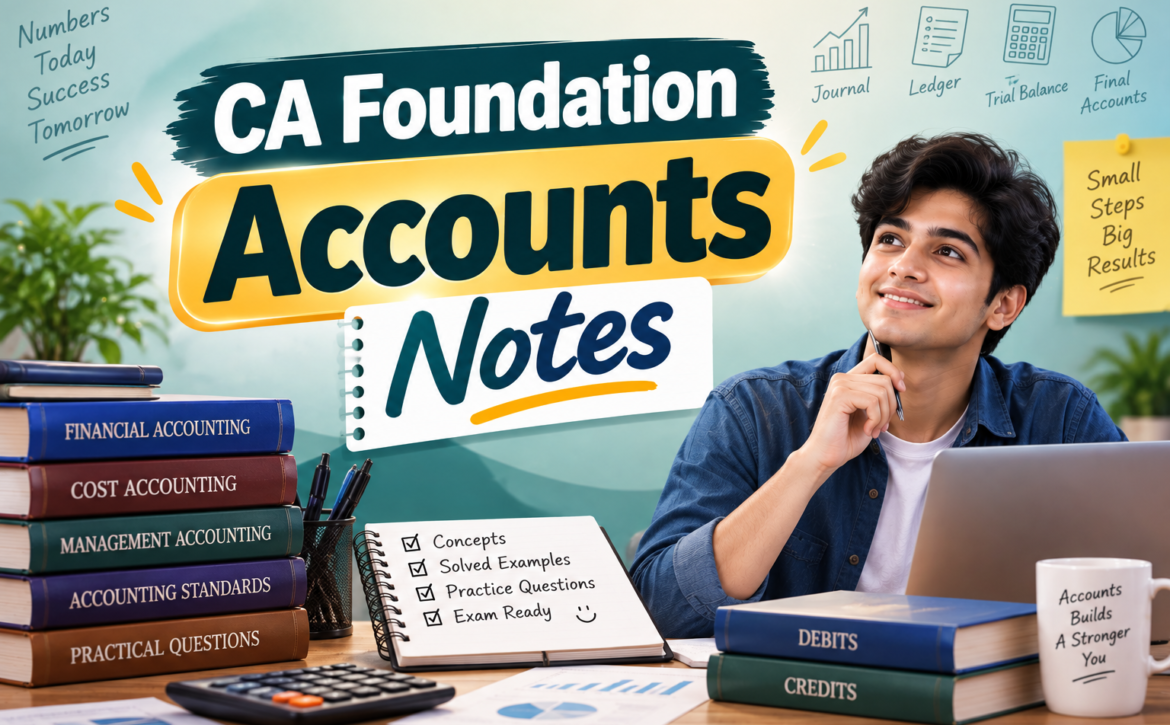
Accounting is often the first subject that gives CA Foundation students a real feel for professional-level studies.
At school level, many students are comfortable with basic journal entries and ledger accounts. But when they enter CA Foundation, the subject becomes more detailed. There are adjustments, financial statements, depreciation, inventories, special transactions and several areas where one small mistake can change the entire answer.
That is exactly why good CA Foundation Accounts Notes can make a difference.
The purpose of notes should not be to replace the ICAI study material. Instead, good notes should make revision faster, help you remember important concepts and give you a quick reference before solving questions or attempting a test.
ICAI’s current Foundation Paper 1 Accounting study-material page lists the Accounting material under the New Scheme of Education and Training, including a separate section relevant for May 2027 and onwards and another applicable from May 2026 onwards.
If you are preparing for CA Foundation, the most effective approach is simple:
Understand the concept → solve illustrations → practise questions → analyse mistakes → revise → test yourself again.
This guide explains how to make that process easier.
What Is CA Foundation Accounting?
CA Foundation Accounting is Paper 1 of the Foundation course. The subject is designed to develop an understanding of basic accounting concepts and their practical application.
Accounting is not simply about remembering debit and credit rules. You need to understand why a particular transaction is recorded in a particular way and how that transaction eventually affects the financial statements.
The syllabus broadly moves from basic accounting concepts to accounting processes, special transactions and preparation of financial statements.
The current ICAI material includes areas such as the Theoretical Framework, Accounting Process, Bank Reconciliation Statement, Inventories, Depreciation and Amortisation, Bills of Exchange and Promissory Notes and Final Accounts of Sole Proprietors.
CA Foundation Accounts Chapters
A useful way to approach the subject is to divide it into conceptual and practical areas.
| Chapter / Area | What You Learn |
| Theoretical Framework | Accounting concepts, principles, terminology and standards |
| Accounting Process | Journal, ledger, trial balance, subsidiary books and cash book |
| Bank Reconciliation Statement | Reconciling cash book and bank statement |
| Inventories | Valuation and accounting of inventory |
| Depreciation and Amortisation | Depreciation concepts, methods and accounting treatment |
| Bills of Exchange & Promissory Notes | Recording and accounting for bills |
| Final Accounts | Trading Account, Profit & Loss Account and Balance Sheet |
| Partnership Accounts | Partnership-related accounting concepts |
| Not-for-Profit Organisations | Receipt & Payment, Income & Expenditure and Balance Sheet |
| Company Accounts | Basic accounting for shares, debentures and financial statements |
The exact applicable material should always be checked against the ICAI notification for your examination attempt.
Why CA Foundation Accounts Notes Are Important
Accounting is a practice-oriented subject.
You may understand a chapter when your teacher explains it, but that does not necessarily mean you can solve an unfamiliar question in the examination.
This is where revision notes become useful.
Good notes help you:
- Revise chapters quickly
- Remember accounting rules
- Keep important formats in one place
- Review common adjustments
- Revise formulas and calculations
- Track repeated mistakes
- Prepare before mock tests
- Save time during final revision
For example, instead of reading an entire chapter on depreciation before every test, you can maintain a one-page revision sheet containing the important concepts, methods, formulas and common adjustments.
That is what useful notes should look like.
Chapter 1: Theoretical Framework
The first chapter is the foundation of accounting.
Students sometimes underestimate it because it contains fewer lengthy calculations than other chapters. That can be a mistake.
You need to understand the basic language and principles of accounting before moving into more practical chapters.
Important areas include:
- Meaning and scope of accounting
- Accounting concepts
- Accounting principles
- Accounting conventions
- Accounting terminology
- Capital and revenue expenditure
- Capital and revenue receipts
- Contingent assets and liabilities
- Accounting policies
- Valuation principles
- Accounting estimates
- Accounting Standards
- Indian Accounting Standards
Capital vs Revenue
| Capital | Revenue |
| Usually related to acquisition or improvement of long-term assets | Usually related to routine business operations |
| Generally provides benefit over a longer period | Generally relates to current period operations |
| Example: Purchase of machinery | Example: Regular repair expense |
Do not simply memorise examples. Understand the reason behind the classification.
Chapter 2: Accounting Process
This is where accounting starts becoming practical.
You should become comfortable with the complete flow:
Transaction → Journal → Ledger → Trial Balance → Financial Statements
Important topics
- Journal entries
- Ledger accounts
- Trial balance
- Subsidiary books
- Cash book
- Rectification of errors
A common mistake is jumping directly to difficult questions without becoming comfortable with basic journal entries.
Spend enough time here.
If the foundation is weak, later chapters become unnecessarily difficult.
Journal Entries: The Real Foundation
When learning journal entries, ask three questions:
- What accounts are involved?
- What type of accounts are they?
- What is the effect of the transaction?
For example, if a business purchases machinery for cash, you should understand that machinery is being acquired as an asset and cash is decreasing.
The objective is not to mechanically remember:
Machinery A/c Dr.
To Cash A/c
The objective is to understand why the entry is passed.
Once the logic becomes clear, accounting becomes much less intimidating.
Chapter 3: Bank Reconciliation Statement
Bank Reconciliation Statement, commonly called BRS, is another important practical area.
The basic purpose of BRS is to explain the difference between the balance shown by the cash book and the balance shown by the bank statement/pass book.
Common reasons for differences
- Cheques issued but not presented
- Cheques deposited but not collected
- Bank charges
- Interest credited by bank
- Direct deposits
- Direct payments
- Errors in records
Best way to study BRS
Do not memorise a long list of additions and deductions.
Instead, understand the effect of every item.
Ask:
Did the bank balance increase or decrease? Did the cash book record it? Which balance am I starting from?
Once you think this way, BRS becomes much easier.
Chapter 4: Inventories
Inventory valuation is an important part of accounting because inventory affects both the financial position and the profit of a business.
Important areas include:
- Meaning of inventory
- Cost of inventory
- Net Realisable Value
- Inventory valuation principles
- Inventory record-keeping
- Methods and techniques of valuation
When making your CA Foundation Accounting Notes, keep inventory formulas and valuation rules together rather than scattering them across multiple pages.
Also practise numerical questions regularly.
Chapter 5: Depreciation and Amortisation
Depreciation is one of those topics where conceptual clarity and calculation practice need to go together.
You should understand:
- Meaning of depreciation
- Need for depreciation
- Factors affecting depreciation
- Methods of depreciation
- Accounting treatment
- Change in method of depreciation
- Amortisation
Important Depreciation Methods
| Method | Basic Idea |
| Straight Line Method | Depreciation is generally spread evenly over the useful life |
| Written Down Value Method | Depreciation is calculated on the relevant reduced book value |
Do not focus only on the formula.
Understand what happens to the asset’s book value after depreciation is charged.
That understanding helps you solve variations in practical questions.
Chapter 6: Bills of Exchange and Promissory Notes
Bills of Exchange can initially look confusing because several parties and dates may be involved.
The easiest way to understand the chapter is to create a simple transaction flow.
Learn:
- Meaning of bill of exchange
- Promissory note
- Parties to a bill
- Acceptance
- Discounting
- Endorsement
- Dishonour
- Retirement
- Renewal
- Accommodation bills
Practical Tip
Whenever you solve a bill question, first identify:
Who is the drawer?
Who is the drawee?
Who is the payee?
What is the due date?
What happened to the bill?
Once these five points are clear, the accounting entries become much easier.
Chapter 7: Final Accounts of Sole Proprietors
This is one of the most practical areas of Foundation Accounting.
Students need to understand how different items ultimately affect:
- Trading Account
- Profit and Loss Account
- Balance Sheet
The chapter covers final accounts for manufacturing and non-manufacturing entities and related adjustments.
Important adjustments
Depending on the question, adjustments may include:
- Closing stock
- Outstanding expenses
- Prepaid expenses
- Accrued income
- Income received in advance
- Depreciation
- Bad debts
- Provision-related adjustments
- Interest on capital
- Interest on drawings
The best way to master final accounts
Do not try to memorise where every item goes without understanding its effect.
For each adjustment, ask:
Does it affect profit?
Does it affect an asset or liability?
Does it affect both?
That simple habit can prevent many errors.
Chapter 8: Partnership Accounts
Partnership accounting introduces students to accounting situations involving more than one owner.
Important areas include:
- Partnership final accounts
- Admission of a partner
- Retirement of a partner
- Death of a partner
- Goodwill
- Basic accounting treatment for partnership changes
- Introduction to LLPs
Partnership questions can become lengthy, so working-note discipline is important.
Write your calculations clearly.
Do not try to complete everything mentally.
Chapter 9: Financial Statements of Not-for-Profit Organisations
Not-for-profit organisations do not operate primarily with the objective of earning profit.
Therefore, their accounting treatment has some important differences from ordinary business entities.
You should understand:
- Receipt and Payment Account
- Income and Expenditure Account
- Balance Sheet
- Capital Fund
- Subscription adjustments
- Specific funds
- Difference between capital and revenue items
Quick Comparison
| Receipt & Payment | Income & Expenditure |
| Cash-based statement | Accrual-based statement |
| Includes capital and revenue receipts/payments | Generally focuses on revenue income and expenditure |
| Shows actual cash/bank transactions | Determines surplus or deficit |
Understanding this difference is much more useful than simply memorising definitions.
Chapter 10: Introduction to Company Accounts
Company Accounts introduce students to the basic accounting treatment relating to companies.
Important areas include:
- Shares
- Debentures
- Issue of shares
- Issue of debentures
- Forfeiture of shares
- Reissue of forfeited shares
- Basic financial statement presentation
Company accounting may appear technical initially, but it becomes manageable when each transaction is broken into stages.
For example:
Application → Allotment → Calls → Receipt → Possible Forfeiture/Reissue
Practise the sequence instead of trying to memorise isolated entries.
How to Make Effective CA Foundation Accounts Notes
There is a big difference between notes and rewriting the textbook.
If your 30-page chapter becomes a 25-page notebook, you have probably not created revision notes.
Good notes should be short enough to revise quickly.
Use this structure:
Concept → Rule → Formula → Format → Example → Common Mistake
For practical chapters, add one solved illustration.
For theoretical chapters, use:
- Definitions
- Differences
- Key principles
- Examples
- Short explanations
Best Way to Revise CA Foundation Accounts
Accounting requires repeated practice.
A useful revision cycle is:
First Revision
Understand the concept and solve basic questions.
Second Revision
Solve questions without looking at the solution.
Third Revision
Attempt mixed questions and timed practice.
Final Revision
Use short notes, formulas, formats and your mistake notebook.
This is much more effective than reading the same chapter repeatedly without solving questions.
Common Mistakes Students Make in CA Foundation Accounts
1. Learning Entries Without Understanding
If you only memorise entries, a slightly different question can confuse you.
2. Avoiding Written Practice
Accounting is a practical subject. Reading solutions is not the same as solving questions.
3. Ignoring Working Notes
Working notes often make lengthy questions much easier to manage.
4. Not Checking the Final Answer
After completing a question, check whether your balance sheet, ledger or calculation actually agrees.
5. Repeating the Same Mistake
Maintain a mistake register.
Write:
Question → Mistake → Correct Treatment → Reason
Review this before every test.
How to Improve Your Accounts Score
If you want to improve your score, do not only solve more questions.
Solve questions with analysis.
Suppose you score 52/100 in a mock test.
Instead of simply saying, “I need to practise more,” divide the lost marks:
| Reason | Marks Lost |
| Conceptual mistake | 10 |
| Calculation error | 6 |
| Wrong accounting treatment | 8 |
| Time management | 5 |
| Question misunderstood | 4 |
| Total | 33 |
Now your next study session becomes specific.
You know exactly what needs improvement.
This is how test practice becomes useful.
30-Day CA Foundation Accounts Study Plan
| Days | Study Focus |
| 1–3 | Theoretical Framework |
| 4–7 | Accounting Process |
| 8–9 | Bank Reconciliation Statement |
| 10–12 | Inventories |
| 13–15 | Depreciation |
| 16–18 | Bills of Exchange |
| 19–22 | Final Accounts |
| 23–25 | Partnership / related areas |
| 26 | Not-for-Profit Organisations |
| 27 | Company Accounts |
| 28 | Full revision |
| 29 | Mock Test |
| 30 | Mistake Analysis + Final Revision |
This is only a sample plan. Students preparing for multiple Foundation papers should divide their available study hours accordingly.
Official ICAI CA Foundation Accounts Study Material PDF
When preparing for CA Foundation Accounts, your first reference should always be the applicable ICAI study material.
For the September 2026 examination, ICAI’s official Board of Studies applicability document lists Foundation Paper 1: Accounting (Module 1 and Module 2) as the August 2024 edition, with reprint August 2025 onwards.
Download the Official ICAI PDF
Download Official ICAI Foundation & Intermediate Study Material Applicability PDF – September 2026
This official document helps students verify which edition of the study material is applicable for the September 2026 examination.
For the actual Accounting study material, students can also visit:
Official ICAI Foundation Paper 1 – Accounting Study Material
The ICAI page currently includes a section for May 2026 onwards and separately identifies material relevant for May 2027 and onwards.
Important: Always check the study-material applicability, corrigenda, RTPs and other exam-specific updates for your own attempt before final revision.
Use ICAI Resources Along With Your Notes
Your personal notes should be a revision layer, not a replacement for official material.
A strong preparation system looks like this:
ICAI Study Material
↓
Concept Understanding
↓
Personal Revision Notes
↓
Question Practice
↓
Mock Test
↓
Performance Analysis
↓
Weak Area Revision
ICAI also provides Board of Studies learning resources and recorded sessions. Its September 2026 Foundation learning schedule includes Paper 1 Accounting sessions covering areas such as the Theoretical Framework, Accounting Process, Bank Reconciliation Statement and Inventories.
How CA Mentoring Program Can Support Your Accounts Preparation
Accounting preparation becomes much easier when you have a proper system for studying, testing and reviewing performance.
At CA Mentoring Program, students can combine structured preparation with regular testing and performance tracking.
A good mentoring approach can help students with:
- Study planning
- Daily accountability
- Chapter-wise preparation
- Regular tests
- Performance evaluation
- Weak-area identification
- Revision planning
- Full-syllabus practice
If you are looking for structured guidance for your CA preparation, you can explore:
The important thing is consistency. Even two focused hours of accounting practice every day can be more productive than studying for ten hours only once a week.
CA Foundation Accounts Revision Checklist
Before your examination, make sure you have covered:
- Accounting concepts and terminology
- Journal entries
- Ledger posting
- Trial balance
- Subsidiary books
- Cash book
- Rectification of errors
- Bank reconciliation
- Inventory valuation
- Depreciation
- Bills and promissory notes
- Final accounts
- Partnership-related accounting
- Not-for-profit accounting
- Company accounting basics
- Important formats
- Common adjustments
- Mistakes from previous tests
Do not leave revision until the final few days.
Final Thoughts
CA Foundation Accounts is not a subject that should be prepared through memorisation alone.
The students who eventually become comfortable with Accounts are usually the ones who stop asking, “Which entry should I remember?” and start asking, “Why is this entry being passed?”
That small change in thinking can completely change your preparation.
Use the official ICAI material as your base. Create short CA Foundation Accounts Notes for revision. Practise questions regularly. Maintain a mistake register. Attempt mock tests under exam conditions and analyse the questions you get wrong.
Most importantly, do not judge your Accounts preparation by how many chapters you have read.
Judge it by how many questions you can solve without looking at the solution.
That is the real test of preparation.