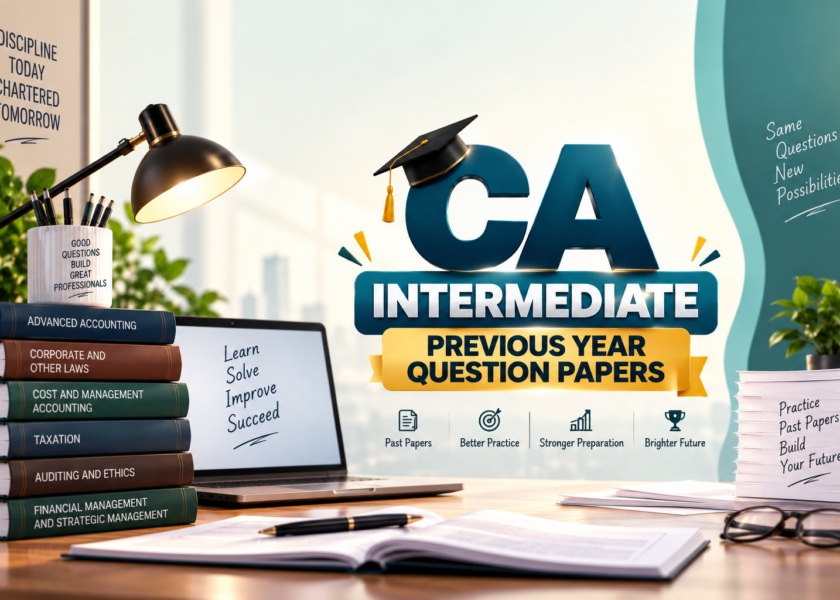
CA Inter Advanced Accounting Question Paper: Previous Papers PDF
CA Inter Advanced Accounting Question Paper: Previous Year Papers PDF, Pattern & Preparation Guide
For CA Intermediate students, Advanced Accounting is one of those subjects where preparation becomes much easier once you understand how ICAI actually frames questions. Reading accounting concepts from study material is important, but it is only one part of the preparation. The real improvement starts when you sit with a CA Inter Advanced Accounting Question Paper and try to solve it without looking at the solution.
Previous-year question papers show you the level of practical application expected in the examination. They also help you understand how ICAI combines accounting standards, company accounts, partnership-related topics and other areas into practical questions.
If you are preparing for an upcoming CA Intermediate attempt, solving previous papers should not be treated as something to do only during the last week. They can be used throughout preparation to understand question patterns, identify weak chapters, improve working-note presentation and build confidence.
CA Inter Advanced Accounting Question Paper PDF – Official ICAI Links
The Institute of Chartered Accountants of India (ICAI) lists Advanced Accounting as Paper 1 of CA Intermediate Group I under the current scheme. Its official question-paper archive provides session-wise papers.
Below are the latest five available examination-session question papers for Advanced Accounting:
| Exam Session | Official Question Paper |
| September 2026 | CA Inter Advanced Accounting Question Paper – September 2026 |
| May 2026 | CA Inter Advanced Accounting Question Paper – May 2026 |
| January 2026 | CA Inter Advanced Accounting Question Paper – January 2026 |
| September 2025 | CA Inter Advanced Accounting Question Paper – September 2025 |
| May 2025 | CA Inter Advanced Accounting Question Paper – May 2025 |
Note: ICAI’s official archive also contains earlier Advanced Accounting papers, including January 2025, September 2024 and May 2024. Students who want additional practice can continue with those papers after completing the latest sessions.
Why CA Inter Advanced Accounting Question Papers Matter
Many students make the mistake of studying Advanced Accounting chapter by chapter and assuming that completing the study material means the preparation is finished.
In reality, accounting preparation has another important stage: application.
You may understand an Accounting Standard while reading it, but a question can present the same concept through a completely different practical situation. A previous-year paper helps you see that difference.
Here is what regular paper practice can improve:
| Preparation Area | Benefit of Previous Papers |
| Concept application | Shows how concepts are converted into practical questions |
| Question familiarity | Makes ICAI-style questions less intimidating |
| Time management | Helps you understand how long different questions take |
| Working notes | Improves calculation and presentation habits |
| Weak areas | Makes recurring mistakes easier to identify |
| Revision | Converts passive reading into active practice |
| Confidence | Gives you experience before the actual examination |
The biggest advantage is that you stop preparing only for chapters and start preparing for the actual examination.
How to Use CA Inter Advanced Accounting Previous Year Papers
Simply downloading five papers is not enough.
You need to use them properly.
1. Start With the Latest Paper
Begin with the most recent paper available for your applicable syllabus.
Do not immediately check the solution. Read the question carefully and try to understand what the examiner is asking.
If you cannot solve a question, mark it and move ahead.
2. Solve Questions Chapter-Wise Initially
During the first stage of preparation, you do not necessarily need to attempt an entire three-hour paper.
Suppose you have completed Accounting Standards. Take questions related to those concepts from previous papers and solve them together.
This helps you understand how the same concept can be tested in different ways.
3. Move Towards Full-Paper Practice
Once most of the syllabus has been revised, start solving complete papers.
Set a timer.
Keep your calculator, writing material and other examination essentials ready.
Try to recreate the examination environment as closely as possible.
4. Analyse Your Mistakes
This is the step many students skip.
After checking your paper, do not just calculate your marks.
Ask:
- Why did I make this mistake?
- Did I misunderstand the concept?
- Did I miss an adjustment?
- Was my calculation wrong?
- Did I forget a working note?
- Did I misunderstand the requirement?
- Did I spend too much time on one question?
The answers to these questions are more valuable than the marks alone.
CA Inter Advanced Accounting Exam Preparation Strategy
Advanced Accounting requires both conceptual clarity and numerical practice.
A student who only reads theory may struggle with practical questions. At the same time, someone who only solves questions without understanding the underlying accounting treatment can become dependent on patterns.
A balanced approach works better.
Step 1: Build Your Conceptual Base
Start with the ICAI study material and understand the accounting treatment properly.
Do not focus only on memorising journal entries.
Understand why the treatment is required.
For example, when studying an Accounting Standard, try to understand:
- Recognition
- Measurement
- Classification
- Presentation
- Disclosure
- Practical application
This makes unfamiliar questions easier to handle.
ICAI maintains a dedicated Advanced Accounting study-material page for Paper 1 under the Intermediate course. The material is updated according to the applicable examination cycle.
Step 2: Make Short Revision Notes
You do not need to rewrite the entire chapter.
Create concise notes containing:
- Important accounting treatments
- Adjustment points
- Common journal entries
- Important formats
- Accounting Standard provisions
- Frequently confused concepts
- Common calculation areas
These notes become particularly useful during the final revision.
Step 3: Solve ICAI Questions
Before depending heavily on external question banks, make sure you have attempted ICAI material.
Previous examination papers are particularly valuable because they show how the concepts have been tested in actual examinations.
Step 4: Practise With Time Limits
Initially, accuracy should be your priority.
Later, speed becomes equally important.
A good practice method is:
Concept → Question → Check → Analyse → Revise → Reattempt
This cycle is much more effective than simply solving hundreds of questions without reviewing your mistakes.
Important Areas to Focus on in Advanced Accounting
The exact weightage can change from one examination to another, so students should not prepare solely according to predictions.
Instead, understand the broad areas covered in the syllabus.
Accounting Standards
Accounting Standards form an important part of Advanced Accounting preparation. Students should understand both the provisions and their practical application.
Instead of memorising isolated paragraphs, practise situations where you have to determine the appropriate accounting treatment.
Company Accounts
Company-accounting questions can require careful application of concepts and proper presentation.
Focus on understanding the complete process rather than memorising individual formats.
Amalgamation and Reconstruction
These topics often require multiple adjustments.
While practising them, pay attention to:
- Purchase consideration
- Journal entries
- Treatment of assets and liabilities
- Goodwill or capital reserve
- Shareholders’ accounts
- Reconstruction adjustments
Branch Accounts
Branch-related questions require clarity regarding the type of branch and the accounting treatment involved.
Practise the complete flow instead of solving only isolated adjustments.
Partnership Accounts
Partnership-related accounting requires careful treatment of changes in the partnership structure and related adjustments.
Financial Statements
Students should be comfortable with the presentation and adjustment of financial statements under the applicable requirements.
The key is to practise complete questions rather than learning formats mechanically.
How to Read an Advanced Accounting Question
One of the most underrated skills in CA preparation is reading the question correctly.
A question may contain several pieces of information, but not every line will necessarily require a separate calculation.
Use this approach:
Read the Requirement First
Before starting the calculation, understand exactly what the question asks you to prepare.
Is it asking for:
- Journal entries?
- Calculation?
- Ledger accounts?
- Financial statements?
- Accounting treatment?
- Disclosure?
- Explanation?
Identify the Adjustments
Underline or mentally note words such as:
- Before adjustment
- After adjustment
- Outstanding
- Prepaid
- Provision
- Revaluation
- Amalgamation
- Acquisition
- Depreciation
- Contingent
- Estimated
- Fair value
These words can completely change the treatment.
Prepare Working Notes
Do not try to perform every calculation mentally.
Working notes reduce mistakes and make your solution easier to review.
CA Inter Advanced Accounting Question Paper: How to Improve Marks
Getting a question right is important, but presentation also matters.
A good accounting answer should generally be:
Clear + Structured + Accurate + Complete
Use Proper Working Notes
If a calculation is required, show the calculation.
For example:
Calculation of Purchase Consideration
- Equity shareholders
- Preference shareholders
- Other relevant adjustments
- Total purchase consideration
This is much easier to follow than placing one final figure without explanation.
Show Journal Entries Properly
Where journal entries are required, maintain proper format:
| Particulars | Dr. | Cr. |
| Relevant Account | ₹XX | |
| To Relevant Account | ₹XX |
Do not mix multiple treatments into one unclear entry.
Avoid Unnecessary Explanations
Accounting answers should be precise.
If a short explanation is sufficient, do not spend ten minutes writing a page.
That time can be used for another question.
A Practical 30-Day CA Inter Advanced Accounting Plan
If your basic syllabus preparation is already complete, the following plan can be useful for revision.
| Days | Main Focus |
| Days 1–5 | Revise Accounting Standards and important concepts |
| Days 6–10 | Practise major practical chapters |
| Days 11–15 | Solve previous-year questions chapter-wise |
| Days 16–20 | Attempt complete question papers |
| Days 21–23 | Analyse mistakes and revise weak areas |
| Days 24–26 | Solve another set of complete papers |
| Days 27–28 | Revise short notes and important adjustments |
| Day 29 | Full-length timed paper |
| Day 30 | Final mistake revision |
This is not a replacement for complete syllabus preparation. It is a revision framework for students who have already covered the subject once.
Previous Paper vs Mock Test vs Study Material
Students often ask which resource should receive the most attention.
The answer depends on your preparation stage.
| Resource | Best Use |
| ICAI Study Material | Concept building |
| ICAI Previous Papers | Understanding actual examination questions |
| RTP | Exam-oriented revision |
| MTP | Full-paper practice |
| Suggested Answers | Understanding solution approach |
| Personal Notes | Fast revision |
The mistake is choosing only one resource.
A better strategy is to use each resource for its intended purpose.
How Many CA Inter Advanced Accounting Papers Should You Solve?
There is no magic number.
If you have enough time, solve all available recent ICAI papers relevant to your syllabus.
But quality matters more than quantity.
For example, solving five papers without checking mistakes is less useful than solving three papers and carefully analysing every error.
A practical approach is:
First paper: Understand your current level.
Second paper: Improve weak areas.
Third paper: Focus on speed and presentation.
Fourth paper: Simulate the actual examination.
Fifth paper: Final assessment and revision.
If you have additional time, go further into older papers and chapter-wise practice.
Common Mistakes Students Make in Advanced Accounting
1. Memorising Without Understanding
Accounting treatments become difficult when students memorise entries without understanding the reason behind them.
2. Ignoring Working Notes
A final answer may be wrong simply because an intermediate calculation was skipped.
3. Practising Only Easy Questions
If you always solve familiar questions, you may struggle when ICAI changes the presentation.
4. Not Revising Accounting Standards
Students sometimes focus heavily on practical chapters and leave conceptual areas for the end.
5. Spending Too Much Time on One Question
If a question is taking much longer than expected, move ahead and return later if time permits.
6. Not Analysing Previous Papers
Downloading papers is not preparation. Solving, checking and learning from them is preparation.
How CA Mentoring Program Can Support Your Preparation
Preparing for CA Intermediate becomes more manageable when students have a clear study structure.
CA Mentoring Program can be used as part of a broader preparation approach where students focus on conceptual learning, revision, practice and examination strategy.
For Advanced Accounting, the most useful habits are simple:
- Study the concept properly.
- Practise ICAI questions.
- Solve previous-year papers.
- Maintain a mistake notebook.
- Revise difficult adjustments regularly.
- Attempt full papers under time pressure.
- Analyse every paper after completion.
The goal is not to predict the next question. The goal is to become comfortable solving a question even when its presentation is unfamiliar.
Final Words
The CA Inter Advanced Accounting Question Paper is one of the most useful resources for understanding the actual examination environment.
Do not wait until the final few days to open previous papers. Start using them as soon as you have enough conceptual understanding to solve questions independently.
Begin chapter-wise, move towards mixed practice, and finally attempt complete papers under exam conditions.
Most importantly, do not judge your preparation only by your score in a mock paper. Sometimes a low score in practice is actually useful because it exposes the areas that still need work.
After every paper, identify your mistakes, revise the underlying concept and attempt similar questions again.
That is how previous-year papers become more than PDFs sitting in a folder. They become a genuine part of your CA Intermediate preparation strategy.