CA Final - CA Mentoring Program - Page 4

Category: CA Final

CA Final Chapter Wise Weightage Nov 2026: Subject-Wise Marks, Important Chapters & Preparation Strategy

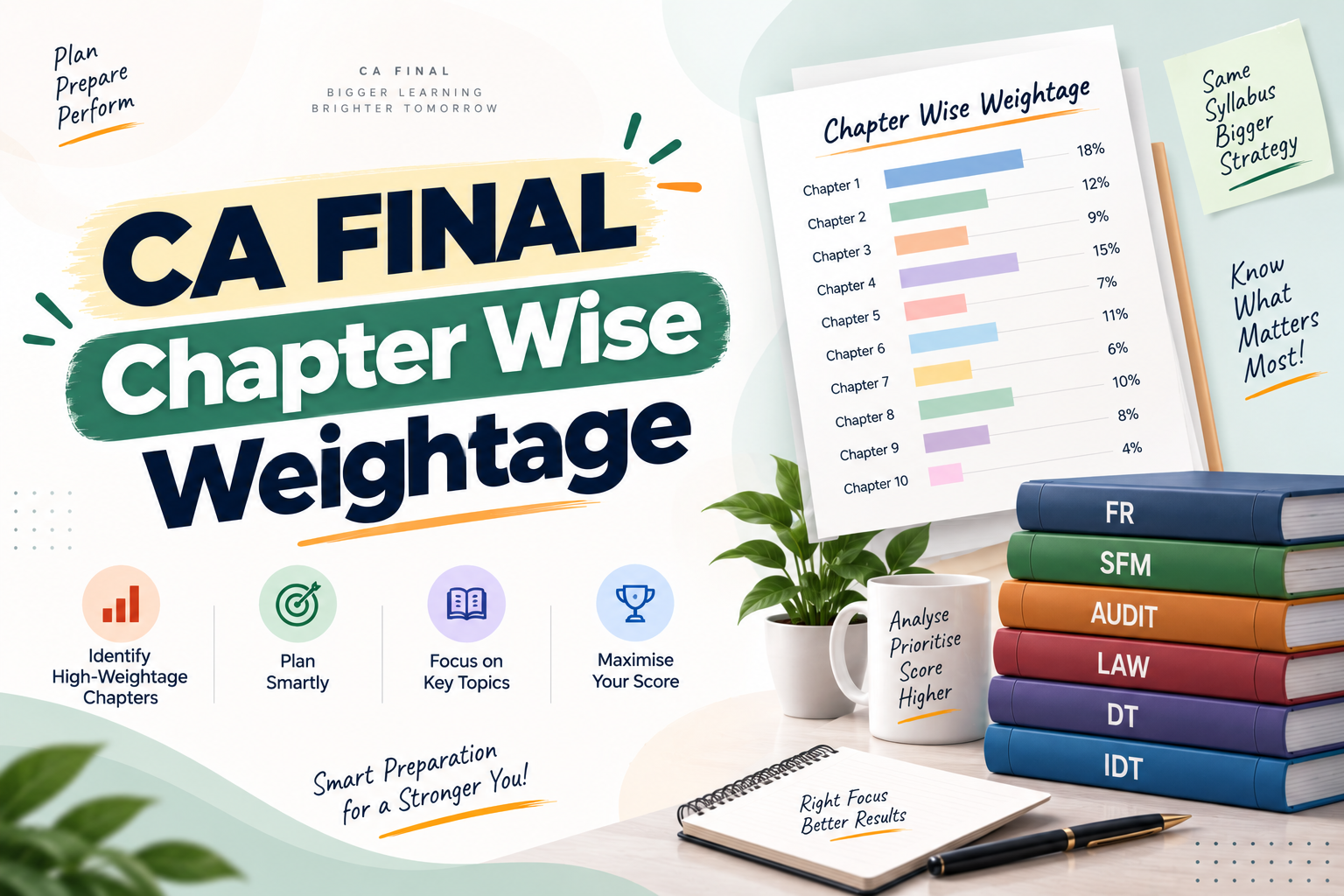
CA Final Chapter Wise Weightage Nov 2026

Preparing for the CA Final November 2026 examination is not simply about completing the syllabus once. At the Final level, the syllabus is extensive, questions are application-oriented, and students have to balance conceptual understanding with revision and exam practice.

One question that naturally comes to every CA Final student is:

“Which chapters should I study first, and how much weightage can I expect from each topic?”

This is where chapter-wise and section-wise weightage becomes useful.

However, there is an important point students should understand before using any weightage table: ICAI does not guarantee fixed marks for individual chapters in the CA Final paper. ICAI provides section-wise weightage ranges for the syllabus, while chapter-level priorities are generally derived from the syllabus structure, previous examination trends, RTPs, MTPs and repeated areas of testing.

Therefore, the weightage given in this article should be treated as a study-priority guide, not a prediction of the November 2026 question paper.

The CA Final New Scheme currently consists of six papers:

Paper Subject Marks Group
Paper 1 Financial Reporting 100 Group 1
Paper 2 Advanced Financial Management 100 Group 1
Paper 3 Advanced Auditing, Assurance & Professional Ethics 100 Group 1
Paper 4 Direct Tax Laws & International Taxation 100 Group 2
Paper 5 Indirect Tax Laws 100 Group 2
Paper 6 Integrated Business Solutions 100 Group 2

ICAI’s current examination resources confirm these six papers under the New Scheme.

Is CA Final Chapter Wise Weightage Nov 2026 Official?

This is probably the most important clarification for students.

There is no fixed official chapter-wise marks guarantee from ICAI.

For example, if a website says:

“Chapter X will definitely carry 15 marks in CA Final Nov 2026”

you should not treat that statement as an ICAI prediction.

ICAI’s framework provides section-wise weightage ranges, while actual marks can move from one chapter or area to another depending on the paper.

That is why the best approach is to combine:

  • ICAI’s prescribed section-wise weightage
  • Previous CA Final question papers
  • RTPs
  • MTPs
  • ICAI study material
  • Amendments and applicable updates
  • Recent examination trends
  • Your own strengths and weaknesses

ICAI itself encourages students to use the specified weightages to allocate study time efficiently rather than treating weightage as a substitute for complete preparation.

CA Final Paper 1: Financial Reporting Weightage Nov 2026

Financial Reporting is one of the most concept-intensive papers in CA Final. Instead of trying to memorize every Ind AS independently, students should understand how different standards interact with financial statements.

Indicative Section-Wise Weightage

Area Indicative Weightage Priority
Financial Reporting Framework & Conceptual Framework 10–15% High
Ind AS 115 – Revenue 5–10% High
Assets & Liabilities 15–25% Very High
Presentation & Disclosure-related Ind AS 15–20% High
Financial Instruments 10–15% Very High
Group Accounting & Consolidation 10–20% Very High
Other reporting areas Balance Medium

The exact paper can vary within these ranges.

High-Priority FR Chapters

Students should give special attention to:

  • Conceptual Framework
  • Ind AS 1, 7 and 34
  • Ind AS 115
  • Ind AS 2
  • Ind AS 16
  • Ind AS 23
  • Ind AS 36
  • Ind AS 38
  • Ind AS 40
  • Ind AS 105
  • Ind AS 116
  • Ind AS 19
  • Ind AS 37
  • Financial Instruments
  • Ind AS 32, 109 and 107
  • Consolidation
  • Business Combinations
  • Analysis of Financial Statements
  • Share-Based Payments

Recent chapter-trend analyses also place assets, financial instruments, consolidation and financial statement analysis among the areas deserving particularly strong preparation.

FR Preparation Tip

Do not prepare FR by reading standards repeatedly without solving questions.

A better sequence is:

Concept → ICAI illustration → Past question → RTP/MTP → Timed practice.

CA Final Paper 2: Advanced Financial Management Weightage Nov 2026

AFM rewards students who can apply financial concepts to numerical situations.

Some students make the mistake of preparing only the chapters they find easy. That can become risky because ICAI can combine concepts in a single question.

High-Priority AFM Areas

Topic Priority
Financial Policy & Corporate Strategy Medium
Risk Management High
Security Analysis High
Security Valuation Very High
Portfolio Management Very High
Mutual Funds High
International Financial Management High
Foreign Exchange & Risk Management Very High
Interest Rate Risk Management High
Derivatives Analysis & Valuation Very High
Corporate Valuation Very High
Mergers, Acquisitions & Corporate Restructuring Very High
Startup Finance Medium
Securitization Medium

Recent trend-based analyses consistently identify foreign exchange, security valuation, mergers and acquisitions, derivatives and portfolio management as important preparation areas.

How to Prepare AFM

AFM is not a subject where simply watching lectures guarantees marks.

After completing a concept, solve enough questions to become comfortable with:

  • Formula selection
  • Calculation speed
  • Interpretation
  • Presentation
  • Working notes
  • Calculator usage
  • Time management

Maintain a formula and mistake notebook. Before every revision, revise the mistakes rather than rereading the entire chapter.

CA Final Paper 3: Advanced Auditing, Assurance & Professional Ethics

Audit can become a high-scoring paper when preparation is structured correctly.

The biggest mistake students make is treating Audit as a purely theoretical subject and trying to memorize every line.

Instead, focus on concept + keywords + application + answer presentation.

Important Audit Areas for Nov 2026

Area Priority
Quality Control & Engagement Standards Very High
Professional Ethics Very High
Audit Planning, Strategy & Execution Medium
Risk Assessment & Internal Control High
Audit in Automated Environment High
Audit Reports High
Company Audit High
Audit Committee & Corporate Governance High
Consolidated Financial Statements Audit High
Audit of Banks Very High
Audit of Insurance Companies High
Audit of PSU High
Internal Audit Medium
Due Diligence, Investigation & Forensic Audit High
ESG / Sustainability Assurance High
Professional Ethics Very High

Recent CA Final Audit analyses identify Quality Control/Engagement Standards and Professional Ethics as particularly important areas, with company audit, governance, fiscal-law audit, forensic audit and sector-specific audits also requiring serious attention.

Audit Answer-Writing Strategy

For every major question, train yourself to write:

Provision → Explanation → Application → Conclusion

Use appropriate technical terms from ICAI study material.

Do not fill pages just to increase the length of your answer. In CA Final Audit, relevant points and proper presentation matter more than unnecessary repetition.

CA Final Paper 4: Direct Tax Laws & International Taxation

Direct Tax is one of the papers where understanding the overall structure of the syllabus makes preparation significantly easier.

For November 2026, the broad official section-wise structure is particularly useful.

Section Area Indicative Weightage
Section I Computation of Tax Liability 40–45%
Section II Tax Administration 20–30%
Section III International Taxation 30–35%

These ranges mean that Computation of Tax Liability and International Taxation together can account for a substantial portion of the paper, making both areas important for serious preparation.

Important Direct Tax Topics

Computation of Tax Liability

Focus strongly on:

  • Computation of total income
  • Heads of income
  • Set-off and carry-forward of losses
  • Deductions
  • Special provisions for companies
  • Tax planning
  • Charitable and religious trusts
  • Political parties
  • Business trusts
  • GAAR
  • Taxation of digital transactions

Tax Administration

Give attention to:

  • TDS and TCS
  • Assessment procedures
  • Income-tax authorities
  • Appeals and revision
  • Dispute resolution
  • Penalties
  • Offences and prosecution
  • Tax audit
  • Undisclosed income

International Taxation

Important areas include:

  • Transfer Pricing
  • Non-resident taxation
  • Double Taxation Relief
  • Tax treaties
  • OECD Model Convention
  • UN Model Convention
  • BEPS
  • Treaty interpretation
  • Advance Rulings

DT Preparation Tip

Do not postpone amendments until the last few days.

For tax papers, the applicable statutory amendments, notifications, circulars and examination-specific material should be checked carefully before the examination.

CA Final Paper 5: Indirect Tax Laws Weightage Nov 2026

Indirect Tax Laws covers two major areas:

  1. GST
  2. Customs & Foreign Trade Policy

The GST portion requires a strong understanding of both substantive and procedural provisions.

High-Priority GST Areas

GST Area Priority
Supply Very High
Charge of GST & Reverse Charge Very High
Exemptions High
Place of Supply Very High
Time of Supply High
Value of Supply Very High
Input Tax Credit Very High
Computation of GST Liability Very High
Registration Medium
Tax Invoice & Documentation Medium
Returns & Payment High
Refund High
Assessment & Audit High
Demand & Recovery High
Appeals High
Offences & Penalties High

ICAI’s own study guidance emphasizes beginning GST preparation with substantive provisions such as supply, charge, classification, exemptions, place/time/value of supply and input tax credit before moving into procedural and enforcement provisions.

Customs & FTP

Students should particularly focus on:

  • Levy and exemptions
  • Classification
  • Valuation
  • Types of customs duties
  • Import and export procedures
  • Warehousing
  • Refund
  • Foreign Trade Policy
  • Export promotion schemes

IDT Strategy

Keep the Bare Act and relevant rules accessible while studying.

After completing each major topic, solve practical questions instead of only reading provisions.

CA Final Paper 6: Integrated Business Solutions

IBS is different from the traditional CA Final papers.

It is an open-book, case-study-based paper designed to test multidisciplinary application rather than isolated chapter memory.

ICAI has specified that Paper 6 is assessed through five case studies of 25 marks each, of which students attempt four. The assessment comprises 40% MCQs and 60% descriptive questions within the case studies, and the examination duration is four hours.

Major IBS Knowledge Areas

IBS can integrate knowledge from:

  • Financial Reporting
  • Advanced Financial Management
  • Audit
  • Direct Tax
  • Indirect Tax
  • Corporate and Economic Laws
  • Strategic Cost and Performance Management
  • Strategic Management

How to Prepare IBS

The biggest mistake would be to leave IBS entirely for the last week.

Instead:

  1. Understand the case-study format.
  2. Practice identifying the issue.
  3. Identify which subject concepts are involved.
  4. Read the facts carefully.
  5. Apply the relevant provisions.
  6. Practice answering under time pressure.

The goal is not merely to “find the answer in the book.”

The real skill is knowing where to look, what to apply and how to present the conclusion.

CA Final Nov 2026: Overall Chapter Priority

If you want a quick revision framework, use the following classification.

Priority What It Means Study Approach
A – Very High Frequently tested / conceptually important Complete + revise + multiple questions
B – High Strong scoring potential Complete + practice
C – Medium Can contribute marks Complete once + revise
D – Lower Priority Smaller/less predictable areas Do not completely skip; revise selectively

A student preparing for November 2026 should not interpret “lower priority” as “skip this chapter.”

CA Final is unpredictable enough that selective study can backfire.

How to Use CA Final Chapter Wise Weightage Correctly

Weightage should answer one question:

“Where should I spend more of my limited preparation time?”

It should not answer:

“Which chapters can I leave?”

Suppose you have 10 hours available for FR.

Instead of spending 1 hour on every chapter, you can allocate additional time to areas such as financial instruments, assets, consolidation and business combinations while still covering the remaining syllabus.

The same principle applies to Audit, AFM, DT and IDT.

A Practical 3-Level Preparation Model

Level 1 – Coverage

Complete the entire syllabus at least once.

Level 2 – Priority Revision

Spend additional time on high-priority areas identified through official weightage and past-paper analysis.

Level 3 – Exam Simulation

Solve RTPs, MTPs and previous papers under actual time constraints.

This three-step system is much safer than trying to predict the exact questions.

CA Final Nov 2026 Preparation Strategy for the Last Few Weeks

If you are approaching the November 2026 examination with limited time, follow this approach.

Step 1: Finish the Remaining Syllabus

Do not wait for “perfect preparation.”

Complete pending chapters quickly and move into revision.

Step 2: Build a Priority List

Mark every chapter as:

  • Strong
  • Average
  • Weak

Then combine this with weightage.

Your first revision should focus on high-weightage + weak areas.

Step 3: Solve ICAI Material

Do not rely only on coaching notes.

ICAI study material, RTPs, MTPs and previous examination papers should form the core of your final revision.

ICAI’s Board of Studies provides study material, revision test papers, mock tests, lectures and other examination resources through its student resources.

Step 4: Practice Full-Length Papers

At least several full papers should be attempted before the examination.

This helps identify:

  • Slow calculation speed
  • Poor answer presentation
  • Lack of revision
  • Weak chapters
  • Time-management problems

Step 5: Track Your Mistakes

After every mock test, maintain a simple table:

Mistake Reason Solution
Concept error Concept unclear Revise theory
Calculation error Carelessness Slow down
Forgot provision Poor revision Add to revision list
Time shortage Poor planning Practice timed papers
Presentation issue Lack of answer practice Improve format

This small habit can make your final revision much more effective.

Why You Should Not Rely Only on Weightage

Imagine a student studies only the “top 5 chapters” and ignores everything else.

What happens if ICAI changes the distribution of questions?

That student immediately loses flexibility.

A much stronger strategy is:

100% syllabus coverage + weightage-based priority + repeated practice.

This is especially important because CA Final questions are increasingly designed to test application, analysis and integration, rather than straightforward recall.

The May 2026 result also demonstrates how demanding the Final examination remains: ICAI reported a 12% pass rate for Group I, 20.49% for Group II and 14.07% for candidates appearing for both groups.

The takeaway is simple: there is no safe shortcut based only on predicted weightage.

CA Final Chapter Wise Weightage Nov 2026: Quick Revision Table

Paper Highest-Priority Areas
Financial Reporting Assets, Financial Instruments, Consolidation, Business Combinations, Analysis of FS
Advanced Financial Management Forex, Security Valuation, Derivatives, Portfolio, M&A, Corporate Valuation
Advanced Audit Quality Control, Professional Ethics, Reporting, Company Audit, Bank Audit, Forensic Audit
Direct Tax Computation, Tax Administration, Transfer Pricing, International Taxation, DTAA
Indirect Tax Supply, ITC, Valuation, Place of Supply, GST Liability, Customs
Integrated Business Solutions Multidisciplinary Case Studies, Strategic Management, Integrated application

Remember: these are preparation priorities, not guaranteed marks.

Final Words for CA Final Students

The November 2026 CA Final attempt should not be approached with a “guess the paper” mindset.

Weightage can help you decide where to spend more time, but concept clarity, complete syllabus coverage, ICAI material, amendments, question practice and revision are what ultimately build exam readiness.

If you are preparing with limited time, do not panic after seeing the size of the syllabus. Break it into manageable targets.

Finish one topic.

Solve questions.

Revise it.

Move to the next.

And when you return for your second and third revisions, the syllabus will feel much smaller than it did at the beginning.

For additional guidance, study planning and CA preparation support, students can explore CA Mentoring Program.

The goal should not be to predict exactly what ICAI will ask in November 2026.

The goal should be to become prepared enough that whatever ICAI asks from the syllabus, you can attempt it confidently.
CA Final Syllabus Nov 2026: Complete Subject-Wise Guide, Papers, Marks & Preparation Strategy

If you are preparing for the CA Final November 2026 examination, one of the first things you should do is understand the complete syllabus before creating your study plan.

CA Final is not a course where simply completing lectures means your preparation is complete. At this level, you need to combine conceptual understanding, ICAI study material, question practice, revision, amendments, mock tests and proper answer-writing skills.

Under the ICAI New Scheme of Education and Training, the CA Final course consists of six papers divided into two groups. Each paper carries 100 marks. The six papers cover Financial Reporting, Advanced Financial Management, Advanced Auditing, Assurance and Professional Ethics, Direct Tax Laws & International Taxation, Indirect Tax Laws, and Integrated Business Solutions.

For students appearing in CA Final Nov 2026, knowing the syllabus is only the beginning. The bigger question is: How should you actually prepare each subject?

This guide explains the CA Final Syllabus Nov 2026, subject-wise paper structure, preparation approach, study material strategy and practical tips that can help you prepare more effectively.

CA Final Syllabus Nov 2026 at a Glance

The CA Final syllabus under the current New Scheme is divided into Group I and Group II, with three papers in each group.

Group Paper Subject Marks
Group I Paper 1 Financial Reporting 100
Group I Paper 2 Advanced Financial Management 100
Group I Paper 3 Advanced Auditing, Assurance and Professional Ethics 100
Group II Paper 4 Direct Tax Laws & International Taxation 100
Group II Paper 5 Indirect Tax Laws 100
Group II Paper 6 Integrated Business Solutions – Multidisciplinary Case Study with Strategic Management 100

The most important thing to understand is that these six papers are not identical in nature. Some require extensive numerical practice, some require strong conceptual and writing skills, while Paper 6 demands the ability to analyse and apply concepts across business situations.

That is why preparing every subject in exactly the same way is usually not a good strategy.

CA Final Group 1 Syllabus Nov 2026

Group I contains three papers:

  • Financial Reporting
  • Advanced Financial Management
  • Advanced Auditing, Assurance and Professional Ethics

Let’s understand what each subject demands from a student.

1. Financial Reporting

Financial Reporting (FR) is one of the most important practical subjects in CA Final.

At this level, you are expected to move beyond basic accounting concepts and understand how accounting principles are applied to complex financial reporting situations.

The subject requires a combination of conceptual clarity and problem-solving ability.

Major areas to prepare in Financial Reporting include:

  • Indian Accounting Standards (Ind AS)
  • Conceptual framework for financial reporting
  • Presentation of financial statements
  • Accounting policies, estimates and errors
  • Revenue recognition
  • Financial instruments
  • Consolidated financial statements
  • Business combinations
  • Corporate financial reporting
  • Other advanced financial reporting concepts

The exact applicability of study material and amendments should always be checked against the ICAI material applicable to the November 2026 attempt.

How to Prepare for Financial Reporting

One of the biggest mistakes students make in FR is trying to remember accounting treatments without understanding the reasoning behind them.

Instead, follow this approach:

Concept → Accounting Treatment → Illustration → ICAI Questions → Revision

Whenever you complete a topic, solve questions without immediately checking the solution.

Maintain a small error notebook containing:

  • Accounting treatments you forget
  • Questions you got wrong
  • Concepts that take longer to understand
  • Important adjustments
  • Frequently used formulas or rules

This notebook can become extremely useful during your final revision.

2. Advanced Financial Management

Advanced Financial Management (AFM) is another highly practical CA Final subject.

Unlike subjects where reading plays a major role, AFM demands regular numerical practice. You may understand the concept today but still struggle in the examination if you have not practised enough questions.

Major areas covered in the current Final Course include topics such as:

  • Financial policy and corporate strategy
  • Risk management
  • Advanced capital budgeting
  • Security analysis
  • Security valuation
  • Portfolio management
  • Securitisation
  • Mutual funds
  • Derivatives
  • Foreign exchange exposure
  • International financial management
  • Interest rate risk management
  • Business valuation
  • Mergers and acquisitions
  • Corporate restructuring
  • Startup finance

Best Way to Study AFM

Don’t wait until the end of the syllabus to start solving questions.

A simple study cycle works well:

Learn the concept → Understand the formula → Solve illustrations → Practise ICAI questions → Attempt exam-level questions

Try to maintain a concise formula and concept sheet. There is no benefit in creating a 50-page formula book that you never revise.

The objective should be quick recall and correct application.

3. Advanced Auditing, Assurance and Professional Ethics

Advanced Auditing is very different from FR and AFM.

Here, understanding the concept is important, but answer presentation and professional language can make a major difference to your performance.

Important areas include:

  • Quality control
  • General auditing principles
  • Audit planning
  • Audit strategy and execution
  • Materiality
  • Risk assessment
  • Internal controls
  • Audit evidence
  • Audit completion and review
  • Audit reporting
  • Digital auditing and assurance
  • Group audits
  • Bank and NBFC audits
  • Internal audit
  • Investigation and forensic accounting
  • ESG assurance
  • Professional ethics

How Should You Study Audit?

Do not simply read the same chapter five times.

Instead, after reading a topic, close your book and try to recall the important points.

While practising questions, use this structure:

Requirement → Relevant Principle → Application → Conclusion

For case-based questions, avoid writing everything you remember about the chapter.

The examiner is looking for an answer to the specific question asked.

Also focus on important keywords. Your answer should demonstrate that you understand the relevant auditing principle rather than simply reproducing memorised paragraphs.

CA Final Group 2 Syllabus Nov 2026

Group II consists of:

  • Direct Tax Laws & International Taxation
  • Indirect Tax Laws
  • Integrated Business Solutions – Multidisciplinary Case Study with Strategic Management

Group II can feel challenging because taxation requires regular updates and Paper 6 requires a different style of preparation altogether.

4. Direct Tax Laws & International Taxation

Direct Tax Laws & International Taxation is a dynamic subject.

This is particularly important because tax provisions, amendments and applicable provisions can change with time. Therefore, students preparing for November 2026 should not blindly depend on old books, old notes or previous-attempt material.

Important areas include:

  • Basic concepts of income tax
  • Residential status
  • Heads of income
  • Computation of total income
  • Tax liability
  • Assessment procedures
  • Appeals and revisions
  • Penalties and prosecution
  • International taxation
  • Transfer pricing
  • Double taxation relief
  • Tax treaties
  • Cross-border taxation

How to Prepare for Direct Tax

A useful approach is:

Understand → Apply → Practise → Revise

After completing a chapter, solve practical questions.

Don’t postpone question practice until the entire syllabus is complete.

Also maintain a separate list of amendments and important changes applicable to your attempt.

This becomes particularly useful during the last revision.

5. Indirect Tax Laws

Indirect Tax is another subject where conceptual understanding and practical application go hand in hand.

The preparation generally requires strong understanding of GST and Customs-related provisions included in the applicable ICAI syllabus.

Important areas students should focus on include:

  • Supply
  • Time of supply
  • Place of supply
  • Input tax credit
  • Registration
  • Returns
  • Valuation
  • Payment of tax
  • Refunds
  • Compliance provisions
  • Customs-related concepts

Instead of memorising provisions in isolation, try to understand how they work in a real business transaction.

For example, while studying Input Tax Credit, don’t just remember the conditions. Ask yourself:

When can a business claim ITC? What conditions apply? What restrictions exist? What happens in practical situations?

That approach makes revision much easier.

6. Integrated Business Solutions – Multidisciplinary Case Study with Strategic Management

Paper 6 is perhaps the most different paper in the CA Final structure.

Integrated Business Solutions (IBS) is designed around multidisciplinary case-study-based application and Strategic Management.

Students should not prepare for this paper like a conventional theory subject.

Instead, you need to develop the ability to:

  • Read a business case carefully
  • Identify the actual problem
  • Connect relevant concepts
  • Analyse alternatives
  • Apply professional judgement
  • Reach a logical conclusion
  • Present your answer clearly

Why Is Paper 6 Different?

Imagine a case involving a company facing financial, taxation, strategic and operational challenges.

You may know each individual concept separately, but the real test is whether you can identify which concepts are relevant to the case and use them appropriately.

That is why simply memorising notes is not enough.

How to Prepare for IBS

Start case-study practice early.

For every case, ask yourself:

  • What is the main problem?
  • What information is relevant?
  • Which concepts apply?
  • What alternatives are available?
  • What are the risks?
  • What would be the most appropriate solution?
  • Can I justify my conclusion?

The more cases you solve, the more comfortable you become with this style of examination.

CA Final Syllabus Nov 2026: Subject-Wise Preparation Approach

One strategy does not work equally well for all six subjects.

Subject Nature of Subject Main Focus
Financial Reporting Practical + Conceptual Ind AS + Problem Solving
Advanced Financial Management Practical Numerical Practice + Concepts
Advanced Auditing Theory + Application Concepts + Answer Writing
Direct Tax Laws Practical + Theory Provisions + Amendments + Practice
Indirect Tax Laws Practical + Theory GST/Customs + Application
Integrated Business Solutions Case Study Analysis + Application + Case Practice

This table is useful when preparing your weekly timetable.

For example, spending five hours reading Audit and then ignoring question practice for FR and AFM may not give you the balance required for CA Final.

Your preparation should reflect the nature of each paper.

How to Complete the CA Final Nov 2026 Syllabus

A common mistake among CA Final students is confusing syllabus completion with exam preparation.

You may finish every lecture and still not be ready for the examination.

Why?

Because preparation has multiple stages.

Phase 1: Concept Building

During your first study cycle, focus on understanding.

Don’t worry if one difficult chapter takes more time than expected.

Ask yourself:

“Can I explain this concept without looking at my notes?”

If the answer is yes, you are moving in the right direction.

Phase 2: Question Practice

After understanding the concept, solve questions.

For practical subjects, this is compulsory.

For theory subjects, practise writing structured answers.

The objective is to convert passive knowledge into active recall.

Phase 3: First Revision

Don’t leave revision until the entire syllabus is completed.

If you study a chapter today and don’t look at it for two months, you may have to learn a large part of it again.

Use short revision cycles.

For example:

Study → Revise → Practise → Revisit

This keeps older chapters alive in your memory.

Phase 4: Mock Tests

Mock tests should not be treated as an activity you do only after completing 100% of the syllabus.

They help you identify weaknesses.

After every test, analyse:

  • Questions you could not attempt
  • Questions where you made calculation mistakes
  • Concepts you misunderstood
  • Questions that consumed too much time
  • Presentation issues
  • Topics requiring another revision

A mock test without analysis is only half useful.

ICAI Study Material for CA Final Nov 2026

For CA Final preparation, ICAI study material should remain your primary academic reference.

ICAI provides study material under the New Scheme along with examination-oriented resources.

Students should be careful while using PDFs, notes and videos found online. An older resource may contain content that is not applicable to your November 2026 attempt.

A practical resource hierarchy can be:

Priority Resource Purpose
1 ICAI Study Material Primary syllabus coverage
2 Applicable Amendments/Updates Latest changes
3 RTPs Exam-oriented practice
4 MTPs Examination simulation
5 Previous Exam Questions Pattern + practice
6 Revision Notes Quick revision
7 Mock Tests Time management

Before your final revision, always verify the latest applicable material and amendments from ICAI.

CA Final Nov 2026 Preparation Strategy for Working Students

A large number of CA Final students are simultaneously handling articleship, employment or other responsibilities.

If you are one of them, don’t create a timetable that looks impressive but is impossible to follow.

A realistic plan is better.

Example Daily Study Framework

Study Session Suggested Activity
Session 1 New concept / lecture
Session 2 Practical question practice
Session 3 Second subject
Session 4 Revision
Session 5 Test / active recall
End of Day Check actual progress

You don’t necessarily need to study for 12–14 hours every day.

Consistency matters more.

If you can genuinely complete three focused hours every day, that can be more valuable than planning ten hours and repeatedly failing to follow the timetable.

How to Revise the CA Final Syllabus Effectively

Revision should not mean reading the entire book again.

Your revision method should become faster with every cycle.

First Revision

Focus on understanding and identifying weak areas.

Second Revision

Focus on recall, questions and important concepts.

Final Revision

Focus on:

  • Important provisions
  • Formulas
  • Amendments
  • Frequently tested concepts
  • Mistakes
  • Case studies
  • Short notes
  • Difficult questions

The final revision should not be the first time you are seeing a chapter.

Common Mistakes Students Make While Preparing for CA Final Nov 2026

Even hardworking students can make avoidable mistakes.

1. Studying Only One Subject

Completing one subject completely before touching another may not always be practical.

A balanced study schedule can help maintain continuity.

2. Ignoring ICAI Material

Coaching notes can be useful, but students should not completely ignore ICAI material.

3. Delaying Revision

“I’ll revise after completing the syllabus” is one of the most common traps.

4. Avoiding Mock Tests

Some students don’t take tests because they are afraid of getting low marks.

Remember: a low score during practice is much better than discovering the same weakness in the actual examination.

5. Using Outdated Material

This is particularly risky for taxation and other dynamic areas.

6. Memorising Without Understanding

CA Final increasingly demands application.

Understanding the reason behind a provision is generally more useful than memorising isolated lines.

CA Final Nov 2026: A Practical Study Formula

If you are confused about where to start, use this simple framework:

Learn → Practise → Revise → Test → Analyse → Improve

Repeat this cycle throughout your preparation.

For practical subjects:

Concept + Questions + Repetition

For theory subjects:

Concept + Recall + Answer Writing

For IBS:

Concept + Case Analysis + Application

There is no shortcut that can replace these three things: consistency, practice and revision.

How CA Mentoring Can Help During Final Preparation

A good CA preparation plan is not only about knowing the syllabus.

Many students know what they have to study but struggle with:

  • Deciding daily targets
  • Maintaining consistency
  • Tracking study hours
  • Completing revisions
  • Avoiding procrastination
  • Identifying weak subjects
  • Staying accountable

This is where structured mentoring can be helpful.

CA Mentoring Program offers guidance-oriented support for CA students, including study planning, daily targets, progress tracking and follow-up. Its mentoring program is designed to provide structured guidance throughout the preparation journey.

However, mentorship should support your preparation—not replace your own effort.

The actual result still depends on how consistently you study, practise, revise and test yourself.

Final Checklist for CA Final Nov 2026 Students

Before entering the final preparation phase, make sure you have:

  • Completed the applicable ICAI study material
  • Covered all six papers
  • Completed question practice
  • Revised every major topic
  • Prepared amendment notes where applicable
  • Solved previous examination questions
  • Attempted RTPs and MTPs
  • Taken full-length mock tests
  • Analysed your mistakes
  • Practised answer writing
  • Created a realistic final revision schedule

If you can tick most of these boxes, your preparation is moving in the right direction.

Final Words

The CA Final Syllabus Nov 2026 may look huge when you see all six papers together.

But don’t look at it as one massive syllabus.

Break it down into:

6 Papers → Chapters → Topics → Weekly Targets → Daily Tasks

That makes the preparation much more manageable.

Remember that CA Final is not won by studying one exceptionally long day. It is built through hundreds of ordinary days where you sit down, complete the planned work, revise what you studied and keep moving forward.

Use ICAI material as your foundation. Practise questions instead of only watching lectures. Revise before you forget. Take mock tests before the actual examination. And when your preparation goes off track—which it probably will at some point—don’t waste another week feeling guilty about it.

Simply restart.

Your goal for November 2026 should not be to say, “I have studied everything.”

Your goal should be to reach the examination hall thinking:

“I have studied it, revised it, practised it and tested myself on it.”

That difference can matter enormously in CA Final.

CA Final Study Material Nov 2026: Paper-Wise ICAI Study Material, Preparation Strategy & Important Resources

CA Final Study Material Nov 2026: What Students Should Actually Study

Preparing for CA Final is not simply about collecting more books.

In fact, one of the biggest mistakes students make before the examination is downloading every possible PDF, buying multiple reference books and saving hundreds of videos—only to become confused about what they should actually study.

For the November 2026 CA Final examination, the starting point should be clear: understand the applicable ICAI syllabus, identify the official study material, keep amendments and exam-specific updates in the preparation cycle, and then supplement the ICAI material with question practice and revision resources.

The Institute of Chartered Accountants of India (ICAI) has published the Board of Studies study-material information for the Final Course, November 2026 Examination. (ICAI BoS)

This guide from CA Mentoring Program explains how to use the CA Final Study Material for Nov 2026 effectively, what each paper demands, which resources should be kept in your preparation stack, and how to turn the study material into an actual exam strategy.

Because honestly, having the material is one thing.

Knowing how to use it is what makes the difference.

CA Final Papers for November 2026

Under the current CA Final scheme, there are six papers divided equally between two groups.

Group Paper Subject Marks
Group I Paper 1 Financial Reporting 100
Group I Paper 2 Advanced Financial Management 100
Group I Paper 3 Advanced Auditing, Assurance & Professional Ethics 100
Group II Paper 4 Direct Tax Laws & International Taxation 100
Group II Paper 5 Indirect Tax Laws 100
Group II Paper 6 Integrated Business Solutions 100

ICAI’s official CA Final course page lists these six papers, with Paper 6 covering Integrated Business Solutions through a multidisciplinary case-study approach with Strategic Management. (ICAI)

That means your preparation cannot be based purely on traditional chapter-by-chapter reading.

The new pattern requires a combination of:

  • Conceptual understanding
  • Practical application
  • Question-solving ability
  • Case-study analysis
  • Revision
  • Presentation skills
  • Current amendments and applicable updates

What Is CA Final Study Material for Nov 2026?

CA Final Study Material refers primarily to the academic material provided by ICAI through its Board of Studies.

It is designed around the syllabus and provides the conceptual and practical foundation required for the respective Final papers.

For the November 2026 attempt, students should not blindly depend on an older attempt’s material. The applicable edition, amendments, RTPs, updates and other examination-specific resources need to be checked carefully.

For example, ICAI has separately published Paper 4 study material applicable for May 2026 and November 2026, along with related updates/corrigendum resources. (ICAI)

This is why students should always verify the applicability of a resource for their particular attempt before making it the foundation of preparation.

Paper-Wise CA Final Study Material Nov 2026

Let’s understand what you should focus on for each paper.

1. Financial Reporting

Financial Reporting is one of those subjects where simply reading the material repeatedly may not be enough.

You need to understand the accounting treatment and then practise applying it.

Major areas include:

  • Ind AS
  • Financial statement presentation
  • Measurement and recognition principles
  • Assets and liabilities
  • Revenue recognition
  • Financial instruments
  • Business combinations
  • Consolidated financial statements
  • First-time adoption of Ind AS
  • Analysis of financial statements
  • Professional and ethical duties
  • Accounting and technology

The best approach is to combine concept reading + illustrations + practical questions + revision.

How to use FR study material

Start with the ICAI material to understand the basic framework.

Then:

  1. Read the concept.
  2. Understand the accounting treatment.
  3. Solve illustrations without looking at the solution.
  4. Mark difficult adjustments.
  5. Practise exam-level questions.
  6. Revisit mistakes during revision.

Do not turn FR into a reading subject.

FR improves when you solve.

2. Advanced Financial Management

AFM can become a high-scoring subject if you build strong conceptual clarity and practise consistently.

The syllabus covers areas such as:

  • Financial policy and corporate strategy
  • Risk management
  • Capital budgeting
  • Security analysis
  • Security valuation
  • Portfolio management
  • Securitisation
  • Mutual funds
  • Derivatives
  • Foreign exchange exposure
  • International financial management
  • Interest rate risk management
  • Business valuation
  • Mergers and acquisitions
  • Startup finance

The mistake many students make is studying AFM only during the final few weeks.

That usually creates unnecessary pressure.

A better AFM strategy

Maintain a separate formula and concept notebook.

Every time you solve a difficult problem, ask yourself:

“Why did I use this formula or approach?”

That question is more valuable than memorising another formula.

Try to solve a few problems every day rather than keeping the entire subject for one long weekend session.

3. Advanced Auditing, Assurance & Professional Ethics

Audit is different from FR and AFM.

Here, understanding the language of the subject matters enormously.

Important areas include:

  • Quality control
  • General auditing principles
  • Audit planning
  • Risk assessment
  • Internal controls
  • Audit evidence
  • Completion and review
  • Reporting
  • Specialized areas
  • Related services
  • Review engagements
  • Assurance services
  • Digital auditing
  • Group audits
  • Bank and NBFC audits
  • Public sector undertakings
  • Internal audit
  • Due diligence
  • Investigation and forensic accounting
  • ESG assurance
  • Professional ethics

For Audit, don’t make the mistake of highlighting entire pages.

Instead, identify:

  • Key provisions
  • Important terms
  • Reporting requirements
  • Exceptions
  • Conditions
  • Lists
  • Practical situations

During revision, your marked study material should become much smaller and easier to revise.

4. Direct Tax Laws & International Taxation

Taxation is highly dependent on the applicability of provisions and updates.

Therefore, students preparing for November 2026 should pay particular attention to the applicable study material, statutory changes, judicial updates and ICAI examination resources rather than relying on an old set of notes.

ICAI’s Paper 4 page specifically identifies the Final Paper 4 material applicable to May 2026 and November 2026 and provides associated update resources. (ICAI)

Your preparation should cover:

  • Core concepts
  • Computation-based questions
  • Case-based application
  • International taxation
  • Relevant amendments
  • Judicial developments
  • Exam-oriented questions

Tax preparation rule

Don’t wait until revision time to understand amendments.

Create an “Amendments + Important Updates” section from the beginning.

That small habit can save a lot of time before the examination.

5. Indirect Tax Laws

Indirect Tax requires a combination of conceptual clarity and application.

Your preparation should cover the applicable areas under:

  • GST
  • Customs
  • Relevant procedural provisions
  • Practical computations
  • Case-based questions
  • Applicable amendments and updates

For GST, don’t just memorise sections.

Try to understand the sequence:

Transaction → Supply → Taxability → Place of Supply → Time of Supply → Value → Input Tax Credit → Liability → Compliance

Once this chain becomes clear, solving application-based questions becomes much easier.

6. Integrated Business Solutions

Paper 6 is different from the traditional preparation style.

It is built around a multidisciplinary case-study approach with Strategic Management. (ICAI)

This means students need to learn how different concepts connect with each other.

For this paper, don’t restrict yourself to isolated chapter reading.

Instead, practise:

  • Case studies
  • Integrated questions
  • Application-based problems
  • Strategic analysis
  • Interpretation of business situations
  • Linking concepts from different papers

The official BoS material for the Final course also indicates that Integrated Business Solutions uses inputs from the core Final papers along with SPOM-related material and IBS case-study resources. (ICAI BoS)

So, Paper 6 preparation should gradually happen alongside your preparation for the other papers, rather than being treated as something you will completely start after finishing everything else.

CA Final Study Material Nov 2026: Resources You Should Keep

A good preparation system does not require 20 different resources.

Instead, create a focused resource stack.

Resource Purpose Priority
ICAI Study Material Core concepts & syllabus Very High
RTP Exam-oriented practice & updates Very High
MTP Exam simulation Very High
Previous Question Papers Understand question trends Very High
Amendments/Updates Applicable changes Very High
ICAI Mock Tests Practice under exam conditions High
Revision Notes Quick revision High
Reference Books Additional explanation/practice Moderate
Test Series Writing & performance analysis High

ICAI has also announced Mock Test Papers Series I & II for CA Final students appearing in November 2026, demonstrating the importance of attempting examination-oriented practice before the actual attempt. (ICAI)

Is ICAI Study Material Enough for CA Final Nov 2026?

This is one of the most common questions students ask.

The answer is:

ICAI Study Material should be the foundation of your preparation, but your complete preparation should not stop at reading the study material.

You also need to practise questions, revise, analyse mock tests and keep up with applicable updates.

Think about it this way:

Study Material = Learning

RTP = Application

MTP = Practice

Past Papers = Pattern Understanding

Mock Tests/Test Series = Exam Performance

You need all of these pieces to build a complete preparation strategy.

The ICAI BoS Knowledge Portal itself is designed as a central repository for study content including syllabus, study material, revision test papers, mock test papers, lectures and announcements. (ICAI)

How to Study CA Final Study Material Without Getting Overwhelmed

Here’s a practical approach.

Step 1: Start with the applicable ICAI material

Don’t begin with five different teachers’ notes.

First understand what ICAI expects.

Step 2: Make your first reading fast

The first reading is about understanding the subject.

Don’t try to memorise everything.

Step 3: Mark important areas

Use minimal highlighting.

Mark:

  • Difficult concepts
  • Important provisions
  • Frequently forgotten points
  • Questions you couldn’t solve
  • Important adjustments

Step 4: Start question practice early

Don’t wait until you finish 100% of the syllabus.

After completing a topic, practise questions from it.

Step 5: Create revision material

Your second revision should be faster than your first.

Your third revision should be faster than your second.

If every revision takes the same amount of time, your notes are probably too bulky.

How Many Revisions Are Ideal for CA Final?

There is no magical number that guarantees success.

But a practical target is:

First Revision

Understand the complete syllabus again.

Second Revision

Focus on important concepts, marked questions and weak areas.

Third Revision

Focus on exam-oriented questions, amendments, formulas and memory-based areas.

Final Revision

Keep it extremely selective.

At this stage, you should not be learning entire chapters from scratch.

CA Final Nov 2026 Study Plan Using ICAI Material

If you are preparing seriously, divide your preparation into four phases.

Phase Main Objective What to Do
Phase 1 Concept Building Complete first reading
Phase 2 Question Practice Solve ICAI/RTP/MTP/PYQs
Phase 3 Revision Revise + identify weak areas
Phase 4 Exam Mode Full-length tests + final revision

A common mistake is spending too much time in Phase 1.

Students keep watching lectures and reading books because it feels productive.

But CA Final preparation becomes exam-ready only when you start writing answers and solving problems.

How CA Mentoring Program Can Help With CA Final Preparation

The role of a mentoring platform should not be to add another layer of confusion.

At CA Mentoring Program, the focus should be on helping students bring structure to their preparation.

CA Mentoring Program

A student preparing for CA Final Nov 2026 should ideally have clarity about:

  • What to study
  • When to study
  • What to revise
  • What to practise
  • Where mistakes are happening
  • How much syllabus is actually completed
  • Whether exam writing speed is improving

Mentoring becomes particularly valuable when students are unable to judge their own preparation.

You may feel that you’ve studied a chapter three times.

But if you cannot solve an exam question from it independently, the chapter isn’t really exam-ready yet.

That’s where objective performance tracking becomes important.

CA Final Study Material Nov 2026: Common Mistakes to Avoid

1. Using outdated material

Always verify applicability for the November 2026 examination.

2. Collecting too many books

More resources don’t automatically mean better preparation.

3. Ignoring RTP and MTP

These should be part of your exam preparation, not optional extras.

4. Only watching lectures

Watching a 3-hour lecture is not the same as being able to solve a 3-hour paper.

5. Not practising answer presentation

Especially in theory-heavy papers, presentation matters.

6. Leaving revision for the last month

Revision should start before the entire syllabus feels “perfect.”

7. Ignoring weak chapters

Students naturally keep revising what they already know.

Your marks improve faster when you fix what you don’t know.

Final Checklist for CA Final November 2026

Before the examination, ask yourself:

  • Have I completed the applicable ICAI Study Material?
  • Have I checked the latest applicable updates?
  • Have I completed RTPs?
  • Have I attempted MTPs?
  • Have I solved previous exam papers?
  • Have I taken full-length mock tests?
  • Can I complete papers within the required time?
  • Have I revised every subject at least twice?
  • Have I created a short revision resource?
  • Do I know my weakest chapters?
  • Have I practised case-based questions?
  • Can I reproduce important concepts without looking at the book?

If most of these answers are “yes”, your preparation is moving in the right direction.

Final Words

CA Final is not cleared by finding the perfect book.

It is cleared by using the right material consistently.

For the CA Final November 2026 attempt, keep ICAI’s applicable study material at the centre of your preparation. Add RTPs, MTPs, previous papers, applicable amendments and mock-test practice around it. ICAI’s own resources for November 2026 include examination guidance, mock tests and BoS academic resources, so students should keep checking official updates rather than relying entirely on old PDFs or third-party summaries. (ICAI)

And remember one thing:

You don’t need to study everything available on the internet. You need to study the right things repeatedly and learn how to reproduce them in the examination.

That is the difference between preparation that feels busy and preparation that actually moves you towards a CA Final result.

For structured guidance and mentoring support, students can explore CA Mentoring Program and build a preparation strategy around their individual strengths, weaknesses and target attempt.

Visit CA Mentoring Program

CA Final Course Nov 2026: Complete Preparation Guide, Subjects, Study Plan & Mentorship

CA Final Course Nov 2026: Where Preparation Becomes a Serious Game

Preparing for CA Final is very different from preparing for the earlier levels of the Chartered Accountancy course.

At this stage, most students already know how to study. The bigger challenge is knowing what to study, when to revise it, how much practice is enough, and how to stay consistent until the examination.

That is why choosing the right CA Final Course Nov 2026 should not be limited to comparing lecture hours or course prices.

A good CA Final preparation system should help you build conceptual clarity, complete the syllabus, practise questions, revise multiple times, attempt tests and analyse your mistakes.

The November 2026 CA Final examination is especially important for students who have already invested months in their preparation. ICAI’s current examination schedule places Group I papers on 2, 4 and 6 November 2026, while Group II papers are scheduled for 9, 11 and 13 November 2026.

So, if November 2026 is your target, this is not the stage to prepare randomly.

You need a system.

And that is exactly what this guide is about.

What Is the CA Final Course Nov 2026?

The CA Final Course Nov 2026 refers to the preparation journey followed by students targeting the November 2026 CA Final examination under ICAI’s current scheme.

The course is divided into two groups containing six papers.

Group Paper Subject Marks
Group I Paper 1 Financial Reporting 100
Group I Paper 2 Advanced Financial Management 100
Group I Paper 3 Advanced Auditing, Assurance and Professional Ethics 100
Group II Paper 4 Direct Tax Laws & International Taxation 100
Group II Paper 5 Indirect Tax Laws 100
Group II Paper 6 Integrated Business Solutions – Multidisciplinary Case Study with Strategic Management 100

ICAI’s current Final Course structure identifies these six papers under the New Scheme.

The important point is that CA Final is not simply about completing six subjects.

It is about being able to recall, apply and present what you have studied under examination pressure.

Why Choosing the Right CA Final Course Matters

There is a common mistake among CA Final students.

They compare courses based on:

  • Number of lectures
  • Faculty popularity
  • Course price
  • Duration of classes
  • Number of PDFs
  • Number of books

These things matter, but they should not be your only criteria.

Imagine two students.

Student A watches every lecture but postpones revision and tests.

Student B studies slightly fewer hours but follows a proper cycle of learning, revision, question practice and testing.

By examination time, Student B may be much more exam-ready.

That is why the right CA Final course for November 2026 should fit into a complete preparation system.

A strong preparation system should include:

  1. Conceptual learning
  2. ICAI study material
  3. Question practice
  4. Revision
  5. Amendments and updates
  6. Mock tests
  7. Answer-writing practice
  8. Performance analysis
  9. Time management
  10. Continuous accountability

A course should make preparation easier to execute—not make your resource list bigger.

CA Final Nov 2026 Subjects: What Should You Prepare?

Understanding every paper before beginning preparation is important because each subject requires a different approach.

1. Financial Reporting

Financial Reporting is one of the most practice-oriented papers in CA Final.

Students often make the mistake of treating FR as a theory subject because it involves accounting standards and concepts.

It is not.

You need to understand the concept and then be able to apply it to complicated situations.

Your FR preparation should include:

  • Ind AS concepts
  • Practical adjustments
  • Consolidation
  • Financial instruments
  • Business combinations
  • Presentation and disclosure
  • Standards-based questions
  • Integrated practical problems
  • Regular revision

Do not wait until the entire syllabus is completed before solving questions.

Learn → Practise → Analyse → Revise should be your FR cycle.

2. Advanced Financial Management

AFM can become a scoring subject when concepts and calculations are both strong.

The biggest danger is passive learning.

Watching an AFM lecture and thinking, “I understood it,” is not enough.

Take a question.

Keep your calculator ready.

Solve it without looking at the solution.

Then compare your working.

Your AFM preparation should focus heavily on:

  • Concept clarity
  • Formula retention
  • Practical application
  • Calculation speed
  • Question practice
  • Mistake analysis
  • Timed tests

Create a separate formula and mistake notebook.

Before every revision, go through both.

3. Advanced Auditing, Assurance and Professional Ethics

Audit requires a different study approach.

Many students repeatedly read Audit but still struggle to reproduce answers in the examination.

The reason is simple: reading and writing are different skills.

For Audit, learn to identify:

  • The requirement of the question
  • Relevant concepts
  • Important keywords
  • Applicable provisions
  • Proper answer structure
  • Conclusion

Do not try to memorise every line mechanically.

Understand the concept first.

Then learn how to express it in examination language.

Regular writing practice can make a significant difference.

4. Direct Tax Laws & International Taxation

Tax is dynamic.

That means your preparation must be attempt-specific.

For November 2026, do not blindly use an old book simply because someone recommends it.

Always verify the applicable study material, amendments and provisions for your attempt.

Focus on:

  • Basic concepts
  • Computation of income
  • Tax liability
  • Assessment procedures
  • Appeals
  • Penalties
  • International taxation
  • Transfer pricing
  • Double taxation
  • Tax treaties
  • Case-based applications

A good tax strategy is:

Understand → Solve → Revise → Update

Keep amendments separate so that they can be revised quickly near the examination.

5. Indirect Tax Laws

Indirect Tax requires conceptual clarity as well as practical application.

Instead of memorising provisions randomly, build a logical connection between topics.

For example, when studying GST, understand how different provisions connect with one another rather than treating every provision as an isolated chapter.

Your preparation should include:

  • Conceptual understanding
  • Practical questions
  • Case-based questions
  • Revision
  • Applicable amendments
  • ICAI questions
  • Mock tests

The more organised your notes are, the faster your final revision becomes.

6. Integrated Business Solutions

Paper 6 is different from a traditional subject because of its multidisciplinary and case-study orientation.

It tests whether you can connect concepts and apply them to a business situation.

That means your preparation should not remain limited to chapter-wise reading.

Practise case studies.

Ask yourself:

What is the problem?

Which concepts are relevant?

What information is important?

What conclusion should be reached?

The earlier you develop this habit, the more comfortable you can become with case-based questions.

CA Final Course Nov 2026: Ideal Preparation Strategy

There is no single timetable that works for every CA student.

An article assistant, a full-time student and a working professional may have completely different schedules.

So don’t copy somebody else’s 14-hour timetable.

Instead, build a timetable around your actual available time.

A practical preparation cycle can be divided into four stages:

Phase Main Objective Key Activities
Phase 1 Concept Building Classes + ICAI material
Phase 2 Syllabus Completion Complete pending topics
Phase 3 Revision & Practice Revision + questions
Phase 4 Exam Preparation Mocks + final revision

The exact duration of each phase depends on your preparation level.

How to Make a CA Final Study Plan for Nov 2026

Before creating a timetable, make a realistic assessment.

Create four columns:

Subject Completed Pending Revision Status
FR — — —
AFM — — —
Audit — — —
DT — — —
IDT — — —
IBS — — —

Now mark every chapter.

Don’t rely on memory.

Write it down.

Once you see your actual position, planning becomes much easier.

Your weekly target should include:

  • New topics
  • Old-topic revision
  • Question practice
  • One or more tests
  • Mistake analysis
  • Backlog clearance

A good weekly plan is better than an unrealistic daily plan.

CA Final Revision Strategy for November 2026

Revision is where many CA students lose marks.

They spend months completing lectures and then discover that they don’t remember what they studied two months earlier.

Don’t let that happen.

First Revision

The first revision should focus on understanding and recall.

Don’t try to make everything perfect.

Your goal is to bring the entire syllabus back into memory.

Second Revision

Now increase speed.

Focus on:

  • Important concepts
  • Difficult chapters
  • Frequently tested areas
  • Mistakes
  • Practical questions
  • Important provisions

Final Revision

The final revision should be highly targeted.

You should already know the syllabus.

This phase should focus on quick recall, important questions, amendments, formulas, charts, mistakes and exam-oriented practice.

Why Mock Tests Matter for CA Final Nov 2026

Many students postpone tests until they have completed 100% of the syllabus.

That sounds logical.

But it can create a problem.

You may know the concepts but still struggle with:

  • Completing the paper
  • Choosing questions
  • Managing time
  • Presenting answers
  • Handling pressure
  • Avoiding silly mistakes

Mock tests expose these weaknesses before the actual examination.

ICAI also conducts mock-test activities for Final students, making official mock resources an important part of examination preparation.

Don’t just attempt a mock test.

Analyse it.

After every test, record:

Problem Example Solution
Conceptual mistake Wrong application Revise concept
Silly mistake Calculation error Slow down/check
Time issue Last questions incomplete Practise timed tests
Memory issue Forgot provision Add to revision list
Presentation issue Poor structure Practise answer writing

Your mistakes are data.

Use them.

CA Final Course vs Self-Study: Which Is Better?

This is one of the most common questions students ask.

The answer depends on you.

Factor Course Self-Study
Faculty Guidance Strong Self-managed
Structure Usually structured Must be created
Doubt Support Available depending on course Self-research
Accountability Can be higher Depends on discipline
Flexibility Course-dependent Very high
Cost Usually higher Usually lower
Suitable For Students needing direction Highly disciplined students

There is no rule that says every CA Final student must join an expensive full course.

At the same time, there is also no prize for preparing completely alone.

The better question is:

What does your preparation currently lack?

If your concepts are weak, you may need teaching.

If your concepts are good but consistency is poor, you may need mentorship.

If you understand everything but cannot score in tests, you may need test practice and analysis.

Know your problem before buying the solution.

Why Mentorship Can Help CA Final Students

Classes teach you what to study.

Mentorship can help you decide how and when to execute your preparation.

This difference becomes important at CA Final level.

The CA Mentoring Program focuses on areas such as study planning, daily targets, progress tracking, personal interaction and follow-up. The program’s official page states that it provides study maps, daily/hourly study reports, study plans, daily targets and follow-up support.

That kind of structure can be particularly useful for students who repeatedly create timetables but struggle to follow them.

Mentorship can help with:

  • Study planning
  • Daily targets
  • Accountability
  • Progress tracking
  • Revision planning
  • Test planning
  • Identifying weak areas
  • Maintaining consistency

But remember one thing.

A mentor cannot replace your effort.

Mentorship can provide direction.

You still have to do the work.

How to Choose the Best CA Final Course for Nov 2026

Before enrolling, ask these questions.

1. Is the course aligned with the current ICAI syllabus?

This is non-negotiable.

2. Is the faculty suitable for your learning style?

A famous teacher is not automatically the right teacher for you.

3. Is sufficient practice provided?

Learning without solving questions is incomplete preparation.

4. Is revision support available?

Find out how the course handles revision.

5. Are tests included?

Testing should be part of your preparation from relatively early stages.

6. How are doubts handled?

A doubt that remains unresolved for weeks can create problems later.

7. Does the course fit your schedule?

If you have articleship, don’t choose a course timetable that you cannot realistically follow.

8. Is there accountability?

If consistency is your biggest problem, this can be more important than additional study material.

Common Mistakes Students Make During CA Final Preparation

Studying Without a Target

“Today I will study FR.”

That is not a target.

A better target is:

“I will complete this topic, solve 20 questions and revise yesterday’s concepts.”

Be specific.

Collecting Too Many Books

More resources do not equal better preparation.

One properly revised resource is more useful than five untouched books.

Ignoring ICAI Material

Your coaching notes can be useful, but ICAI material, applicable updates, RTPs, MTPs and examination resources should have an important place in your preparation.

Avoiding Difficult Subjects

If you keep postponing your weakest subject, it becomes a bigger problem near the examination.

Face it early.

Not Revising

Finishing a chapter is not the same as remembering it.

Revision must be planned from the beginning.

Not Analysing Tests

Marks alone don’t tell the full story.

A 55-mark test with excellent analysis may be more valuable than an 80-mark test that you never review.

A Practical Daily Routine for CA Final Nov 2026

Don’t blindly follow a 12- or 14-hour timetable.

Instead, build your routine around focused study blocks.

Study Block Activity
Session 1 Main subject / difficult topic
Session 2 Practical question practice
Session 3 Second subject
Session 4 Revision
Session 5 Test / MCQs / recall
End of Day Progress review

If you have articleship or work, reduce the number of sessions.

Consistency matters more than an impressive timetable.

CA Final Nov 2026: What Should Be Your Priority?

If you are targeting November 2026, your priorities should be clear.

Priority 1: Complete the Applicable Syllabus

Don’t leave major portions untouched.

Priority 2: Start Revision Early

Do not wait for syllabus completion to think about revision.

Priority 3: Solve Questions

Reading creates familiarity.

Solving creates exam ability.

Priority 4: Attempt Mock Tests

Develop exam temperament before the actual examination.

Priority 5: Analyse Mistakes

Your mistakes tell you exactly where your preparation needs improvement.

Priority 6: Keep Yourself Updated

Especially for subjects affected by amendments, taxation, laws and other changes, always verify the applicable material for your attempt.

Why CA Mentoring Program Can Be Useful for CA Final Aspirants

The purpose of a mentoring program should not be to give students another pile of PDFs.

It should make preparation more organised.

The official CA Mentoring Program offers mentorship for CA students and describes its approach around guidance, study planning, daily targets, progress tracking and follow-up.

For a student who already has classes but struggles with execution, that distinction can be valuable.

You can explore the official program here:

CA Mentoring Program

The website also lists CA Final-oriented resources and test-series options, which can be useful for students looking to combine learning with exam practice.

Final Words: Make November 2026 Your Planned Attempt

CA Final is not an examination that should be approached casually.

But it also doesn’t need to become a source of constant panic.

The difference is planning.

You don’t need to study perfectly every day.

You need to keep moving.

Some days you will complete five targets.

Some days you may complete only two.

That is okay.

What matters is that you don’t disappear from your preparation for weeks.

For the CA Final Course Nov 2026, think beyond lectures.

Think about the complete journey:

Learn → Practise → Revise → Test → Analyse → Improve

If you follow that cycle consistently, your preparation becomes much stronger.

Use ICAI resources as your academic foundation. Choose faculty according to your learning requirements. Practise questions regularly. Start testing yourself before the final stage. Keep track of your weak areas. And if consistency is your biggest challenge, consider structured mentorship and accountability.

The objective should not simply be to enter the examination hall having “completed the syllabus.”

Your objective should be to enter the hall knowing:

I have studied it.
I have revised it.
I have practised it.
I have tested it.
I know where I make mistakes.
And I am ready to write the paper.

That is what real CA Final preparation looks like.

Online Learning Steps-up: What the World is Learning

Or, would you prefer a straightforward response that covers key points and makes sense of abstract concepts? Though clarity is key, Google also places a high value on being thorough. This means marketers need to be careful…

Superfoods, Herbalism, Nutrition Basics and Your Health

Or, would you prefer a straightforward response that covers key points and makes sense of abstract concepts? Though clarity is key, Google also places a high value on being thorough. This means marketers need to be careful…

Science-Based Workout: Build Muscle, Lose Fat & Get Fit

Or, would you prefer a straightforward response that covers key points and makes sense of abstract concepts? Though clarity is key, Google also places a high value on being thorough. This means marketers need to be careful…

Be the Best Boss: Develop Your Potential Employees

Or, would you prefer a straightforward response that covers key points and makes sense of abstract concepts? Though clarity is key, Google also places a high value on being thorough. This means marketers need to be careful…

4 Tips for Successful Cross- Team Collaboration

Or, would you prefer a straightforward response that covers key points and makes sense of abstract concepts? Though clarity is key, Google also places a high value on being thorough. This means marketers need to be careful…