Uncategorized - CA Mentoring Program

Category: Uncategorized

CA Final IBS Question Paper: Previous Year Papers

CA Final IBS Question Paper: Previous Year Papers PDF, Exam Pattern & Preparation Guide

Preparing for CA Final Integrated Business Solutions (IBS) is very different from preparing for a conventional subject. IBS does not simply ask you to remember provisions or solve isolated numerical questions. It expects you to look at a business situation from different angles and connect concepts from multiple CA Final papers before arriving at a practical conclusion.

That is exactly why the CA Final IBS Question Paper has become an important resource for students preparing for upcoming attempts. By solving previous papers, you get a better idea of how ICAI presents case studies, connects different subjects, frames MCQs and descriptive questions, and expects candidates to apply their knowledge.

For students preparing with CA Mentoring Program, previous-year IBS papers can also be used as a practical revision tool after completing the relevant concepts. The objective should not be to memorise old answers. Instead, students should understand how the case is structured and why a particular approach works.

CA Final IBS Question Paper PDF – Official ICAI Resources

The current CA Final Paper 6 is Integrated Business Solutions (Multidisciplinary Case Study with Strategic Management). ICAI’s official examination resources identify IBS as Paper 6 under Group II.

IBS was introduced under the New Scheme, so there is not a conventional five-year archive of IBS papers like some older CA Final subjects. The following are the recent available IBS examination sessions and official ICAI resources related to those papers.

Exam Session Paper Official ICAI Resource
May 2026 CA Final IBS ICAI May 2026 IBS Paper Resource
January 2026 CA Final IBS ICAI January 2026 IBS Paper Resource
September 2025 CA Final IBS ICAI September 2025 IBS Paper Resource
May 2025 CA Final IBS ICAI May 2025 IBS Paper Resource
November 2024 CA Final IBS ICAI November 2024 IBS Paper Resource

Important: The ICAI resources above are the official session-wise Paper 6 resources. Students should always check the latest ICAI material, case-study digest, study guidelines and applicable amendments along with previous papers before preparing for a new attempt.

What Is CA Final IBS?

Integrated Business Solutions is designed around multidisciplinary business case studies. Instead of testing one subject in isolation, the paper requires students to bring together concepts from different areas of the CA Final curriculum.

ICAI’s Board of Studies material for Paper 6 has included the core Final papers along with Strategic Professional/Other Module-related material and IBS Case Study Digest resources. For the May 2026 examination, ICAI specifically listed the applicable core-paper study material, SPOM Set-A and Set-B material, IBS Case Study Digests and relevant study guidelines for Paper 6.

This makes one thing very clear: IBS preparation is about integration rather than isolated revision.

For example, a single business case can require you to think about:

  • Financial Reporting
  • Advanced Financial Management
  • Auditing
  • Direct Taxation
  • Indirect Taxation
  • Strategic Management
  • Business decisions
  • Risk management
  • Technology or operational considerations
  • Professional judgement

You may know each individual topic well but still find IBS difficult if you cannot connect those concepts inside a business scenario.

Why Should You Solve CA Final IBS Previous Year Papers?

Reading study material gives you knowledge. Solving question papers tells you how that knowledge is actually tested.

This difference is especially important for IBS.

1. You Understand the Case Study Approach

IBS questions are built around business situations. A student needs to read the facts carefully before deciding which concepts are relevant.

Previous papers help you become comfortable with this style.

2. You Learn How ICAI Connects Subjects

One case may contain accounting, finance, taxation and strategic issues at the same time. Previous papers help you identify these connections faster.

3. You Improve Case Reading Speed

A common problem is spending too much time reading the case and then rushing through the questions.

Regular paper practice helps you identify:

  • Important facts
  • Numbers
  • Legal or accounting triggers
  • Business risks
  • Relevant assumptions
  • Required conclusions

4. You Improve Answer Presentation

IBS is not only about arriving at an answer. Your reasoning and presentation also matter, particularly in descriptive portions.

A well-structured answer is easier to evaluate than a long paragraph containing disconnected points.

5. You Identify Repeated Themes

Exact questions may not repeat, but the underlying concepts, business situations and ways of testing application can appear again in different forms.

That is why students should analyse previous papers instead of simply checking their final answers.

CA Final IBS Question Paper Pattern

IBS is fundamentally different from a traditional subject paper because it revolves around multidisciplinary case studies.

A useful way to think about the paper is:

Area What You Need to Do
Case facts Read and identify relevant information
Technical concepts Identify applicable CA Final concepts
Integration Connect concepts from multiple subjects
Analysis Interpret the business situation
Decision-making Arrive at a logical conclusion
Answer writing Present the reasoning clearly
Time management Complete case reading and answers within the exam

The exact structure, instructions and applicable content should always be checked from the question paper and ICAI’s latest examination guidance for the relevant attempt.

What Subjects Can Be Integrated in IBS?

The biggest mistake students make is treating IBS as a completely separate theory subject.

IBS should instead be viewed as a practical application paper.

Financial Reporting

You may need to interpret financial statements, accounting treatments, disclosures or reporting implications within a larger business situation.

Advanced Financial Management

Cases can require financial decision-making, valuation, investment analysis, financing considerations or risk-related thinking.

Auditing

Audit risks, controls, evidence, professional responsibilities and assurance considerations may become part of a business case.

Direct Tax Laws

A business decision can have direct tax consequences. The case may require you to identify the relevant tax implications rather than merely reproduce a provision.

Indirect Tax Laws

GST-related implications can become relevant when analysing transactions, supply structures or business models.

Strategic Management

Strategic thinking is particularly important because IBS asks you to understand the business as a whole.

The important skill is not memorising every chapter separately. It is knowing when a particular concept becomes relevant inside a real-world business situation.

How to Analyse a CA Final IBS Question Paper

Do not solve an IBS paper like a normal question paper.

Use the following approach.

Step 1: Read the Entire Case Carefully

Do not immediately start searching your memory for a chapter.

First understand:

  • Who is the company?
  • What does it do?
  • What problem is it facing?
  • What decision needs to be made?
  • What financial or operational information has been provided?

Step 2: Mark the Important Facts

While reading, identify figures, dates, transactions, risks, regulations and management decisions that could influence your answer.

Step 3: Identify the Relevant Subjects

Ask yourself:

Is this accounting?

Is this taxation?

Is this finance?

Is this audit?

Is this strategy?

Sometimes the answer will be more than one of these.

Step 4: Link the Concepts

This is the most important part.

Suppose a company is considering a new investment. You should not look only at the financial return. Depending on the case, you may also need to think about taxation, reporting, risk, controls and strategic consequences.

Step 5: Answer What Has Actually Been Asked

Students sometimes write everything they know about the case.

That is not effective.

If the question asks for three specific points, answer those three points clearly instead of writing an unrelated chapter.

How to Prepare for CA Final IBS Using Previous Papers

A good preparation strategy has three stages.

Stage 1: Build Your Core Concepts

Before jumping into previous papers, complete the relevant portions of the core CA Final subjects.

You do not need to wait until every subject is 100% perfect before starting IBS practice. But you should have enough conceptual understanding to recognise the applicable provisions.

Stage 2: Start Case-Based Practice

Once your concepts are reasonably strong, start solving IBS cases.

Initially, you can solve them without strict time pressure.

Focus on understanding the logic.

Stage 3: Attempt Full Papers

After practising individual cases, start attempting complete papers in exam-like conditions.

Keep a timer.

Do not stop the clock every time you forget a concept.

This gives you a much more realistic picture of your preparation.

A Simple 15-Day CA Final IBS Revision Plan

Days Focus
Day 1–3 Revise core concepts from major Final subjects
Day 4–5 Strategic Management and integration-based concepts
Day 6–8 Solve previous IBS case studies
Day 9–10 Analyse mistakes and revise weak areas
Day 11–12 Attempt another complete paper
Day 13 Review important case-study themes
Day 14 Revise formulas, provisions and key concepts
Day 15 Full paper simulation and final analysis

The purpose of this plan is not to finish the entire CA Final syllabus in 15 days. It is meant for the stage where your core preparation is already done and you want to sharpen your IBS-specific exam approach.

Common Mistakes Students Make in IBS

Mistake 1: Treating IBS Like a Theory Paper

IBS requires application. Reading notes repeatedly without case practice is usually not enough.

Mistake 2: Ignoring the Case Facts

The case contains information for a reason. A technically correct concept may still be irrelevant if it does not apply to the facts given.

Mistake 3: Starting With the Questions Without Understanding the Case

This often results in fragmented answers.

Read the case first. Understand the business situation. Then move to the questions.

Mistake 4: Writing Extremely Long Answers

More words do not automatically mean a better answer.

Your response should be structured, relevant and supported by appropriate reasoning.

Mistake 5: Not Revising Amendments and Current Material

IBS can depend on the applicable syllabus and study material for a particular examination attempt. ICAI’s May 2026 material, for example, specified the particular editions and additional IBS resources applicable to Paper 6.

Therefore, do not rely exclusively on an old paper or old case study.

CA Final IBS Question Paper vs IBS Case Study Digest

Both are useful, but they serve different purposes.

Resource Main Purpose
Previous Question Papers Understand actual exam presentation
IBS Case Study Digest Practise broader case-based application
Study Material Build conceptual foundation
RTP Check exam-oriented preparation
MTP Simulate exam practice
Suggested Answers Understand answer approach and presentation

A strong preparation strategy uses these resources together rather than depending on only one.

How to Use Suggested Answers Correctly

After solving a paper, do not immediately open the suggested answer.

First finish your own attempt.

Then compare:

  1. Did I identify the correct issue?
  2. Did I use the correct concept?
  3. Did I apply it to the facts?
  4. Did I address the actual requirement?
  5. Was my conclusion clear?
  6. Did I miss any important point?
  7. Was my answer unnecessarily lengthy?

This process is much more useful than simply checking whether your final conclusion matches the suggested answer.

ICAI publishes session-wise suggested-answer resources for Paper 6, including September 2025, January 2026, November 2024 and May 2026.

How CA Mentoring Program Can Help With IBS Preparation

IBS preparation becomes easier when you have a structured approach instead of randomly solving cases.

CA Mentoring Program can be positioned as a preparation resource where students can combine conceptual revision with exam-oriented practice.

For IBS specifically, students should focus on:

  • Understanding the case before answering
  • Connecting multiple subjects
  • Improving analytical thinking
  • Practising professional answer writing
  • Reviewing mistakes after every paper
  • Following the applicable ICAI material for the attempt
  • Practising under realistic time limits

The goal should be to develop a repeatable problem-solving method rather than depend on predictions about what will appear in the next examination.

Final Thoughts on CA Final IBS Question Paper

The CA Final IBS Question Paper is more than just a previous-year paper. It is a practical window into the kind of thinking required in the Integrated Business Solutions examination.

If you are preparing for your next CA Final attempt, do not keep IBS practice for the last few days. Start with individual case studies, understand how different subjects connect, and gradually move towards complete timed papers.

Most importantly, do not measure your preparation only by the number of papers you have solved. After every paper, spend time analysing why you got something wrong, why a particular concept was applicable, and how your answer could have been presented better.

That analysis is where much of the real improvement happens.

For the latest attempt, always cross-check the applicable ICAI study material, amendments, case-study resources and examination instructions before relying on an older question paper. ICAI’s own Paper 6 applicability document demonstrates that the material applicable to IBS can be updated for a particular examination session.
FAQ


CA Intermediate Study Material January 2027: Complete Subject-Wise Guide for Students

Preparing for CA Intermediate is not just about collecting books, PDFs, notes and question banks. The real challenge is knowing what to study, when to study it and which material deserves your maximum attention.

If you are appearing for the CA Intermediate January 2027 examination, your preparation should be based on the latest applicable ICAI study material rather than random notes available online.

The ICAI Board of Studies provides official study material along with Revision Test Papers (RTPs), Mock Test Papers (MTPs), Suggested Answers, question papers, Saransh and other learning resources. ICAI describes its BoS Knowledge Portal as a repository where students can access study material and other examination-oriented resources.

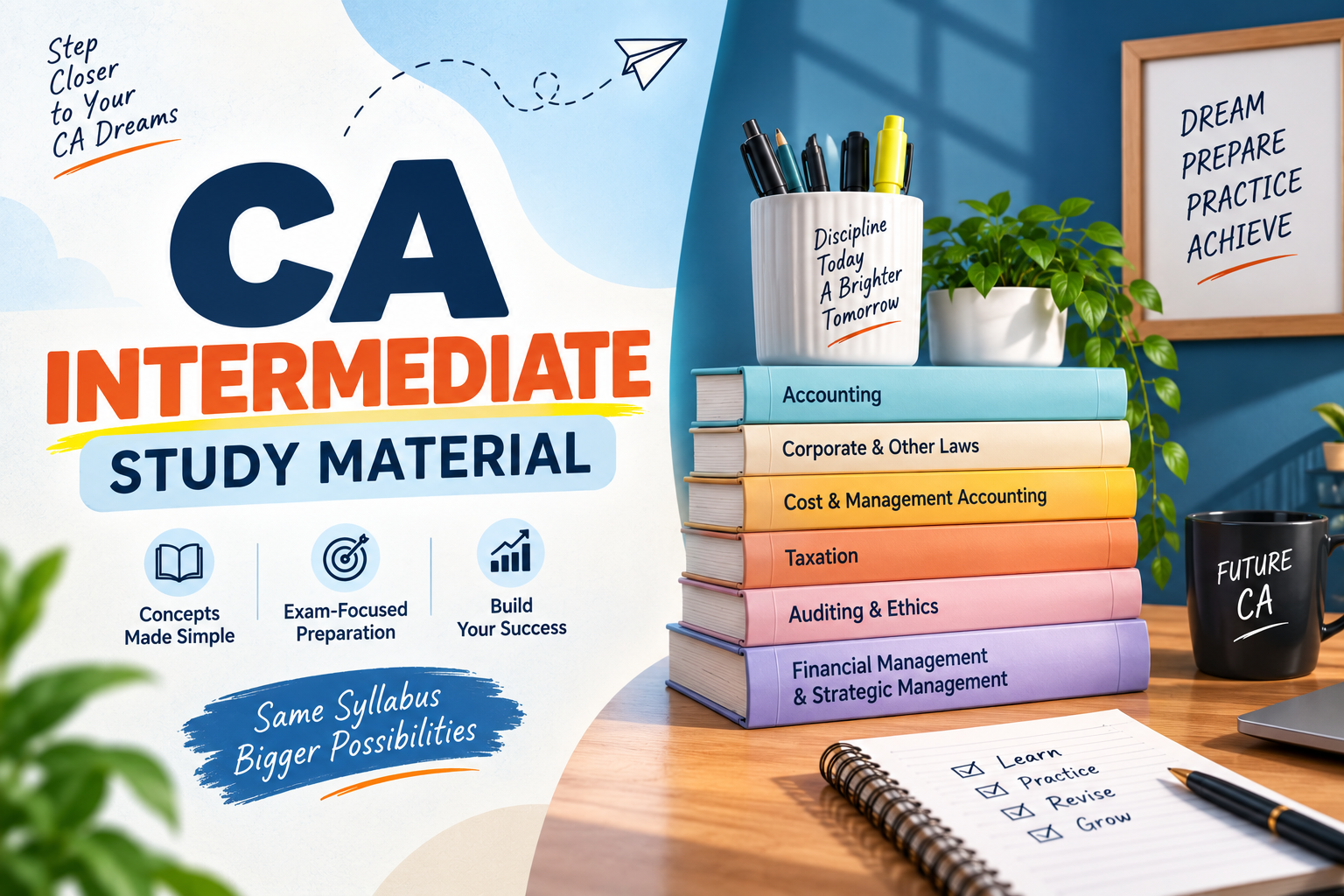
For January 2027 students, the CA Intermediate course under the New Scheme consists of six papers divided into two groups. Group 1 includes Advanced Accounting, Corporate and Other Laws, and Taxation. Group 2 includes Cost and Management Accounting, Auditing and Ethics, and Financial Management and Strategic Management.

This guide explains the CA Intermediate Study Material January 2027, subject-wise resources, how to use ICAI material effectively, what additional resources you should consider and how to build a practical preparation plan.

CA Intermediate January 2027: Subject-Wise Study Material

The first thing every student should understand is the structure of the course.

Group Paper Subject Marks
Group 1 Paper 1 Advanced Accounting 100
Group 1 Paper 2 Corporate and Other Laws 100
Group 1 Paper 3 Taxation 100
Group 2 Paper 4 Cost and Management Accounting 100
Group 2 Paper 5 Auditing and Ethics 100
Group 2 Paper 6 Financial Management and Strategic Management 100

Taxation is divided into Income-tax Law and GST, while Paper 6 is divided into Financial Management and Strategic Management.

This means your preparation should not be based on only one type of resource. You need a combination of concept learning, question practice, revision and exam-oriented testing.

1. CA Intermediate Advanced Accounting Study Material January 2027

Advanced Accounting is one of the subjects where conceptual clarity and regular problem-solving go hand in hand.

Reading the chapter once is not enough. You need to understand the accounting treatment, study the illustrations and then solve questions without looking at the solution.

For January 2027, students should use the applicable ICAI study material and then supplement it with revision-oriented resources.

How to Study Advanced Accounting

A practical sequence would be:

  1. Read the concept from the ICAI material.
  2. Understand the illustrations given after the concept.
  3. Solve the questions yourself.
  4. Mark questions where you made mistakes.
  5. Revise those questions after a few days.
  6. Practise RTP, MTP and previous examination questions.
  7. Attempt full-length papers before the examination.

The biggest mistake students make in Accounting is spending too much time reading and too little time writing.

Accounting is a practice subject.

If you understand a chapter today but do not solve questions for the next two weeks, your confidence may disappear when you sit down with a fresh question.

2. CA Intermediate Corporate and Other Laws Study Material January 2027

Corporate and Other Laws requires a different preparation approach.

Here, students need to balance understanding, provisions, keywords and answer presentation.

The official ICAI material should be your starting point because the applicable provisions and study content can change. ICAI currently lists separate Intermediate Corporate and Other Laws study material under the New Scheme and identifies the applicable examination cycle for updated editions.

How to Prepare Law

Do not try to memorise every paragraph word-for-word.

Instead, focus on:

  • Meaning of the provision
  • Important conditions
  • Exceptions
  • Time limits
  • Definitions
  • Penalties and consequences
  • Important keywords
  • Practical application
  • Exam-oriented questions

A good technique is to maintain a Law Revision Notebook.

Keep important provisions, difficult sections and commonly confused points in one place. During your final revision, this notebook can save a significant amount of time.

3. CA Intermediate Taxation Study Material January 2027

Taxation is divided into two parts:

  • Section A – Income-tax Law
  • Section B – Goods and Services Tax (GST)

For January 2027, students should be particularly careful about applicability and amendments.

Do not assume that an old taxation book or an old YouTube lecture automatically remains valid for your attempt.

ICAI’s official Taxation material identifies the applicable cycle for Income-tax Law and GST for the January 2027 examination.

Income Tax Preparation

Income Tax requires a mixture of:

  • Conceptual understanding
  • Provisions
  • Computation practice
  • Practical questions
  • Amendments
  • Repeated revision

Do not simply read solved examples. Cover the solution and try to calculate the answer yourself.

GST Preparation

GST becomes much easier when you understand the logic behind the provisions.

Prepare topics systematically and create short revision notes for:

  • Definitions
  • Supply
  • Time of supply
  • Place of supply
  • Input Tax Credit
  • Registration
  • Returns
  • Payment of tax
  • Relevant procedural provisions

Most importantly, keep your material updated according to the applicability prescribed for your examination.

4. CA Intermediate Cost and Management Accounting Study Material January 2027

Cost and Management Accounting is a subject where practice directly affects performance.

You may understand a formula today, but unless you solve enough questions, it is difficult to apply it quickly during the examination.

The ICAI’s current Intermediate Paper 4 material contains modules covering topics such as Material Cost, Employee Cost, Overheads, Activity Based Costing, Cost Sheet, Cost Accounting Systems, Unit and Batch Costing, Job Costing, Process Costing, Standard Costing, Marginal Costing and Budgets.

Best Approach for Costing

Create three categories of questions:

Category What to Do
Easy Solve quickly during revision
Moderate Practise regularly
Difficult Mark and revisit multiple times

Maintain a separate Formula + Mistake Book.

Whenever you make an error, write down why you made it. Was it a formula problem? Calculation mistake? Conceptual confusion? Wrong interpretation?

This small habit can make your final revision much more effective.

5. CA Intermediate Auditing and Ethics Study Material January 2027

Auditing is often considered a theory-heavy subject, but simply memorising paragraphs is not a reliable strategy.

The better approach is to understand why an audit procedure exists and what the auditor is expected to do.

Your preparation should include:

  • ICAI Study Material
  • Important concepts
  • Definitions
  • Standards and principles
  • Practical situations
  • RTPs
  • MTPs
  • Previous exam questions
  • Suggested Answers

How to Score Better in Audit

While revising, focus on important words and phrases.

For example, if a question asks about a specific responsibility, your answer should clearly address the requirement instead of writing a generic paragraph about auditing.

Practise writing answers within a time limit.

A student who knows the answer but cannot complete the paper on time can still lose marks.

6. CA Intermediate Financial Management and Strategic Management Study Material January 2027

Paper 6 consists of two sections:

Section A – Financial Management

Section B – Strategic Management

These two subjects require different preparation methods.

Financial Management

FM needs regular numerical practice.

Your preparation should include:

  • Formula revision
  • Concept understanding
  • Practical questions
  • Calculator speed
  • Mixed-question practice
  • Mock papers

Do not wait until the final month to start solving FM questions.

Strategic Management

SM requires structured revision.

Focus on:

  • Concepts
  • Keywords
  • Headings
  • Frameworks
  • Practical application
  • Question-answer practice

One useful technique is to convert long chapters into one-page revision sheets.

When the examination approaches, these short sheets become extremely useful.

What Is Included in ICAI CA Intermediate Study Material?

The official ICAI learning ecosystem contains much more than just the main textbook.

Students can use resources such as:

  • Study Material
  • Revision Test Papers
  • Suggested Answers
  • Mock Test Papers
  • Previous Year Question Papers
  • Saransh – Last Mile Referencer
  • Subject-specific capsules
  • Case studies and case scenarios
  • Amendments and developments
  • BoS announcements

ICAI’s Board of Studies specifically states that its academic work includes study material, RTPs, MTPs, Suggested Answers, practice questions and case studies. Its study material is also designed with learning aids such as diagrams, tables, flowcharts, illustrations and questions for practice.

That is why students should not treat the main textbook as the only resource.

ICAI Study Material vs Private Notes: What Should You Follow?

This is one of the most common questions among CA Intermediate students.

The answer is simple:

Use ICAI Study Material as your foundation and coaching notes as a support system.

Resource Main Purpose Priority
ICAI Study Material Concepts + official content Very High
Coaching Notes Simplified explanation High
RTP Revision + exam-oriented practice Very High
MTP Exam simulation Very High
Suggested Answers Answer presentation Very High
Previous Papers Understanding question trends High
Short Notes Fast revision High
Random PDFs Additional practice Low

The problem is not using multiple resources.

The problem is using too many resources without completing any of them properly.

How to Download CA Intermediate Study Material for January 2027?

Students should always check the latest material through the official ICAI Board of Studies resources.

ICAI maintains a dedicated Study Material section under the New Scheme and also provides its BoS Knowledge Portal for students.

Before downloading or studying any PDF, check:

  1. The subject name.
  2. The applicable examination attempt.
  3. Whether amendments are applicable.
  4. Whether the material is from the official ICAI source.
  5. Whether an updated version has been released.

This is especially important for subjects such as Taxation and Law, where changes can affect examination applicability.

CA Intermediate January 2027 Preparation Strategy

Having the right material is only half the job.

The other half is using it properly.

Phase 1: Concept Building

During your first study cycle, concentrate on understanding.

Do not worry too much about speed.

Your objective should be:

“Can I explain this concept to someone else?”

If yes, move ahead.

If not, revise before continuing.

Phase 2: Question Practice

After completing a chapter, immediately solve questions.

For practical subjects, this is non-negotiable.

For theory subjects, write answers rather than only reading them.

Phase 3: Revision

Your second revision should be faster.

This is where:

  • Short notes
  • Marked questions
  • Formulas
  • Important provisions
  • Charts
  • Tables

become useful.

Phase 4: RTP + MTP + Previous Papers

This phase should be treated seriously.

ICAI’s Mock Test Papers are specifically intended to help students assess preparation under examination-like conditions and identify weak areas.

Try to replicate the actual examination environment.

Sit for the complete duration.

Do not pause the paper.

Do not check answers midway.

Then evaluate your performance honestly.

How Many Times Should You Revise CA Intermediate Study Material?

There is no magical number.

Three effective revisions are usually better than six rushed revisions.

A practical approach can look like this:

Revision Objective
1st Understand the entire syllabus
2nd Strengthen weak concepts
3rd Exam-oriented revision
Final Rapid recall + important questions

Your final revision should not feel like the first time you are seeing the chapter.

If that happens, your earlier revisions were probably too passive.

Common Mistakes Students Make With CA Inter Study Material

1. Collecting Too Many Books

More PDFs do not automatically mean more preparation.

2. Ignoring ICAI Material

For CA examinations, students should not completely depend on private notes.

3. Avoiding Question Practice

Especially dangerous for Accounting, Costing, FM and Taxation.

4. Delaying Revision

Finishing the syllabus once is not the same as being exam-ready.

5. Ignoring Suggested Answers

Suggested Answers help students understand how answers are presented and evaluated.

6. Not Checking Applicability

Old material can create confusion, particularly in subjects affected by amendments.

7. Taking Mock Tests Too Late

Mock papers should be used before the final days, not only after completing everything.

How CA Mentoring Program Can Help With Your Preparation

Good study material gives you the content.

But many students still struggle with one question:

“What should I do next?”

That is where proper academic guidance can make a difference.

CA Mentoring Program can be used as a supportive platform for students who want more structured guidance during their CA preparation.

A mentor-oriented approach can help students identify weak areas, improve consistency, plan revisions and avoid wasting time on resources that do not contribute meaningfully to their preparation.

The goal should not be to study for 14 hours one day and then do nothing for two days.

A sustainable plan is much more useful.

CA Intermediate January 2027: Suggested Daily Study Structure

Every student’s schedule will be different, but a balanced day could look like this:

Study Block Focus
Morning Practical Subject
Midday Theory Subject
Evening Second Practical/Theory Subject
Night Revision + MCQs/Questions

You can also follow a 3 + 2 + 1 approach:

  • 3 hours – Main subject
  • 2 hours – Second subject
  • 1 hour – Revision/practice

The exact number of hours matters less than consistency.

If you have six hours available, use six hours properly.

If you have eight hours, use eight properly.

Do not compare your study hours with someone else’s timetable.

Final Checklist for CA Intermediate Study Material January 2027

Before entering your final preparation phase, make sure you have:

☐ Latest applicable ICAI Study Material
☐ Completed all six papers or your selected group
☐ Updated Taxation material
☐ Completed chapter-wise question practice
☐ Revised important Law provisions
☐ Practised Accounting, Costing and FM numericals
☐ Revised Audit and SM multiple times
☐ Completed applicable RTPs
☐ Attempted MTPs
☐ Solved previous examination questions
☐ Checked Suggested Answers
☐ Prepared short revision notes
☐ Taken full-length mock examinations

Final Thoughts

The CA Intermediate Study Material January 2027 should not be treated as just a collection of PDFs or books.

Your real study material ecosystem should include the ICAI Study Material + RTPs + MTPs + Suggested Answers + previous examination questions + your own revision notes.

ICAI’s current New Scheme resources provide students with a comprehensive set of academic and examination-oriented materials, while the BoS Knowledge Portal brings many of these resources together in one place.

The smartest approach is not to keep searching for a “secret book” that guarantees marks.

There isn’t one.

What works is much simpler: use the right material, complete it properly, revise it repeatedly and practise writing answers under exam conditions.

If you are preparing for January 2027, start by identifying the exact material applicable to your attempt. Then create a realistic timetable and stick to it.

And remember one thing: CA Intermediate preparation is a long game. You do not need to be perfect every day. You need to be consistent enough for the next several months.

That consistency—more than the number of books on your desk—can ultimately make the difference.

CA Foundation Study Material January 2027: Complete Guide, Subjects, Preparation Strategy & Resources

Preparing for the CA Foundation January 2027 examination can feel confusing when you have study material, books, revision notes, practice papers, mock tests and online classes coming from different sources. The bigger challenge is not finding material—it is knowing what to study, which material to prioritize and how to use it effectively.

For a first-time CA Foundation student, the right study material can make a huge difference. You do not need ten different books for every subject. What you need is a reliable core source, regular practice, proper revision and a realistic study plan.

The ICAI Board of Studies (BoS) provides students with study material and several supporting resources through its Knowledge Portal. The portal brings together study content, syllabus, revision test papers, mock test papers, suggested answers, announcements and other academic resources.

If you are preparing for CA Foundation January 2027, this guide will help you understand the study material, subject-wise preparation approach, revision resources and the right way to combine ICAI material with coaching or self-study.

CA Foundation January 2027: What Should Students Study?

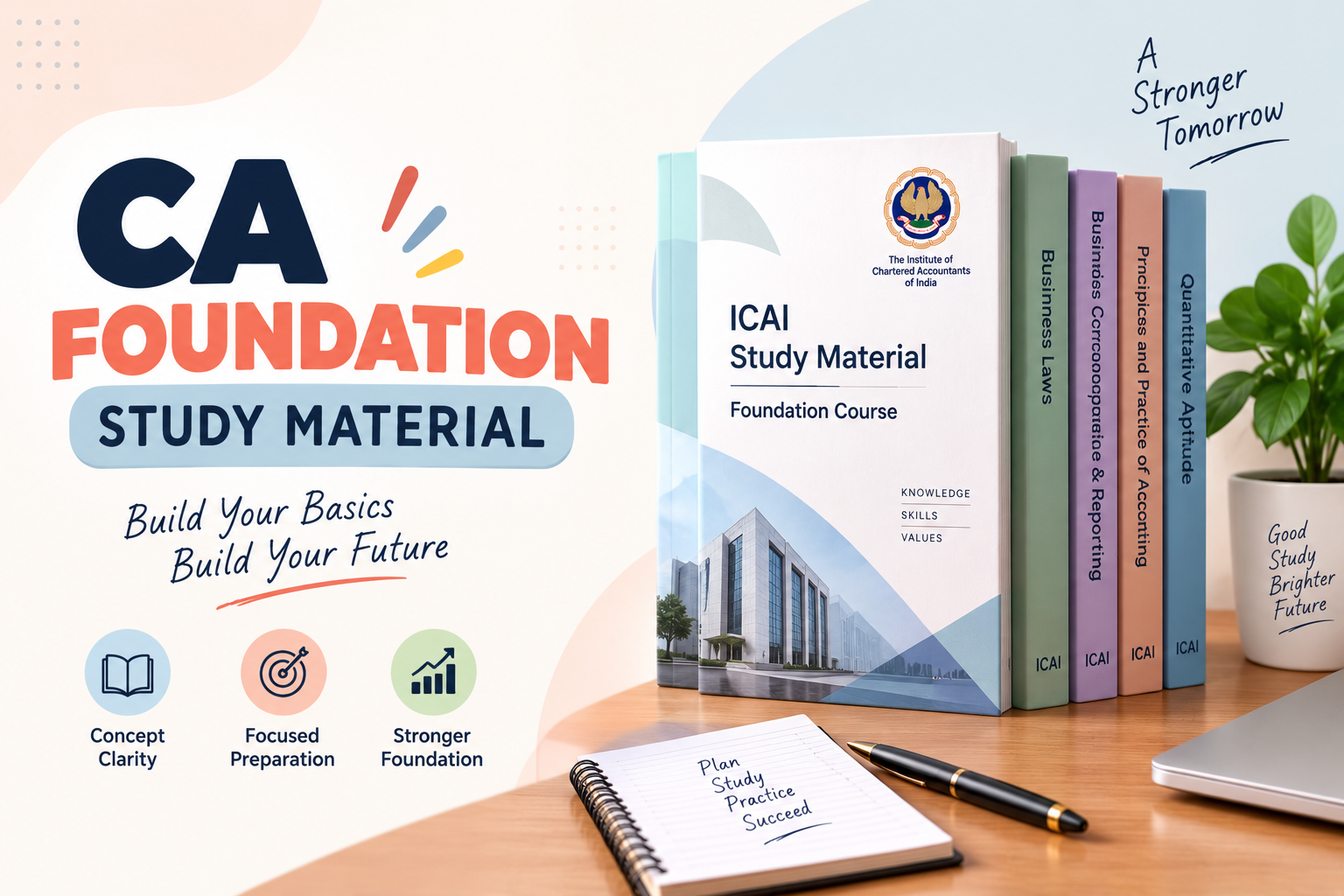
The CA Foundation course under the current scheme consists of four papers:

  1. Accounting
  2. Business Laws
  3. Quantitative Aptitude
  4. Business Economics

The ICAI’s Foundation course information also lists these four papers, with Quantitative Aptitude covering Business Mathematics, Logical Reasoning and Statistics.

The important thing to remember is that every subject requires a slightly different preparation strategy.

CA Foundation Paper Nature of Subject What You Should Focus On
Paper 1: Accounting Practical + Conceptual Concepts, illustrations, problems and repeated practice
Paper 2: Business Laws Theoretical Concepts, provisions, keywords and answer presentation
Paper 3: Quantitative Aptitude Practical Formulas, concepts, speed and accuracy
Paper 4: Business Economics Theoretical + Conceptual Understanding concepts, revision and MCQ practice

Instead of treating all four papers in exactly the same way, students should build a separate strategy for each.

Why ICAI Study Material Matters for CA Foundation January 2027

One of the most common mistakes made by Foundation students is collecting too many resources.

A student may have:

  • ICAI Study Material
  • Coaching notes
  • Faculty books
  • Short notes
  • YouTube lectures
  • Telegram PDFs
  • Previous-year papers
  • Test series
  • Revision charts

After a few weeks, the student has plenty of material but very little clarity about what to actually study.

The ICAI study material should remain one of your core resources.

ICAI’s BoS Knowledge Portal is specifically designed as a repository of student academic resources and provides paper-wise access to study materials along with revision test papers, mock test papers, suggested answers, study-related information and other resources.

This does not mean you cannot use coaching material. You absolutely can. The better approach is to use coaching notes to understand concepts and ICAI material to strengthen your preparation and align yourself with the examination framework.

A simple rule:

Learn from your preferred teacher → Read ICAI material → Practise questions → Revise → Test yourself.

That cycle is much more effective than continuously switching between books.

CA Foundation Study Material January 2027 – Subject-Wise Guide

1. CA Foundation Accounting Study Material

Accounting is a subject where reading alone will not be enough.

You may understand a chapter while watching a lecture, but the real test begins when you sit down with a question and have to solve it without help.

For Accounting, your preparation should include:

  • Concept reading
  • ICAI illustrations
  • Solved questions
  • Practice questions
  • Repeated revision
  • Full-length paper practice

Important areas should be studied systematically rather than randomly.

How to use the Accounting Study Material

Start with the concept. Understand why a particular accounting treatment is used. Then work through the illustrations yourself.

Do not simply highlight the solution.

Close the book and try the question independently.

If you make a mistake, mark the reason for the mistake. Was it a conceptual error? Calculation error? Journal entry error? Did you forget a treatment?

This small habit can improve your preparation considerably.

Accounting Preparation Formula

Concept → Illustration → Practice → Error Analysis → Revision

For students targeting a strong score in January 2027, Accounting should receive consistent practice throughout the preparation period.

2. CA Foundation Business Laws Study Material

Business Laws is different from Accounting.

Here, understanding the concept is important, but how you write and present the answer also matters.

Students often make the mistake of trying to memorize entire paragraphs. That can become difficult when the syllabus is large.

Instead, focus on:

  • Understanding the provision
  • Identifying important legal terms
  • Understanding the situation given in the question
  • Applying the relevant provision
  • Writing a logical conclusion

A good answer should demonstrate that you understand the legal point instead of simply reproducing random lines.

How to Study Business Laws

Read the chapter carefully first.

Then create short revision points for:

  • Definitions
  • Important provisions
  • Exceptions
  • Conditions
  • Rights and duties
  • Important concepts

After completing a chapter, solve questions without immediately looking at the answer.

For revision, your short notes should help you recall the complete concept quickly.

3. CA Foundation Quantitative Aptitude Study Material

Quantitative Aptitude includes:

  • Business Mathematics
  • Logical Reasoning
  • Statistics

For many students, this paper becomes a scoring opportunity once the basics are clear.

However, there is one catch: speed matters.

You can know the formula and still lose marks if you take too long to solve a question.

Therefore, your preparation should include timed practice.

A Better Approach for Quantitative Aptitude

First understand the formula and concept.

Then solve basic questions.

After that, move towards exam-level questions.

Once you are comfortable, start solving questions with a timer.

Keep a separate formula notebook containing:

  • Important formulas
  • Short methods
  • Frequently used concepts
  • Common mistakes
  • Difficult questions

During revision, this notebook can save a lot of time.

4. CA Foundation Business Economics Study Material

Business Economics can become easier when you focus on understanding instead of memorizing every line.

The subject contains concepts that become much simpler when you connect them with real-world business situations.

For example, instead of memorizing a definition mechanically, ask yourself:

“What does this actually mean in a business environment?”

This makes revision easier.

For Economics preparation, focus on:

  • Concept clarity
  • Important terminology
  • Graphs and relationships where applicable
  • Chapter-wise revision
  • MCQ practice
  • Repeated testing

After completing a chapter, try explaining the concept to yourself in simple language.

If you can explain it without opening the book, you probably understand it.

ICAI Study Material vs Coaching Notes: What Should You Follow?

This is one of the most searched questions among CA Foundation students.

The answer is simple: you do not necessarily have to choose only one.

Both resources have different purposes.

Resource Best Used For
ICAI Study Material Primary academic reference and syllabus-aligned study
Coaching Notes Simplified explanation and quick revision
Faculty Lectures Concept clarity
RTPs Exam-oriented practice
MTPs Mock examination experience
Previous Papers Understanding question patterns
Short Notes Last-minute revision
Test Series Time management and performance analysis

The mistake is not using multiple resources.

The mistake is using too many resources without a system.

Choose one primary learning source and use the remaining resources to support it.

Is ICAI Study Material Enough for CA Foundation January 2027?

For many students, ICAI study material can form the foundation of preparation. However, “enough” depends on how you use it.

Simply reading the study material once is not preparation.

You need to combine it with:

  • Concept learning
  • Question practice
  • RTPs
  • Mock tests
  • Revision
  • Previous examination questions
  • Regular self-assessment

The ICAI BoS ecosystem includes study material as well as revision and testing resources, which means students can build a substantial preparation system around official academic resources.

If you are taking online coaching, use your classes for explanation and doubt-solving while keeping the official study material as an important reference point.

What Other Resources Should CA Foundation January 2027 Students Use?

Study material is only one part of preparation.

A serious preparation strategy should include several stages.

1. Study Material

Use it for detailed learning and understanding.

2. Revision Test Papers

RTPs can help you understand the type of questions and concepts being emphasized for a particular examination.

3. Mock Test Papers

MTPs are useful for testing your preparation under examination-like conditions.

4. Suggested Answers

Suggested answers can help you understand how answers are expected to be approached and presented.

5. Previous-Year Questions

These help you become familiar with question styles and recurring concepts.

6. Self-Made Revision Notes

These are especially useful during the final revision.

The ICAI BoS portal lists resources such as revision test papers, mock test papers and suggested answers alongside study material.

How to Make a CA Foundation January 2027 Study Plan

A good study plan does not have to look impressive on paper.

It has to be realistic enough to follow every day.

For example, a student preparing alongside college may not be able to study 10–12 hours every day. Instead of creating an unrealistic schedule, create a timetable around your actual routine.

Example Daily Study Structure

Study Block Activity
Morning New concept / difficult subject
Afternoon Lecture or concept learning
Evening Question practice
Night Revision + short notes
Weekly Mock/test + error analysis

The most important part is consistency.

Studying for six hours one day and doing nothing for the next two days is less effective than maintaining a manageable routine every day.

90-Day Strategy for CA Foundation January 2027

If you have approximately three months for preparation, divide your preparation into three stages.

Phase 1: Concept Building

First 45 days

Focus on completing the syllabus and understanding concepts.

Do not worry about achieving perfect speed at this stage.

Your priority should be:

Understanding > Completion > Revision

Phase 2: Practice & Revision

Next 25–30 days

Start revising completed chapters while solving questions.

Focus on identifying weak areas.

Create an error list.

For example:

Problem Reason Action
Accounting mistake Concept unclear Re-read concept
Law answer incomplete Poor presentation Practise answer writing
Maths calculation error Lack of speed Timed practice
Economics wrong MCQ Confusion between concepts Revise comparison notes

This error notebook can become one of your most useful resources.

Phase 3: Final Revision

The final weeks should not be spent learning everything from scratch.

This is where your earlier preparation pays off.

Focus on:

  • Revision notes
  • Important concepts
  • Formula revision
  • Difficult questions
  • RTPs
  • MTPs
  • Previous questions
  • Mock tests
  • Mistakes from earlier tests

Avoid starting a completely new book during the final days unless there is a genuine reason.

How Much Study Material Should You Use?

This is where students often make preparation unnecessarily complicated.

You don’t need:

5 books + 3 teachers + 10 PDFs + unlimited YouTube videos.

Instead, create a simple resource hierarchy.

Recommended Resource Hierarchy

Level 1 – Core

ICAI Study Material

Level 2 – Learning Support

One reliable coaching/faculty resource

Level 3 – Practice

RTP + MTP + previous questions

Level 4 – Revision

Your own short notes + marked questions

This system keeps preparation focused.

Common Mistakes Students Make While Using CA Foundation Study Material

Mistake 1: Reading Without Practising

Reading Accounting or Quantitative Aptitude for hours without solving questions creates a false sense of preparation.

Mistake 2: Ignoring Theory Subjects

Some students postpone Business Laws and Economics until the last month.

That is risky.

Mistake 3: Collecting Too Many PDFs

More PDFs do not automatically mean more knowledge.

Mistake 4: Avoiding Mock Tests

A student may know the syllabus but still struggle to complete the paper on time.

Tests reveal this problem before the actual examination.

Mistake 5: Not Analysing Mistakes

Giving a test is only half the job.

The real benefit comes from checking:

Why did I lose the marks?

Mistake 6: Starting Revision Too Late

Revision should happen continuously rather than only during the final week.

How CA Mentoring Program Can Support Your Preparation

Preparing for CA Foundation can sometimes feel lonely, particularly when you are studying from home and don’t know whether your preparation is moving in the right direction.

This is where proper guidance can make the journey more structured.

CA Mentoring Program can be positioned as a support system for students who want guidance, accountability and a more organized approach to CA preparation.

A mentoring-focused approach can help students with areas such as:

  • Study planning
  • Consistency
  • Goal setting
  • Revision planning
  • Exam preparation
  • Identifying weak areas
  • Motivation and accountability

The idea is not to replace the student’s hard work.

Rather, the objective should be to make that hard work more planned and purposeful.

CTA: Start Your CA Foundation Preparation With the Right Guidance

If you are targeting CA Foundation January 2027, don’t wait until the final weeks to decide how you will prepare.

Build your study plan, organize your resources and start working consistently.

Explore CA preparation guidance with CA Mentoring Program.

CA Foundation January 2027 Preparation Checklist

Before moving deeper into your preparation, make sure you have these resources organized:

Preparation Requirement Status
ICAI Study Material ✓
Subject-wise Study Plan ✓
Faculty/Coaching Resource ✓
Chapter-wise Practice ✓
Revision Notes ✓
RTPs ✓
MTPs ✓
Previous Questions ✓
Mock Test Schedule ✓
Error Notebook ✓
Final Revision Plan ✓

Keep this checklist somewhere visible.

It sounds simple, but seeing your preparation progress can keep you motivated during the long preparation cycle.

A Practical Strategy for Students Starting Late

If you are reading this article and thinking:

“I haven’t started properly yet. Can I still prepare for January 2027?”

Don’t spend the next few days worrying about the time you have already lost.

Start with today’s available time.

First, understand your remaining syllabus.

Then divide chapters according to difficulty.

Start with the subjects or chapters that need the most attention, while continuing regular revision of easier areas.

Most importantly, avoid the temptation to finish the syllabus at any cost and leave no time for revision.

A better target is:

Complete → Revise → Practise → Test → Improve

That cycle should continue until the examination.

What Makes Good CA Foundation Study Material?

Good study material should not merely contain information.

It should help you answer four questions:

  1. What do I need to learn?
  2. Do I understand the concept?
  3. Can I solve or answer questions based on it?
  4. Can I recall it during the examination?

If a resource helps you move through all four stages, it is useful.

That is why students should not judge study material only by its page count or number of questions.

The real value lies in how effectively you can use it.

Final Thoughts on CA Foundation Study Material January 2027

The CA Foundation January 2027 examination is not something you should prepare for by constantly searching for “the best book” or “the best PDF.”

The most effective preparation usually comes from a simple system followed consistently.

Keep the ICAI Study Material at the center of your academic preparation. Use lectures or coaching resources when you need better conceptual explanations. Practise questions regularly. Use RTPs, MTPs and previous questions to test yourself. Revise repeatedly and maintain an error notebook.

ICAI’s current student resources provide a structured ecosystem around study material, revision, mock tests and other learning resources, while its Knowledge Portal is intended to bring these resources together for students.

And remember one thing: CA Foundation is your first step into the CA journey.

You do not need to know everything on Day 1.

You simply need to keep improving every day.

If you are targeting January 2027, start with the material you need, create a realistic timetable and stay consistent. With the right resources, proper guidance and disciplined revision, your preparation can become much more manageable.

Your goal should not be to study everything available. Your goal should be to study the right things well.

ICAI Study Material Jan 2027: Complete Guide for CA Foundation, Intermediate & Final Students

Preparing for the CA examination is not only about studying for long hours. It is about studying the right material at the right time.

For students appearing in the January 2027 CA examinations, one question becomes especially important: Which ICAI study material should I follow?

With changes in the CA curriculum, updated editions, amendments, Revision Test Papers (RTPs), Mock Test Papers (MTPs), and subject-wise applicability dates, it is easy for students to get confused. Many students download multiple PDFs from different sources and end up spending more time deciding what to study than actually studying.

The safest approach is simple: make the latest applicable ICAI study material your primary source and then supplement it with the relevant RTPs, amendments, MTPs and past examination questions.

ICAI’s Board of Studies provides study content through its academic resources, including course-wise and paper-wise study material. Its current resources also show subject-specific applicability information, which means students should always verify the material applicable to their particular examination attempt rather than relying on an old PDF or a random online compilation.

If you are preparing for January 2027, this guide will help you understand how to use ICAI Study Material effectively and build a preparation strategy around it.

What Is ICAI Study Material?

ICAI Study Material is the academic material prepared and provided by the Institute of Chartered Accountants of India (ICAI) for students pursuing the CA course.

It is designed according to the applicable syllabus and provides the core concepts, provisions, illustrations, practical questions, case-based situations and other learning content required for examination preparation.

For a CA student, study material should not be treated as just another book.

It should be the foundation of your preparation.

Coaching notes can make concepts easier to understand. Revision books can help you revise faster. Test series can improve your answer-writing and exam temperament. But when it comes to understanding what ICAI expects students to study, the Institute’s own material deserves priority.

ICAI also provides additional academic resources such as announcements, revision material, mock tests and other examination-oriented resources through its Board of Studies ecosystem.

ICAI Study Material Jan 2027: Why It Matters

The January 2027 attempt is particularly important for students who want to prepare early instead of depending entirely on last-minute revision.

A common mistake among CA students is to start collecting resources without first identifying the applicable material.

For example, a student may have:

  • An old ICAI study material PDF
  • Coaching notes from an earlier batch
  • An old RTP
  • Previous-year amendments
  • A question bank
  • Multiple revision books

Having more resources does not automatically mean better preparation.

In fact, too many resources can create confusion.

A better approach is:

ICAI Study Material → Amendments/Updates → RTP → MTP → Previous-Year Questions → Revision/Test Practice

This keeps preparation organised and reduces the chances of studying irrelevant content.

ICAI Study Material for January 2027: What Should Students Check?

Before beginning preparation, check these five things:

Checkpoint What You Should Verify
Course Foundation, Intermediate or Final
Attempt January 2027
Scheme Applicable scheme of education and training
Subject Exact paper you are preparing
Applicability Edition, amendments, RTP/MTP and other updates

This is important because the applicable material can vary between subjects and examination attempts.

For instance, ICAI has already published subject-wise material showing applicability for later examinations. The Intermediate Taxation material, for example, carries applicability information covering May 2027, September 2027 and January 2028 for the relevant section.

Similarly, ICAI has published new-scheme subject material with specific examination applicability for Intermediate papers.

Therefore, students should not assume that one edition applies to every CA examination.

ICAI Study Material Jan 2027 for CA Foundation

CA Foundation is the first major academic stage of the Chartered Accountancy journey.

Students appearing for January 2027 should focus on understanding the syllabus and building strong fundamentals instead of trying to finish every available book in the market.

The Foundation course currently consists of four papers:

  1. Accounting
  2. Business Laws
  3. Quantitative Aptitude
  4. Business Economics

ICAI’s official student resources list these four Foundation papers under the current course structure.

How Foundation Students Should Use ICAI Material

For Foundation students, the study material should be used differently for different subjects.

Accounting

Read the concepts first and then solve the illustrations and questions.

Do not simply watch lectures and assume that the chapter is complete. Accounting requires practice.

A useful routine is:

Concept → Illustration → Practice Questions → Revision → Test

Business Laws

Law requires repeated reading.

While studying the ICAI material, focus on:

  • Definitions
  • Provisions
  • Exceptions
  • Conditions
  • Practical situations
  • Important terminology

Do not try to memorise entire paragraphs blindly. Understand what the provision means and then learn how ICAI frames the answer.

Quantitative Aptitude

For Quantitative Aptitude, practice matters more than passive reading.

Maintain a formula notebook and regularly solve questions without looking at the solution.

Business Economics

Understand the logic behind economic concepts rather than treating the subject as pure memorisation.

Make short revision notes after completing each chapter.

ICAI Study Material Jan 2027 for CA Intermediate

CA Intermediate is where students generally experience a significant jump in the depth and complexity of the syllabus.

The current Intermediate course includes six papers divided into two groups.

Group 1

Paper Subject
Paper 1 Advanced Accounting
Paper 2 Corporate and Other Laws
Paper 3 Taxation

Group 2

Paper Subject
Paper 4 Cost and Management Accounting
Paper 5 Auditing and Ethics
Paper 6 Financial Management and Strategic Management

ICAI’s current academic search results list subject-wise study material for these papers and specify applicability for relevant examinations.

Why ICAI Material Is Important at Intermediate Level

At Intermediate, students often depend heavily on coaching notes.

Coaching can certainly help with understanding difficult topics, but students should not completely ignore ICAI material.

The Institute’s material can help students become familiar with:

  • Terminology
  • Practical application
  • Conceptual presentation
  • Case-based questions
  • Subject-specific language
  • Examples and illustrations

For subjects such as Law, Audit and Taxation, this becomes particularly important.

ICAI Study Material Jan 2027 for CA Final

CA Final preparation requires a more analytical approach.

At this stage, simply reading chapters repeatedly is not enough.

Students need to understand concepts, apply provisions, solve practical questions and develop the ability to handle integrated case-based situations.

The current Final structure includes:

Group 1

  • Financial Reporting
  • Advanced Financial Management
  • Advanced Auditing, Assurance and Professional Ethics

Group 2

  • Direct Tax Laws & International Taxation
  • Indirect Tax Laws
  • Integrated Business Solutions

ICAI’s examination resources identify these papers under the Final course structure.

For Final students, the study material should therefore be combined with:

  • Amendments
  • RTPs
  • MTPs
  • Previous-year examination questions
  • Case-study practice
  • Revision
  • Timed writing practice

ICAI Study Material vs Coaching Notes: Which Should You Study?

This is one of the most common questions among CA students.

The answer is: you do not necessarily have to choose only one.

Use them for different purposes.

ICAI Study Material Coaching Material
Official academic source Simplified learning source
Closely aligned with ICAI curriculum Often easier for first-time learning
Useful for terminology and concepts Useful for lectures and revision
Includes illustrations and questions Usually structured around teaching methodology
Important for self-study Useful for difficult topics

The smartest strategy is to use coaching resources for understanding and ICAI material for alignment and reinforcement.

How to Download ICAI Study Material for January 2027

Students should obtain their material from official ICAI academic resources whenever possible.

The ICAI Board of Studies Knowledge Portal functions as a central academic repository where students can access course and paper-wise resources, including study material and other examination-related content.

The basic process is:

  1. Visit the official ICAI/BoS academic resources.
  2. Select your course.
  3. Select the relevant paper.
  4. Check the examination applicability.
  5. Download the latest applicable material.
  6. Check whether amendments, RTPs or other updates are required.
  7. Keep the files organised subject-wise.

Do not rely solely on a Google search result saying “latest ICAI study material” because an old PDF can continue to appear online even after a newer version has been released.

What About RTP for January 2027?

RTP stands for Revision Test Paper.

It is an important part of CA examination preparation because it gives students additional examination-oriented questions and helps them understand how concepts may be tested.

However, RTP should not replace the study material.

A good sequence is:

Study Chapter → Revise Chapter → Solve ICAI Questions → Attempt RTP → Analyse Mistakes

Students should avoid opening the RTP for the first time one or two days before the examination.

Use it as a revision tool throughout preparation.

What About MTP for January 2027?

MTP stands for Mock Test Paper.

Mock tests are useful for understanding whether you can actually apply what you have studied under examination conditions.

Reading a chapter and feeling confident is very different from solving questions within a fixed time.

A proper mock test can reveal:

  • Time-management problems
  • Weak chapters
  • Calculation mistakes
  • Presentation issues
  • Poor question selection
  • Lack of revision
  • Difficulty recalling provisions

Therefore, students should take MTPs seriously.

How to Use ICAI Study Material Without Feeling Overwhelmed

A large syllabus can look frightening when you see everything together.

Instead of thinking:

“I have so much left to study.”

Think:

“What is the next chapter I need to complete?”

Break your preparation into smaller targets.

Step 1: Understand the Syllabus

Make a subject-wise chapter list.

Step 2: Mark Difficult Topics

Identify chapters that need lectures or additional explanation.

Step 3: Complete the First Reading

Do not aim for perfection during the first reading.

Your goal should be understanding.

Step 4: Solve Questions

After studying a topic, solve relevant questions.

Step 5: Revise

Revision converts familiarity into retention.

Step 6: Test Yourself

Attempt RTPs, MTPs and previous examination questions.

Step 7: Analyse

Do not just check your marks.

Find out why you lost marks.

A Practical Study Plan for January 2027

If you are preparing for January 2027, avoid creating an unrealistic timetable with 14–16 hours of study every day.

Consistency is more valuable than extreme schedules.

A practical weekly structure can look like this:

Activity Suggested Focus
Concept Learning 45–50%
Question Practice 20–25%
Revision 15–20%
RTP/MTP/PYQ 10–15%

These percentages are not fixed rules. Your study pattern should depend on your level, remaining syllabus and personal strengths.

For example, a student weak in Accounting may need substantially more question practice, while a student struggling with Law may need more revision and writing practice.

Common Mistakes Students Make With ICAI Study Material

1. Studying an Old Edition

This is one of the biggest mistakes.

Always check applicability for your attempt.

2. Collecting Too Many PDFs

More PDFs do not equal more marks.

3. Ignoring ICAI Questions

Students sometimes solve coaching questions but skip questions given in the official material.

That is not a good strategy.

4. Leaving RTP and MTP Until the End

These resources should become part of your preparation, not just emergency material.

5. Reading Without Solving

Especially in practical subjects, passive reading creates false confidence.

6. Ignoring Amendments

For subjects affected by amendments, studying an outdated provision can create serious problems.

7. Not Revising

The first reading gives you familiarity. Revision builds retention.

Why Students Should Follow Official Updates

CA syllabus and academic resources can change.

This is particularly important for subjects involving laws, taxation, accounting standards and other areas where updates can affect examination applicability.

ICAI regularly publishes announcements and course-specific academic information. Its search system currently includes January 2027-related announcements, including the commencement of Live Virtual Classes for Foundation students appearing in January 2027.

That is why students should develop one simple habit:

Check the official ICAI update before finalising your study material.

How CA Mentoring Program Can Help With Your Preparation

Having the right study material is important, but knowing how to use it is equally important.

CA Mentoring Program can be used as a supportive learning resource for students who want more structured guidance during their CA preparation.

The goal should not be to replace ICAI material.

Instead, students can combine official study material with proper guidance, conceptual learning, revision planning and regular practice.

A good preparation system should answer four questions:

  1. What do I need to study?
  2. How should I study it?
  3. When should I revise it?
  4. How do I know whether I am exam-ready?

That is where structured mentoring can make preparation more manageable.

Final Strategy for ICAI Study Material Jan 2027

If you remember only one thing from this article, remember this:

Do not confuse preparation with collecting resources.

For the January 2027 attempt, build your preparation around the applicable ICAI study material and then add the resources that actually improve your performance.

Your preparation can follow this simple cycle:

ICAI Study Material
↓
Concept Understanding
↓
Question Practice
↓
Revision
↓
RTP
↓
MTP
↓
Previous-Year Questions
↓
Mock Exam
↓
Mistake Analysis
↓
Final Revision

This approach is much more effective than jumping between five different books for the same chapter.

The CA journey is long, and every student’s preparation style will be different. Some students understand concepts quickly but struggle with revision. Others require more practice before they become confident. Some need mentoring to stay consistent.

There is no single timetable that works for everyone.

But one principle remains useful for almost every CA student:

Study the right material, revise it multiple times, practise questions regularly and keep checking official ICAI updates for your examination attempt.

For January 2027 aspirants, starting with the correct study material can remove a lot of unnecessary confusion and give your preparation a clear direction.

And remember—your goal is not to finish the maximum number of books.

Your goal is to understand the syllabus well enough to write the examination confidently.

CA Intermediate Course January 2027: Complete Guide to Syllabus, Preparation, Study Plan & Success

Clearing CA Foundation feels like a big achievement—and it is. But once you enter CA Intermediate, the preparation game changes.

The syllabus becomes deeper, questions require stronger conceptual understanding, and simply completing lectures is no longer enough. You need a system that combines concept clarity, question practice, revision, mock tests and performance analysis.

If you are planning to appear for the CA Intermediate January 2027 examination, now is the right time to start thinking beyond just “finishing the syllabus.”

The Institute of Chartered Accountants of India (ICAI) currently lists six papers under the Intermediate New Scheme: three in Group I and three in Group II. Group I consists of Advanced Accounting, Corporate and Other Laws, and Taxation, while Group II consists of Cost and Management Accounting, Auditing and Ethics, and Financial Management and Strategic Management.

ICAI’s official announcements have also specifically included students appearing for the January 2027 Intermediate examination in its academic and Live Virtual Classes announcements.

This guide is designed for students who want to prepare seriously for January 2027—whether you are studying both groups or planning to appear for one group at a time.

Why CA Intermediate Is Different from CA Foundation

At Foundation level, many students are still learning how to approach professional examinations.

Intermediate demands a more mature preparation style.

You cannot rely only on:

  • Watching lectures
  • Reading notes
  • Memorising answers
  • Solving questions occasionally
  • Studying intensely just before exams

Instead, you need to develop a cycle:

Learn → Understand → Practise → Test → Analyse → Revise

That cycle should continue throughout your preparation.

The biggest shift is this:

At Intermediate level, studying is not the same as preparing for the examination.

You may complete every lecture and still feel underprepared if you have not solved enough questions or tested yourself.

CA Intermediate January 2027 Subjects

Under the current New Scheme, CA Intermediate has six papers divided into two groups.

Group Paper Subject Main Preparation Requirement
Group I Paper 1 Advanced Accounting Concepts + Practical Questions
Group I Paper 2 Corporate and Other Laws Conceptual Understanding + Answer Writing
Group I Paper 3 Taxation Concepts + Problem Solving + Updates
Group II Paper 4 Cost and Management Accounting Concepts + Numerical Practice
Group II Paper 5 Auditing and Ethics Concept Clarity + Revision
Group II Paper 6 Financial Management and Strategic Management Numericals + Conceptual Theory

This six-paper structure should be the starting point for your preparation plan.

Do not create your timetable simply around the number of chapters. Create it around the type of preparation each subject requires.

CA Intermediate January 2027 Syllabus: How to Approach It

The latest applicable ICAI study material should always be your primary reference when preparing for the examination. ICAI provides syllabus and study-material resources under the New Scheme through its official platforms.

One important point for January 2027 aspirants is taxation.

ICAI’s current material specifically identifies the Income-tax Law and GST material applicable to the January 2027 examination.

Therefore, students should avoid blindly using old notes, old lectures or outdated amendment compilations.

Always check the applicability mentioned by ICAI before finalising your preparation material.

Group I: What Should You Focus On?

1. Advanced Accounting

Advanced Accounting is not a subject where passive reading will take you very far.

The more you practise, the more comfortable you become with adjustments, formats and different types of questions.

Your preparation should involve:

  • Understanding accounting standards and concepts
  • Studying illustrations carefully
  • Solving ICAI questions
  • Practising without looking at solutions
  • Maintaining an error notebook
  • Revising difficult adjustments
  • Attempting timed tests

A useful strategy is to solve a question yourself before checking the solution.

Even if your answer is wrong, that struggle is useful because it shows exactly where your understanding needs improvement.

A simple rule:

Read less passively. Solve more actively.

2. Corporate and Other Laws

Law can become one of the most frustrating subjects if you try to memorise everything word-for-word.

Instead, understand the structure of each provision.

Ask yourself:

  • What is the provision?
  • Why does it exist?
  • What are its conditions?
  • Are there exceptions?
  • How would it apply to a practical situation?
  • How should I present it in the examination?

Make short revision notes containing keywords, conditions, exceptions and important provisions.

Most importantly, practise writing answers.

Knowing a provision and presenting it effectively are two different skills.

3. Taxation

Taxation requires regular attention because it combines conceptual understanding with practical application.

For January 2027 preparation, students should pay particular attention to the latest ICAI-applicable study material and statutory updates. ICAI’s official resources distinguish material according to examination applicability, including January 2027.

A strong Tax preparation routine includes:

  1. Learn the concept.
  2. Understand the relevant provision.
  3. Study illustrations.
  4. Solve practical questions.
  5. Revise regularly.
  6. Keep track of applicable amendments and updates.
  7. Attempt exam-oriented tests.

Do not leave Taxation entirely for the end.

It becomes much easier when studied consistently.

Group II: What Should You Focus On?

4. Cost and Management Accounting

Costing rewards practice.

If you understand the basic logic behind a calculation but do not solve enough questions, you may still struggle during the examination.

Your preparation should focus on:

  • Understanding formulas
  • Knowing the logic behind calculations
  • Solving illustrations
  • Practising different question patterns
  • Working on calculation speed
  • Revising frequently used formulas
  • Attempting timed tests

Keep a separate formula and mistake sheet.

When revising, do not simply read the formula.

Solve at least one representative question with it.

5. Auditing and Ethics

Auditing is often underestimated.

Students sometimes read the chapters repeatedly but find it difficult to reproduce the concepts during the examination.

The solution is active revision.

While studying Audit, focus on:

  • Understanding the purpose of each concept
  • Identifying keywords
  • Creating chapter-wise revision notes
  • Practising questions
  • Revising repeatedly
  • Learning how to structure answers
  • Testing yourself without looking at the book

Audit is a subject where multiple revisions can make a significant difference.

6. Financial Management and Strategic Management

This paper combines two different styles of preparation.

Financial Management

FM requires:

  • Concept clarity
  • Formula knowledge
  • Numerical practice
  • Speed
  • Accuracy
  • Regular revision

Strategic Management

SM requires:

  • Conceptual understanding
  • Keyword-based revision
  • Repeated reading
  • Practical understanding
  • Proper answer presentation

Do not use exactly the same preparation method for FM and SM simply because they are part of the same paper.

Treat them as two different subjects within your preparation.

How Much Time Should You Give to CA Intermediate January 2027?

There is no universal number of study hours that guarantees success.

A student who studies five focused hours may make better progress than someone who sits with books for ten hours but spends half the time distracted.

Instead of asking:

“How many hours should I study?”

Ask:

“What did I actually complete today?”

A practical study structure could look like this:

Activity Suggested Daily Time
Main Subject Learning 2–3 Hours
Second Subject 1.5–2 Hours
Question Practice 1.5–2 Hours
Revision 45–60 Minutes
MCQs/Test Practice 30–60 Minutes

This is only a framework. Your actual schedule should depend on your classes, college, work, commute and current preparation level.

CA Intermediate January 2027 Study Plan

The best study plan is one you can follow for months—not one that looks impressive for three days.

Divide your preparation into four stages.

Stage 1: Concept Building

During the first stage, focus on understanding.

Your priorities should be:

  • Complete lectures/classes systematically
  • Read ICAI material
  • Understand concepts
  • Solve basic questions
  • Prepare short notes
  • Identify difficult chapters

Do not rush simply to increase your completed-chapter count.

A chapter is not really complete until you understand it and can solve basic questions from it.

Stage 2: First Revision

Once a subject starts reaching completion, revision should begin immediately.

Do not wait for all six papers to finish.

Use a rolling revision system:

New Topic + Previous Topic Revision + Question Practice

For example:

If you study Taxation for two hours today, spend 30–45 minutes revising yesterday’s topic.

This prevents the “I studied it two months ago but remember nothing now” problem.

Stage 3: Intensive Practice

Now increase the number of questions.

Focus on:

  • ICAI questions
  • Illustrations
  • Previous examination questions
  • Mock tests
  • Revision test papers
  • Case-based questions
  • Time-bound practice

At this stage, your goal is no longer just knowledge.

Your goal is exam readiness.

Stage 4: Final Revision

The final phase should be about refinement.

Focus on:

  • Weak chapters
  • Important concepts
  • Formula revision
  • Amendments
  • Repeated mistakes
  • Mock-test analysis
  • Time management

Avoid making major changes to your resources at this stage.

How to Divide Your Time Between CA Intermediate Subjects

A common mistake is giving equal time to every subject simply because there are six papers.

Your time allocation should also depend on:

  • Your current strength
  • Your conceptual understanding
  • The size of the syllabus
  • Your practice requirement
  • Your previous test performance

A sample weekly distribution could be:

Subject Priority
Advanced Accounting High Practice
Corporate & Other Laws High Revision
Taxation High Concept + Practice
Cost & Management Accounting High Practice
Auditing & Ethics High Revision
FM & SM Mixed Practice + Revision

This does not mean one subject is more important than another.

It simply recognises that different subjects need different types of effort.

Should You Prepare One Group or Both Groups?

This is one of the most important decisions for an Intermediate student.

There is no universally correct answer.

Consider both groups if:

  • You have sufficient preparation time.
  • You can maintain consistency across six subjects.
  • You have a strong study routine.
  • You are comfortable handling multiple subjects.
  • You can complete revisions and tests on time.

Consider one group if:

  • You are starting relatively late.
  • Your basics need considerable work.
  • You have limited daily study time.
  • You prefer deeper preparation over wider coverage.
  • Managing six subjects simultaneously affects your consistency.

The objective should not be to appear for the maximum number of papers.

The objective should be to give yourself a realistic opportunity to perform well.

Why Mock Tests Matter for CA Intermediate January 2027

You cannot discover your real exam performance simply by reading notes.

You discover it by sitting down with a question paper and a clock.

Mock tests help you identify:

  • Knowledge gaps
  • Time-management problems
  • Calculation mistakes
  • Weak chapters
  • Poor answer presentation
  • Questions you avoid
  • Topics that need another revision

Use this cycle:

Mock Test → Evaluation → Mistake Analysis → Revision → Retest

For example, suppose you score 48% in your first test.

Do not simply feel disappointed.

Break the score down.

Problem What It Tells You
10 marks lost due to calculation Need more numerical practice
8 marks lost due to incomplete answers Improve presentation
12 marks lost from one chapter Chapter needs revision
7 marks lost due to time Practise timed papers
5 marks from silly mistakes Slow down and verify

Now the 48% score has become a roadmap.

The Importance of ICAI Material for January 2027

When preparing for CA Intermediate, students often collect too many resources.

One teacher’s notes.

Another teacher’s summary book.

A Telegram PDF.

A YouTube marathon.

An old question bank.

A friend’s handwritten notes.

Eventually, the student has ten resources but has properly completed none.

Your preparation should remain anchored to the latest applicable ICAI material.

ICAI’s official Intermediate study-material page provides resources for all six papers under the New Scheme.

Use additional resources when they genuinely improve your understanding—not simply because someone recommended them.

How to Choose the Right CA Intermediate Course

The word “course” can mean different things to different students.

A good CA Intermediate learning programme should ideally provide more than video lectures.

Before choosing a course, consider:

1. Teaching Quality

Does the faculty explain the “why” behind a concept?

2. Doubt Support

Can you get your doubts resolved without waiting unnecessarily?

3. Revision Support

Does the programme help you revise rather than simply complete lectures?

4. Testing

Are regular tests available?

5. Performance Analysis

Can you understand where you are losing marks?

6. Study Planning

Are you given practical guidance on managing multiple subjects?

7. Mentorship

Is there someone who can help you when your preparation goes off track?

The best course is not necessarily the one with the longest list of features.

It is the one that actually helps you study better.

How CA Mentoring Program Can Help CA Intermediate January 2027 Aspirants

The transition from Foundation to Intermediate can feel confusing.

Students often know what they need to study but struggle with questions such as:

  • Which subject should I prioritise?
  • Should I appear for one group or both?
  • Why am I forgetting what I studied?
  • How many revisions should I target?
  • Why are my mock-test scores low?
  • How do I recover if I fall behind?
  • How should I analyse my mistakes?

This is where structured mentoring can be useful.

CA Mentoring Program can help students approach preparation with greater structure, accountability and clarity.

The objective should not be to make students dependent on a mentor.

The objective should be to help students become more organised and independent learners.

[CTA: Get Guidance for Your CA Intermediate January 2027 Preparation]

Common CA Intermediate Preparation Mistakes to Avoid

Mistake 1: Watching Lectures All Day

Completing lectures feels productive, but lectures are only one part of preparation.

Follow every major learning session with practice.

Mistake 2: Ignoring Revision

You may understand a chapter today and forget most of it after several weeks.

Revision solves that problem.

Mistake 3: Avoiding Difficult Subjects

Do not keep postponing the subject you dislike.

Your weak areas usually need the most attention.

Mistake 4: Collecting Too Many Books

More resources can create confusion.

Use a focused resource strategy.

Mistake 5: Taking Mock Tests Too Late

Tests should start before you feel completely ready.

They are designed to reveal weaknesses.

Mistake 6: Not Analysing Mistakes

A test without analysis is a missed opportunity.

Always understand why you lost marks.

Mistake 7: Changing Your Strategy Every Week

Consistency matters.

Give a reasonable amount of time to a strategy before deciding whether it works.

A Practical Weekly Tracker for CA Intermediate January 2027

You can use a tracker like this:

Task Mon Tue Wed Thu Fri Sat Sun
Advanced Accounting ✓ ✓ ✓ ✓ ✓ ✓ Revision
Corporate & Other Laws ✓ ✓ ✓ ✓ ✓ ✓ Revision
Taxation ✓ ✓ ✓ ✓ ✓ ✓ Test
Cost & Management Accounting ✓ ✓ ✓ ✓ ✓ ✓ Practice
Auditing & Ethics ✓ ✓ ✓ ✓ ✓ ✓ Revision
FM & SM ✓ ✓ ✓ ✓ ✓ ✓ Test
Mock/Chapter Test — — ✓ — — ✓ Analysis

The exact schedule is less important than following it consistently.

What Should You Do If You Fall Behind?

This happens to almost every serious student.

Maybe you had college exams.

Maybe you became sick.

Maybe classes took longer than expected.

Maybe you underestimated a subject.

The wrong response is:

“My plan is ruined. I will start again next Monday.”

Instead:

Step 1: Stop adding unnecessary tasks.

Focus on the most important pending topics.

Step 2: Identify your backlog.

Write down exactly what is pending.

Step 3: Prioritise.

Separate urgent, important and low-priority tasks.

Step 4: Adjust your timetable.

Do not try to complete a one-week backlog in two days.

Step 5: Resume immediately.

A delayed plan is better than an abandoned plan.

CA Intermediate January 2027: Final Preparation Checklist

Before entering the final stage, ask yourself:

  • Have I completed the applicable syllabus?
  • Have I revised every subject?
  • Have I solved enough practical questions?
  • Have I practised ICAI questions?
  • Have I attempted mock tests?
  • Have I analysed my mistakes?
  • Have I revised weak chapters?
  • Have I prepared formula sheets?
  • Have I revised important provisions?
  • Have I covered applicable taxation updates?
  • Can I complete papers within the required time?
  • Do I have a final revision plan?

If you cannot tick every box, don’t panic.

The purpose of the checklist is to tell you where you need to improve next.

Final Thoughts: Prepare for January 2027 with a Strategy, Not Just a Timetable

The CA Intermediate Course January 2027 is an important stage in your Chartered Accountancy journey.

It is also the stage where many students realise that CA preparation is not about studying harder every single day. It is about studying smarter, consistently and with the right feedback.

You need to know what to study.

You need to know how to practise.

You need to revise before you forget.

You need to test yourself before the actual examination.

And when something goes wrong, you need to identify the problem instead of simply studying for longer hours.

Remember this simple preparation formula:

Concept Clarity + ICAI Material + Question Practice + Revision + Mock Tests + Mistake Analysis = Stronger CA Intermediate Preparation

If you are targeting January 2027, start building that system now.

Do not wait until you feel completely ready.

You become ready by preparing consistently.

And if you need structured guidance, planning and accountability during your preparation, explore CA Mentoring Program and choose the kind of support that fits your preparation needs.

Hello world!

Welcome to WordPress. This is your first post. Edit or delete it, then start writing!