
ICAI Self-Paced Online Modules (SPOM): Subjects, Eligibility, Registration, Exam Pattern and Preparation Tips
Preparing for the CA Final examination involves more than completing the main subjects. Students also need to understand the additional learning requirements introduced under ICAI’s New Scheme of Education and Training. One important part of this scheme is the ICAI Self-Paced Online Modules (SPOM).
Many CA students have similar questions about SPOM. Which subjects are compulsory? How many learning hours are required? Can students choose their own subjects? Is there a separate fee? And does completing the online lectures mean that the requirement is fulfilled?
These questions matter because a student may complete most of the CA Final syllabus but still need to meet the applicable SPOM requirements before becoming eligible for the relevant examination or membership, depending on the student’s circumstances and the rules applicable to their batch.
This guide explains the ICAI Self-Paced Online Modules, their subjects, learning hours, registration process, examination pattern and preparation strategy. It also includes official ICAI resources so students can verify the latest requirements before making an exam plan.
What Are ICAI Self-Paced Online Modules?
Self-Paced Online Modules, commonly called SPOM, are structured learning modules introduced by the Institute of Chartered Accountants of India (ICAI) under the New Scheme of Education and Training.
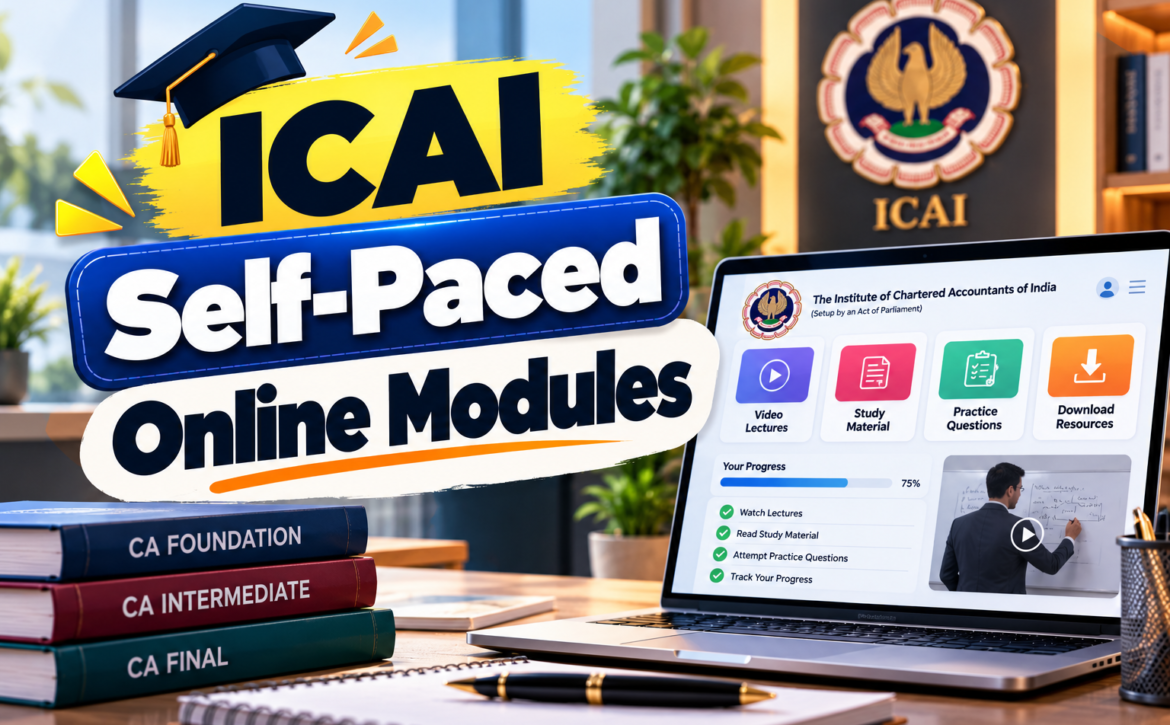
The modules allow eligible students to study specific subjects through ICAI’s digital learning platform at their own pace. Students can access the prescribed learning material, follow video lectures where available, monitor their progress and complete the required learning hours.
SPOM is designed to broaden students’ knowledge beyond the traditional examination subjects. The modules cover areas such as corporate and economic laws, strategic cost management, risk management, international taxation, valuation, entrepreneurship and digital controls.
However, completing the prescribed learning hours and qualifying the SPOM examination are separate requirements. Students should check both before considering a module complete.
Official resources:
- ICAI SPOM and New Scheme resources
- ICAI Digital Learning Campus login
- ICAI Self-Paced Module Test portal
ICAI SPOM Subjects: Understanding SET A, B, C and D
SPOM is divided into four sets. SET A and SET B are the core mandatory modules under the scheme, while SET C and SET D offer choices among specialised and multidisciplinary subjects. The exact requirements applicable to an individual student should be confirmed through the latest ICAI rules and exemption notifications.
Overview of SPOM Sets
| SPOM Set | Subject or category | Selection requirement | Prescribed learning hours |
| SET A | Corporate and Economic Laws | Mandatory, subject to applicable exemptions | 40 hours |
| SET B | Strategic Cost & Performance Management | Mandatory, subject to applicable exemptions | 40 hours |
| SET C | One elective subject | Choose one, subject to applicable rules | Generally 20 hours |
| SET D | One multidisciplinary subject | Choose one, subject to applicable rules | Generally 20 hours |
The hours shown above reflect ICAI’s published SPOM framework. Students should verify the latest applicable instructions for their examination cycle before planning their completion dates.
SET A: Corporate and Economic Laws
SET A focuses on corporate and economic laws. It includes important areas of company law, securities laws and economic legislation.
The material covers topics such as the appointment and qualification of directors, managerial personnel, board meetings, investigation, mergers and arrangements, prevention of oppression and mismanagement, winding up, securities regulations, foreign exchange law and insolvency-related legislation.
For students preparing for CA Final, these subjects are relevant because professional assignments frequently involve interpreting legal provisions, assessing regulatory compliance and understanding corporate transactions.
How to prepare: Read the relevant ICAI material carefully, identify important legal provisions, and make short revision notes for concepts that are difficult to recall. Since amendments can affect legal answers, always use the study material applicable to your examination.
Official resource: ICAI SET A study material and updates
SET B: Strategic Cost & Performance Management
SET B covers strategic cost management and performance management. It aims to develop a deeper understanding of how organisations analyse costs, evaluate performance and make business decisions.
Topics include the modern business environment, lean systems, specialist cost management techniques, strategic revenue and profit management, performance measures, transfer pricing, standard costing and case studies.
This module can help students connect technical concepts with practical business situations. Rather than treating every topic as an isolated theory, students should try to understand how cost information supports planning, pricing, resource allocation and performance evaluation.
How to prepare: Maintain a separate list of key concepts and formulas, revise the logic behind each technique, and practise applying the concepts to examples. Do not rely exclusively on memorising definitions.
Official resource: ICAI SPOM module resources
SET C: Elective Subjects
SET C offers specialised subjects. Students generally select one subject from the available options, subject to the applicable ICAI requirements.
| SET C subject | Main area of learning |
| Risk Management | Identifying, assessing and managing business risks |
| Sustainable Development and Sustainability Reporting | Sustainability practices, reporting and related frameworks |
| Public Finance and Government Accounting | Public expenditure, government finance and accounting |
| The Insolvency and Bankruptcy Code, 2016 | Insolvency processes and the legal framework |
| International Taxation | Cross-border taxation and international tax principles |
| The Arbitration and Conciliation Act, 1996 | Alternative dispute resolution and arbitration |
| Forensic Accounting | Investigating financial irregularities and analysing evidence |
| Valuation | Assessing the value of businesses and financial interests |
| Financial Services and Capital Markets | Financial products, services and capital markets |
| Forex and Treasury Management | Foreign exchange and treasury operations |
The available material and subject options should be checked on ICAI’s official website for the relevant examination cycle.
Choosing a subject purely because another student says it is easy may not be the best decision. Your existing knowledge, interest in the subject, familiarity with the terminology and available preparation time should all be considered.
For example, a student interested in corporate transactions may find valuation or insolvency interesting. Someone curious about financial markets may prefer Financial Services and Capital Markets. These are examples of personal fit, not guarantees that one subject will be easier than another.
Official resource: ICAI SET C subjects and updates
SET D: Multidisciplinary Subjects
SET D introduces students to areas beyond the conventional accounting and taxation syllabus. It is intended to encourage a broader understanding of professional and business environments.
| SET D subject | What students explore |
| The Constitution of India & Art of Advocacy | Constitutional foundations and advocacy skills |
| Psychology & Philosophy | Human behaviour, reasoning and philosophical perspectives |
| Entrepreneurship & Start-up Ecosystem | Business creation, innovation and the start-up environment |
| Digital Ecosystem and Controls | Digital systems, technology-related processes and controls |
A CA professional may work with business owners, technology teams, management and regulators. A broader perspective can help students understand different business situations and communicate more effectively.
When selecting a SET D subject, review the official syllabus, sample material and learning content first. A familiar topic can be a sensible choice, but it is still important to understand the scope and assessment requirements.
Official resource: ICAI Self-Paced Online Modules
Who Is Eligible for ICAI SPOM?
SPOM is associated with ICAI’s New Scheme of Education and Training. ICAI’s published guidance states that students registered for the Final Course can access the modules through the digital learning platform.
However, access to learning material and eligibility for a particular SPOM test are not necessarily the same thing. Exemptions and transition provisions may also depend on a student’s examination history, course status and the rules applicable to a particular attempt.
Before beginning, students should check:
- Whether their CA Final registration and student records are in order.
- Which SPOM sets they are required to complete.
- Whether any exemption applies to their case.
- Which syllabus and amendments are relevant to their examination.
- Whether the prescribed learning hours have been completed and recorded.
Students following an earlier scheme or transition arrangement should not assume that the requirements applicable to a friend or classmate are identical to theirs.
For confirmation, use the official ICAI SPOM page and the applicable examination announcements. If your circumstances are unusual, seek clarification from ICAI rather than relying solely on informal online discussions.
How to Register for ICAI Self-Paced Online Modules
Students can access SPOM through ICAI’s Digital Learning Campus. The following process provides a practical starting point; portal instructions may change, so follow the latest directions displayed by ICAI.
Step 1: Open the ICAI Digital Learning Campus
Visit https://lms.icai.org/login. Make sure you are using the official ICAI portal rather than an unofficial website offering similar-looking courses.
Step 2: Sign In Using an Available Login Method
ICAI has provided login options that include OTP-based access through the mobile number registered with the Self-Service Portal (SSP) and signing in with SSP credentials. Use the method currently offered on the portal.
If your registered mobile number or profile details are incorrect, resolve the issue through the appropriate ICAI service before proceeding.
Step 3: Open the SPOM Section
After logging in, locate the Self-Paced Online Modules section. Review the sets and subjects displayed on your dashboard.
Check the prescribed subjects applicable to you instead of assuming that all four sets have identical selection requirements.
Step 4: Complete the Prescribed Learning Hours
Study the available learning material and complete the required hours for each applicable set. ICAI’s learning platform provides progress information so students can monitor their completion status.
Do not treat watching a few selected videos as proof that the prescribed hours have been fulfilled. Confirm the status recorded on the official dashboard.
Step 5: Verify Completion Before Booking a Test
Once you have completed the applicable learning requirements, check your dashboard and the examination portal for the next steps.
The ICAI Self-Paced Module Test portal is used for registration and booking for SPOM tests. Follow the current instructions for available centres, dates, documents and fees.
ICAI SPOM Exam Pattern and Passing Criteria
Completing SPOM learning hours does not, by itself, mean that the student has qualified the module. Students must also meet the applicable test requirement unless an official exemption applies.
ICAI’s published SPOM FAQs state a minimum qualifying score of 50% in a module, with no negative marking under the described framework. Since examination instructions can be updated, check the current rules before your test.
| Exam-related point | What students should know |
| Learning requirement | Complete the prescribed hours for the applicable module |
| Test registration | Follow instructions on the official SPMT portal |
| Passing requirement | ICAI’s published FAQ states a minimum of 50% |
| Negative marking | The published FAQ states there is no negative marking |
| Final exam marks | SPOM marks are not added to CA Final examination marks |
| Attempts | Refer to the latest ICAI rules for applicable attempt provisions |
| Exemptions | Depend on the official criteria relevant to the student’s case |
Important: The table summarises the published framework and should not replace the current examination announcement. Always confirm the test-specific instructions before booking.
Official reference: ICAI SPOM FAQs and learning guidance
Is the SPOM Examination Conducted Online?
The learning modules are accessed online. However, students should not assume that the test itself can be taken from home simply because the learning is online.
ICAI introduced a separate Self-Paced Module Test portal for candidates who have completed the required learning hours. The test announcement describes test-centre arrangements and registration through the SPMT portal.
Check the latest announcement for your chosen date, available test centre and booking requirements:
ICAI Self-Paced Module Test portal
Is There a Separate Fee for ICAI SPOM?
ICAI’s published announcements state that no separate fee is payable for accessing the Self-Paced Online Modules on the learning platform.
However, students should distinguish between access to the learning material and the process for registering for the examination. Check the current SPMT portal and applicable ICAI announcements for any test-related charges or updated conditions before booking.
Avoid making payments through unofficial websites or agents claiming that they can guarantee SPOM qualification.
How to Prepare for ICAI SPOM Exams Effectively
The flexible nature of SPOM is helpful, but flexibility can also make it easy to postpone studying. A simple routine can prevent the learning hours from becoming a last-minute burden.
1. Check Your Requirements First
Before creating a timetable, identify the sets you need to complete and confirm whether any exemption applies. This prevents you from spending time planning for a module that may not be required in your case.
2. Make a Realistic Learning Schedule
Break the prescribed hours into manageable sessions. For instance, a student with several weeks available may choose to study for one or two focused hours on suitable days, depending on other commitments.
The purpose is to build a routine that you can maintain alongside articleship, work or CA Final preparation.
3. Take Notes While Studying
Do not simply let the lectures play in the background. Write short notes on important provisions, concepts, definitions and examples. For technical subjects, record the reasoning behind a concept rather than copying long paragraphs.
4. Revise the Difficult Topics
Some subjects may feel familiar at first but become harder when you revisit them. Keep a list of confusing topics and review them before attempting the test.
For SET A, this may involve legal provisions and their application. For SET B, it may mean understanding strategic cost and performance management techniques. Your revision method should suit the subject.
5. Use Official Study Material
The ICAI website provides subject-specific SPOM material and relevant updates. Use the version applicable to your exam cycle, especially where amendments or updated content have been published.
Useful starting points:
6. Track Progress on the Dashboard
Check whether your learning progress is being recorded correctly. If the dashboard does not reflect your activity as expected, review the portal’s instructions and contact the appropriate ICAI support channel before leaving the issue until the last moment.
7. Keep Time for Test Preparation
Completing the learning hours is one part of the process; preparing to answer questions is another. Once you have finished the learning requirement, set aside time to revise the material and understand the test instructions.
Do not book a test solely because the dashboard shows completion if you have not reviewed the subject or confirmed your readiness.
Common Mistakes CA Students Should Avoid
Students can save time and avoid unnecessary stress by paying attention to a few common mistakes.
Assuming all students have the same requirements: Exemptions and transition rules can differ. Confirm your own status.
Confusing learning completion with qualification: Check both the prescribed hours and the applicable test requirement.
Choosing an elective without reviewing the syllabus: Read the official outline before making your selection.
Using outdated study material: Amendments and updated modules can affect the relevant content. Check ICAI’s current resources.
Leaving the module until the last minute: SPOM should be planned alongside the broader CA Final preparation schedule.
Relying on unofficial claims: No coaching provider or website should be treated as the final authority on eligibility, exemptions or examination rules. ICAI’s official announcements take priority.
How CA Mentoring Program Can Support Your CA Preparation
Understanding ICAI SPOM requirements is one part of planning the CA journey. Students also need to manage their main subjects, revision cycles, mock tests and time commitments.
At CA Mentoring Program, students can explore resources related to CA preparation and study planning. Use these resources to build a more organised routine, identify areas that need revision and manage your preparation alongside other course requirements.
A practical study plan should be based on your current progress, available hours and exam timeline. If you are balancing articleship with CA Final preparation, divide your weekly schedule into realistic blocks instead of trying to study every subject intensively every day.
Keep official ICAI notifications as your reference for SPOM eligibility, syllabus, learning-hour requirements, test booking and exemptions. Mentoring and study resources can support your preparation, but they should not replace the Institute’s official instructions.
Final Thoughts
ICAI Self-Paced Online Modules are an important part of the New Scheme of Education and Training for students to whom the requirements apply. Understanding the four sets, completing the prescribed learning hours and following the test process can help students manage this responsibility without unnecessary confusion.
The best approach is straightforward: verify your applicable requirements, select the correct subjects, study through the official learning platform, track your progress and prepare for the test well in advance. Most importantly, confirm the latest ICAI announcements before making decisions about eligibility or exemptions.
With a clear plan and reliable information, SPOM can become a manageable part of your overall CA preparation rather than an unexpected hurdle near the examination.