CA Foundation Subjects January 2027: Complete Syllabus, Exam Pattern & Preparation Guide
If you are planning to appear for the CA Foundation January 2027 examination, one of the first things you should understand is the complete list of subjects, what each paper covers, how the papers are conducted, and how you should divide your preparation time.
For many students, CA Foundation is the first serious step into the Chartered Accountancy journey. The syllabus may look manageable when you see the four subject names, but the real challenge begins when you start preparing for all four papers together. Accounting requires consistent practice, Business Laws needs conceptual understanding and writing skills, Quantitative Aptitude demands speed and accuracy, while Business Economics requires both conceptual clarity and regular revision.
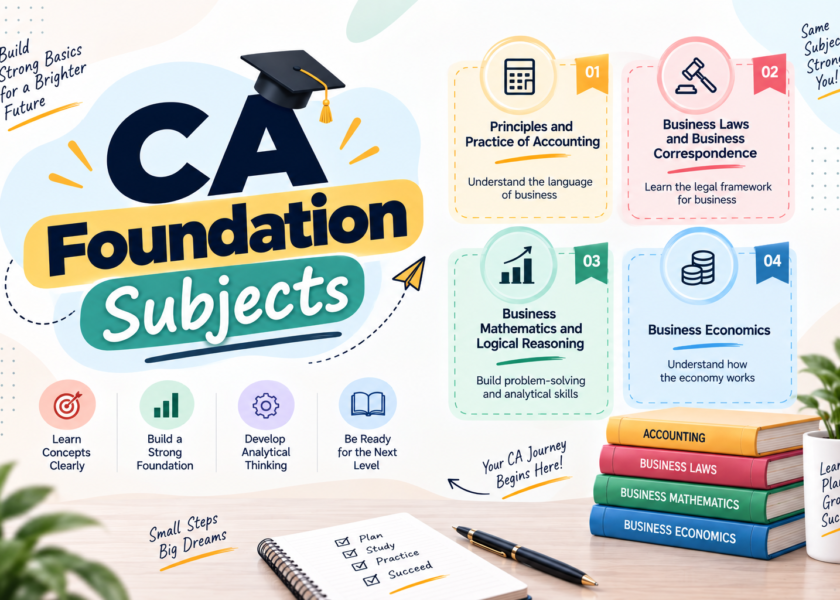
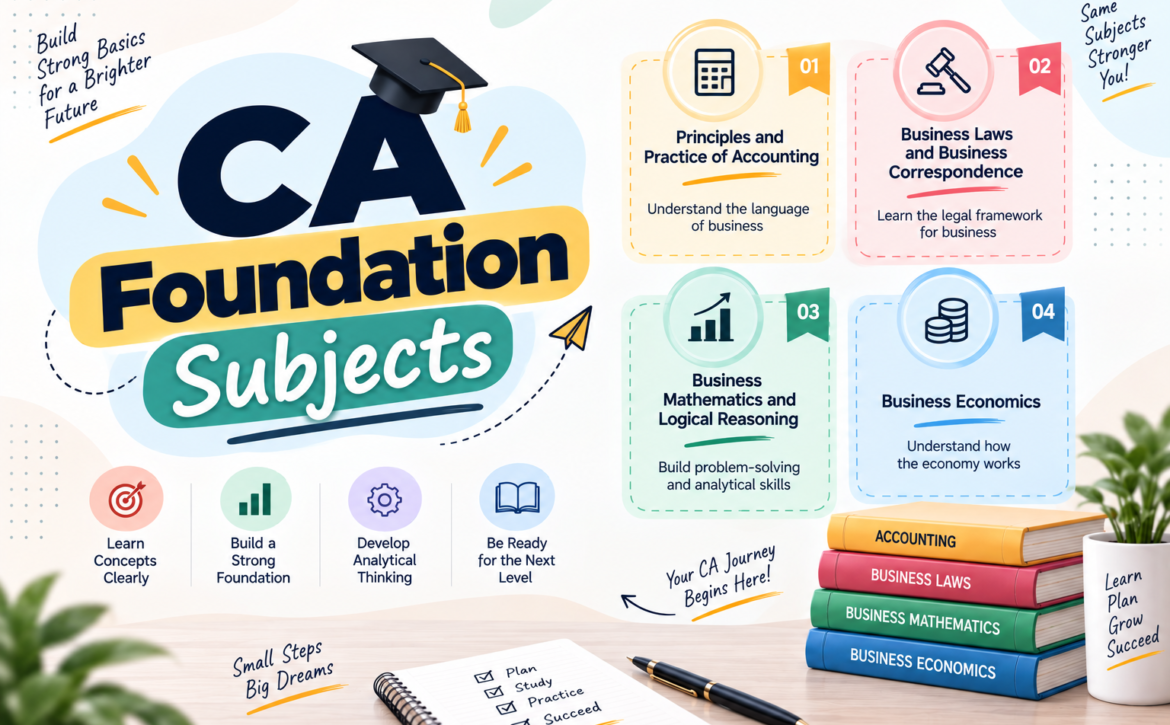
Under the current ICAI Foundation structure, there are four papers:
- Accounting
- Business Laws
- Quantitative Aptitude
- Business Economics
ICAI’s official Foundation resources list these four papers under the current scheme. ICAI has also announced Live Virtual Classes for students appearing in the January 2027 Foundation Examination.
If you are preparing for January 2027, this guide will help you understand the CA Foundation subjects January 2027, their structure, preparation approach, and the mistakes you should avoid.
CA Foundation Subjects January 2027
The CA Foundation examination consists of four papers. Each paper carries its own importance, and students need to score at least the required minimum in every paper while also meeting the aggregate passing requirement.
Here is a quick overview:
| Paper | Subject | Nature of Paper | Marks |
| Paper 1 | Accounting | Subjective | 100 |
| Paper 2 | Business Laws | Subjective | 100 |
| Paper 3 | Quantitative Aptitude | Objective | 100 |
| Paper 4 | Business Economics | Objective | 100 |
| Total | 4 Papers | — | 400 |
ICAI’s examination FAQs state that Papers 1 and 2 are subjective, while Papers 3 and 4 are objective. The same official guidance states that objective papers carry negative marking of 0.25 marks for every wrong answer.
This means your preparation cannot be exactly the same for all four subjects.
CA Foundation Paper 1 – Accounting
Accounting is the first paper of CA Foundation and is one of the most important subjects for students who want to build a strong base for the next levels of the CA course.
The biggest mistake students make in Accounting is treating it like a theory subject. It is not.
You may understand a concept while watching a lecture, but that does not necessarily mean you will be able to solve a question correctly in the examination.
Accounting requires repeated practice.
What should you focus on in Accounting?
Students should focus on understanding the logic behind accounting treatments rather than simply memorising formats.
Important areas generally include:
- Accounting principles and concepts
- Basic accounting processes
- Journal entries
- Ledger and trial balance
- Bank reconciliation
- Inventories
- Depreciation and amortisation
- Bills of exchange
- Final accounts
- Partnership-related accounting
- Company accounts
- Financial statement-related concepts
The exact applicable study material and amendments should always be checked against the ICAI material prescribed for your examination attempt. ICAI’s Board of Studies currently provides Foundation study material through its official portal.
How to prepare Accounting for January 2027
Do not wait until the last month to start solving practical questions.
A better approach is:
Concept → Illustration → Practice → Revision → Test
Try to solve questions without looking at the solution. If you make a mistake, identify why you made it.
For example, if you repeatedly make mistakes in journal entries, simply solving another 20 questions may not solve the problem. You first need to understand the rule behind the entry.
That is the difference between studying Accounting and actually learning Accounting.
CA Foundation Paper 2 – Business Laws
Business Laws is the second paper of CA Foundation and is a subject where students often underestimate the importance of language.
You do not necessarily need to write extremely complicated English. What matters more is whether you understand the legal concept and can present your answer logically.
The current Foundation structure identifies Paper 2 as Business Laws.
What makes Business Laws challenging?
The problem is usually not the number of chapters alone.
Students struggle because legal provisions can initially feel unfamiliar.
You may read a provision once and feel that you understand it. But when an application-based question appears, you may not know which provision to apply.
Therefore, your preparation should focus on:
- Understanding provisions
- Remembering important keywords
- Practising case-based questions
- Learning how to structure answers
- Revising provisions regularly
A simple answer-writing approach
When practising descriptive questions, try following this structure:
Provision → Explanation → Application → Conclusion
This makes your answer easier to understand and helps you avoid writing unnecessary information.
Do not turn every answer into a long story.
In CA Foundation, clarity matters.
CA Foundation Paper 3 – Quantitative Aptitude
Quantitative Aptitude is the third paper and is an objective paper.
The subject combines different areas of quantitative ability. ICAI’s current Foundation information identifies Paper 3 as Quantitative Aptitude, with Business Mathematics, Logical Reasoning and Statistics forming its broad components.
For students who are comfortable with calculations, this paper can become a scoring opportunity. For students who have been away from Mathematics for a long time, however, it can initially feel difficult.
The good news is that improvement is possible with regular practice.
Major areas of Quantitative Aptitude
The paper broadly covers:
- Business Mathematics
- Logical Reasoning
- Statistics
Each area requires a slightly different preparation method.
Business Mathematics
The key is practice.
Instead of reading formulas repeatedly, make a formula sheet and solve questions using those formulas.
Logical Reasoning
Logical Reasoning can improve considerably with practice.
Focus on understanding the pattern of questions instead of trying to memorise solutions.
Statistics
Statistics requires both conceptual understanding and calculation practice.
Make sure you understand the meaning of formulas before using them.
The biggest mistake in Quantitative Aptitude
Students often spend too much time trying to solve one difficult question.
Remember that this is an objective paper. Time management matters.
If a question is consuming too much time, move ahead and return to it later if appropriate.
CA Foundation Paper 4 – Business Economics
Business Economics is the fourth CA Foundation paper.
At first glance, students may consider Economics an easy subject because it is largely theoretical. However, scoring well requires much more than simply reading chapters once.
ICAI’s current Foundation material includes areas such as the nature and scope of business economics, demand and supply, production and cost, market structures, business cycles, national income, public finance, money market, international trade and the Indian economy.
Important areas to understand
Some broad areas include:
- Nature and Scope of Business Economics
- Demand and Supply
- Consumer Behaviour
- Production and Cost
- Different Market Structures
- Business Cycles
- National Income
- Public Finance
- Money Market
- International Trade
- Indian Economy
The key to Economics is understanding relationships.
For example, do not just memorise the law of demand. Understand why demand generally changes when price changes and what factors can cause the relationship to change.
Once the concept becomes clear, revision becomes much easier.
CA Foundation January 2027 Exam Pattern
Understanding the examination pattern is just as important as understanding the syllabus.
The current Foundation examination pattern has two descriptive papers and two objective papers.
| Paper | Subject | Type | Marks | Duration |
| Paper 1 | Accounting | Subjective | 100 | 3 Hours |
| Paper 2 | Business Laws | Subjective | 100 | 3 Hours |
| Paper 3 | Quantitative Aptitude | Objective | 100 | 2 Hours |
| Paper 4 | Business Economics | Objective | 100 | 2 Hours |
ICAI’s official examination guidance confirms that Papers 1 and 2 are subjective and Papers 3 and 4 are objective. ICAI examination information also specifies two hours for Papers 3 and 4, while Papers 1 and 2 are conducted for three hours.
For objective papers, negative marking is applicable. ICAI states that 0.25 marks are deducted for every incorrect answer in the objective papers.
CA Foundation Passing Criteria for January 2027
One of the most important things students should understand is that simply scoring 50% overall is not enough.
According to ICAI’s examination FAQ, a student must secure:
- At least 40% marks in each paper, and
- At least 50% marks in aggregate across all four papers.
For example:
| Paper | Marks |
| Accounting | 55 |
| Business Laws | 48 |
| Quantitative Aptitude | 52 |
| Business Economics | 50 |
| Total | 205/400 |
The aggregate is above 50%, but the student would still need to ensure that the individual paper requirement is satisfied.
This is why your preparation should not focus only on your strongest subject.
Which CA Foundation Subject Is the Easiest?
There is no universal answer.
A commerce student who has studied Mathematics regularly may find Quantitative Aptitude easier. Another student may find Business Economics easier because they enjoy theoretical subjects.
Your personal strengths matter.
A useful way to look at the four subjects is:
| Subject | Main Skill Required | Preparation Style |
| Accounting | Concept + Calculation | Daily Practice |
| Business Laws | Understanding + Presentation | Reading + Writing |
| Quantitative Aptitude | Speed + Accuracy | Question Practice |
| Business Economics | Concept + Retention | Reading + Revision |
Instead of asking, “Which subject is easiest?”, ask:
“Which subject needs the most improvement from me?”
That question will help you build a much better study plan.
How to Prepare for CA Foundation January 2027
If January 2027 is your target attempt, do not create a preparation strategy based purely on the number of chapters.
Create it around three stages.
Stage 1: Complete the Concepts
Your first target should be completing the syllabus properly.
Do not rush through lectures just to tick chapters off your list.
After every topic, ask yourself:
Can I solve a basic question without looking at the solution?
If the answer is no, the chapter is not really complete.
Stage 2: Practice Questions
Once concepts are clear, increase your question-solving.
For Accounting and Quantitative Aptitude, regular practice is extremely important.
For Business Laws and Economics, practise questions after completing each chapter so that you can identify what you actually remember.
Stage 3: Revision and Mock Tests
Revision should not be left for the final few days.
A better strategy is to revise multiple times.
For example:
First Revision: Within a few days of completing a topic
Second Revision: After completing the subject
Third Revision: During your final preparation
Final Revision: Short notes, formulas and important concepts
Mock tests should also be treated seriously.
Do not just check your marks.
Analyse:
- Which questions were wrong?
- Why were they wrong?
- Did you make a calculation mistake?
- Did you misunderstand the question?
- Did you forget a concept?
- Did you spend too much time on one question?
That analysis is often more valuable than simply taking another mock test.
Suggested Daily Study Plan for CA Foundation
A student preparing for January 2027 can divide study time according to individual strengths, but a balanced routine could look like this:
| Activity | Suggested Time |
| Accounting | 2 Hours |
| Business Laws | 1.5 Hours |
| Quantitative Aptitude | 1.5 Hours |
| Business Economics | 1.5 Hours |
| Revision/Test Practice | 1 Hour |
| Total | 7.5 Hours |
This is only a sample.
If you have college, school, coaching or other responsibilities, adjust the schedule accordingly.
The important thing is consistency.
Studying for 7 hours one day and then doing almost nothing for the next two days is usually less effective than maintaining a realistic daily routine.
Best Study Material for CA Foundation January 2027
Your first priority should always be the official ICAI study material applicable to your attempt.
ICAI’s Board of Studies provides Foundation study material and examination-related resources through its official platforms.
You can supplement ICAI material with:
- Revision Test Papers
- Mock Test Papers
- Previous examination questions
- Suggested Answers
- Your class notes
- Short revision notes
- Practice tests
ICAI has also published Foundation suggested answers for previous examinations, which can help students understand how answers are presented and evaluated.
For students who are taking classes or using additional learning support, the goal should not be collecting ten different resources.
The goal should be mastering the right resources.
Common Mistakes CA Foundation Students Should Avoid
1. Starting all four subjects together without a plan
This often creates confusion.
Complete subjects in a structured sequence while keeping regular revision of previously studied topics.
2. Ignoring the difficult subject
Students often spend more time on subjects they already like.
That feels productive but may not improve the final result.
3. Leaving revision for the last month
Revision is not something you do after preparation.
Revision is part of preparation.
4. Solving too few questions
Especially in Accounting and Quantitative Aptitude, watching lectures is not enough.
You need to solve questions yourself.
5. Ignoring negative marking
In objective papers, random guessing can hurt your score because incorrect answers attract negative marking.
6. Using outdated study material
This is particularly important for students preparing for a future attempt.
Always check the ICAI material applicable to your examination.
How CA Mentoring Program Can Help in Your Preparation
Preparing for CA Foundation can sometimes feel overwhelming, especially if you are studying for the course for the first time.
A structured mentoring approach can help students understand where they currently stand, identify weak areas, plan revision, and maintain consistency.
CA Mentoring Program can be explored by students looking for structured guidance and mentoring support during their CA preparation.
The important thing is not simply joining a course or buying study material.
Before choosing any learning support, consider whether it actually helps you with:
- Concept clarity
- Doubt resolution
- Regular testing
- Revision planning
- Exam strategy
- Time management
- Performance tracking
A good learning system should make your preparation more organised rather than adding more resources and confusion.
Final Words: How to Approach CA Foundation January 2027
The CA Foundation January 2027 examination should not be treated as an exam that you can crack through last-minute studying.
The four subjects are different, and each demands a different approach.
Accounting needs practice.
Business Laws needs conceptual understanding and proper presentation.
Quantitative Aptitude needs speed and accuracy.
Business Economics needs understanding and repeated revision.
The good news is that you do not need to be perfect from Day 1.
You just need to improve consistently.
Start with the ICAI syllabus and applicable study material. Build your concepts. Practise questions. Revise regularly. Take mock tests. Analyse your mistakes. Then repeat the process.
If you stay consistent, the four subjects stop looking like four separate mountains and start becoming four manageable parts of one preparation plan.
For January 2027 aspirants, this is the right time to focus on clarity, consistency and exam-oriented practice rather than constantly searching for new resources.
Remember one simple rule:
Don’t study just to finish the syllabus. Study until you can confidently answer questions from the syllabus.
That mindset can make a major difference in your CA Foundation preparation.