CA Subjects for January 2027: Complete Subject-Wise Guide for Foundation & Intermediate
If you are planning to appear for the CA January 2027 examination, one of the first things you need to understand is the complete list of subjects, the structure of each paper, and how you should divide your preparation time.
Many students make the mistake of starting their preparation without first understanding the syllabus. They collect books, join classes, download PDFs and make study schedules, but after a few weeks they realise that some subjects require regular practice while others need repeated revision.
That is why knowing the CA subjects for January 2027 is more important than it may initially seem.
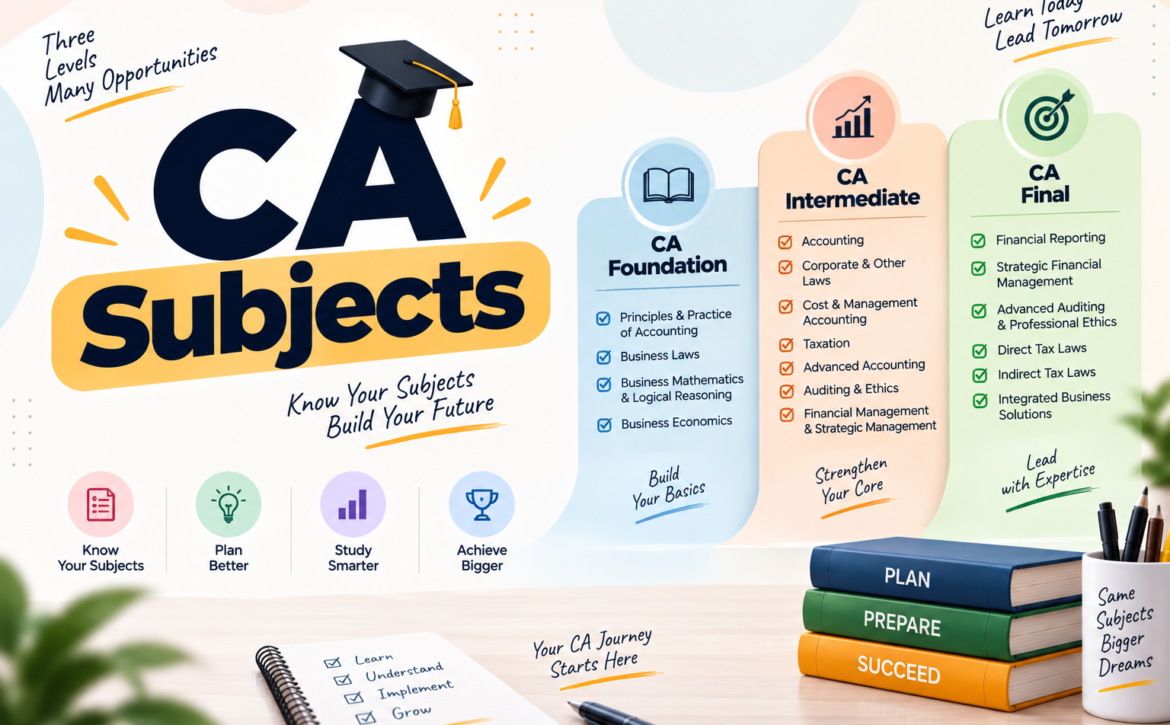
Under the current ICAI examination structure, January 2027 is relevant for CA Foundation and CA Intermediate students. ICAI’s current syllabus pages list four papers for Foundation and six papers for Intermediate. For Intermediate students, the six papers are divided equally between Group I and Group II.
This guide from CA Mentoring Program explains the subjects, paper structure, preparation approach and practical strategy you can use for the January 2027 attempt.
CA Subjects for January 2027 at a Glance
Before going into the details, here is the complete overview.
| CA Level | Group | Papers | Subjects |
| CA Foundation | — | Paper 1 | Accounting |
| CA Foundation | — | Paper 2 | Business Laws |
| CA Foundation | — | Paper 3 | Quantitative Aptitude |
| CA Foundation | — | Paper 4 | Business Economics |
| CA Intermediate | Group I | Paper 1 | Advanced Accounting |
| CA Intermediate | Group I | Paper 2 | Corporate and Other Laws |
| CA Intermediate | Group I | Paper 3 | Taxation |
| CA Intermediate | Group II | Paper 4 | Cost and Management Accounting |
| CA Intermediate | Group II | Paper 5 | Auditing and Ethics |
| CA Intermediate | Group II | Paper 6 | Financial Management and Strategic Management |
ICAI’s official syllabus pages confirm this current subject structure.
CA Foundation Subjects for January 2027
CA Foundation is the entry point into the Chartered Accountancy course. The Foundation course currently consists of four papers.
CA Foundation Subjects
- Accounting
- Business Laws
- Quantitative Aptitude
- Business Economics
ICAI’s New Scheme syllabus identifies these four papers as the Foundation subjects.
Let’s understand what students should expect from each subject.
1. CA Foundation Accounting
Accounting is one of the most important subjects in CA Foundation because it builds the base for several concepts that students encounter later in CA Intermediate.
You should not approach Accounting as a subject that can be completed simply by reading theory.
The real improvement comes when you start solving questions yourself.
Important areas generally include concepts of accounting, accounting process, financial statements and other fundamental accounting topics prescribed by ICAI.
How to prepare for Accounting
A practical approach is:
- Understand the concept first.
- Solve ICAI illustrations.
- Practise questions without looking at the solution.
- Maintain a separate mistake notebook.
- Revise formats regularly.
- Attempt timed practice papers.
If you are weak in calculations, do not postpone practice. Accounting becomes easier when you solve questions consistently.
2. CA Foundation Business Laws
Business Laws is different from Accounting because understanding the language of the law matters as much as remembering the provisions.
Students often read chapters several times but still struggle to write effective answers.
The better approach is to understand:
Provision → Meaning → Application → Conclusion
When you solve practical questions, focus on identifying the legal provision involved and then applying it to the facts given in the question.
How to prepare for Business Laws
Read the ICAI study material carefully and pay attention to definitions, provisions, exceptions and practical situations.
A good revision cycle can include:
- First reading for understanding
- Second reading for retention
- Question practice
- Revision of important provisions
- Writing practice before the examination
3. CA Foundation Quantitative Aptitude
Quantitative Aptitude requires regular practice.
It is difficult to become comfortable with Mathematics, Logical Reasoning and Statistics by studying them only during the final weeks.
ICAI identifies Paper 3 as Quantitative Aptitude.
The biggest advantage of this paper is that consistent practice can significantly improve your speed and accuracy.
How to prepare for Quantitative Aptitude
Try solving questions every day instead of studying the subject only once or twice a week.
Focus on:
- Concept clarity
- Formula revision
- Short calculation techniques
- Question-solving speed
- Accuracy
- Mock-test practice
Keep a formula sheet and revise it frequently.
4. CA Foundation Business Economics
Business Economics is comparatively theory-oriented, but that does not mean it should be left for the end.
Students often underestimate Economics because they feel it can be completed quickly. This can create unnecessary pressure before the examination.
Understand the concepts instead of trying to memorise every sentence.
Create short notes for:
- Definitions
- Key concepts
- Differences
- Important economic principles
- Graphs and applications
- Frequently tested areas
Regular revision is more effective than one long study session.
CA Intermediate Subjects for January 2027
CA Intermediate is a major step up from Foundation.
The current Intermediate course has six papers, divided into two groups of three papers each.
Group I
| Paper | Subject | Broad Nature |
| Paper 1 | Advanced Accounting | Practical + Conceptual |
| Paper 2 | Corporate and Other Laws | Theory + Application |
| Paper 3 | Taxation | Practical + Conceptual |
Group II
| Paper | Subject | Broad Nature |
| Paper 4 | Cost and Management Accounting | Practical |
| Paper 5 | Auditing and Ethics | Theory + Application |
| Paper 6 | Financial Management and Strategic Management | Practical + Theory |
Let’s look at each subject separately.
1. CA Intermediate Advanced Accounting
Advanced Accounting is Paper 1 of CA Intermediate Group I.
The subject requires conceptual understanding along with extensive question practice.
A common mistake is to spend too much time watching lectures and too little time solving questions.
For Accounting, solving is studying.
Preparation strategy
Start with ICAI concepts and illustrations.
Then move towards:
- Practice questions
- RTPs
- MTPs
- Previous examination questions
- Revision tests
Maintain a list of adjustments and concepts that you repeatedly get wrong.
This can save considerable time during the final revision.
2. CA Intermediate Corporate and Other Laws
Corporate and Other Laws is Paper 2 of Group I.
This subject demands consistent reading because the language and provisions need to become familiar before you can reproduce them effectively in the examination.
Do not rely entirely on shortcuts or summary notes.
Your primary source should remain the applicable ICAI study material and other official updates relevant to your attempt.
Best way to study Law
Use a three-stage approach:
Understand → Recall → Write
After completing a chapter, close the book and try explaining the provision in your own words.
Then practise writing answers using proper legal terminology.
This is particularly useful for students who understand the concept but lose marks because their answers are poorly structured.
3. CA Intermediate Taxation
Taxation is Paper 3 and contains:
- Section A: Income-tax Law
- Section B: Goods and Services Tax
ICAI currently identifies the Income-tax Law portion as applicable to the May 2026, September 2026 and January 2027 examinations.
Similarly, ICAI’s GST material identifies the relevant GST portion for the January 2027 examination.
This makes it especially important for January 2027 students to use the correct attempt-specific study material, amendments and updates.
Income-tax Law
Students should build their preparation around concepts first.
Instead of trying to memorise individual provisions randomly, understand how taxation works across different heads of income and the overall computation process.
GST
GST requires conceptual clarity and question practice.
Areas such as supply, charge, place of supply, exemptions, time of supply, value of supply, input tax credit, registration and returns form part of the prescribed material.
Taxation preparation tip
Never depend on old notes blindly.
Tax laws can change, and the material applicable to one examination may not necessarily be the same for another.
For January 2027, always verify the applicable ICAI material and statutory updates before finalising your preparation.
4. CA Intermediate Cost and Management Accounting
Cost and Management Accounting is Paper 4 of Group II.
This is a practical subject, so question-solving should occupy a significant part of your preparation.
Students sometimes read solutions and feel that they understand the chapter. However, the real test comes when you have to solve a question from scratch.
How to prepare
Follow this sequence:
- Understand the concept.
- Solve the basic illustration.
- Solve additional questions.
- Attempt exam-oriented questions.
- Practise under time pressure.
- Analyse your mistakes.
Do not ignore chapters simply because you find them difficult.
A difficult chapter today can become a scoring chapter after enough practice.
5. CA Intermediate Auditing and Ethics
Auditing and Ethics is Paper 5.
For many students, this subject feels challenging because the answer depends heavily on conceptual understanding and presentation.
The key is to understand why an audit procedure or principle exists instead of memorising isolated paragraphs.
How to improve Audit preparation
Make concise revision notes containing:
- Important concepts
- Standards-related points
- Definitions
- Procedures
- Important keywords
- Differences
- Frequently tested areas
During answer writing, use headings and logical points.
A well-structured answer is easier for the examiner to evaluate than a large paragraph containing several unrelated points.
6. CA Intermediate Financial Management and Strategic Management
Paper 6 contains two different areas:
Section A: Financial Management
Section B: Strategic Management
ICAI’s current Intermediate structure identifies Paper 6 as Financial Management and Strategic Management, with these two sections.
This makes the paper interesting but also requires two different preparation styles.
Financial Management
FM requires regular numerical practice.
Focus on:
- Concepts
- Formulas
- Problem-solving
- Calculation speed
- Revision
- Mock tests
Do not merely memorise formulas. Understand where and why they are used.
Strategic Management
SM requires conceptual understanding and good presentation.
Create short notes and use keywords while revising.
For theory answers, practise writing direct and relevant responses rather than filling pages unnecessarily.
CA Foundation vs CA Intermediate Subjects
If you are deciding which preparation strategy to follow, the difference between Foundation and Intermediate should be clear.
| Factor | CA Foundation | CA Intermediate |
| Number of Papers | 4 | 6 |
| Difficulty | Entry Level | Advanced |
| Practical Subjects | Accounting, Quantitative Aptitude | Accounting, Taxation, Costing, FM |
| Theory-Oriented Areas | Laws, Economics | Laws, Audit, Strategic Management |
| Preparation Style | Concept + Practice | Concept + Extensive Practice |
| Revision Requirement | High | Very High |
| Question Practice | Important | Essential |
The jump from Foundation to Intermediate is significant. Students who develop disciplined study habits early generally find the transition easier.
How Many Subjects Should You Study at Once?
This is one of the most practical questions students ask.
The answer depends on your preparation stage.
Studying six subjects simultaneously does not necessarily mean studying all six every day.
A better approach is to maintain a balanced combination.
For example:
| Day Type | Subject Combination |
| Day 1 | Practical + Theory |
| Day 2 | Practical + Practical |
| Day 3 | Theory + Practical |
| Day 4 | Practical + Theory |
| Day 5 | Revision + Practice |
| Day 6 | New Topics + Question Practice |
| Day 7 | Weekly Revision + Test |
This prevents one subject from being completely ignored for several weeks.
How to Make a CA January 2027 Study Plan
Your study plan should be based on the time remaining, your current level and the number of papers you are attempting.
A simple three-phase strategy works well.
Phase 1: Concept Building
Complete the syllabus systematically.
Your goal should not be speed alone.
Focus on understanding concepts and identifying difficult chapters.
Phase 2: Question Practice
Once a substantial portion of the syllabus is complete, increase your question-solving time.
Use:
- ICAI illustrations
- Practice questions
- RTPs
- MTPs
- Previous exam questions
Phase 3: Revision and Mock Tests
The final phase should focus on retention and examination performance.
At this stage, avoid repeatedly starting new resources.
Revise what you have already studied and test yourself.
How CA Mentoring Program Can Help January 2027 Students
Preparing for CA is not only about collecting study material.
Many students know what to study but struggle with:
- Maintaining consistency
- Completing daily targets
- Revising on time
- Tracking performance
- Identifying weak areas
- Staying accountable
This is where structured mentoring can make a difference.
CA Mentoring Program provides mentoring and guidance for CA, CS and CMA students. Its website highlights customised study plans, daily guidance, activity tracking, one-to-one accountability, mentoring kits, daily exams with evaluation and chapter-wise test series among its support features.
For students preparing for January 2027, having a system that keeps preparation organised can be more useful than simply increasing the number of study hours.
The objective should be simple:
Study → Practise → Test → Analyse → Improve → Repeat.
Common Mistakes Students Make While Preparing for January 2027
1. Studying Without Checking the Applicable Syllabus
This is particularly risky for subjects such as Taxation.
Always verify the material applicable to your examination attempt.
2. Collecting Too Many Resources
Five books do not automatically provide five times more knowledge.
Choose reliable primary material and use additional resources only when necessary.
3. Ignoring Revision
Finishing a chapter once does not mean you remember it.
Revision must be scheduled from the beginning.
4. Watching Lectures Without Practising
Lectures can build understanding, but examinations test what you can actually reproduce or solve.
5. Leaving Mock Tests for the End
Mock tests should be introduced before the final week.
They help you understand:
- Time management
- Presentation
- Question selection
- Calculation speed
- Weak areas
Smart Tips to Score Better in CA January 2027
1. Follow ICAI Material
Make ICAI study material the foundation of your preparation.
2. Practise Every Day
Even 30–60 minutes of question practice can make a difference when done consistently.
3. Keep a Mistake Book
Write down questions, concepts and mistakes that you repeatedly make.
4. Revise Before You Forget
Use spaced revision instead of waiting until the entire syllabus is completed.
5. Practise Writing
This is especially important for Law, Audit, Strategic Management and other theory-heavy areas.
6. Track Your Progress
At the end of every week, ask:
- What did I complete?
- What is pending?
- Which chapters are weak?
- How many questions did I solve?
- Did I take a test?
This turns preparation into something measurable.
Final Checklist for CA January 2027 Preparation
Before the examination, make sure you have:
| Checklist | Status |
| Completed the applicable syllabus | ✓ |
| Revised all major chapters | ✓ |
| Solved ICAI questions | ✓ |
| Practised RTPs/MTPs where applicable | ✓ |
| Attempted mock tests | ✓ |
| Revised important formulas | ✓ |
| Revised theory subjects | ✓ |
| Prepared short revision notes | ✓ |
| Analysed mistakes | ✓ |
| Practised time management | ✓ |
Final Thoughts
Knowing the CA subjects for January 2027 is only the starting point.
The real challenge is converting the syllabus into a realistic study plan and then following that plan consistently.
For CA Foundation students, the four papers—Accounting, Business Laws, Quantitative Aptitude and Business Economics—require a combination of conceptual understanding, practice and revision.
For CA Intermediate students, the six papers cover Advanced Accounting, Corporate and Other Laws, Taxation, Cost and Management Accounting, Auditing and Ethics, and Financial Management and Strategic Management.
Most importantly, do not compare your preparation with someone else’s timetable.
One student may complete ten hours every day but retain very little. Another may study six focused hours and revise effectively. What matters is whether your preparation is moving forward.
If you are preparing for January 2027, start by identifying your papers, divide the syllabus into manageable targets, practise regularly and build revision into your timetable from day one.
And if you feel that you understand what to study but struggle to remain consistent, structured mentoring and accountability can help you stay on track.
Your goal should not simply be to finish the CA syllabus. Your goal should be to finish it, revise it, practise it and enter the examination hall with confidence.