
CA Ravi Agarwal - CA Mentoring Program - Page 5

Income From House Property Notes: Complete CA Taxation Study Guide

Income From House Property Notes: Complete Guide for CA Students

Income From House Property is one of those chapters in CA Taxation that looks simple when you first read it but becomes tricky when you start solving practical questions.

The reason is quite straightforward. You are not always taxed on the actual rent received from a property. The Income-tax law uses concepts such as annual value, expected rent, actual rent, municipal taxes, standard deduction, interest on borrowed capital, self-occupied property and deemed let-out property to arrive at taxable income.

For CA students, this chapter is therefore less about memorising isolated provisions and more about understanding the sequence in which the computation works.

These Income From House Property Notes are designed to help you understand the chapter in an exam-oriented way, revise important provisions quickly and approach practical questions with more confidence.

The chapter forms part of Heads of Income in the ICAI Income-tax Law syllabus for CA Intermediate. ICAI’s current course material lists Income from House Property as Unit 2 under Chapter 3, Heads of Income. (ICAI)

What Is Income From House Property?

Under the Income-tax Act, income from a qualifying house property is generally taxable under the head “Income from House Property.”

The important point is that taxation under this head is based on the annual value of the property, rather than simply looking at the cash actually received by the owner.

The basic charging provision is Section 22.

For a property to generally fall under this head, three broad conditions need to be considered:

  1. There should be a building or land appurtenant to a building.
  2. The assessee should be the owner or deemed owner of the property.
  3. The property should not be occupied by the owner for carrying on their own business or profession.

This is one of the first things students should remember before jumping into calculations.

Quick Concept

House Property + Ownership + Not used for own business/profession = Income from House Property

Of course, the chapter contains several exceptions and special situations, so this formula should be treated as a starting point rather than the complete law.

Why Is Income From House Property Important for CA Exams?

This chapter deserves proper attention because it combines conceptual provisions with practical computation.

Students commonly encounter questions involving:

  • Self-occupied property
  • Let-out property
  • Deemed let-out property
  • Municipal taxes
  • Expected rent
  • Actual rent
  • Vacancy
  • Unrealised rent
  • Standard deduction
  • Interest on housing loans
  • Pre-construction interest
  • Co-ownership
  • Joint ownership
  • More than one house property
  • Loss from house property

A student who understands the computation mechanism can usually solve these questions much faster than someone who has memorised individual sections without understanding their connection.

Important Sections Under Income From House Property

Here is a quick revision table for the major provisions you should know.

Section Important Provision
Section 22 Chargeability of income from house property
Section 23 Determination of annual value
Section 24 Deductions from income from house property
Section 25A Arrears of rent and unrealised rent
Section 26 Property owned by co-owners
Section 27 Deemed ownership

The core provisions for computation are primarily Sections 22, 23 and 24.

Section 22: Chargeability of Income From House Property

Section 22 provides the foundation of this entire chapter.

The annual value of property consisting of a building or land appurtenant thereto, of which the assessee is the owner, is generally chargeable under the head Income from House Property, subject to the conditions prescribed by law.

One important exception is property used by the owner for their own business or profession.

For example, suppose a person owns a building and uses it as their own office for carrying on business.

The income from that property is not normally taxable under the head Income from House Property because the property is being used for the owner’s own business or profession.

Exam Tip

Whenever a practical question starts with several properties, don’t immediately start calculating rent.

First identify:

Who owns the property?

How is the property being used?

Is it self-occupied, let out or deemed to be let out?

That classification determines the next steps.

Section 23: Determination of Annual Value

Section 23 is arguably the most important part of the computation.

For a let-out property, students generally need to work through concepts such as:

  • Expected rent
  • Actual rent
  • Vacancy
  • Municipal taxes
  • Gross Annual Value
  • Net Annual Value

The calculation may appear complicated initially, but once the sequence is understood, it becomes much easier.

Expected Rent

Expected rent is broadly determined with reference to the reasonable rental value of the property, considering the prescribed rules and applicable limits.

For exam purposes, students should be careful about the distinction between:

  • Municipal value
  • Fair rent
  • Standard rent, where applicable
  • Actual rent

These figures do not simply get added together.

Instead, they are used according to the prescribed mechanism for determining expected rent.

Actual Rent

Actual rent refers to the rent receivable or received from the property, subject to the applicable provisions.

Suppose a property is rented for ₹30,000 per month.

The annual rent would initially be:

₹30,000 × 12 = ₹3,60,000

However, the final taxable amount cannot always be assumed to be ₹3,60,000 because vacancy, unrealised rent and other provisions may affect the computation.

This is where many students make mistakes.

Vacancy Allowance

Vacancy can have a significant impact on the taxable annual value of a let-out property.

Consider a simple example.

A house is rented at ₹30,000 per month but remains vacant for three months during the year.

The actual rent for nine months would be:

₹30,000 × 9 = ₹2,70,000

Where the statutory conditions for vacancy allowance are satisfied, the vacancy provisions can affect the determination of annual value.

Remember

Do not mechanically multiply monthly rent by 12 in every question.

Always check:

Was the property vacant?

Was it actually let?

Is the vacancy provision applicable?

Municipal Taxes

Municipal taxes can be deducted while determining the Net Annual Value, provided the relevant conditions are satisfied.

A key point students often forget is that municipal taxes are generally considered only when they are borne by the owner and actually paid during the relevant previous year, subject to the applicable provisions.

Computation Flow

A useful way to remember the calculation is:

Gross Annual Value

Less: Municipal Taxes actually paid by owner

= Net Annual Value

Then the deductions under Section 24 are considered.

Section 24: Deductions From Income From House Property

Once the Net Annual Value is determined, Section 24 becomes relevant.

The two major deductions students should remember are:

1. Standard Deduction

A standard deduction is available at the prescribed percentage of Net Annual Value.

For normal computation under the applicable provisions, this is generally 30% of Net Annual Value.

2. Interest on Borrowed Capital

Interest payable on borrowed capital used for acquisition, construction, repair, renewal or reconstruction of the property may be deductible subject to the applicable conditions and limits.

This is one of the most frequently tested areas of the chapter.

Standard Deduction Under Section 24(a)

The standard deduction is conceptually straightforward.

If the Net Annual Value is ₹4,00,000, the standard deduction at 30% would be:

₹4,00,000 × 30% = ₹1,20,000

Therefore:

Income after standard deduction = ₹2,80,000

An important point is that this deduction is provided irrespective of the actual amount spent by the taxpayer on repairs and maintenance.

So, if the owner actually spends ₹50,000 on repairs, they do not separately claim ₹50,000 in addition to the standard deduction under the normal computation.

Interest on Borrowed Capital Under Section 24(b)

Interest on borrowed capital is another major area of Income From House Property.

The borrowing may be connected with:

  • Acquisition of property
  • Construction of property
  • Repair
  • Renewal
  • Reconstruction

The tax treatment depends on the nature and purpose of the property and the applicable conditions.

For exam preparation, don’t simply memorise one fixed limit.

Pay attention to:

  1. Purpose of borrowing
  2. Date of borrowing
  3. Date of completion/acquisition
  4. Whether the property is self-occupied or let out
  5. Applicable tax regime/provisions
  6. Whether the interest relates to the pre-construction period

Pre-Construction Period Interest

This is a favourite area for practical questions.

Suppose a taxpayer takes a loan for construction of a house.

Interest may accrue before the construction is completed.

Instead of simply ignoring this interest, the law provides a specific mechanism for dealing with such interest.

Broadly, qualifying pre-construction interest is aggregated and allowed in prescribed instalments beginning from the relevant year, subject to applicable provisions.

Exam Approach

Whenever you see:

Loan + Construction + Interest before completion

stop and check whether pre-construction interest is involved.

This small habit can prevent a major calculation error.

Self-Occupied House Property

A self-occupied property is one that is used by the owner for their own residence, subject to the applicable provisions.

The tax treatment differs considerably from a let-out property.

This is why students should never use the let-out property formula blindly for a self-occupied house.

For eligible self-occupied properties, the annual value is generally taken as nil, subject to the conditions and number of properties permitted under the applicable law.

However, interest on borrowed capital can still become relevant.

Simple Revision Table

Particular Self-Occupied Property
Annual Value Generally Nil, subject to conditions
Municipal Tax No deduction from annual value where GAV is Nil
Standard Deduction Not applicable where annual value is Nil
Interest on Loan Deduction subject to applicable conditions/limits
Final Income Can result in loss where eligible interest is deductible

Let-Out House Property

A let-out property is one that is actually rented out.

The computation generally follows this sequence:

Expected Rent / Actual Rent considerations

Gross Annual Value

Less: Municipal Taxes

Net Annual Value

Less: Standard Deduction

Less: Interest on Borrowed Capital

Income From House Property

This flow should become second nature before you start solving exam questions.

Deemed Let-Out Property

This is another area where students often get confused.

A property may be treated as deemed let out under the applicable provisions even when it is not actually generating rent.

The rules regarding the number of self-occupied properties and deemed let-out properties have to be studied according to the relevant assessment year and applicable law.

For exam preparation, always check the current ICAI study material applicable to your attempt rather than relying on an old formula from a previous attempt.

ICAI’s current Intermediate Taxation material for May 2026, September 2026 and January 2027 includes Income from House Property under Unit 2 of Heads of Income. (ICAI)

Income From House Property Computation Format

A standard exam-oriented format can make practical questions much easier.

Particulars Amount
Gross Annual Value XXX
Less: Municipal Taxes (XXX)
Net Annual Value XXX
Less: Deduction u/s 24(a) (XXX)
Less: Interest on Borrowed Capital u/s 24(b) (XXX)
Income From House Property XXX

For revision, students should practise writing this format without looking at their notes.

Once the format becomes familiar, your attention can remain focused on the tricky part: determining the correct figures.

Example of Income From House Property Calculation

Let’s take a simple illustration.

Mr. A owns a house that is let out during the year.

Assume:

  • Gross Annual Value = ₹5,00,000
  • Municipal taxes actually paid = ₹40,000
  • Interest on borrowed capital = ₹1,20,000

Step 1: Calculate NAV

Gross Annual Value = ₹5,00,000

Less:

Municipal Taxes = ₹40,000

Therefore:

Net Annual Value = ₹4,60,000

Step 2: Standard Deduction

30% of ₹4,60,000:

₹1,38,000

Step 3: Interest

Interest deduction:

₹1,20,000

Step 4: Taxable Income

₹4,60,000 − ₹1,38,000 − ₹1,20,000

= ₹2,02,000

This is the basic computation pattern.

Actual examination questions can include additional facts such as vacancy, unrealised rent, co-ownership, multiple properties and different borrowing situations.

Arrears of Rent and Unrealised Rent

Students should also pay attention to arrears of rent and unrealised rent.

These provisions are particularly important because rent may be received or recovered in a year different from the year in which the property was originally let.

The tax treatment is governed by specific provisions and should not be confused with ordinary annual rent computation.

For revision, remember:

Current rent ≠ Arrears of rent ≠ Unrealised rent

Each needs to be analysed according to the applicable provisions.

Co-Ownership of House Property

Section 26 deals with situations where a property is owned by two or more persons.

If the shares of the co-owners are definite and ascertainable, the income is generally dealt with separately in the hands of the co-owners according to the applicable provisions.

This means that the entire property income should not automatically be treated as belonging to only one person.

Exam Tip

Whenever you see:

Two owners + definite shares

immediately think about Section 26.

Deemed Ownership Under Section 27

Sometimes the person who legally appears to own a property may not be the only person treated as owner for income-tax purposes.

Section 27 contains provisions dealing with deemed ownership.

This is an area where students often make the mistake of applying only common-law ownership concepts.

For CA exams, focus on the specific situations covered under the Income-tax Act.

Common Mistakes Students Make

Here are some mistakes that can cost easy marks:

1. Starting calculation without identifying property type

First determine whether the property is:

  • Self-occupied
  • Let out
  • Deemed let out
  • Used for own business/profession

2. Ignoring municipal tax conditions

Municipal tax is not simply deducted because it exists.

Check whether it has actually been paid and whether the relevant conditions are satisfied.

3. Forgetting standard deduction

Students sometimes calculate NAV and directly subtract interest.

Remember Section 24(a).

4. Treating actual rent as final taxable income

Actual rent is only one component in the annual value calculation.

5. Missing pre-construction interest

This is particularly common in loan-based questions.

6. Using old rules

Tax law changes.

Always revise from the study material applicable to your examination attempt.

How to Make Effective Income From House Property Notes

Good notes should not become another textbook.

Your notes should help you answer three questions quickly:

What is the provision?

What is the computation method?

What is the common exam trap?

A practical revision sheet can look like this:

Topic What to Remember
Section 22 Chargeability
Section 23 Annual value
GAV Annual value before municipal taxes
Municipal Tax Deductible subject to conditions
NAV GAV – eligible municipal taxes
Section 24(a) Standard deduction
Section 24(b) Interest on borrowed capital
SOP Special annual value treatment
Let-Out Annual value computation required
Deemed Let-Out Apply applicable provisions
Section 26 Co-ownership
Section 27 Deemed ownership

This type of table is much more useful during last-week revision than pages of continuous theory.

How to Study Income From House Property for CA Exams

A good approach is to divide your preparation into three rounds.

Round 1: Understand

Read the chapter properly and understand why each step exists.

Don’t worry about speed.

Round 2: Practise

Solve practical illustrations covering different property situations.

Try to identify the property type before looking at the solution.

Round 3: Revise

Create a one-page revision sheet containing:

  • Important sections
  • Annual value formula
  • Deduction structure
  • Interest provisions
  • Special cases
  • Common mistakes

Then solve questions under time pressure.

This is where your preparation starts becoming exam-ready.

Use Notes Along With Practice

Reading Income From House Property Notes is useful, but reading alone will not make you confident in practical questions.

After completing the chapter, solve questions without looking at the solution.

If your answer is wrong, don’t just correct the final figure.

Find out where the mistake happened:

  • Classification?
  • Annual value?
  • Municipal tax?
  • Standard deduction?
  • Interest?
  • Special provision?

This approach is much more effective because you start identifying your weak areas instead of repeatedly making the same mistake.

For students who want structured preparation, CA Mentoring Program provides exam-oriented mentoring, daily guidance, activity tracking, accountability and test-based evaluation. Its website also lists CA Foundation, CA Intermediate and CA Final test series resources. (CA Mentoring Program)

CA Mentoring Program

Final Revision Checklist

Before considering Income From House Property completed, make sure you can confidently explain:

  • What Section 22 covers
  • When income is taxable under this head
  • How annual value is determined
  • Difference between expected rent and actual rent
  • Treatment of vacancy
  • Treatment of municipal taxes
  • Net Annual Value
  • Standard deduction under Section 24(a)
  • Interest under Section 24(b)
  • Pre-construction interest
  • Self-occupied property
  • Let-out property
  • Deemed let-out property
  • Arrears of rent
  • Unrealised rent
  • Co-ownership
  • Deemed ownership
  • Computation of house property income/loss

If you can solve a mixed practical question covering several of these concepts without referring to your book, the chapter is in a strong position.

Conclusion

Income From House Property is not a chapter that should be prepared by memorising formulas alone.

The real key is to understand the sequence of computation.

First identify the property and ownership. Then determine the applicable annual value. After that, calculate the Net Annual Value and apply the relevant deductions. Finally, consider special provisions such as interest, vacancy, co-ownership and deemed ownership.

For CA students, the best Income From House Property Notes are therefore not the longest notes—they are the ones that make the chapter easier to recall when you are sitting in the examination hall.

Use these notes as your conceptual base, revise the applicable ICAI study material for your attempt, and then solve enough practical questions to make the computation flow automatic.

The official ICAI material confirms that Income from House Property remains a dedicated unit within the Income-tax Law portion of CA Intermediate Taxation, making it an important part of systematic preparation. (ICAI)
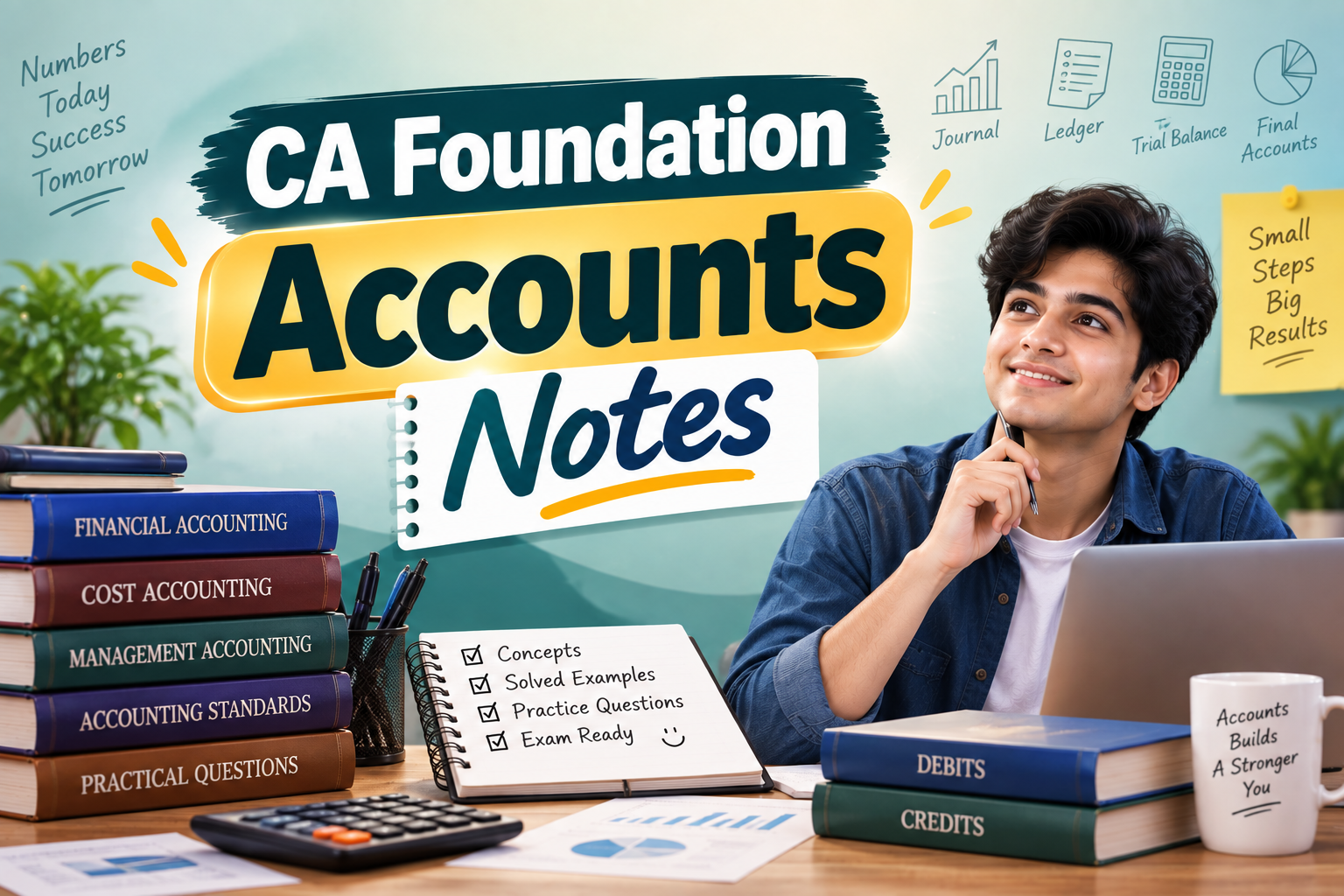

CA Foundation Accounts Notes: Complete Study and Revision Guide

Accounting is often the first subject that gives CA Foundation students a real feel for professional-level studies.

At school level, many students are comfortable with basic journal entries and ledger accounts. But when they enter CA Foundation, the subject becomes more detailed. There are adjustments, financial statements, depreciation, inventories, special transactions and several areas where one small mistake can change the entire answer.

That is exactly why good CA Foundation Accounts Notes can make a difference.

The purpose of notes should not be to replace the ICAI study material. Instead, good notes should make revision faster, help you remember important concepts and give you a quick reference before solving questions or attempting a test.

ICAI’s current Foundation Paper 1 Accounting study-material page lists the Accounting material under the New Scheme of Education and Training, including a separate section relevant for May 2027 and onwards and another applicable from May 2026 onwards.

If you are preparing for CA Foundation, the most effective approach is simple:

Understand the concept → solve illustrations → practise questions → analyse mistakes → revise → test yourself again.

This guide explains how to make that process easier.

What Is CA Foundation Accounting?

CA Foundation Accounting is Paper 1 of the Foundation course. The subject is designed to develop an understanding of basic accounting concepts and their practical application.

Accounting is not simply about remembering debit and credit rules. You need to understand why a particular transaction is recorded in a particular way and how that transaction eventually affects the financial statements.

The syllabus broadly moves from basic accounting concepts to accounting processes, special transactions and preparation of financial statements.

The current ICAI material includes areas such as the Theoretical Framework, Accounting Process, Bank Reconciliation Statement, Inventories, Depreciation and Amortisation, Bills of Exchange and Promissory Notes and Final Accounts of Sole Proprietors.

CA Foundation Accounts Chapters

A useful way to approach the subject is to divide it into conceptual and practical areas.

Chapter / Area What You Learn
Theoretical Framework Accounting concepts, principles, terminology and standards
Accounting Process Journal, ledger, trial balance, subsidiary books and cash book
Bank Reconciliation Statement Reconciling cash book and bank statement
Inventories Valuation and accounting of inventory
Depreciation and Amortisation Depreciation concepts, methods and accounting treatment
Bills of Exchange & Promissory Notes Recording and accounting for bills
Final Accounts Trading Account, Profit & Loss Account and Balance Sheet
Partnership Accounts Partnership-related accounting concepts
Not-for-Profit Organisations Receipt & Payment, Income & Expenditure and Balance Sheet
Company Accounts Basic accounting for shares, debentures and financial statements

The exact applicable material should always be checked against the ICAI notification for your examination attempt.

Why CA Foundation Accounts Notes Are Important

Accounting is a practice-oriented subject.

You may understand a chapter when your teacher explains it, but that does not necessarily mean you can solve an unfamiliar question in the examination.

This is where revision notes become useful.

Good notes help you:

  • Revise chapters quickly
  • Remember accounting rules
  • Keep important formats in one place
  • Review common adjustments
  • Revise formulas and calculations
  • Track repeated mistakes
  • Prepare before mock tests
  • Save time during final revision

For example, instead of reading an entire chapter on depreciation before every test, you can maintain a one-page revision sheet containing the important concepts, methods, formulas and common adjustments.

That is what useful notes should look like.

Chapter 1: Theoretical Framework

The first chapter is the foundation of accounting.

Students sometimes underestimate it because it contains fewer lengthy calculations than other chapters. That can be a mistake.

You need to understand the basic language and principles of accounting before moving into more practical chapters.

Important areas include:

  • Meaning and scope of accounting
  • Accounting concepts
  • Accounting principles
  • Accounting conventions
  • Accounting terminology
  • Capital and revenue expenditure
  • Capital and revenue receipts
  • Contingent assets and liabilities
  • Accounting policies
  • Valuation principles
  • Accounting estimates
  • Accounting Standards
  • Indian Accounting Standards

Capital vs Revenue

Capital Revenue
Usually related to acquisition or improvement of long-term assets Usually related to routine business operations
Generally provides benefit over a longer period Generally relates to current period operations
Example: Purchase of machinery Example: Regular repair expense

Do not simply memorise examples. Understand the reason behind the classification.

Chapter 2: Accounting Process

This is where accounting starts becoming practical.

You should become comfortable with the complete flow:

Transaction → Journal → Ledger → Trial Balance → Financial Statements

Important topics

  • Journal entries
  • Ledger accounts
  • Trial balance
  • Subsidiary books
  • Cash book
  • Rectification of errors

A common mistake is jumping directly to difficult questions without becoming comfortable with basic journal entries.

Spend enough time here.

If the foundation is weak, later chapters become unnecessarily difficult.

Journal Entries: The Real Foundation

When learning journal entries, ask three questions:

  1. What accounts are involved?
  2. What type of accounts are they?
  3. What is the effect of the transaction?

For example, if a business purchases machinery for cash, you should understand that machinery is being acquired as an asset and cash is decreasing.

The objective is not to mechanically remember:

Machinery A/c Dr.
To Cash A/c

The objective is to understand why the entry is passed.

Once the logic becomes clear, accounting becomes much less intimidating.

Chapter 3: Bank Reconciliation Statement

Bank Reconciliation Statement, commonly called BRS, is another important practical area.

The basic purpose of BRS is to explain the difference between the balance shown by the cash book and the balance shown by the bank statement/pass book.

Common reasons for differences

  • Cheques issued but not presented
  • Cheques deposited but not collected
  • Bank charges
  • Interest credited by bank
  • Direct deposits
  • Direct payments
  • Errors in records

Best way to study BRS

Do not memorise a long list of additions and deductions.

Instead, understand the effect of every item.

Ask:

Did the bank balance increase or decrease? Did the cash book record it? Which balance am I starting from?

Once you think this way, BRS becomes much easier.

Chapter 4: Inventories

Inventory valuation is an important part of accounting because inventory affects both the financial position and the profit of a business.

Important areas include:

  • Meaning of inventory
  • Cost of inventory
  • Net Realisable Value
  • Inventory valuation principles
  • Inventory record-keeping
  • Methods and techniques of valuation

When making your CA Foundation Accounting Notes, keep inventory formulas and valuation rules together rather than scattering them across multiple pages.

Also practise numerical questions regularly.

Chapter 5: Depreciation and Amortisation

Depreciation is one of those topics where conceptual clarity and calculation practice need to go together.

You should understand:

  • Meaning of depreciation
  • Need for depreciation
  • Factors affecting depreciation
  • Methods of depreciation
  • Accounting treatment
  • Change in method of depreciation
  • Amortisation

Important Depreciation Methods

Method Basic Idea
Straight Line Method Depreciation is generally spread evenly over the useful life
Written Down Value Method Depreciation is calculated on the relevant reduced book value

Do not focus only on the formula.

Understand what happens to the asset’s book value after depreciation is charged.

That understanding helps you solve variations in practical questions.

Chapter 6: Bills of Exchange and Promissory Notes

Bills of Exchange can initially look confusing because several parties and dates may be involved.

The easiest way to understand the chapter is to create a simple transaction flow.

Learn:

  • Meaning of bill of exchange
  • Promissory note
  • Parties to a bill
  • Acceptance
  • Discounting
  • Endorsement
  • Dishonour
  • Retirement
  • Renewal
  • Accommodation bills

Practical Tip

Whenever you solve a bill question, first identify:

Who is the drawer?
Who is the drawee?
Who is the payee?
What is the due date?
What happened to the bill?

Once these five points are clear, the accounting entries become much easier.

Chapter 7: Final Accounts of Sole Proprietors

This is one of the most practical areas of Foundation Accounting.

Students need to understand how different items ultimately affect:

  • Trading Account
  • Profit and Loss Account
  • Balance Sheet

The chapter covers final accounts for manufacturing and non-manufacturing entities and related adjustments.

Important adjustments

Depending on the question, adjustments may include:

  • Closing stock
  • Outstanding expenses
  • Prepaid expenses
  • Accrued income
  • Income received in advance
  • Depreciation
  • Bad debts
  • Provision-related adjustments
  • Interest on capital
  • Interest on drawings

The best way to master final accounts

Do not try to memorise where every item goes without understanding its effect.

For each adjustment, ask:

Does it affect profit?
Does it affect an asset or liability?
Does it affect both?

That simple habit can prevent many errors.

Chapter 8: Partnership Accounts

Partnership accounting introduces students to accounting situations involving more than one owner.

Important areas include:

  • Partnership final accounts
  • Admission of a partner
  • Retirement of a partner
  • Death of a partner
  • Goodwill
  • Basic accounting treatment for partnership changes
  • Introduction to LLPs

Partnership questions can become lengthy, so working-note discipline is important.

Write your calculations clearly.

Do not try to complete everything mentally.

Chapter 9: Financial Statements of Not-for-Profit Organisations

Not-for-profit organisations do not operate primarily with the objective of earning profit.

Therefore, their accounting treatment has some important differences from ordinary business entities.

You should understand:

  • Receipt and Payment Account
  • Income and Expenditure Account
  • Balance Sheet
  • Capital Fund
  • Subscription adjustments
  • Specific funds
  • Difference between capital and revenue items

Quick Comparison

Receipt & Payment Income & Expenditure
Cash-based statement Accrual-based statement
Includes capital and revenue receipts/payments Generally focuses on revenue income and expenditure
Shows actual cash/bank transactions Determines surplus or deficit

Understanding this difference is much more useful than simply memorising definitions.

Chapter 10: Introduction to Company Accounts

Company Accounts introduce students to the basic accounting treatment relating to companies.

Important areas include:

  • Shares
  • Debentures
  • Issue of shares
  • Issue of debentures
  • Forfeiture of shares
  • Reissue of forfeited shares
  • Basic financial statement presentation

Company accounting may appear technical initially, but it becomes manageable when each transaction is broken into stages.

For example:

Application → Allotment → Calls → Receipt → Possible Forfeiture/Reissue

Practise the sequence instead of trying to memorise isolated entries.

How to Make Effective CA Foundation Accounts Notes

There is a big difference between notes and rewriting the textbook.

If your 30-page chapter becomes a 25-page notebook, you have probably not created revision notes.

Good notes should be short enough to revise quickly.

Use this structure:

Concept → Rule → Formula → Format → Example → Common Mistake

For practical chapters, add one solved illustration.

For theoretical chapters, use:

  • Definitions
  • Differences
  • Key principles
  • Examples
  • Short explanations

Best Way to Revise CA Foundation Accounts

Accounting requires repeated practice.

A useful revision cycle is:

First Revision

Understand the concept and solve basic questions.

Second Revision

Solve questions without looking at the solution.

Third Revision

Attempt mixed questions and timed practice.

Final Revision

Use short notes, formulas, formats and your mistake notebook.

This is much more effective than reading the same chapter repeatedly without solving questions.

Common Mistakes Students Make in CA Foundation Accounts

1. Learning Entries Without Understanding

If you only memorise entries, a slightly different question can confuse you.

2. Avoiding Written Practice

Accounting is a practical subject. Reading solutions is not the same as solving questions.

3. Ignoring Working Notes

Working notes often make lengthy questions much easier to manage.

4. Not Checking the Final Answer

After completing a question, check whether your balance sheet, ledger or calculation actually agrees.

5. Repeating the Same Mistake

Maintain a mistake register.

Write:

Question → Mistake → Correct Treatment → Reason

Review this before every test.

How to Improve Your Accounts Score

If you want to improve your score, do not only solve more questions.

Solve questions with analysis.

Suppose you score 52/100 in a mock test.

Instead of simply saying, “I need to practise more,” divide the lost marks:

Reason Marks Lost
Conceptual mistake 10
Calculation error 6
Wrong accounting treatment 8
Time management 5
Question misunderstood 4
Total 33

Now your next study session becomes specific.

You know exactly what needs improvement.

This is how test practice becomes useful.

30-Day CA Foundation Accounts Study Plan

Days Study Focus
1–3 Theoretical Framework
4–7 Accounting Process
8–9 Bank Reconciliation Statement
10–12 Inventories
13–15 Depreciation
16–18 Bills of Exchange
19–22 Final Accounts
23–25 Partnership / related areas
26 Not-for-Profit Organisations
27 Company Accounts
28 Full revision
29 Mock Test
30 Mistake Analysis + Final Revision

This is only a sample plan. Students preparing for multiple Foundation papers should divide their available study hours accordingly.

Official ICAI CA Foundation Accounts Study Material PDF

When preparing for CA Foundation Accounts, your first reference should always be the applicable ICAI study material.

For the September 2026 examination, ICAI’s official Board of Studies applicability document lists Foundation Paper 1: Accounting (Module 1 and Module 2) as the August 2024 edition, with reprint August 2025 onwards.

Download the Official ICAI PDF

Download Official ICAI Foundation & Intermediate Study Material Applicability PDF – September 2026

This official document helps students verify which edition of the study material is applicable for the September 2026 examination.

For the actual Accounting study material, students can also visit:

Official ICAI Foundation Paper 1 – Accounting Study Material

The ICAI page currently includes a section for May 2026 onwards and separately identifies material relevant for May 2027 and onwards.

Important: Always check the study-material applicability, corrigenda, RTPs and other exam-specific updates for your own attempt before final revision.

Use ICAI Resources Along With Your Notes

Your personal notes should be a revision layer, not a replacement for official material.

A strong preparation system looks like this:

ICAI Study Material

Concept Understanding

Personal Revision Notes

Question Practice

Mock Test

Performance Analysis

Weak Area Revision

ICAI also provides Board of Studies learning resources and recorded sessions. Its September 2026 Foundation learning schedule includes Paper 1 Accounting sessions covering areas such as the Theoretical Framework, Accounting Process, Bank Reconciliation Statement and Inventories.

How CA Mentoring Program Can Support Your Accounts Preparation

Accounting preparation becomes much easier when you have a proper system for studying, testing and reviewing performance.

At CA Mentoring Program, students can combine structured preparation with regular testing and performance tracking.

A good mentoring approach can help students with:

  • Study planning
  • Daily accountability
  • Chapter-wise preparation
  • Regular tests
  • Performance evaluation
  • Weak-area identification
  • Revision planning
  • Full-syllabus practice

If you are looking for structured guidance for your CA preparation, you can explore:

CA Mentoring Program

The important thing is consistency. Even two focused hours of accounting practice every day can be more productive than studying for ten hours only once a week.

CA Foundation Accounts Revision Checklist

Before your examination, make sure you have covered:

  • Accounting concepts and terminology
  • Journal entries
  • Ledger posting
  • Trial balance
  • Subsidiary books
  • Cash book
  • Rectification of errors
  • Bank reconciliation
  • Inventory valuation
  • Depreciation
  • Bills and promissory notes
  • Final accounts
  • Partnership-related accounting
  • Not-for-profit accounting
  • Company accounting basics
  • Important formats
  • Common adjustments
  • Mistakes from previous tests

Do not leave revision until the final few days.

Final Thoughts

CA Foundation Accounts is not a subject that should be prepared through memorisation alone.

The students who eventually become comfortable with Accounts are usually the ones who stop asking, “Which entry should I remember?” and start asking, “Why is this entry being passed?”

That small change in thinking can completely change your preparation.

Use the official ICAI material as your base. Create short CA Foundation Accounts Notes for revision. Practise questions regularly. Maintain a mistake register. Attempt mock tests under exam conditions and analyse the questions you get wrong.

Most importantly, do not judge your Accounts preparation by how many chapters you have read.

Judge it by how many questions you can solve without looking at the solution.

That is the real test of preparation.

CA Foundation Business Economics Notes: Complete Study & Revision Guide

Business Economics is one of the important subjects in the CA Foundation course. Many students initially consider Economics easy because the subject includes familiar concepts such as demand, supply, money, markets, inflation and the Indian economy. However, scoring well requires more than simply reading the chapters once.

The real advantage comes from understanding concepts, remembering important terms, connecting theories with practical examples and revising the syllabus multiple times.

Good CA Foundation Business Economics Notes can make this process much easier. Instead of going through the entire study material every time, students can use properly structured notes for quick revision, concept recall and last-minute preparation.

For CA Foundation preparation, the official ICAI study material should remain the primary source. Your personal notes should work as a revision tool alongside it.

What Is CA Foundation Business Economics?

Business Economics is Paper 4 of the CA Foundation course. ICAI includes topics that help students understand how economic principles influence business decisions and the overall economy.

The subject covers areas such as:

  • Basic economic concepts
  • Demand and supply
  • Production and cost
  • Market structures
  • Business cycles
  • National income
  • Public finance
  • Money market
  • International trade
  • Indian economy

The syllabus contains 10 major chapters, making a systematic revision plan important.

CA Foundation Business Economics Chapters

Chapter Topic Main Focus
1 Introduction to Business Economics Basic economic concepts
2 Theory of Demand and Supply Demand, supply and elasticity
3 Theory of Production and Cost Production and cost concepts
4 Price Determination in Different Markets Market structures
5 Business Cycles Economic fluctuations
6 Determination of National Income National income concepts
7 Public Finance Government revenue and expenditure
8 Money Market Money and banking
9 International Trade Global trade and exchange
10 Indian Economy Structure and major economic issues

These chapters should not be studied with the same strategy. Some require conceptual understanding, while others need regular revision of definitions, classifications and economic relationships.

Chapter 1: Introduction to Business Economics

The first chapter creates the foundation for the rest of the subject.

Business Economics applies economic principles to business decision-making. Since resources are limited but human wants are unlimited, individuals and businesses constantly have to make choices.

Important concepts

  • Scarcity
  • Choice
  • Opportunity cost
  • Utility
  • Production Possibility Curve
  • Microeconomics
  • Macroeconomics
  • Economic problems
  • Central problems of an economy

Microeconomics vs Macroeconomics

Microeconomics Macroeconomics
Studies individual units Studies the economy as a whole
Demand of a product National income
Individual consumer Overall employment
Individual firm General price level
Product pricing Economic growth

Do not just memorize these differences. Try connecting every concept with a simple real-world example.

Chapter 2: Theory of Demand and Supply

Demand and supply are among the most important concepts in Business Economics.

Demand refers to the quantity of a commodity that consumers are willing and able to purchase at different prices during a given period.

The law of demand generally explains an inverse relationship between price and quantity demanded, subject to its assumptions and exceptions.

Important topics

  • Meaning of demand
  • Determinants of demand
  • Law of demand
  • Demand schedule
  • Demand curve
  • Changes in demand
  • Elasticity of demand
  • Price elasticity
  • Income elasticity
  • Cross elasticity
  • Supply
  • Law of supply
  • Market equilibrium

Types of Elasticity

Type What it Measures
Price Elasticity Response to change in price
Income Elasticity Response to change in income
Cross Elasticity Response to price change of another good

For revision, prepare separate notes for definitions, formulas, diagrams and exceptions.

Chapter 3: Theory of Production and Cost

This chapter explains how businesses transform inputs into output and how different costs behave during production.

Students should understand the relationship between inputs and output instead of trying to memorize isolated definitions.

Important concepts

  • Production function
  • Total Product
  • Average Product
  • Marginal Product
  • Law of Variable Proportions
  • Returns to Scale
  • Fixed Cost
  • Variable Cost
  • Total Cost
  • Average Cost
  • Marginal Cost

Important Cost Concepts

Cost Meaning
Fixed Cost Does not change with output in the short run
Variable Cost Changes with level of output
Total Cost Fixed Cost + Variable Cost
Average Cost Cost per unit of output
Marginal Cost Additional cost of producing an additional unit

Practice relationships between these concepts because questions can test whether you actually understand them.

Chapter 4: Price Determination in Different Markets

A business does not operate in the same market conditions as every other business. The pricing process depends on the market structure.

The major market structures covered include:

  • Perfect Competition
  • Monopoly
  • Monopolistic Competition
  • Oligopoly

Market Structure Comparison

Market Sellers Product Price Control
Perfect Competition Many Homogeneous Very limited
Monopoly One Unique/no close substitute High
Monopolistic Competition Many Differentiated Some
Oligopoly Few Similar or differentiated Significant

Use examples from everyday business situations to remember the characteristics.

Chapter 5: Business Cycles

Business activity does not remain constant forever. Economies experience periods of growth as well as slowdown.

These fluctuations are studied through business cycles.

The commonly discussed stages are:

  1. Expansion
  2. Peak
  3. Contraction
  4. Trough
  5. Recovery

During expansion, economic activity generally increases. At the peak, economic activity reaches a high point before moving toward contraction. The trough represents the lowest phase, after which recovery may begin.

How to Study Business Cycles

Create a simple cycle diagram in your notes and write the major characteristics of each stage around it.

This makes revision much faster than reading long paragraphs repeatedly.

Chapter 6: Determination of National Income

National income is another major area of Business Economics.

Students should understand the meaning and relationship between different national income concepts.

Important terms

  • GDP
  • GNP
  • NDP
  • NNP
  • Nominal Income
  • Real Income
  • Per Capita Income
  • Consumption
  • Saving
  • Investment

Methods of Measuring National Income

The three broad approaches are:

  • Income Method
  • Expenditure Method
  • Product/Output Method

A common mistake is learning formulas without understanding what each component represents. While making CA Foundation Economics Notes, write the formula first and then add a one-line explanation of every important component.

Chapter 7: Public Finance

Public Finance deals with the financial activities of the government.

It helps students understand how governments collect money, spend it and manage public resources.

Important areas

  • Public Revenue
  • Public Expenditure
  • Public Debt
  • Taxation
  • Fiscal Policy
  • Government Budget

Direct Tax vs Indirect Tax

Direct Tax Indirect Tax
Burden is generally borne by the person on whom it is imposed Burden can generally be shifted
Paid directly to government Collected through transactions/suppliers
Example: Income Tax Example: GST

For exam preparation, pay attention to definitions, classifications, objectives and differences.

Chapter 8: Money Market

Money is an essential part of every modern economy. This chapter explains the role of money, banking and monetary systems.

Important topics

  • Meaning and functions of money
  • Demand for money
  • Supply of money
  • Commercial banks
  • Central banking
  • Credit creation
  • Monetary policy
  • Money market instruments

Students often mix up monetary policy and fiscal policy.

A simple way to remember the distinction is:

Monetary policy → money, credit and interest-related economic management

Fiscal policy → government revenue and expenditure

Prepare a separate comparison table in your revision notes.

Chapter 9: International Trade

International trade explains how countries exchange goods and services with one another.

No country produces everything efficiently. Differences in resources, technology, costs and production capabilities create opportunities for international trade.

Important concepts

  • Meaning of international trade
  • Advantages of international trade
  • Absolute advantage
  • Comparative advantage
  • Balance of Trade
  • Balance of Payments
  • Exchange Rate
  • Tariffs
  • Quotas

Domestic Trade vs International Trade

Domestic Trade International Trade
Takes place within a country Takes place between countries
Same national currency generally used Foreign exchange may be involved
Fewer geographical restrictions Greater geographical distance
National regulations apply International rules and policies may apply

Understanding these differences makes the chapter easier to revise.

Chapter 10: Indian Economy

The final chapter connects economic concepts with India’s economic environment.

Students should focus on understanding the structure of the Indian economy and major economic issues.

Important areas

  • Features of the Indian economy
  • Economic growth
  • Economic development
  • Agriculture
  • Industry
  • Services
  • Infrastructure
  • Employment
  • Poverty
  • Inflation
  • Economic reforms

Since economic information can change over time, students should always check the latest applicable ICAI material, amendments and exam-specific updates while preparing.

How to Make Effective CA Foundation Business Economics Notes

Not every note is useful.

If your notes are almost as lengthy as the original study material, they will not help much during revision.

A better approach is to create short, structured and exam-oriented notes.

1. Start With ICAI Study Material

Read the relevant ICAI chapter first. Understand the concept before shortening it.

2. Highlight Important Definitions

Definitions are easy to revise when they are kept separately.

3. Make Comparison Tables

For example:

  • Micro vs Macro
  • Direct vs Indirect Tax
  • GDP vs GNP
  • Domestic vs International Trade
  • Perfect Competition vs Monopoly

4. Keep Diagrams Separate

Demand curves, business cycle diagrams and other visual concepts should be practiced separately.

5. Maintain a Mistake List

Whenever you get a question wrong, write down the reason.

This becomes one of the most valuable parts of your CA Foundation Business Economics Revision Notes.

How to Use CA Foundation Economics Notes for Revision

Making notes is only half the job. Using them correctly is more important.

A practical revision cycle can be:

First Reading → Notes → Questions → Mistake Analysis → Revision → Mock Test → Final Revision

After completing a chapter, avoid immediately moving to another chapter without testing yourself.

Try answering questions without looking at your notes. This tells you whether you actually remember the concept.

Common Mistakes Students Make in Business Economics

1. Studying Only Before the Exam

Economics may look manageable initially, but a large syllabus becomes difficult if revision is postponed.

2. Memorising Without Understanding

Definitions and classifications are important, but understanding the concept helps you remember them for longer.

3. Ignoring Diagrams

Some economic concepts become much easier when represented visually.

4. Not Revising Wrong Answers

Solving hundreds of questions without analysing mistakes is less useful than carefully reviewing the questions you got wrong.

5. Using Too Many Study Sources

Multiple books and notes can create confusion. Keep ICAI material as the core source and use additional notes for revision and practice.

30-Day CA Foundation Business Economics Study Plan

Days Focus
1–3 Introduction to Business Economics
4–7 Demand and Supply
8–10 Production and Cost
11–13 Market Structures
14–16 Business Cycles
17–20 National Income
21–22 Public Finance
23–24 Money Market
25–27 International Trade
28 Indian Economy
29 Full Syllabus Revision
30 Mock Test + Mistake Analysis

You can adjust this schedule according to your available study hours and other CA Foundation papers.

Download Official ICAI CA Foundation Business Economics Study Material PDF

Students preparing for CA Foundation Business Economics should use the applicable official ICAI study material as their primary academic source.

For the September 2026 examination, ICAI’s official applicability document lists Foundation Paper 4 – Business Economics as the August 2024 edition, reprint August 2025 onwards. Always check the applicability for your own attempt before final preparation.

Official ICAI PDF:

You can also check the official ICAI Foundation page for Paper 4:

For study material, RTPs, MTPs, lectures and other Board of Studies resources, students can use:

Important: The applicable study material, RTPs, amendments and other exam-related resources can vary by attempt. Students should verify the latest ICAI notification and applicability document before starting final revision.

How CA Mentoring Can Improve Business Economics Preparation

Self-study becomes easier when students know what to study, when to revise and how to measure progress.

A structured mentoring approach can help students maintain consistency through:

  • Customized study planning
  • Daily guidance
  • Regular activity tracking
  • One-to-one accountability
  • Chapter-wise testing
  • Full-syllabus testing
  • Performance evaluation
  • Identification of weak areas
  • Regular revision planning

For students who want structured preparation along with testing and performance tracking, you can explore:

CA Mentoring Program

The important point is that notes should not replace practice. Your preparation should combine concept learning + revision + question practice + test analysis.

How to Identify Weak Areas in Business Economics

One of the best ways to improve your score is to identify exactly where you are losing marks.

Problem Possible Reason Action
Definitions forgotten Insufficient revision Create definition list
MCQs repeatedly wrong Concept unclear Re-read the topic
Confusion between terms Similar concepts Create comparison table
Diagrams incorrect Not practiced Practice separately
Time pressure Less test practice Attempt timed tests
Same mistakes repeated No analysis Maintain error log

This approach turns test results into a practical study plan.

Last-Minute Revision Strategy for CA Foundation Economics

During the final days before the examination, do not try to read everything from scratch.

Focus on:

  1. Important definitions
  2. Key concepts
  3. Comparison tables
  4. Important relationships
  5. Diagrams
  6. Frequently made mistakes
  7. Formulas and numerical concepts, wherever applicable
  8. Mock-test mistakes
  9. Difficult chapters
  10. Quick revision notes

Your final revision should be much shorter than your first reading.

Final Checklist for CA Foundation Business Economics

Before the examination, make sure you have:

  • Completed the applicable ICAI study material
  • Revised all 10 chapters
  • Prepared short revision notes
  • Practiced important questions
  • Reviewed incorrect answers
  • Revised important definitions
  • Practiced diagrams and conceptual relationships
  • Attempted timed tests
  • Analysed mock-test performance
  • Completed multiple rounds of revision

Final Thoughts

Business Economics can become a high-confidence subject when preparation is consistent and concept-focused.

The goal should not be to collect hundreds of pages of notes. Instead, create clear CA Foundation Business Economics Notes that help you revise the entire syllabus quickly and identify the areas where you need more practice.

Start with the applicable ICAI study material, prepare concise notes, revise chapter-wise, solve questions regularly and analyse every mistake.

With the right combination of understanding, revision, testing and performance analysis, Business Economics becomes much easier to manage during CA Foundation preparation.

CA Foundation Business Law Notes: Complete Chapter-Wise Study & Revision Guide

CA Foundation Business Law Notes: A Practical Guide for Better Preparation

Business Laws is one of the most interesting subjects in the CA Foundation course.

At first, many students assume that it will be an easy theory paper. There are no lengthy calculations, no complicated formulas and no numerical problems to solve. But once preparation starts, students often realise that Business Laws requires something different: conceptual clarity, legal understanding, proper revision and the ability to apply provisions to practical situations.

This is where good CA Foundation Business Law Notes can make a real difference.

The purpose of notes should not be to replace the ICAI study material. Instead, good notes should make revision easier by bringing important concepts, definitions, provisions, examples, differences and exceptions together in an organised manner.

For the current Foundation Paper 2 structure, ICAI covers seven major areas: Indian Regulatory Framework, the Indian Contract Act, the Sale of Goods Act, the Indian Partnership Act, the Limited Liability Partnership Act, the Companies Act and the Negotiable Instruments Act.

If you are preparing for CA Foundation, this guide will help you understand what your Business Law notes should contain, how to prepare them and how to use them effectively before the examination.

Why Are CA Foundation Business Law Notes Important?

Imagine that you studied a chapter three weeks ago.

You remember the topic, but you cannot remember:

  • the exact legal provision,
  • the important exceptions,
  • the difference between two similar concepts,
  • the example used to explain the provision, or
  • how to apply the provision to a practical question.

Now imagine having a concise revision resource containing all of these points in one place.

That is the real purpose of Business Law notes.

Good notes can help you:

  1. Revise chapters faster.
  2. Remember important legal terminology.
  3. Identify important provisions.
  4. Understand differences between similar concepts.
  5. Revise exceptions quickly.
  6. Prepare for case-based questions.
  7. Improve answer writing.
  8. Identify weak areas before the examination.

However, there is an important distinction:

Good notes simplify revision; they do not eliminate the need to study the actual concepts.

For CA Foundation, students should use their notes along with the applicable ICAI study material and examination-specific updates.

CA Foundation Business Laws Syllabus

The current ICAI Paper 2 Business Laws material contains seven chapters. The official ICAI page also provides the detailed units under the respective chapters.

Chapter Subject Area
Chapter 1 Indian Regulatory Framework
Chapter 2 The Indian Contract Act, 1872
Chapter 3 The Sale of Goods Act, 1930
Chapter 4 The Indian Partnership Act, 1932
Chapter 5 The Limited Liability Partnership Act, 2008
Chapter 6 The Companies Act, 2013
Chapter 7 The Negotiable Instruments Act, 1881

The Contract Act section itself is divided into several units, including nature of contracts, consideration, essential elements, performance, breach and remedies, contingent and quasi contracts, indemnity and guarantee, bailment and pledge, and agency.

This is why students should avoid making one huge set of unorganised notes.

Chapter-wise notes are much easier to revise.

Chapter 1: Indian Regulatory Framework

The Indian Regulatory Framework introduces students to the basic legal environment in India.

While this chapter may not feel as intimidating as the Contract Act, it should not be ignored.

Your notes should focus on:

  • Meaning of law
  • Sources of law
  • Types of laws
  • Basic legal framework
  • Important regulatory concepts
  • Relevant legal terminology

How should you make notes for this chapter?

Keep them short.

Create a one- or two-page revision sheet containing:

Concept → Meaning → Important Point → Example

The objective is to make this chapter easy to revise rather than turning it into another textbook.

Chapter 2: The Indian Contract Act, 1872

This is one of the most important areas of Business Laws and deserves serious attention.

Students often find the Contract Act difficult because several concepts are interconnected.

For example, you may understand an agreement but then come across questions involving:

  • offer,
  • acceptance,
  • consideration,
  • capacity,
  • free consent,
  • legality,
  • void agreements,
  • performance,
  • breach,
  • indemnity,
  • guarantee,
  • bailment,
  • pledge, or
  • agency.

Instead of preparing each concept in isolation, connect them.

Important topics for your notes

Topic What to Focus On
Contract Meaning and essential elements
Offer Meaning, communication and revocation
Acceptance Rules and communication
Consideration Meaning, essentials and exceptions
Capacity Competency of parties
Free Consent Factors affecting free consent
Void Agreements Important categories
Performance Rules relating to performance
Breach Types and consequences
Remedies Legal remedies for breach
Indemnity Rights and liabilities
Guarantee Parties and nature of guarantee
Bailment Rights and duties
Pledge Rights of pawnor and pawnee
Agency Creation and termination

A useful revision format is:

Definition → Provision → Explanation → Example → Exception

This makes the material easier to remember.

Chapter 3: The Sale of Goods Act, 1930

The Sale of Goods Act becomes easier once you understand the relationships between its concepts.

Students should pay particular attention to:

  • Contract of sale
  • Sale and agreement to sell
  • Conditions and warranties
  • Transfer of ownership
  • Transfer of title
  • Delivery of goods
  • Unpaid seller
  • Rights of an unpaid seller

Important comparison for revision

Basis Sale Agreement to Sell
Transfer of ownership Takes place immediately Takes place at a future time or subject to a condition
Nature Executed contract Executory contract
Risk Generally passes with ownership Generally remains until ownership passes
Rights Buyer gets ownership rights Buyer gets contractual rights

Similarly, students should prepare separate comparison notes for conditions and warranties.

When concepts look similar, comparison tables are often much easier to revise than long paragraphs.

Chapter 4: The Indian Partnership Act, 1932

Partnership is a chapter where understanding the basic structure is extremely important.

Your notes should cover:

  • Meaning of partnership
  • Essential elements
  • Partnership deed
  • Rights of partners
  • Duties of partners
  • Authority of partners
  • Relationship between partners
  • Admission of a partner
  • Retirement of a partner
  • Registration
  • Dissolution

One useful technique is to create a separate page titled:

Rights, Duties and Liabilities of Partners

Instead of repeatedly reading the entire chapter, you can use this page during quick revisions.

Also pay attention to the concept of mutual agency, because it helps explain the legal relationship between partners.

Chapter 5: Limited Liability Partnership Act, 2008

LLP is different from an ordinary partnership, and students should understand this difference instead of simply memorising definitions.

Your notes should include:

  • Meaning of LLP
  • Characteristics of LLP
  • Partners
  • Designated partners
  • Incorporation
  • Liability of partners
  • Contribution
  • Relationship between partners
  • Conversion into LLP
  • Winding up and dissolution

Partnership vs LLP

Basis Partnership LLP
Main Law Indian Partnership Act, 1932 LLP Act, 2008
Legal Structure Partnership relationship Separate legal entity
Liability Partners’ liability as per partnership law Limited liability subject to applicable law
Compliance Relatively simpler Specific statutory compliance
Continuity Depends on applicable partnership terms Perpetual succession

Don’t just memorise the table.

Understand why an LLP has a separate legal identity and why limited liability is one of its important characteristics.

Chapter 6: The Companies Act, 2013

The Companies Act introduces Foundation students to important concepts relating to companies.

Your notes should cover topics such as:

  • Meaning of company
  • Features of company
  • Types of companies
  • Incorporation
  • Memorandum of Association
  • Articles of Association
  • Share capital
  • Membership
  • Directors
  • Meetings
  • Other basic company-law concepts

This chapter contains many technical terms.

A definition bank can therefore be extremely useful.

For example, keep important terms together instead of scattering them throughout your notes.

Quick revision method

Create three columns:

Term Meaning Key Point
Company Legal business organisation Separate legal identity
Member Person recognised as member Membership has legal significance
Director Person appointed to the board Manages company affairs through board
MOA Fundamental constitutional document Defines scope and objects
AOA Internal rules of company Governs internal management

This format makes last-minute revision considerably easier.

Chapter 7: The Negotiable Instruments Act, 1881

This chapter becomes much more manageable when you understand the different instruments and parties involved.

Important topics include:

  • Negotiable instruments
  • Promissory note
  • Bill of exchange
  • Cheque
  • Parties to instruments
  • Negotiation
  • Endorsement
  • Crossing
  • Dishonour
  • Payment-related concepts

Promissory Note vs Bill of Exchange

Basis Promissory Note Bill of Exchange
Nature Promise to pay Order to pay
Main parties Maker and payee Drawer, drawee and payee
Basic action Maker promises payment Drawer orders payment
Acceptance Not required in the same way Drawee may accept

Creating such tables in your notes can save a lot of time during revision.

How to Prepare the Best CA Foundation Business Law Notes

You don’t need expensive stationery or complicated note-making systems.

A simple approach works.

Step 1: Read the Concept First

Before making notes, understand the topic from the applicable ICAI study material.

Don’t start copying sentences.

Ask yourself:

What does this provision actually mean?

If you cannot explain it in simple words, you probably need to understand it again before making notes.

Step 2: Identify the Important Legal Points

After understanding the concept, identify:

  • Definitions
  • Provisions
  • Conditions
  • Exceptions
  • Important terms
  • Examples
  • Differences
  • Practical applications

These are the points that should make it into your revision notes.

Step 3: Make Notes Short

A common mistake is making notes almost as long as the study material.

If your 100-page study material becomes a 90-page notebook, something has gone wrong.

The purpose is compression.

A good note should allow you to revise a chapter in significantly less time.

Step 4: Add Practical Examples

Law becomes easier when you connect it with real situations.

For example, instead of only remembering a definition of an offer, imagine a person making a definite proposal to another person to sell something at a specified price.

Ask:

Is this actually an offer?

That mental application makes the concept easier to remember.

How to Use CA Foundation Business Law Notes for Revision

Notes become most valuable when revision starts.

A simple revision cycle can be:

First Revision: Understand all concepts.

Second Revision: Focus on provisions and important terminology.

Third Revision: Revise differences and exceptions.

Fourth Revision: Solve practical questions.

Final Revision: Use short notes and mistake lists.

Suggested revision structure

Revision Main Focus
Revision 1 Complete understanding
Revision 2 Important provisions
Revision 3 Definitions, differences and exceptions
Revision 4 Question practice
Final Revision Short notes + mistakes

You don’t have to follow the same number of revisions as another student.

The important thing is repeated active revision.

How to Improve CA Foundation Business Law Answer Writing

Knowing the provision does not automatically mean you will write a strong answer.

In practical questions, students need to connect the legal principle with the facts.

A useful structure is:

1. Provision

State the relevant legal principle.

2. Explanation

Explain what the provision means.

3. Application

Apply the provision to the facts given in the question.

4. Conclusion

Give a clear final answer.

This can be remembered as:

P → E → A → C

Provision → Explanation → Application → Conclusion

The exact presentation may vary according to the question, but this structure helps students avoid writing vague answers.

Common Mistakes Students Make in Business Law

1. Studying only from summaries

Short notes are excellent for revision, but students should not completely ignore the applicable ICAI study material.

2. Memorising without understanding

Legal provisions become much easier when their meaning is clear.

3. Ignoring exceptions

Students often remember the general rule but forget the exception.

In application-based questions, that can create problems.

4. Not practising case-based questions

Business Laws is not only about definitions.

You need to know how to apply the law.

5. Making excessively long notes

Notes should reduce your revision time, not increase it.

6. Starting revision too late

Business Law becomes difficult when an entire syllabus is left for the last few days.

Regular revision is a much better strategy.

Official ICAI CA Foundation Business Laws Study Material PDF

Students looking for CA Foundation Business Law Notes PDF should also keep the official ICAI study material as their primary reference.

The ICAI Board of Studies has specified the material applicable for the September 2026 Foundation examination. For Paper 2: Business Laws, ICAI lists the August 2024 edition, reprinted from August 2025 onwards, along with the RTP for September 2026.

Download the Official ICAI PDF

Download Official ICAI Foundation & Intermediate Study Material Applicable for September 2026

This is an official ICAI Board of Studies document.

Students can also access the chapter-wise Foundation Course – Paper 2: Business Laws material directly through ICAI’s official website.

Visit Official ICAI Business Laws Study Material Page

Important: Always check the examination-specific RTP, amendments, announcements and applicability documents relevant to your attempt. Study material can change between examination cycles.

CA Foundation Business Law Notes vs ICAI Study Material

Students sometimes ask whether they should study notes or the official material.

The answer is: use both for different purposes.

Resource Best Use
ICAI Study Material Detailed learning and conceptual understanding
Personal Notes Revision
Short Notes Last-minute revision
Question Practice Application
RTP Exam-oriented practice
Mock Tests Time management and performance evaluation
Mistake Book Correcting repeated errors

Think of the ICAI study material as the foundation and your notes as the revision layer.

One should support the other.

30-Day CA Foundation Business Law Preparation Plan

If you have around one month for focused Business Law preparation, you can divide the syllabus into four stages.

Week Focus
Week 1 Indian Regulatory Framework + Contract Act
Week 2 Contract Act + Sale of Goods
Week 3 Partnership + LLP + Companies
Week 4 Negotiable Instruments + Full Revision

Within each week, follow:

Learn → Make Notes → Revise → Practise → Analyse

Don’t judge your progress only by the number of chapters completed.

Ask yourself:

“Can I solve a question on this topic without looking at the answer?”

That is a much better measure of preparation.

One-Day Revision Strategy for CA Foundation Business Law

Sometimes you may need to revise Business Law in a very short period.

In that situation, don’t try to read every line again.

Use this order:

Definitions → Provisions → Differences → Exceptions → Examples → Questions → Mistakes

Quick revision table

Area What to Revise
Definitions Key legal terminology
Provisions Important legal rules
Differences Similar concepts
Exceptions Special situations
Examples Application
Questions Exam practice
Mistakes Weak areas

This approach is especially useful before a test or mock examination.

How CA Mentoring Program Can Help With CA Foundation Preparation

Preparing for CA Foundation is not only about collecting study material.

Many students understand the concepts but struggle with consistency.

They may start strongly, lose momentum after a few weeks, postpone revision and then feel pressured when examinations approach.

A structured approach can help.

CA Mentoring Program provides resources and mentoring support for CA students, including study planning, guidance, accountability and test-oriented preparation.

You can explore the official website here:

CA Mentoring Program

Students can also use test-based preparation to understand whether they are actually improving.

For Business Law specifically, regular testing can help identify:

  • weak chapters,
  • forgotten provisions,
  • answer-writing problems,
  • time-management issues,
  • repeated mistakes.

The goal should not simply be to complete the syllabus.

The goal should be to know where you stand before the actual examination.

How to Make Your Business Law Preparation More Effective

A simple daily routine can make a significant difference.

For example:

Read

Study a new concept from the applicable material.

Revise

Review yesterday’s concept for a few minutes.

Write

Practise at least a few answers.

Analyse

Check where your answer was incomplete.

Repeat

Come back to difficult concepts regularly.

This cycle may look simple, but consistency is what makes it effective.

Final Checklist for CA Foundation Business Law

Before your examination, make sure you can confidently answer these questions:

  • Have I covered every chapter?
  • Have I read the applicable ICAI study material?
  • Do I know the important definitions?
  • Can I explain major provisions?
  • Can I differentiate similar concepts?
  • Do I remember important exceptions?
  • Have I practised case-based questions?
  • Can I apply provisions to facts?
  • Have I revised my mistakes?
  • Have I practised enough questions?
  • Have I checked the applicable RTP and updates?
  • Can I revise the complete syllabus quickly?

If you can answer yes to most of these questions, your preparation is moving in the right direction.

Final Thoughts

Preparing Business Law for CA Foundation is not about memorising hundreds of pages and hoping that everything comes back during the examination.

It is about building understanding and then revising that understanding repeatedly.

Start with the applicable ICAI study material. Understand the provision. Create concise CA Foundation Business Law Notes. Add examples and important differences. Practise application-based questions. Analyse your mistakes. Then revise the same material again.

Don’t underestimate the value of short revision notes.

At the same time, don’t make the mistake of treating notes as a replacement for the official study material.

The strongest preparation combines:

ICAI Study Material + Notes + Revision + Question Practice + RTP + Mock Tests + Mistake Analysis

Business Law may look like a purely theoretical subject, but once you understand how the provisions work in practical situations, it becomes much more manageable.

So, instead of asking only “How many chapters have I completed?”, start asking:

“How confidently can I apply what I have studied?”

That change in approach can make your Business Law preparation much more effective.

CA Final Notes: Complete Subject-Wise Notes for Effective CA Final Preparation

CA Final Notes: Your Smart Companion for the Final Stage of CA Preparation

The CA Final stage is different from everything you have experienced earlier in the Chartered Accountancy journey.

By the time you reach CA Final, you already know how to study. You have cleared Foundation, survived Intermediate, handled lengthy chapters, written countless questions, and probably learned the hard way that simply reading a book again and again does not guarantee marks.

At the Final level, revision becomes just as important as learning.

This is exactly where well-structured CA Final Notes can make a major difference.

Good notes are not supposed to replace ICAI Study Material. Instead, they should help you revise concepts faster, remember important provisions, connect related topics and identify areas that need another round of practice.

For the current CA Final course structure, ICAI lists six papers:

Group Paper Subject
Group I Paper 1 Financial Reporting
Group I Paper 2 Advanced Financial Management
Group I Paper 3 Advanced Auditing, Assurance and Professional Ethics
Group II Paper 4 Direct Tax Laws & International Taxation
Group II Paper 5 Indirect Tax Laws
Group II Paper 6 Integrated Business Solutions

The Institute’s Board of Studies also provides study material and examination-oriented resources through its knowledge ecosystem. Therefore, while preparing your personal notes, students should always cross-check the latest applicable ICAI material, amendments, RTPs, mock tests and announcements.

Why Are CA Final Notes So Important?

CA Final preparation can become overwhelming because the syllabus is extensive and several subjects require continuous revision.

Imagine studying Financial Reporting today and revisiting it after six weeks. You may remember the broad concept but forget the adjustment, exception or presentation requirement that can actually make a difference in the examination.

That is why students should gradually convert their detailed learning material into short, revision-friendly notes.

Effective CA Final notes can help you:

  • Revise large chapters in less time
  • Remember important concepts and provisions
  • Identify frequently tested areas
  • Revise amendments before examinations
  • Maintain a list of mistakes made during practice
  • Quickly revisit formulas and practical approaches
  • Improve answer-writing confidence
  • Reduce the pressure of studying everything from scratch before the exam

The objective is simple:

First understand. Then condense. Finally revise.

CA Final Subject-Wise Notes

Every CA Final subject demands a different approach. Making the same type of notes for every paper is one of the common mistakes students make.

A practical approach is to prepare notes according to the nature of the subject.

1. CA Final Financial Reporting Notes

Financial Reporting is a concept-heavy and application-oriented subject. At this level, merely memorising accounting treatment is rarely enough.

Your Financial Reporting notes should focus on:

  • Important Ind AS concepts
  • Recognition and measurement principles
  • Presentation requirements
  • Accounting treatments
  • Adjustments
  • Common practical issues
  • Important journal entries
  • Frequently made mistakes
  • Practical question formats
  • Important exceptions

A useful way to prepare FR notes is to create a concept + treatment + example format.

For example:

Note Section What to Include
Concept Core accounting principle
Treatment Accounting treatment required
Adjustment Common adjustment
Example Short practical illustration
Mistake Alert Error students commonly make

Avoid copying entire chapters into your notebook. Your notes should help you recall the chapter, not become another textbook.

2. CA Final Advanced Financial Management Notes

Advanced Financial Management requires a combination of conceptual understanding, formulas and extensive practical application.

Your AFM notes should ideally contain:

  • Important formulas
  • Formula application
  • Shortcuts where appropriate
  • Important assumptions
  • Step-by-step calculation methods
  • Common adjustments
  • Question-solving approaches
  • Mistakes to avoid

A separate formula book can be extremely useful.

However, don’t simply write formulas.

For every important formula, mention:

Formula → Meaning → When to use → One short example

This small habit can save a lot of time during revision.

For practical subjects like AFM, solving questions is more important than producing beautiful notes.

Your notes should support practice—not replace it.

3. CA Final Advanced Auditing, Assurance and Professional Ethics Notes

Audit is often considered a difficult paper because students have to remember concepts, standards, requirements and answer presentation simultaneously.

Your Audit notes should be highly structured.

A good Audit revision page can include:

  • Meaning
  • Objective
  • Key requirements
  • Important provisions
  • Exceptions
  • Auditor’s responsibilities
  • Reporting requirements
  • Important keywords
  • Practical examples
  • Answer-writing points

Use keywords intelligently

In Audit, presentation matters.

Instead of writing extremely long paragraphs during revision, identify the keywords that should appear in your final answer.

For example:

Requirement → Explanation → Procedure → Conclusion

This makes revision faster and also trains your mind to present answers logically.

ICAI’s resources should remain your primary reference for applicable study material and updates. Students should not rely on old notes when amendments or syllabus changes are applicable to their examination attempt.

4. CA Final Direct Tax Laws & International Taxation Notes

Taxation is one of the subjects where updates and amendments matter enormously.

A set of CA Final Direct Tax notes prepared months earlier may not be sufficient for your examination attempt.

Your notes should therefore have separate sections for:

Concept Notes

Include:

  • Important provisions
  • Definitions
  • Tax treatment
  • Conditions
  • Exceptions
  • Computation methods

Amendment Notes

Maintain a separate amendment tracker containing:

Area What to Record
Section Relevant section
Change What changed
Earlier Provision Previous position
New Provision Current position
Applicability Examination applicability
Example Short illustration

This makes the final revision much easier.

For International Taxation, create topic-wise summaries rather than trying to memorise the entire material in one go.

5. CA Final Indirect Tax Laws Notes

GST preparation becomes significantly easier when concepts are connected rather than studied in isolation.

Your GST notes can cover:

  • Supply
  • Time of supply
  • Place of supply
  • Value of supply
  • Input tax credit
  • Registration
  • Tax invoice
  • Returns
  • Payment of tax
  • Refund
  • Assessment
  • Demand and recovery
  • Other applicable provisions

A good GST note should answer three questions:

What is the rule?

What is the exception?

How will it be applied in a practical question?

Don’t ignore amendments and statutory updates. ICAI’s applicable study material for an examination attempt specifies the relevant updates, and students should follow the material applicable to their attempt rather than mixing resources from different attempts.

6. CA Final Integrated Business Solutions Notes

Integrated Business Solutions is different from traditional theory or numerical papers.

It requires you to connect concepts from multiple areas and apply them to case-based situations.

Therefore, your IBS notes should not simply be a collection of definitions.

Instead, create:

  • Concept maps
  • Case-based frameworks
  • Important strategic concepts
  • Decision-making approaches
  • Cross-subject connections
  • Common case-study patterns
  • Important points from practice cases
  • Mistakes observed while solving case studies

The more you practise applying concepts to situations, the more useful your notes become.

How to Make Effective CA Final Notes

One of the biggest mistakes CA Final students make is preparing notes that are too detailed.

If your notes are 500 pages, you may hesitate to revise them.

If they are only 20 pages and miss important concepts, they may not be useful either.

The ideal approach is progressive summarisation.

Stage 1: Detailed Learning

Use ICAI Study Material, classes, reference books and other reliable resources to understand the chapter.

Stage 2: First Revision

Highlight important concepts, questions, formulas and provisions.

Stage 3: Condense

Convert those highlighted areas into short notes.

Stage 4: Final Revision Notes

Create extremely concise revision sheets for the final days.

This creates a three-level preparation system:

Stage Material Purpose
Level 1 Detailed Material Learning
Level 2 Short Notes Revision
Level 3 Quick Revision Sheets Final Recall

This method is far more practical than trying to prepare perfect notes from day one.

CA Final Notes vs ICAI Study Material: What Should You Follow?

This question comes up frequently.

The answer is straightforward:

Do not treat personal notes and ICAI Study Material as competitors.

They serve different purposes.

ICAI Study Material Personal CA Final Notes
Detailed Concise
Primary learning source Revision source
Covers syllabus systematically Highlights important points
Useful for conceptual clarity Useful for quick recall
May be lengthy Designed around your needs
Official source Personal revision tool

The ICAI BoS Knowledge Portal provides access to study content, lectures, syllabus-related resources, revision test papers, mock test papers and other student resources.

So, use official material as your foundation and your notes as your revision weapon.

How to Use CA Final Notes for Revision

Making notes is only half the job.

Using them correctly is what matters.

A practical revision cycle can look like this:

First Revision

Read your notes slowly and identify areas you still don’t understand.

Second Revision

Try to recall the concepts without looking at the page.

Third Revision

Solve questions after revising the concept.

Final Revision

Use only short notes, marked questions, formulas, amendments and mistake lists.

This is called active revision.

Simply reading your notes repeatedly may create a false sense of preparation.

Ask yourself:

“Can I explain this concept without looking at my notes?”

If the answer is yes, your revision is working.

If the answer is no, you need active recall.

How to Organise CA Final Notes Digitally

Digital notes can be extremely convenient, especially when you are preparing multiple subjects.

You can organise them like this:

CA Final

→ Financial Reporting
→ AFM
→ Audit
→ Direct Tax
→ Indirect Tax
→ IBS

Inside every subject:

01 – Concepts

02 – Important Questions

03 – Amendments

04 – Mistakes

05 – Last-Day Revision

This structure allows you to locate information quickly.

However, don’t spend more time designing folders than actually studying.

The best notes are not the prettiest notes.

The best notes are the ones you actually revise.

Common Mistakes Students Make While Preparing CA Final Notes

1. Copying Everything

If you copy every line from your study material, you are creating another textbook.

2. Using Outdated Notes

CA Final students must be careful about amendments, updates and applicability.

3. Ignoring Questions

Notes without question practice are incomplete.

4. Making Notes Too Early

Sometimes students start preparing elaborate notes before understanding the chapter.

Understand first. Summarise later.

5. Using Too Many Sources

Ten different books do not automatically mean ten times better preparation.

Choose your primary sources carefully.

6. Never Updating Notes

If a relevant amendment comes later, update your notes immediately.

7. Reading Instead of Recalling

Close the notebook and test yourself.

That is where real retention happens.

A Simple 30-Day CA Final Notes Revision Strategy

If your examination is approaching and your notes are already prepared, you can use a structured revision cycle.

Days Focus
Days 1–5 Financial Reporting + AFM
Days 6–10 Audit
Days 11–15 Direct Tax
Days 16–20 Indirect Tax
Days 21–24 IBS
Days 25–27 Weak Areas + Marked Questions
Days 28–30 Rapid Revision + Mock Practice

Of course, the exact schedule should depend on your attempt, available study hours and preparation level.

For students appearing in a specific attempt, always check the latest ICAI announcements and applicable study material before finalising the revision plan.

For example, ICAI announced Mock Test Paper Series I and II for CA Final students appearing in the November 2026 examinations, showing why attempt-specific resources should be included in preparation.

How CA Mentoring Program Can Help Students Prepare Better

Preparing for CA Final is not only about collecting study material.

Sometimes the bigger problem is deciding:

  • What should I study first?
  • How much should I revise?
  • Which topics need more practice?
  • When should I start mock tests?
  • How should I manage multiple subjects?
  • Which mistakes am I repeating?

This is where proper academic guidance can make preparation more organised.

CA Mentoring Program can be positioned as a supportive resource for students who want structured guidance alongside their self-study.

The objective should never be to make students dependent on someone else’s notes.

The objective should be to help students become more organised, consistent and confident in their own preparation.

Final Checklist for Your CA Final Notes

Before considering your notes complete, check the following:

  • All six CA Final papers are covered
  • Important concepts are clearly summarised
  • Important formulas are separately listed
  • Important provisions are marked
  • Amendments are updated
  • RTPs and mock tests are included in your practice plan
  • Difficult questions are marked
  • Personal mistakes are recorded
  • Weak topics have separate revision notes
  • Final revision sheets are ready
  • Notes are based on the material applicable to your attempt

If you can tick most of these boxes, your notes are likely to be genuinely useful during revision.

Final Words: Make Your CA Final Notes Work for You

CA Final preparation is not a race to collect the maximum number of books, PDFs or handwritten notes.

It is about knowing what to study, why you are studying it and how quickly you can recall it when sitting in the examination hall.

Good CA Final Notes should make your preparation simpler—not more complicated.

Start with the official ICAI material. Understand the concepts properly. Practise questions. Mark your mistakes. Add applicable amendments. Then gradually compress your preparation into short, revision-friendly notes.

And remember one thing: notes alone do not clear CA Final. Consistent revision, question practice, updated study material and disciplined exam preparation do.

Use your notes as a tool to make those things easier.

If you are preparing for the upcoming CA Final examination, don’t wait until the last month to create revision notes. Start building them chapter by chapter now. Even 20 minutes spent improving your notes today can save hours during the final revision.

The goal is not to make the longest notes.

The goal is to make the notes you can trust when the exam is just a few days away.

CA Intermediate Notes: Complete Subject-Wise Notes & Preparation Guide

CA Intermediate Notes: Your Practical Guide to Smarter Exam Preparation

CA Intermediate is the stage where many CA students realize that simply studying for long hours is not enough.

The syllabus becomes wider, questions become more application-oriented, and every subject demands a slightly different preparation strategy. One day you may be solving an Advanced Accounting problem, and the next you may be trying to remember provisions of Law or revise a complicated Taxation concept.

This is exactly where good CA Intermediate Notes can make your preparation easier.

But there is an important difference between simply having notes and having useful notes.

Good notes should help you understand a topic quickly, revise it repeatedly, remember important concepts and, most importantly, write better answers in the examination.

The Institute of Chartered Accountants of India (ICAI) provides study material and other examination-oriented resources through its Board of Studies ecosystem. The BoS Knowledge Portal includes study material, revision test papers, mock test papers, question papers and other student resources.

So, your preparation should not be based on random PDFs collected from multiple sources. Instead, build your preparation around the applicable ICAI material and use well-structured notes as a revision tool.

That is the approach we recommend at CA Mentoring Program.

What Are CA Intermediate Notes?

CA Intermediate Notes are concise and structured study resources designed to make difficult concepts easier to understand and revise.

Instead of going through an entire chapter every time you revise, notes allow you to quickly revisit:

  • Important concepts
  • Formulas
  • Accounting treatments
  • Legal provisions
  • Tax rules
  • Important amendments
  • Audit points
  • Practical questions
  • Frequently tested concepts
  • Important keywords
  • Common mistakes
  • Revision points

The purpose of notes is not to replace your primary study material.

Think of them as a bridge between your first reading and final revision.

For example, if you spend several hours understanding a chapter of Costing during your first study cycle, you should eventually be able to revise its important formulas and concepts within a much shorter period.

That is the real value of good notes.

Why Are CA Intermediate Notes Important?

CA Intermediate has six papers under the current course structure. Group 1 includes Advanced Accounting, Corporate and Other Laws and Taxation, while Group 2 includes Cost and Management Accounting, Auditing and Ethics, and Financial Management and Strategic Management.

Each paper has a different personality.

Subject What Your Notes Should Focus On
Advanced Accounting Concepts, accounting treatments, formats, adjustments and practical problems
Corporate and Other Laws Provisions, keywords, exceptions, sections and answer presentation
Taxation Concepts, provisions, amendments, computations and practical application
Cost and Management Accounting Formulas, concepts, formats and problem-solving
Auditing and Ethics Standards, principles, keywords and answer-writing points
Financial Management Formulas, concepts, techniques and practical questions
Strategic Management Concepts, headings, keywords and application

A common mistake is trying to prepare every subject in exactly the same way.

That rarely works.

Your notes should be designed according to the nature of the subject.

CA Intermediate Notes Subject-Wise

1. CA Intermediate Advanced Accounting Notes

Advanced Accounting requires both conceptual understanding and continuous question practice.

Reading an accounting solution can create a false feeling that you understand the chapter. The real test comes when you close the book and solve the question yourself.

Your Advanced Accounting notes should therefore contain:

  • Important accounting concepts
  • Accounting standards and relevant principles
  • Formats
  • Journal entries wherever relevant
  • Important adjustments
  • Working notes
  • Commonly made mistakes
  • Important illustrations
  • Difficult questions
  • Short revision points

How to Make Better Accounting Notes

Do not copy entire solutions into your notebook.

Instead, write down why a particular treatment is being followed.

For example:

Concept → Accounting Treatment → Adjustment → Working Note → Final Presentation

This makes your revision much faster.

ICAI’s applicable study material should remain your primary reference, while your personal notes should highlight areas that you repeatedly forget or get wrong.

2. CA Intermediate Corporate and Other Laws Notes

Law is one of those subjects where students often complain:

“I understand the chapter when I read it, but I forget everything during revision.”

The solution is not necessarily reading the chapter five more times.

The better approach is to create structured Law notes.

Your notes should include:

  • Definitions
  • Important provisions
  • Conditions
  • Exceptions
  • Time limits
  • Penalties
  • Important sections
  • Practical examples
  • Keywords
  • Frequently confused provisions

Instead of writing long paragraphs, convert complicated provisions into short points and logical sequences.

For example:

Provision → Conditions → Exception → Consequence → Exam Keyword

This makes revision considerably easier.

Also remember that Law is not just about remembering provisions. Answer presentation matters.

During your revision, practise writing answers using appropriate provisions, facts, reasoning and conclusions.

3. CA Intermediate Taxation Notes

Taxation is a subject where outdated notes can create serious problems.

This is because tax laws, amendments, notifications and examination applicability can change.

ICAI’s applicable material for Taxation specifies the relevant study material and updates for the respective examination cycle. For example, ICAI’s May 2026 material identifies the applicable Income-tax material along with the relevant statutory update.

Therefore, never blindly download an old CA Intermediate Tax Notes PDF and assume that everything remains applicable.

Your Tax notes should cover:

Income Tax

  • Basic concepts
  • Residential status
  • Heads of income
  • Deductions
  • Computation provisions
  • Important exemptions
  • Tax computation
  • Frequently tested concepts
  • Applicable amendments

GST

  • Basic concepts
  • Supply
  • Time of supply
  • Place of supply
  • Input tax credit
  • Registration
  • Returns
  • Payment of tax
  • Important provisions and exceptions

The best Tax notes are not the longest ones.

They are the ones that help you reach the correct answer quickly.

4. CA Intermediate Cost and Management Accounting Notes

Costing is a practice-oriented subject.

You cannot expect notes alone to make you exam-ready.

However, well-prepared Costing notes can become extremely useful during revision.

Your notes should contain:

  • Important formulas
  • Costing concepts
  • Formats
  • Step-by-step approaches
  • Important adjustments
  • Short tricks where genuinely useful
  • Frequently repeated problem types
  • Mistakes to avoid

One useful strategy is to maintain a Formula + Question Notebook.

On one side, write the formula or concept.

On the other side, mention the type of question where it is used.

This helps you connect theory with application.

5. CA Intermediate Auditing and Ethics Notes

Audit can feel difficult because of the amount of theory involved.

But effective notes can make the subject much more manageable.

Your Audit notes should focus on:

  • Important standards
  • Definitions
  • Objectives
  • Procedures
  • Responsibilities
  • Important distinctions
  • Audit evidence
  • Reporting requirements
  • Professional ethics
  • Keywords

Avoid turning Audit notes into another textbook.

If your five-page chapter becomes a 15-page notebook, you have probably summarized too much.

A good Audit revision sheet should ideally answer:

What is it?
Why is it required?
Who is responsible?
What are the important requirements?
What keywords should appear in my answer?

That is much more useful during the final revision.

6. CA Intermediate Financial Management Notes

Financial Management is highly scoring when concepts and formulas are clear.

Your FM notes should include:

  • Important formulas
  • Meaning of variables
  • Formula application
  • Step-by-step calculation
  • Decision-making concepts
  • Important assumptions
  • Common mistakes
  • Difficult questions

Do not simply memorize formulas.

For every major formula, understand:

What does it calculate?
Why is it used?
What does each variable mean?
When should I use it?

Once that connection is clear, FM becomes much less intimidating.

7. CA Intermediate Strategic Management Notes

Strategic Management is different from Financial Management even though they are part of the same paper.

SM requires conceptual understanding, recall and effective answer presentation.

Your notes should include:

  • Definitions
  • Strategic concepts
  • Frameworks
  • Advantages and disadvantages
  • Features
  • Important differences
  • Keywords
  • Examples
  • Practical applications

A useful technique is to convert lengthy concepts into comparison tables.

For example:

Topic Key Point 1 Key Point 2 Key Point 3
Strategy A Meaning Feature Application
Strategy B Meaning Feature Application

This makes last-minute revision much faster.

ICAI Study Material vs CA Intermediate Notes

Students sometimes ask whether they should study from ICAI material or notes.

The better answer is: use both, but for different purposes.

ICAI Study Material CA Intermediate Notes
Detailed Concise
Primary learning resource Revision resource
Covers concepts in depth Highlights important points
Useful during first study Useful during revision
Official source Supplementary resource
Takes more time to revise Faster to revise

Your preparation should ideally follow this sequence:

ICAI Material → Understanding → Question Practice → Notes → RTP/MTP → Revision → Mock Test

This approach prevents you from becoming dependent on short notes before you actually understand the subject.

How to Make Effective CA Intermediate Notes

You don’t need beautiful handwriting or expensive stationery.

You need notes that you can actually revise.

Here is a practical system.

Step 1: Study the Chapter First

Understand the chapter before making detailed notes.

If you start writing everything during the first reading, your notebook may simply become a duplicate textbook.

Step 2: Mark Important Areas

Identify:

  • Difficult concepts
  • Important formulas
  • Frequently forgotten provisions
  • Important questions
  • Mistakes
  • Amendments
  • Exam-oriented points

Step 3: Create Short Revision Notes

After completing the chapter, prepare a shorter version.

This could include:

  • One-page summaries
  • Formula sheets
  • Provision charts
  • Flowcharts
  • Comparison tables
  • Mistake lists

Step 4: Add Your Mistakes

This is one of the most valuable parts of personal notes.

If you repeatedly make the same mistake in questions, write it down.

Your mistakes are personalized revision material.

Step 5: Update Your Notes

Especially for subjects affected by amendments, don’t keep using old notes without checking their applicability.

Always verify the applicable examination material and updates.

How to Use CA Intermediate Notes During Revision

The biggest advantage of good notes is speed.

Suppose your first study takes 30 days.

Your second revision may take 15–20 days.

Your third revision should be considerably faster.

Your notes should help you achieve that.

A Practical Revision Cycle

Revision Main Focus Recommended Approach
First Understanding ICAI material + lectures + questions
Second Strengthening Notes + important questions
Third Speed Short notes + marked questions
Final Recall Formula sheets + keywords + mistakes

The closer you get to the examination, the less time you should spend reading everything from the beginning.

CA Intermediate Notes and Question Practice

Notes alone cannot guarantee good marks.

You have to write.

For practical subjects, solve questions regularly.

For theory subjects, practise writing answers.

ICAI itself provides examination-oriented resources such as RTPs and Mock Test Papers through its student/BoS ecosystem.

A good preparation cycle is:

Learn → Revise → Practise → Test → Analyse → Improve

The last two steps are often ignored.

After every test, ask:

  • Which questions did I leave?
  • Where did I lose marks?
  • Did I misunderstand the concept?
  • Did I make calculation mistakes?
  • Was my presentation weak?
  • Did I run out of time?
  • Which chapters need another revision?

Your next study session should be based on these answers.

Common Mistakes Students Make While Preparing CA Intermediate Notes

1. Collecting Too Many PDFs

Having 20 PDFs does not mean you have better preparation.

It usually creates confusion.

2. Making Notes Too Early

Don’t write every sentence during your first reading.

Understand first.

3. Ignoring ICAI Material

Private notes can be useful, but your preparation should remain connected to the applicable official material.

4. Using Old Tax Notes

Always verify applicability for your examination attempt.

5. Reading Instead of Writing

Especially for Law, Audit and practical subjects, writing practice matters.

6. Not Updating Notes

If an amendment or updated study material applies, your notes must reflect it.

7. Making Notes Beautiful Instead of Useful

Your notes are for marks, not Instagram.

Keep them simple, readable and revision-friendly.

How CA Mentoring Program Can Help With CA Intermediate Preparation

Preparing for CA Intermediate can sometimes feel confusing because students have access to too much information.

The problem is rarely a complete lack of resources.

The real problem is knowing which resource to use and when.

CA Mentoring Program is built around the idea of making CA preparation more structured and student-focused.

Instead of treating preparation as simply “finish the syllabus,” students should focus on:

Concept Clarity + Revision + Practice + Testing + Mentoring

A good preparation system should answer three questions:

  1. What should I study?
  2. How should I study it?
  3. How do I know whether I am actually improving?

That is where structured guidance can make a meaningful difference.

Final CA Intermediate Notes Strategy

If you are preparing for CA Intermediate, don’t wait for the perfect set of notes.

Start with the applicable ICAI study material.

Understand the chapter.

Solve questions.

Then create your own short revision notes based on what you actually find difficult.

Your final notes should become increasingly shorter as your preparation improves.

A good student might initially need 20 pages to understand a chapter.

After several revisions, that same chapter may be reduced to 5 pages.

Eventually, perhaps only one page of formulas, keywords or tricky points is required.

That is the goal of CA Intermediate Notes — not more content, but faster recall.

Remember this simple formula:

Study Material for Understanding + Notes for Revision + Questions for Practice + Tests for Improvement

CA Intermediate is challenging, but it becomes much more manageable when your resources and strategy are organized.

Don’t measure your preparation by the number of hours you sit at your desk.

Measure it by how much you can understand, remember, apply and reproduce in the examination hall.

And when you revise, make your notes work for you — not the other way around.

CA Foundation Notes: Complete Subject-Wise Notes & Preparation Guide

CA Foundation Notes: The Right Way to Study, Revise and Prepare for the Exam

Preparing for the CA Foundation exam for the first time can feel overwhelming. You have lectures to watch, chapters to complete, questions to solve, revision to manage and, on top of everything, several different books and notes available online.

This is where CA Foundation Notes become extremely useful.

Good notes are not simply shorter versions of a textbook. They should help you understand a concept quickly, remember important points, revise a chapter before an exam and identify the areas where you are still making mistakes.

For a CA Foundation student, the objective should not be to collect as many PDFs or handwritten notes as possible. The objective should be to create a focused study system.

The current CA Foundation course has four papers:

Paper Subject Main Preparation Focus
Paper 1 Accounting Concepts, illustrations and problem-solving
Paper 2 Business Laws Concepts, provisions and answer application
Paper 3 Quantitative Aptitude Formulas, concepts, speed and accuracy
Paper 4 Business Economics Conceptual understanding and MCQ practice

ICAI’s Board of Studies provides official study material for these Foundation papers, along with supporting resources such as revision test papers and mock test papers.

The real question, therefore, is not simply “Where can I find CA Foundation Notes?”

It is:

How can I use notes effectively so that they actually improve my preparation?

Let’s understand that step by step.

What Are CA Foundation Notes?

CA Foundation Notes are concise study resources that summarize important concepts, formulas, provisions, examples, practical approaches and revision points from the syllabus.

They may be:

  • Handwritten notes
  • Faculty notes
  • Printed revision notes
  • Self-prepared notes
  • Chapter-wise short notes
  • Formula sheets
  • Mind maps
  • Concept charts
  • Question-and-answer notes
  • Revision summaries

However, every type of note serves a different purpose.

A detailed faculty note may be useful while learning a chapter, whereas a one-page summary may be better during final revision.

That is why students should not expect one set of notes to solve every preparation problem.

The ideal approach is simple:

Learn → Understand → Make Short Notes → Practise → Revise → Test

This cycle is much more valuable than downloading dozens of resources and never revising them.

Why Are CA Foundation Notes Important?

CA Foundation has four different subjects, and each one demands a different style of preparation.

Without organized notes, students often face the same problem near the examination: they remember studying a chapter but cannot revise it quickly.

Imagine having to revise an entire subject of hundreds of pages just a few days before your paper.

It becomes stressful.

Good notes reduce this problem.

1. Faster Revision

Instead of going through an entire chapter, you can revise important concepts from a condensed resource.

2. Better Concept Retention

Writing or organizing concepts in your own words forces you to process the information rather than simply reading it.

3. Easy Identification of Weak Areas

When you revise your notes, you can immediately identify concepts that still feel confusing.

4. Useful Before Tests

Short notes are particularly useful before chapter-wise tests, mock tests and full-syllabus examinations.

5. Less Last-Minute Stress

The closer you get to the exam, the more valuable concise revision material becomes.

Subject-Wise CA Foundation Notes Strategy

Not every subject should be studied in the same manner.

This is one of the biggest mistakes beginners make.

You cannot prepare Accounting exactly like Business Laws, or Economics exactly like Quantitative Aptitude.

Here is a practical approach.

Subject Notes Should Include Revision Method
Accounting Concepts, formats, adjustments, illustrations Solve questions
Business Laws Definitions, provisions, keywords, examples Read + recall
Quantitative Aptitude Formulas, methods, shortcuts, mistakes Timed practice
Business Economics Concepts, differences, important points Repeated revision + MCQs

Let’s look at each subject individually.

1. CA Foundation Accounting Notes

Accounting is a subject where notes alone are not enough.

You need to solve questions repeatedly.

Your Accounting notes should help you remember the concept and approach, but the actual improvement comes from practice.

What Should Your Accounting Notes Contain?

Your notes can include:

  • Important accounting concepts
  • Accounting rules
  • Journal entries
  • Formats
  • Important adjustments
  • Formulae
  • Common errors
  • Practical illustrations
  • Frequently confusing treatments
  • Questions you got wrong in tests

A useful technique is to maintain an Accounting Mistake List.

For example:

Mistake Reason What to Do
Wrong journal entry Concept confusion Revise the treatment
Incorrect adjustment Missed information Read question carefully
Calculation error Lack of checking Recalculate
Wrong format Poor recall Practise presentation

This small notebook can become extremely valuable during revision.

Don’t Just Read Accounting Notes

Read the concept.

Close the notes.

Solve a question.

Then check your answer.

That is where actual learning happens.

2. CA Foundation Business Laws Notes

Business Laws is different.

Many students read Law like a story and assume they understand everything. The problem appears when they have to reproduce the concept accurately.

Your Law notes should therefore be structured and precise.

Include:

  • Important definitions
  • Legal provisions
  • Essential elements
  • Exceptions
  • Conditions
  • Case-based examples
  • Important keywords
  • Differences between similar concepts
  • Practical situations

Use Tables for Confusing Concepts

For example, instead of writing two similar concepts on separate pages, create a comparison table.

Point Concept A Concept B
Meaning Write concise meaning Write concise meaning
Key condition Important condition Important condition
Application Where applicable Where applicable
Example Simple example Simple example

This makes revision considerably easier.

For Law, don’t try to memorize every sentence blindly.

First understand what the provision means, then remember the important legal terms.

3. CA Foundation Quantitative Aptitude Notes

Quantitative Aptitude requires a completely different approach.

You can read a formula ten times and still make mistakes when solving a question.

Therefore, your notes should be highly practical.

Create separate sections for:

  • Formulas
  • Important concepts
  • Question-solving methods
  • Shortcuts
  • Common traps
  • Frequently repeated question types
  • Your own mistakes

Create a Formula Sheet

A formula sheet should be short enough to revise regularly.

For example:

Concept → Formula → When to Use → One Example

This is much better than writing pages of explanations.

Practice With a Timer

Quantitative Aptitude is not only about knowing the answer.

It is also about reaching the answer accurately within the available time.

After completing a chapter, solve questions without looking at your notes.

If you repeatedly make the same mistake, add it to your mistake notebook.

4. CA Foundation Business Economics Notes

Economics requires conceptual understanding as well as regular revision.

Your notes should not turn every chapter into a 20-page document.

Instead, focus on:

  • Definitions
  • Important concepts
  • Key relationships
  • Differences
  • Examples
  • Important terms
  • Charts and diagrams where useful
  • MCQ traps
  • Frequently confused concepts

Use Comparison Tables

For example:

Feature Concept 1 Concept 2
Basic meaning Short explanation Short explanation
Main feature Key point Key point
Example Simple example Simple example
Common confusion Mention it Mention it

This format makes Economics much easier to revise.

ICAI Study Material vs Short Notes: What Should You Study?

This is one of the most important questions for Foundation students.

The answer is: both can have different roles.

ICAI’s Board of Studies Knowledge Portal is designed as a central repository for student resources, including syllabus, study material, revision test papers, mock test papers and other academic resources.

A sensible resource hierarchy looks like this:

Resource Best Use
ICAI Study Material Core learning and reference
Faculty/Coaching Notes Concept explanation
Self-Made Short Notes Personal revision
RTPs Exam-oriented practice
MTPs Mock examination practice
Previous Questions Understanding question patterns
Test Series Time management and performance analysis

The mistake is not using multiple resources.

The mistake is using too many resources without a system.

Should You Make Your Own CA Foundation Notes?

Yes, but don’t make notes just for the sake of making notes.

If you spend three hours decorating a five-page summary that you never revise, those three hours could have been used much more effectively.

Your notes should be:

  • Short
  • Clear
  • Exam-oriented
  • Easy to revise
  • Written in simple language
  • Organized chapter-wise
  • Updated when required

A good rule:

If your notes are almost as long as the original chapter, they probably aren’t revision notes.

Your detailed learning material and final revision notes should serve different purposes.

How to Make Effective CA Foundation Notes

Follow this five-step process.

Step 1: Understand the Chapter

Don’t start writing notes immediately.

First understand the topic through your preferred learning source.

Step 2: Mark Important Information

Identify:

  • Core concepts
  • Formulas
  • Definitions
  • Exceptions
  • Important examples
  • Frequently confusing areas

Step 3: Convert Them Into Short Notes

Now summarize the information.

Use headings, bullets, tables and diagrams wherever they make the concept easier.

Step 4: Add Your Mistakes

This is where your notes become personal.

If you repeatedly make a particular mistake, add it to the relevant chapter.

Step 5: Revise and Update

Your notes should evolve during preparation.

After every test, ask:

“What did I get wrong that should now become part of my revision notes?”

This approach makes your notes increasingly valuable.

How to Use CA Foundation Notes During Different Preparation Stages

Your notes should change in importance as the examination gets closer.

Preparation Stage Main Focus Role of Notes
Early Preparation Understanding Supporting resource
Syllabus Completion Consolidation Chapter-wise revision
First Revision Recall Primary revision tool
Test Phase Weakness identification Error correction
Final Revision Fast recall High-priority resource

During the initial months, don’t spend all your time reading summaries.

You need to build understanding first.

Later, your short notes become much more important.

CA Foundation Notes for Last-Minute Revision

Suppose your examination is approaching and you have limited time.

What should you revise first?

Start with:

  1. Your short notes
  2. Important formulas
  3. Difficult concepts
  4. Mistake notebook
  5. Marked questions
  6. RTPs
  7. MTPs
  8. Previous questions
  9. Important provisions
  10. Frequently confused concepts

Avoid opening completely new books at the last moment unless absolutely necessary.

The final stage is about consolidation, not resource collection.

Common Mistakes Students Make While Using CA Foundation Notes

1. Collecting Too Many PDFs

More material does not automatically mean better preparation.

2. Ignoring ICAI Material

Your notes should support your preparation, not completely replace the official study material.

3. Making Notes Too Detailed

If your “short notes” are 300 pages, revision becomes difficult.

4. Not Updating Notes

If you identify a repeated mistake but never add it to your revision system, you may repeat it again.

5. Reading Without Practising

This is particularly dangerous for Accounting and Quantitative Aptitude.

6. Revising Only Before the Exam

Revision should be continuous.

7. Using Someone Else’s Notes Blindly

A note that works brilliantly for one student may not work equally well for another.

How CA Mentoring Program Can Support Your CA Foundation Preparation

Having good notes is important, but preparation is not only about study material.

Many students know what they should study but struggle with consistency.

They start strongly, miss a few days, fall behind, become anxious and then try to complete everything at once.

This is where structured mentoring can make a difference.

CA Mentoring Program focuses on mentoring and guidance for CA, CS and CMA students. Its program highlights customized study planning, daily guidance, activity tracking, accountability, chapter-wise tests, full-syllabus tests and performance-oriented support.

For a Foundation student, the combination can be powerful:

Study Material + Notes + Practice + Tests + Accountability

The purpose of mentoring should not be to make you dependent on someone else.

The purpose should be to help you build a disciplined preparation routine.

A Simple Daily Routine Using CA Foundation Notes

You don’t necessarily need a complicated 12-hour timetable.

What matters is consistency.

A practical daily structure could look like this:

Study Block Activity
Session 1 Learn a new concept
Session 2 Solve practical questions
Session 3 Revise an older chapter
Session 4 Practice MCQs/questions
Final 20–30 minutes Review short notes

The exact hours can be adjusted according to your college, classes and personal schedule.

The important part is that old topics should continue to come back into your schedule.

Otherwise, you may complete the syllabus but forget the first chapters by the time you reach the last ones.

30-Day Revision Strategy Using CA Foundation Notes

If your syllabus is already completed, your next objective should be revision and testing.

Days 1–10: First Revision

Revise major concepts and solve selected questions.

Days 11–20: Practice Phase

Attempt chapter-wise and mixed questions.

Identify weak areas.

Days 21–25: Target Weak Topics

Use your notes and mistake notebook to focus specifically on problem areas.

Days 26–30: Mock + Final Revision

Attempt full-length tests under examination conditions and revise the mistakes afterward.

A test should never end when you finish writing it.

The real learning begins when you analyze why you lost marks.

The Best CA Foundation Notes Are the Ones You Actually Revise

There is no magic PDF that can guarantee a CA Foundation attempt.

A 20-page set of beautiful notes is useless if you never open it again.

On the other hand, a simple 5-page notebook containing your formulas, mistakes, difficult concepts and important provisions can become incredibly useful if you revise it regularly.

That is the real purpose of CA Foundation Notes.

Use them to:

  • Understand faster
  • Revise smarter
  • Remember longer
  • Identify mistakes
  • Practice better
  • Reduce last-minute pressure

Most importantly, don’t confuse collecting resources with preparing for the exam.

Preparation happens when you sit down, understand a concept, solve a question, make a mistake, correct it and come back to the same concept again.

That process may not always feel exciting.

But it works.

For students preparing seriously for CA Foundation, the best approach is to keep the system simple:

One core study source + useful notes + regular practice + repeated revision + proper testing.

If you can maintain that cycle consistently, your preparation becomes much more manageable.

And when you finally enter the examination hall, you should not be thinking, “I hope I remember something.”

You should be thinking:

“I have practised this before. I know what to do.”

CA Study Notes: Complete Guide for CA Foundation, Intermediate & Final Students

CA Study Notes: Why the Right Notes Can Change Your Preparation

Preparing for the Chartered Accountancy exam is not simply about collecting more study material. In fact, many CA students face the opposite problem—they have too much material and too little time.

You may have ICAI study material, class notes, amendments, Revision Test Papers, Mock Test Papers, question banks, practice questions and additional reference books. Everything looks important, so you keep reading without knowing what should actually be revised before the examination.

This is where CA Study Notes become extremely useful.

Good study notes do not replace your primary study material. Instead, they help you organise important concepts, formulas, provisions, practical adjustments, amendments and exam-oriented points in a format that is easier to revise.

For a CA student, the value of notes becomes even more visible during the final weeks before the examination. Reading an entire module again may take several hours, while well-prepared revision notes can help you revisit the same concepts much faster.

The Institute of Chartered Accountants of India (ICAI), through its Board of Studies, provides official study material and a broader set of academic resources through its BoS Knowledge Portal. Students should always check the applicable study material and updates for their particular examination attempt.

But the real question is:

How should you use CA Study Notes so that they actually improve your preparation?

Let’s understand it step by step.

What Are CA Study Notes?

CA Study Notes are concise, organised learning resources created to make CA subjects easier to understand, revise and recall.

Depending on the subject and student, notes can include:

  • Important concepts
  • Definitions
  • Accounting treatments
  • Formulas
  • Important sections and provisions
  • Practical adjustments
  • Tax provisions
  • Audit keywords
  • Standards and principles
  • Important amendments
  • Chapter summaries
  • Charts and flowcharts
  • Common mistakes
  • Exam-oriented questions
  • Revision points

The best notes are not necessarily the longest notes.

In CA preparation, clarity is more valuable than volume.

A 20-page set of well-organised notes can sometimes be more useful for revision than a 100-page document filled with information that you cannot quickly recall.

Why Are CA Study Notes Important for CA Preparation?

CA examinations require both understanding and retention. Students are expected to understand concepts, apply them to practical situations and present answers appropriately.

This creates a major challenge: how do you revise everything multiple times?

That is where notes help.

1. Faster Revision

During the first reading, you may spend hours understanding a chapter.

During revision, you don’t necessarily need to read every explanation again.

Well-structured notes allow you to revisit the important points quickly.

2. Better Concept Recall

Writing or reading concepts in a concise format helps you identify the actual structure of a chapter.

Instead of remembering random paragraphs, you begin remembering:

Concept → Rule → Exception → Example → Exam Application

This is especially useful for theory-heavy subjects.

3. Easier Last-Minute Preparation

The last 7–15 days before an examination are extremely important.

You cannot realistically study every chapter from the beginning again.

Short revision notes become your quick-reference material during this period.

4. Helps Identify Weak Areas

When you revise your notes, you quickly notice which concepts you still cannot explain.

Those topics can then be marked for another round of study.

5. Improves Confidence

There is also a psychological benefit.

When you know that you have a properly organised revision resource, preparation feels more manageable.

CA Study Notes vs ICAI Study Material: What’s the Difference?

This is one of the most important points students should understand.

CA notes and ICAI study material are not necessarily substitutes for each other.

ICAI’s official study material should remain an important part of your preparation, while concise notes can be used for revision and quick recall. The ICAI BoS provides course-wise academic resources for Foundation, Intermediate and Final students.

Factor ICAI Study Material CA Study Notes
Purpose Detailed learning Quick revision
Content Comprehensive Concise
Concept explanation Detailed Short and focused
Revision speed Slower Faster
Best use First learning + reference Revision + recall
Practical questions Included where applicable Selected important questions
Last-minute revision Less convenient Highly convenient
Ideal approach Primary resource Supporting resource

The smartest approach is not to choose one blindly.

Use the official material to learn and understand, and use well-made notes to revise and retain.

CA Study Notes for Different Levels

The kind of notes you need depends heavily on your CA level.

A Foundation student should not prepare notes in the same way as a Final student.

Let’s look at each level.

CA Foundation Notes

CA Foundation is where students develop the basic academic foundation required for the CA journey.

At this level, notes should focus heavily on concept clarity.

Instead of trying to make extremely short notes from day one, students should initially understand the complete concept and then gradually create concise revision material.

Useful CA Foundation Notes Can Include:

  • Accounting formats
  • Important accounting concepts
  • Business Law provisions
  • Important definitions
  • Mathematical formulas
  • Logical reasoning shortcuts
  • Statistical formulas
  • Economics concepts
  • Important diagrams and relationships
  • Frequently confused concepts

For numerical subjects, don’t make notes that contain only formulas.

A good note should ideally explain:

Formula → Meaning → Application → Example

This makes revision much more effective.

CA Intermediate Notes

CA Intermediate is where the volume and complexity of preparation increase significantly.

Students often feel that there is simply too much to remember.

At this level, your notes should become more structured.

For example:

Subject Type What Your Notes Should Focus On
Accounting Formats, adjustments, treatments and important concepts
Law Sections, provisions, exceptions and keywords
Taxation Provisions, rates, conditions, exceptions and amendments
Costing Formulas, concepts and practical approaches
Auditing Standards, procedures, principles and keywords
Financial Management Formulas, concepts and practical application
Strategic Management Frameworks, concepts and key points

The important thing is to avoid rewriting the entire textbook.

Your notes should answer one question:

“What do I need to remember when I revise this chapter before the exam?”

CA Final Notes

CA Final requires a more mature approach to note-making.

At this stage, students should focus not only on remembering concepts but also on application, presentation and updated provisions.

Your CA Final notes may contain:

  • Important standards
  • Practical adjustments
  • Important provisions
  • Amendments
  • Case-based concepts
  • Frequently tested areas
  • Professional keywords
  • Formula sheets
  • Important exceptions
  • Common errors
  • Previous examination trends
  • Chapter-wise revision points

For subjects involving laws and taxation, students should make sure that their notes correspond to the applicable examination attempt.

Do not blindly rely on an old PDF simply because it is short and easy to read.

An outdated note can create more problems than it solves.

What Makes Good CA Study Notes?

Not every PDF available online deserves a place in your preparation folder.

Before using any CA notes, check the following.

1. Updated Content

The CA syllabus and applicable academic content can change. Always verify whether the notes are relevant to your examination attempt.

2. Simple Language

Notes should make difficult concepts easier—not make them more complicated.

3. Proper Structure

Look for:

  • Headings
  • Subheadings
  • Tables
  • Flowcharts
  • Examples
  • Formula boxes
  • Important points

4. Exam Relevance

Notes should help you prepare for the examination rather than simply provide general information.

5. Conceptual Accuracy

Short notes are useful only when the information inside them is correct.

6. Revision-Friendly Format

If it takes you 30 minutes just to understand how the notes are organised, they are probably not very useful for quick revision.

How to Make Your Own CA Study Notes

There is no rule that your notes have to be professionally designed.

In fact, many successful students create simple handwritten or digital notes.

Here’s a practical method.

Step 1: Complete the First Understanding

Do not make extremely detailed notes while seeing a topic for the first time.

First understand the concept.

Step 2: Identify the Core Information

Ask yourself:

  • What is the main rule?
  • What are the exceptions?
  • What formulas are important?
  • What mistakes do students usually make?
  • What needs to be memorised?
  • What needs practical practice?

Step 3: Create a Short Version

Convert the chapter into concise points.

Step 4: Add Examples

One good example can sometimes explain a concept better than several paragraphs.

Step 5: Add Exam Triggers

Mark things such as:

Important

Exception

Formula

Amendment

Frequently Confused

Practice Again

These small labels can make revision much faster.

Digital vs Handwritten CA Notes

Both methods can work.

The better choice depends on how you personally learn.

Feature Handwritten Notes Digital Notes
Personalisation Excellent Excellent
Editing Difficult Easy
Searchability Low Very high
Visual memory Strong for many students Depends on format
Portability Moderate Excellent
Updating Time-consuming Easy
Revision Very personal Very convenient

If writing helps you remember concepts, handwritten notes can be extremely effective.

If you frequently update your material or study across multiple devices, digital notes may be more practical.

There is no universal winner.

The best note-taking method is the one you actually revise.

How to Use CA Study Notes During Revision

Simply downloading notes is not preparation.

This is where many students make a mistake.

They collect PDFs from different websites, save them in folders and feel productive.

But examination preparation happens when you use the material.

Try this three-stage approach.

First Revision: Understand

Read your notes slowly and connect them with the concepts you studied.

Second Revision: Recall

Close the notes and try to explain the concept yourself.

Ask:

“Can I explain this without looking?”

If the answer is no, revisit the topic.

Third Revision: Test

Solve questions without looking at the solution.

This is particularly important for practical subjects.

The 30-10-5 Revision Method

Here’s a simple method students can adapt.

30 Minutes – Study

Study one topic or chapter section properly.

10 Minutes – Recall

Close your notes and write down the key points from memory.

5 Minutes – Review

Open the notes again and identify what you missed.

This process turns passive reading into active learning.

You don’t have to follow exactly 30-10-5 every time, but the principle is important:

Study → Recall → Check

How CA Study Notes Can Help in the Last 30 Days

When exams are close, your preparation strategy needs to change.

The goal is no longer to discover every possible resource.

The goal is to revise what you have already studied and improve exam performance.

A practical last-month strategy could look like this:

Period Main Focus
30–21 days before exam Complete pending concepts + first revision
20–15 days Second revision + important questions
14–7 days Practice + revision notes
6–3 days Rapid revision + weak areas
Last 2 days Short notes, formulas, provisions and confidence revision
Exam day Only light recall; avoid learning large new topics

The exact schedule should obviously depend on your syllabus completion and examination timetable.

Common Mistakes Students Make With CA Notes

Mistake 1: Collecting Too Many Notes

One chapter from five different teachers rarely gives you five times the knowledge.

It usually gives you five times the confusion.

Mistake 2: Ignoring ICAI Material

Concise notes are helpful, but students should not automatically assume that notes can replace the official material.

Mistake 3: Using Outdated Notes

This can be particularly risky for subjects affected by amendments and changes.

Mistake 4: Making Notes Too Long

If your “short notes” become 80 pages, they are no longer short notes.

Mistake 5: Reading Without Practising

Especially for numerical and application-based subjects, reading alone is not enough.

Mistake 6: Revising Only Once

Notes become valuable through repeated revision.

Where Does CA Mentoring Fit Into Note-Based Preparation?

Study notes answer one question:

“What should I revise?”

Mentoring can help answer another:

“How should I prepare?”

A student may have excellent notes but still struggle with:

  • Creating a realistic timetable
  • Deciding what to prioritise
  • Managing multiple subjects
  • Analysing mock-test performance
  • Handling repeated low scores
  • Improving answer writing
  • Staying consistent
  • Selecting the right revision strategy

This is where structured guidance can become useful.

Students looking for guidance around their CA preparation can explore the resources and mentoring approach available through CA Mentoring Program at CA Mentoring Program.

The important point is that notes, classes, practice and mentoring should work together rather than compete with one another.

A Practical CA Study Notes Strategy

If you want a simple system, try this:

One primary source + one revision notebook + regular question practice.

For each chapter:

  1. Study the concept.
  2. Read the relevant official material.
  3. Attend or revise your classes.
  4. Prepare concise notes.
  5. Solve questions.
  6. Mark mistakes.
  7. Update your notes.
  8. Revise after a few days.
  9. Test yourself.
  10. Repeat before the examination.

This creates a cycle rather than a one-time study session.

CA Notes: The Complete Guide to Making Effective Notes for CA Exam Preparation

Preparing for the Chartered Accountancy exam is not just about studying more hours. It is about remembering the right concepts at the right time, revising efficiently, and being able to reproduce what you have learned in the examination hall.

This is where CA Notes become extremely useful.

Whether you are preparing for CA Foundation, CA Intermediate or CA Final, well-organised notes can make revision faster and help you identify the concepts, formulas, provisions and practical points that deserve another look.

However, there is one common mistake students make: collecting too many notes.

You may have ICAI study material, faculty notes, PDFs, handwritten notes, highlighted textbooks, revision notes and screenshots saved on your phone—and still feel that you have nothing useful to revise from.

The solution is not more material. The solution is better-organised CA notes.

In this guide, we will discuss what CA notes are, why they matter, how to make subject-wise notes, how to use them with ICAI study material, and how to turn them into a practical revision tool.

For students looking for structured guidance, resources and mentoring support, the CA Mentoring Program can also be explored alongside your regular CA preparation.

What Are CA Notes?

CA Notes are concise and organised study resources prepared to help CA students understand, revise and recall important concepts.

They may include:

  • Important concepts
  • Definitions
  • Accounting treatments
  • Formulas
  • Tax provisions
  • Legal provisions
  • Audit points
  • Practical questions
  • Important adjustments
  • Short tricks and memory techniques
  • Important amendments
  • Frequently tested concepts
  • Personal mistakes and corrections
  • Revision points

Good notes are not supposed to reproduce an entire textbook.

Their purpose is to reduce the time required for revision.

For example, reading an entire chapter of 100 pages before every revision may not be practical. A well-prepared 8–15 page revision document can help you quickly revisit the most important concepts before moving to question practice.

That is the real value of CA notes.

Why Are CA Notes Important for CA Students?

CA preparation involves a huge amount of information. The challenge is not simply learning something once; it is retaining it until the examination.

A good set of notes can help you in five major ways.

1. Faster Revision

During the first study cycle, you may need detailed explanations.

During the third or fourth revision, you usually need the important points—not the complete lecture again.

Well-made notes allow you to revise a chapter much faster.

2. Better Concept Recall

Writing a concept in your own words forces you to process it.

Instead of passively reading a paragraph, you have to decide:

What is the actual concept?

What should I remember?

What can be asked in the examination?

That process itself improves learning.

3. Easy Last-Minute Revision

The final days before an examination are extremely valuable.

You cannot realistically revise every book from the beginning.

Short notes, formula sheets, charts and marked questions can become your final revision toolkit.

4. Identifying Weak Areas

Your notes can contain a separate section for:

“Mistakes I Keep Making.”

This is surprisingly powerful.

If you repeatedly make the same mistake in a particular adjustment, section, formula or accounting treatment, write it down.

Your notes then become personalised rather than generic.

5. Reduced Study Stress

When everything is scattered across multiple books and PDFs, revision can feel overwhelming.

A structured note-making system gives you one clear revision path.

CA Notes vs ICAI Study Material: Are They the Same?

No.

This distinction is important.

ICAI provides official study material for Foundation, Intermediate and Final courses, along with other learning resources.

Your personal or faculty-prepared CA notes serve a different purpose.

ICAI Study Material CA Notes
Detailed and comprehensive Concise and revision-focused
Official course resource Personal/faculty-created resource
Useful for detailed study Useful for quick revision
Covers concepts systematically Highlights important concepts
May require more time to revise Faster to revise
Primary reference for many students Supporting revision tool

The smartest approach is generally not to choose one over the other.

Instead:

Understand from your primary study source → make/organise notes → practise questions → revise notes → test yourself.

This approach helps prevent another common problem: depending entirely on short notes without understanding the underlying concept.

How to Make Effective CA Notes

Making notes does not mean copying everything your teacher says.

In fact, copying everything can make notes almost as lengthy as the original study material.

Follow a simple rule:

If a point does not help you understand, remember, solve or revise the topic, think twice before adding it to your notes.

Here is a practical process.

Step 1: Understand the Chapter First

Do not start note-making before understanding the concept.

Attend your lecture, read the chapter or study the relevant material first.

Only after understanding the topic should you start creating your short notes.

Step 2: Identify the Core Concepts

Ask yourself:

  • What is the main concept?
  • What are the important rules?
  • What formulas are involved?
  • What exceptions should I remember?
  • What practical questions can be asked?
  • Which areas did I find difficult?

These points deserve space in your notes.

Step 3: Use Your Own Language

This is one of the biggest differences between useful notes and useless notes.

Suppose you understand a complicated concept only after your teacher explains it with an example.

Write that explanation in simple language.

You are not preparing notes for a textbook publisher.

You are preparing them for your future self.

Step 4: Add Practical Questions

For numerical subjects, concepts alone are not enough.

Your notes should include selected practical questions.

For example:

Chapter: Depreciation

Your notes might contain:

  • Key formula
  • Important accounting treatment
  • Common adjustments
  • One basic illustration
  • One exam-level illustration
  • Common mistake
  • Important question to practise again

This makes your notes much more useful during revision.

Step 5: Maintain a Mistake Book

Create a separate section titled:

“My CA Mistakes”

Whenever you make a mistake in a test or practice question, record:

  1. What was the question?
  2. What did I do wrong?
  3. Why did I make the mistake?
  4. What is the correct approach?
  5. How can I avoid repeating it?

This can become one of the most valuable parts of your CA preparation.

Subject-Wise CA Notes: What Should You Include?

Different CA subjects require different note-making techniques.

You should not prepare notes for Accounting in exactly the same way as Law or Taxation.

Subject Type What Your Notes Should Focus On
Accounting Formats, adjustments, concepts and practical problems
Taxation Sections, provisions, conditions, exceptions and amendments
Law Provisions, keywords, exceptions and case-based understanding
Costing Formulas, concepts, formats and practical questions
FM Formulas, concepts, shortcuts and problem-solving steps
Audit Keywords, provisions, procedures and answer presentation
Strategic Management Concepts, headings, keywords and answer structure
Financial Reporting Standards, treatments, adjustments and illustrations
AFM Formulas, concepts and practical applications
Theory-heavy papers Keywords, headings, exceptions and concise explanations

The objective is to make every page useful for revision.

CA Foundation Notes: How Beginners Should Prepare

CA Foundation students are often tempted to download every PDF they find online.

This usually creates more confusion than clarity.

At the Foundation level, your notes should focus on concept clarity and basic revision.

For example:

Accounting Notes

Include:

  • Accounting concepts
  • Important formats
  • Journal entries
  • Adjustments
  • Important formulas
  • Practical examples
  • Common errors

Business Laws Notes

Focus on:

  • Definitions
  • Important provisions
  • Exceptions
  • Keywords
  • Practical examples
  • Answer-writing points

Quantitative Aptitude Notes

Create:

  • Formula sheets
  • Short methods
  • Important concepts
  • Question types
  • Mistakes

Business Economics Notes

Focus on:

  • Definitions
  • Concepts
  • Differences
  • Important theories
  • Graphs where applicable
  • Keywords

Do not try to make your notes excessively detailed at Foundation level.

The objective is clarity first.

CA Intermediate Notes: What Changes?

CA Intermediate requires a more exam-oriented approach.

At this stage, your notes should connect concepts with practical application.

For example, the applicable ICAI material for September 2026 lists subjects such as Advanced Accounting, Corporate and Other Laws, Taxation, Cost and Management Accounting, Auditing and Ethics, Financial Management and Strategic Management.

Your notes should therefore be organised paper-wise and chapter-wise.

A useful Intermediate notes structure can be:

Chapter → Concept → Important Rule → Illustration → Exam Question → Mistake

For Taxation and Law, remember that applicable amendments and exam-specific updates matter. The ICAI September 2026 material, for example, specifically identifies RTPs and statutory updates alongside the applicable study material for Taxation.

That means old notes should never automatically be treated as sufficient for a new attempt.

CA Final Notes: Why Short Notes Become Even More Important

CA Final preparation can involve a significant volume of technical information.

At this level, your notes should be extremely selective.

Instead of creating a 50-page summary for every chapter, try to create a revision resource that answers:

“What do I need to remember before I enter the examination hall?”

For example, your CA Final notes can contain:

  • Important standards
  • Key provisions
  • Important formulas
  • Important exceptions
  • Frequently confused concepts
  • Amendment points
  • Important case-based areas
  • Selected practical questions
  • Past mistakes
  • Difficult questions
  • Final revision points

CA Final students should also keep exam-specific updates separate from static concepts wherever appropriate.

This makes updating your notes much easier.

Digital CA Notes vs Handwritten Notes

Both can work.

The better choice depends on your learning style.

Handwritten Notes Digital Notes
Better for active writing Faster to edit
Easy to annotate Easy to organise
Useful for memory Easy to search
No screen required Easy to access anywhere
Can become bulky Can become too detailed

If writing helps you remember concepts, handwritten notes may work better.

If you frequently update provisions, amendments or revision points, digital notes may be more convenient.

There is no rule that says successful CA students must use one particular method.

Use the method that helps you revise better.

Should You Buy CA Notes or Make Your Own?

This is another question many students ask.

The answer is: you can use both, but for different purposes.

Faculty or professionally prepared notes can save time and provide structure.

Your own notes can capture:

  • Your weak topics
  • Your mistakes
  • Your preferred explanations
  • Questions you got wrong
  • Important reminders
  • Personal shortcuts

A practical combination is:

Professional/Faulty Notes + ICAI Material + Personal Revision Notes

This avoids wasting hours rewriting everything while still giving you a personalised revision system.

How to Use CA Notes During Revision

Do not simply read your notes repeatedly.

Use active revision.

First Revision

Read the notes carefully and identify gaps.

Second Revision

Try to recall the concept before looking at the answer.

Third Revision

Use questions along with the notes.

Final Revision

Focus on:

  • Formulas
  • Keywords
  • Amendments
  • Important provisions
  • Mistakes
  • Difficult questions
  • Frequently forgotten concepts

A useful revision cycle is:

Read → Close the Notes → Recall → Solve → Check → Correct

This is much more effective than repeatedly highlighting the same page.

How to Make CA Notes That Actually Help in the Exam

Your notes should be designed with the examination in mind.

Ask these questions while preparing them:

Can I revise this page in two minutes?

If not, it may be too detailed.

Does this page contain the important keywords?

For theory subjects, keywords matter.

Does it include my common mistakes?

If not, add them.

Does it cover the latest applicable changes?

Check the applicable examination resources before relying on old notes.

Can I understand this after three months?

Write clearly enough that your future self can understand it quickly.

Common Mistakes Students Make While Preparing CA Notes

1. Making Notes Too Long

If your notes are almost as long as the textbook, you have created another textbook.

The purpose is revision.

2. Copying Faculty Notes Word-for-Word

You do not need to reproduce every sentence.

Understand first. Summarise second.

3. Ignoring ICAI Material

Short notes are useful, but they should not make you completely ignore the applicable official study resources.

4. Using Outdated Notes

This is particularly important for subjects affected by amendments and updates.

Always verify applicability for your examination attempt.

5. Making Beautiful Notes Instead of Useful Notes

Colour coding and formatting can be helpful.

But spending 30 minutes decorating one page does not improve your preparation if the actual revision is incomplete.

6. Never Updating Notes

Your notes should evolve.

After every test, add important mistakes.

After every revision, add forgotten concepts.

After every relevant update, update the affected portion.

A Simple CA Notes-Making Strategy for Every Student

If you want a simple system, use the following five-part structure:

Part 1: Concept Notes

Write the concept in simple language.

Part 2: Exam Points

Add important provisions, formulas, keywords or rules.

Part 3: Questions

Add selected questions that represent the chapter.

Part 4: Mistakes

Record errors you personally make.

Part 5: Final Revision

At the end, create a one-page summary.

This creates three levels of revision:

Detailed Notes → Short Notes → One-Page Revision

That is much easier to manage before examinations.

How CA Notes Can Fit Into Your Complete Preparation Strategy

Notes alone will not clear CA.

They are one component of a bigger preparation system.

A balanced CA preparation cycle can look like this:

Stage Main Activity
1 Understand the concept
2 Study the applicable material
3 Prepare concise notes
4 Solve practical/theory questions
5 Attempt tests
6 Analyse mistakes
7 Update notes
8 Revise repeatedly
9 Practise exam-style questions
10 Final revision

The ICAI ecosystem also includes resources such as study material, revision test papers, mock tests and other student resources, making it important to use your notes as part of a broader preparation plan rather than treating them as the only resource.

Final Thoughts: The Best CA Notes Are the Ones You Can Revise

There is no magical PDF that can replace preparation.

There is no single set of notes that can guarantee a CA student success.

The best CA notes are the ones that help you answer three questions quickly:

What do I need to know?

What do I usually forget?

What do I need to practise again?

That is why students should stop thinking about notes as another study material and start treating them as a revision system.

Use detailed resources to understand.

Use questions to practise.

Use tests to measure performance.

And use concise CA notes to remember and revise.

If you are preparing for CA Foundation, Intermediate or Final and want a more structured approach to preparation and mentoring, you can explore the CA Mentoring Program as an additional learning resource.

Remember one simple principle:

Do not make notes to feel productive. Make notes that make your next revision easier.

That small difference can save you hours when the examination gets closer.

CA Final Previous Year Question Papers: Download Latest ICAI PDFs

Preparing for CA Final is not just about completing the syllabus. At this level, the real challenge is understanding how ICAI converts concepts into examination questions. You may read Financial Reporting, practice Advanced Financial Management, revise Audit or learn Tax provisions repeatedly, but unless you see how those concepts have been tested in actual examinations, preparation can remain incomplete.

This is where CA Final Previous Year Question Papers become extremely valuable.

Previous year papers help you understand the language of ICAI, identify recurring concepts, improve answer-writing, practise case-based questions and evaluate whether your preparation is actually exam-ready. They also give you a realistic idea of the difficulty level and the kind of application expected at the Final level.

In this guide, you will find the latest CA Final Previous Year Question Papers, including official ICAI PDFs for May 2026, January 2026, September 2025, May 2025 and November 2024. You can also learn how to use these papers effectively instead of simply solving them for the sake of completion.

Important: The links below point to question papers hosted on official ICAI resources. For the latest available papers, students should always cross-check the official ICAI question-paper page because new examination attempts are added as they become available.

CA Final Previous Year Question Papers – Latest Attempts

Under the current New Scheme, CA Final consists of six papers divided into two groups. ICAI’s current question-paper page lists the following subjects for the latest attempts.

Group Paper Subject
Group I Paper 1 Financial Reporting
Group I Paper 2 Advanced Financial Management
Group I Paper 3 Advanced Auditing, Assurance and Professional Ethics
Group II Paper 4 Direct Tax Laws & International Taxation
Group II Paper 5 Indirect Tax Laws
Group II Paper 6 Integrated Business Solutions (Multidisciplinary Case Study with Strategic Management)

For convenience, students can access the complete collection through the Official ICAI CA Final Question Papers page.

CA Final Question Papers May 2026

The May 2026 CA Final question papers are among the most relevant papers for students preparing under the current scheme. They provide a recent picture of how ICAI framed questions across all six subjects.

Group I – May 2026

Paper Subject Official Question Paper
Paper 1 Financial Reporting Download May 2026 Financial Reporting Paper
Paper 2 Advanced Financial Management Download May 2026 Advanced Financial Management Paper
Paper 3 Advanced Auditing, Assurance and Professional Ethics Download May 2026 Advanced Auditing Paper

Group II – May 2026

Paper Subject Official Question Paper
Paper 4 Direct Tax Laws & International Taxation Download May 2026 Direct Tax Paper
Paper 5 Indirect Tax Laws Download May 2026 Indirect Tax Paper
Paper 6 Integrated Business Solutions Download May 2026 IBS Paper

Preparation tip: Do not simply read these papers. Attempt them under exam conditions after completing the relevant syllabus.

CA Final Question Papers January 2026

January 2026 papers are also highly useful because they represent another recent examination cycle under the New Scheme.

Group I – January 2026

Paper Subject Official Question Paper
Paper 1 Financial Reporting Download January 2026 Financial Reporting Paper
Paper 2 Advanced Financial Management Download January 2026 Advanced Financial Management Paper
Paper 3 Advanced Auditing, Assurance and Professional Ethics Download January 2026 Advanced Auditing Paper

Group II – January 2026

Paper Subject Official Question Paper
Paper 4 Direct Tax Laws & International Taxation Download January 2026 Direct Tax Paper
Paper 5 Indirect Tax Laws Download January 2026 Indirect Tax Paper
Paper 6 Integrated Business Solutions Download January 2026 IBS Paper

When solving January 2026 papers, pay special attention to the structure of questions, working notes, assumptions, case-study requirements and the level of application expected.

CA Final Question Papers September 2025

The September 2025 attempt is another important reference point for understanding recent ICAI question trends.

Group I – September 2025

Paper Subject Official Question Paper
Paper 1 Financial Reporting Download September 2025 Financial Reporting Paper
Paper 2 Advanced Financial Management Download September 2025 Advanced Financial Management Paper
Paper 3 Advanced Auditing, Assurance and Professional Ethics Download September 2025 Advanced Auditing Paper

Group II – September 2025

Paper Subject Official Question Paper
Paper 4 Direct Tax Laws & International Taxation Download September 2025 Direct Tax Paper
Paper 5 Indirect Tax Laws Download September 2025 Indirect Tax Paper
Paper 6 Integrated Business Solutions Download September 2025 IBS Paper

These papers are particularly useful when you want to compare how similar concepts were presented across different attempts.

CA Final Question Papers May 2025

May 2025 papers should also be part of your CA Final PYQ practice set.

Paper Subject Official Question Paper
Paper 1 Financial Reporting Download May 2025 Financial Reporting Paper
Paper 2 Advanced Financial Management Download May 2025 Advanced Financial Management Paper
Paper 3 Advanced Auditing, Assurance and Professional Ethics Download May 2025 Advanced Auditing Paper
Paper 4 Direct Tax Laws & International Taxation Download May 2025 Direct Tax Paper
Paper 5 Indirect Tax Laws Download May 2025 Indirect Tax Paper
Paper 6 Integrated Business Solutions Download May 2025 IBS Paper

CA Final Question Papers November 2024

November 2024 is an important older attempt to include in your practice because it gives you another reference point for comparing questions across attempts.

Paper Subject Official Question Paper
Paper 1 Financial Reporting Download November 2024 Financial Reporting Paper
Paper 2 Advanced Financial Management Download November 2024 Advanced Financial Management Paper
Paper 3 Advanced Auditing, Assurance and Professional Ethics Download November 2024 Advanced Auditing Paper
Paper 4 Direct Tax Laws & International Taxation Download November 2024 Direct Tax Paper
Paper 5 Indirect Tax Laws Download November 2024 Indirect Tax Paper
Paper 6 Integrated Business Solutions Download November 2024 Integrated Business Solutions Paper

How Many CA Final Previous Year Papers Should You Solve?

A common mistake is believing that solving as many papers as possible automatically guarantees better preparation.

It does not.

Quality matters more than quantity.

For each subject, try to solve at least the latest four to five available attempts properly. If you have enough time, go further back and identify recurring concepts.

A practical target could look like this:

Preparation Stage PYQ Target
First revision Read and analyse 2–3 papers
Second revision Solve 3–4 papers
Final revision Attempt latest 2–3 papers under exam conditions
Strong preparation Analyse 5+ attempts subject-wise

Do not count a paper as “solved” if you only looked at its questions and then checked the solution.

Real practice means writing, calculating, analysing and reviewing.

Why Are CA Final Previous Year Question Papers So Important?

1. They Show You ICAI’s Question Style

Textbooks teach concepts. Previous year papers show you how those concepts can appear in the examination.

This difference becomes extremely important at CA Final.

A chapter may appear straightforward while studying, but the actual examination can combine multiple concepts into one practical problem or case-based question.

2. They Improve Answer Writing

At Final level, knowing the answer is only one part of the job.

You also need to present it properly.

PYQs help you practise:

  • Working notes
  • Calculations
  • Legal provisions
  • Professional language
  • Logical conclusions
  • Assumptions
  • Case-based analysis
  • Proper presentation

For theory-heavy subjects, presentation becomes especially important.

3. They Help Identify Important Areas

You should never assume that a topic is important simply because someone says it is.

Look at actual papers.

When you analyse several attempts, you may notice that certain concepts repeatedly receive attention, although the exact question may change.

That does not mean you should skip the rest of the syllabus. Instead, it helps you understand where deeper practice is required.

Subject-Wise Strategy for CA Final PYQs

Financial Reporting

Financial Reporting requires both conceptual clarity and numerical practice.

While solving previous year papers, focus on:

  • Accounting Standards
  • Ind AS-based adjustments
  • Consolidation
  • Financial statement preparation
  • Practical adjustments
  • Presentation of workings

Do not immediately look at the solution after getting stuck. Give yourself enough time to think through the adjustment.

Advanced Financial Management

AFM is a subject where repeated practice can make a major difference.

Use PYQs to improve:

  • Formula recall
  • Calculation speed
  • Interpretation
  • Step-wise presentation
  • Working notes
  • Financial decision-making

After every paper, create a small list of formulas or concepts where you lost marks.

Advanced Auditing, Assurance and Professional Ethics

Audit requires more than memorising paragraphs.

When analysing PYQs, observe how ICAI frames practical situations and expects students to apply auditing concepts.

Focus on:

  • Keywords
  • Standards
  • Professional judgement
  • Case-based questions
  • Reporting requirements
  • Ethical considerations

After solving a question, compare your answer with the suggested answer and ask yourself: Did I actually address the requirement of the question?

Direct Tax Laws & International Taxation

Tax preparation changes with applicable amendments and provisions, so PYQs should never be used in isolation.

Use previous papers to understand question framing and combine them with the applicable study material, amendments and other ICAI material for your examination attempt.

A useful approach is:

Concept → Provision → Example → PYQ → Revision

Indirect Tax Laws

For GST and related areas, previous year papers help you understand how provisions are converted into practical situations.

Pay attention to:

  • Computation-based questions
  • Legal provisions
  • Input tax credit
  • Supply-related concepts
  • Registration
  • Time and value of supply
  • Practical case scenarios

Always verify the applicability of provisions for your target examination.

Integrated Business Solutions

Paper 6 deserves a different approach because it is built around an integrated, multidisciplinary case-study format with Strategic Management. ICAI lists it as Integrated Business Solutions (Multidisciplinary Case Study with Strategic Management).

Here, simply memorising answers from old papers is not enough.

Instead, practise:

  1. Reading the case carefully.
  2. Identifying the issue.
  3. Connecting the relevant concepts.
  4. Eliminating irrelevant information.
  5. Structuring your response logically.
  6. Managing time across the case.

The objective should be to learn how to think through the case, not memorise the previous answer.

CA Final PYQs vs RTPs vs MTPs

Students often get confused about what to prioritise.

The simple answer is: use all three, but for different purposes.

Resource Main Purpose
Previous Year Papers Understand actual examination trends
RTP Practise revision and updated concepts
MTP Simulate examination practice
Suggested Answers Understand expected presentation
Study Material Build conceptual foundation

ICAI itself encourages students to use previous examination questions along with RTPs, MTPs and Suggested Answers as part of exam preparation.

A good preparation cycle is:

Study Material → Revision → PYQs → RTP → MTP → Analysis

How to Use CA Final Previous Year Papers Effectively

Simply downloading PDFs will not improve your preparation.

Follow this process instead.

Step 1: Complete the Relevant Portion

Do not wait until your entire syllabus is complete.

Once a chapter or group of chapters is revised, start solving related PYQs.

Step 2: Attempt Without Looking at the Solution

Give yourself a fixed amount of time.

Treat the question as if you are sitting in the actual examination.

Step 3: Check Your Answer

Compare your response with the official or reliable suggested answer.

Look for missing concepts, calculation mistakes and presentation issues.

Step 4: Record Your Mistakes

Maintain a simple PYQ error notebook.

For example:

Mistake Type Example
Conceptual Wrong accounting treatment
Calculation Formula/application error
Presentation Missing working note
Theory Provision not properly explained
Time Could not complete question

Step 5: Reattempt Weak Questions

This is where the real improvement happens.

A question you got wrong today can become one of your strongest questions after proper analysis and reattempt.

Where Can You Find Official CA Final Question Papers?

The safest source is the ICAI website.

ICAI maintains a dedicated page for question papers under the New Scheme, where students can access papers from recent attempts. The current page lists May 2026, January 2026, September 2025, May 2025, November 2024 and May 2024.

You can access the official ICAI CA Final Question Papers repository directly.

Students should also use the ICAI Final Course Suggested Answers page for answer-writing analysis. The current Suggested Answer page includes May 2026, January 2026, September 2025, May 2025, November 2024 and May 2024 attempts.

CA Final Previous Year Papers With Suggested Answers

Question papers become much more useful when combined with suggested answers.

Suppose you solved a five-mark theory question and believe your answer is correct. The suggested answer may reveal that you missed:

  • A key provision
  • A required conclusion
  • A specific terminology
  • A working
  • An important assumption
  • One part of the requirement

This is why students should not only ask, “How many questions did I solve?”

A better question is:

“What did I learn from every question I solved?”

That mindset can make your PYQ practice much more effective.

A 30-Day CA Final PYQ Practice Plan

If you have approximately one month before your examination, you can structure your PYQ practice like this:

Days Focus
Days 1–5 Financial Reporting PYQs
Days 6–10 Advanced Financial Management
Days 11–15 Advanced Auditing
Days 16–20 Direct Tax + International Taxation
Days 21–24 Indirect Tax
Days 25–27 Integrated Business Solutions
Days 28–30 Full-paper revision + weak areas

You can adjust this according to your group and preparation level.

The important thing is to avoid spending the entire month simply solving papers without analysing them.

Attempt → Check → Analyse → Improve → Reattempt

That is the cycle you want.

Common Mistakes Students Make While Solving CA Final PYQs

Mistake 1: Solving Only Repeated Questions

A question may repeat conceptually, but not necessarily word-for-word.

Prepare concepts, not predictions.

Mistake 2: Ignoring Older Papers Completely

Older papers can still help with conceptual practice, although you must check whether the underlying law, syllabus or applicability has changed.

Mistake 3: Using Outdated Tax Answers

Tax laws and applicable provisions can change. Always verify the material applicable to your examination attempt.

Mistake 4: Checking Solutions Too Quickly

If you check the answer after two minutes, you are not really testing yourself.

Mistake 5: Ignoring Presentation

At CA Final, presentation should not be treated as an afterthought.

Mistake 6: Not Analysing Mistakes

Your mistakes are valuable only when you learn from them.

How CA Mentoring Program Can Help in Your Preparation

Preparing for CA Final can sometimes feel overwhelming because there are too many resources, too many revisions and too little time.

At CA Mentoring Program, students can approach preparation with a more structured and focused mindset.

The goal should not be to collect hundreds of PDFs.

The goal should be to understand:

  • What to study
  • How to revise
  • How to practise
  • How to analyse performance
  • Where marks are being lost
  • How to improve before the actual examination

A good mentoring approach can help students turn previous year papers into a proper preparation tool rather than another item on their study checklist.

Final Takeaway

CA Final Previous Year Question Papers are among the most useful resources available to a serious CA Final student.

But their value does not come from simply downloading them.

Their real value comes from how you use them.

Start with the latest papers, practise subject-wise, attempt questions without looking at solutions, analyse your mistakes and compare your answer presentation with the suggested answers. Use PYQs alongside ICAI study material, RTPs and MTPs rather than treating them as a replacement for the syllabus.

Most importantly, do not prepare for CA Final by trying to predict the next question.

Prepare yourself to handle whatever question ICAI asks.

That is the real purpose of solving previous year papers.