CA Ravi Agarwal - CA Mentoring Program - Page 7

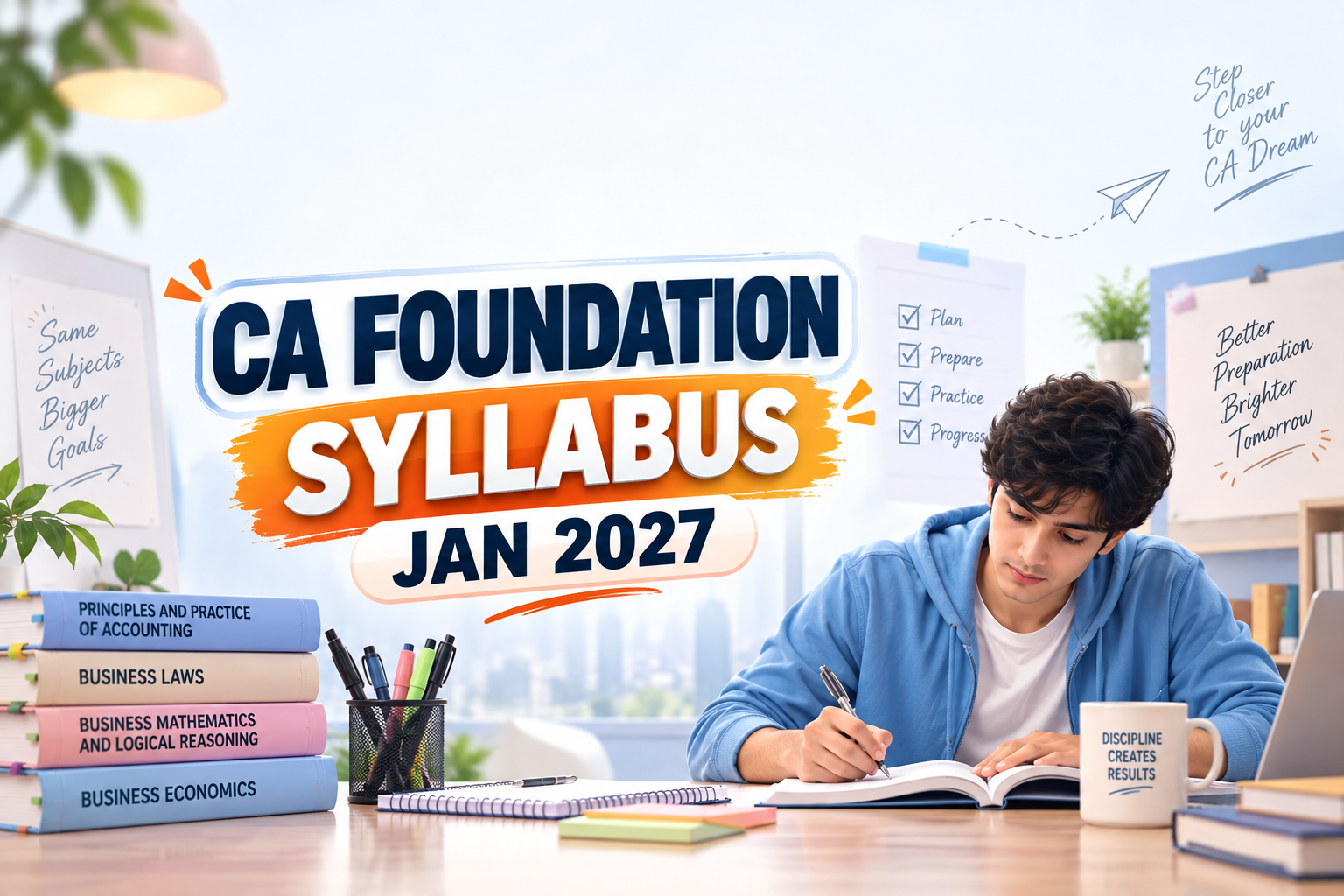
CA Subjects for January 2027: Complete Subject-Wise Guide for Foundation & Intermediate

If you are planning to appear for the CA January 2027 examination, one of the first things you need to understand is the complete list of subjects, the structure of each paper, and how you should divide your preparation time.

Many students make the mistake of starting their preparation without first understanding the syllabus. They collect books, join classes, download PDFs and make study schedules, but after a few weeks they realise that some subjects require regular practice while others need repeated revision.

That is why knowing the CA subjects for January 2027 is more important than it may initially seem.

Under the current ICAI examination structure, January 2027 is relevant for CA Foundation and CA Intermediate students. ICAI’s current syllabus pages list four papers for Foundation and six papers for Intermediate. For Intermediate students, the six papers are divided equally between Group I and Group II.

This guide from CA Mentoring Program explains the subjects, paper structure, preparation approach and practical strategy you can use for the January 2027 attempt.

CA Subjects for January 2027 at a Glance

Before going into the details, here is the complete overview.

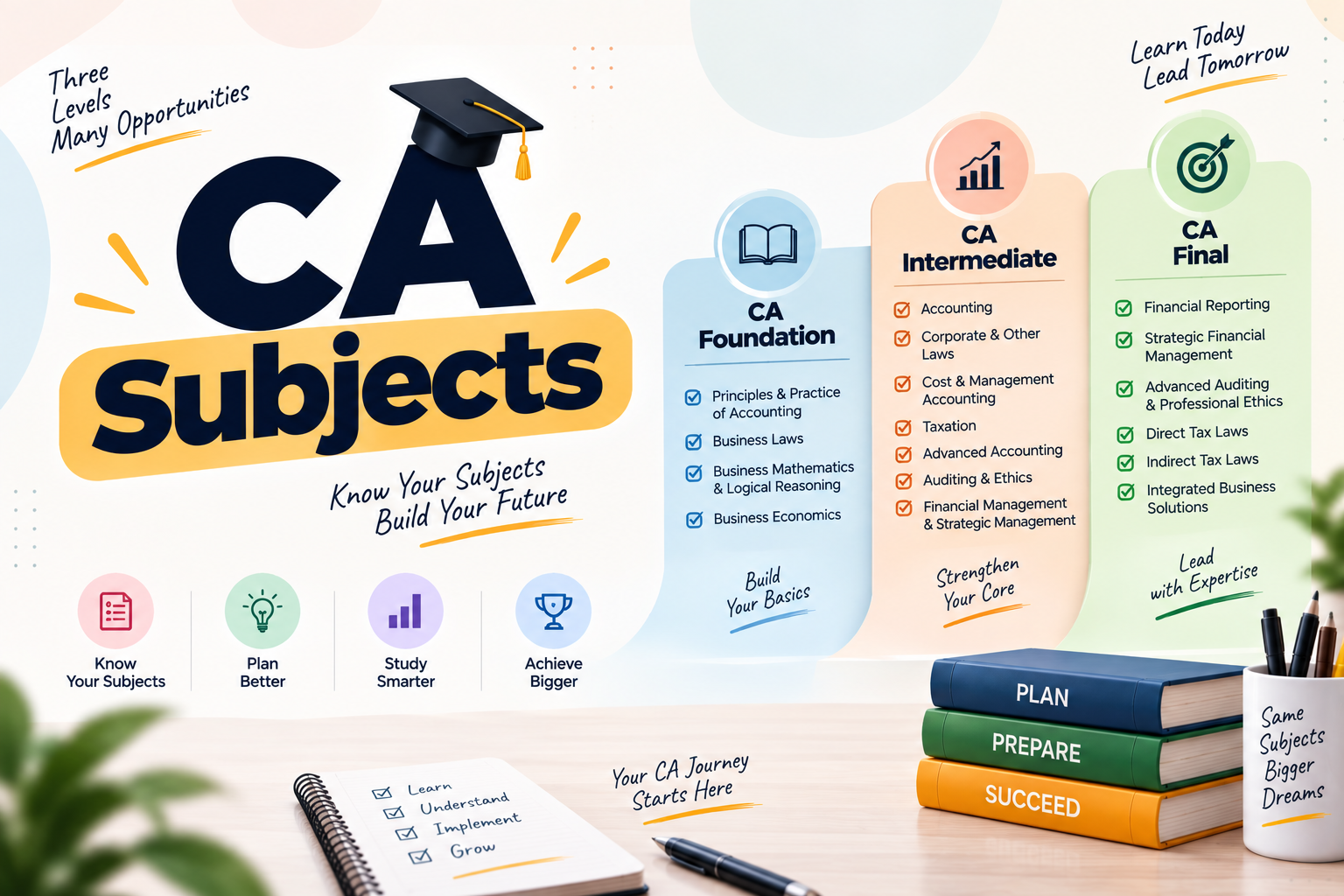
CA Level Group Papers Subjects
CA Foundation Paper 1 Accounting
CA Foundation Paper 2 Business Laws
CA Foundation Paper 3 Quantitative Aptitude
CA Foundation Paper 4 Business Economics
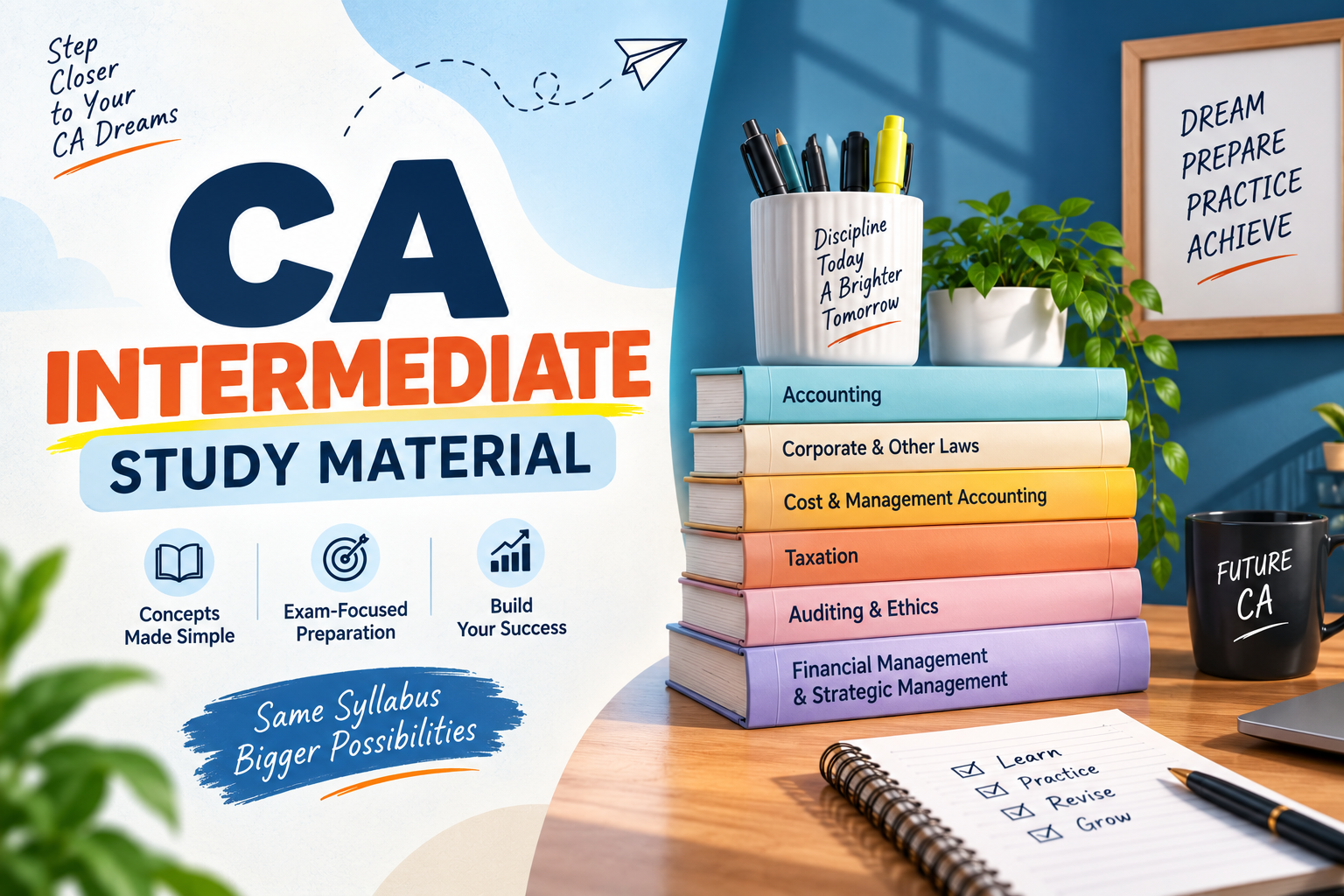
CA Intermediate Group I Paper 1 Advanced Accounting
CA Intermediate Group I Paper 2 Corporate and Other Laws
CA Intermediate Group I Paper 3 Taxation
CA Intermediate Group II Paper 4 Cost and Management Accounting
CA Intermediate Group II Paper 5 Auditing and Ethics
CA Intermediate Group II Paper 6 Financial Management and Strategic Management

ICAI’s official syllabus pages confirm this current subject structure.

CA Foundation Subjects for January 2027

CA Foundation is the entry point into the Chartered Accountancy course. The Foundation course currently consists of four papers.

CA Foundation Subjects

  1. Accounting
  2. Business Laws
  3. Quantitative Aptitude
  4. Business Economics

ICAI’s New Scheme syllabus identifies these four papers as the Foundation subjects.

Let’s understand what students should expect from each subject.

1. CA Foundation Accounting

Accounting is one of the most important subjects in CA Foundation because it builds the base for several concepts that students encounter later in CA Intermediate.

You should not approach Accounting as a subject that can be completed simply by reading theory.

The real improvement comes when you start solving questions yourself.

Important areas generally include concepts of accounting, accounting process, financial statements and other fundamental accounting topics prescribed by ICAI.

How to prepare for Accounting

A practical approach is:

  • Understand the concept first.
  • Solve ICAI illustrations.
  • Practise questions without looking at the solution.
  • Maintain a separate mistake notebook.
  • Revise formats regularly.
  • Attempt timed practice papers.

If you are weak in calculations, do not postpone practice. Accounting becomes easier when you solve questions consistently.

2. CA Foundation Business Laws

Business Laws is different from Accounting because understanding the language of the law matters as much as remembering the provisions.

Students often read chapters several times but still struggle to write effective answers.

The better approach is to understand:

Provision → Meaning → Application → Conclusion

When you solve practical questions, focus on identifying the legal provision involved and then applying it to the facts given in the question.

How to prepare for Business Laws

Read the ICAI study material carefully and pay attention to definitions, provisions, exceptions and practical situations.

A good revision cycle can include:

  • First reading for understanding
  • Second reading for retention
  • Question practice
  • Revision of important provisions
  • Writing practice before the examination

3. CA Foundation Quantitative Aptitude

Quantitative Aptitude requires regular practice.

It is difficult to become comfortable with Mathematics, Logical Reasoning and Statistics by studying them only during the final weeks.

ICAI identifies Paper 3 as Quantitative Aptitude.

The biggest advantage of this paper is that consistent practice can significantly improve your speed and accuracy.

How to prepare for Quantitative Aptitude

Try solving questions every day instead of studying the subject only once or twice a week.

Focus on:

  • Concept clarity
  • Formula revision
  • Short calculation techniques
  • Question-solving speed
  • Accuracy
  • Mock-test practice

Keep a formula sheet and revise it frequently.

4. CA Foundation Business Economics

Business Economics is comparatively theory-oriented, but that does not mean it should be left for the end.

Students often underestimate Economics because they feel it can be completed quickly. This can create unnecessary pressure before the examination.

Understand the concepts instead of trying to memorise every sentence.

Create short notes for:

  • Definitions
  • Key concepts
  • Differences
  • Important economic principles
  • Graphs and applications
  • Frequently tested areas

Regular revision is more effective than one long study session.

CA Intermediate Subjects for January 2027

CA Intermediate is a major step up from Foundation.

The current Intermediate course has six papers, divided into two groups of three papers each.

Group I

Paper Subject Broad Nature
Paper 1 Advanced Accounting Practical + Conceptual
Paper 2 Corporate and Other Laws Theory + Application
Paper 3 Taxation Practical + Conceptual

Group II

Paper Subject Broad Nature
Paper 4 Cost and Management Accounting Practical
Paper 5 Auditing and Ethics Theory + Application
Paper 6 Financial Management and Strategic Management Practical + Theory

Let’s look at each subject separately.

1. CA Intermediate Advanced Accounting

Advanced Accounting is Paper 1 of CA Intermediate Group I.

The subject requires conceptual understanding along with extensive question practice.

A common mistake is to spend too much time watching lectures and too little time solving questions.

For Accounting, solving is studying.

Preparation strategy

Start with ICAI concepts and illustrations.

Then move towards:

  • Practice questions
  • RTPs
  • MTPs
  • Previous examination questions
  • Revision tests

Maintain a list of adjustments and concepts that you repeatedly get wrong.

This can save considerable time during the final revision.

2. CA Intermediate Corporate and Other Laws

Corporate and Other Laws is Paper 2 of Group I.

This subject demands consistent reading because the language and provisions need to become familiar before you can reproduce them effectively in the examination.

Do not rely entirely on shortcuts or summary notes.

Your primary source should remain the applicable ICAI study material and other official updates relevant to your attempt.

Best way to study Law

Use a three-stage approach:

Understand → Recall → Write

After completing a chapter, close the book and try explaining the provision in your own words.

Then practise writing answers using proper legal terminology.

This is particularly useful for students who understand the concept but lose marks because their answers are poorly structured.

3. CA Intermediate Taxation

Taxation is Paper 3 and contains:

  • Section A: Income-tax Law
  • Section B: Goods and Services Tax

ICAI currently identifies the Income-tax Law portion as applicable to the May 2026, September 2026 and January 2027 examinations.

Similarly, ICAI’s GST material identifies the relevant GST portion for the January 2027 examination.

This makes it especially important for January 2027 students to use the correct attempt-specific study material, amendments and updates.

Income-tax Law

Students should build their preparation around concepts first.

Instead of trying to memorise individual provisions randomly, understand how taxation works across different heads of income and the overall computation process.

GST

GST requires conceptual clarity and question practice.

Areas such as supply, charge, place of supply, exemptions, time of supply, value of supply, input tax credit, registration and returns form part of the prescribed material.

Taxation preparation tip

Never depend on old notes blindly.

Tax laws can change, and the material applicable to one examination may not necessarily be the same for another.

For January 2027, always verify the applicable ICAI material and statutory updates before finalising your preparation.

4. CA Intermediate Cost and Management Accounting

Cost and Management Accounting is Paper 4 of Group II.

This is a practical subject, so question-solving should occupy a significant part of your preparation.

Students sometimes read solutions and feel that they understand the chapter. However, the real test comes when you have to solve a question from scratch.

How to prepare

Follow this sequence:

  1. Understand the concept.
  2. Solve the basic illustration.
  3. Solve additional questions.
  4. Attempt exam-oriented questions.
  5. Practise under time pressure.
  6. Analyse your mistakes.

Do not ignore chapters simply because you find them difficult.

A difficult chapter today can become a scoring chapter after enough practice.

5. CA Intermediate Auditing and Ethics

Auditing and Ethics is Paper 5.

For many students, this subject feels challenging because the answer depends heavily on conceptual understanding and presentation.

The key is to understand why an audit procedure or principle exists instead of memorising isolated paragraphs.

How to improve Audit preparation

Make concise revision notes containing:

  • Important concepts
  • Standards-related points
  • Definitions
  • Procedures
  • Important keywords
  • Differences
  • Frequently tested areas

During answer writing, use headings and logical points.

A well-structured answer is easier for the examiner to evaluate than a large paragraph containing several unrelated points.

6. CA Intermediate Financial Management and Strategic Management

Paper 6 contains two different areas:

Section A: Financial Management

Section B: Strategic Management

ICAI’s current Intermediate structure identifies Paper 6 as Financial Management and Strategic Management, with these two sections.

This makes the paper interesting but also requires two different preparation styles.

Financial Management

FM requires regular numerical practice.

Focus on:

  • Concepts
  • Formulas
  • Problem-solving
  • Calculation speed
  • Revision
  • Mock tests

Do not merely memorise formulas. Understand where and why they are used.

Strategic Management

SM requires conceptual understanding and good presentation.

Create short notes and use keywords while revising.

For theory answers, practise writing direct and relevant responses rather than filling pages unnecessarily.

CA Foundation vs CA Intermediate Subjects

If you are deciding which preparation strategy to follow, the difference between Foundation and Intermediate should be clear.

Factor CA Foundation CA Intermediate
Number of Papers 4 6
Difficulty Entry Level Advanced
Practical Subjects Accounting, Quantitative Aptitude Accounting, Taxation, Costing, FM
Theory-Oriented Areas Laws, Economics Laws, Audit, Strategic Management
Preparation Style Concept + Practice Concept + Extensive Practice
Revision Requirement High Very High
Question Practice Important Essential

The jump from Foundation to Intermediate is significant. Students who develop disciplined study habits early generally find the transition easier.

How Many Subjects Should You Study at Once?

This is one of the most practical questions students ask.

The answer depends on your preparation stage.

Studying six subjects simultaneously does not necessarily mean studying all six every day.

A better approach is to maintain a balanced combination.

For example:

Day Type Subject Combination
Day 1 Practical + Theory
Day 2 Practical + Practical
Day 3 Theory + Practical
Day 4 Practical + Theory
Day 5 Revision + Practice
Day 6 New Topics + Question Practice
Day 7 Weekly Revision + Test

This prevents one subject from being completely ignored for several weeks.

How to Make a CA January 2027 Study Plan

Your study plan should be based on the time remaining, your current level and the number of papers you are attempting.

A simple three-phase strategy works well.

Phase 1: Concept Building

Complete the syllabus systematically.

Your goal should not be speed alone.

Focus on understanding concepts and identifying difficult chapters.

Phase 2: Question Practice

Once a substantial portion of the syllabus is complete, increase your question-solving time.

Use:

  • ICAI illustrations
  • Practice questions
  • RTPs
  • MTPs
  • Previous exam questions

Phase 3: Revision and Mock Tests

The final phase should focus on retention and examination performance.

At this stage, avoid repeatedly starting new resources.

Revise what you have already studied and test yourself.

How CA Mentoring Program Can Help January 2027 Students

Preparing for CA is not only about collecting study material.

Many students know what to study but struggle with:

  • Maintaining consistency
  • Completing daily targets
  • Revising on time
  • Tracking performance
  • Identifying weak areas
  • Staying accountable

This is where structured mentoring can make a difference.

CA Mentoring Program provides mentoring and guidance for CA, CS and CMA students. Its website highlights customised study plans, daily guidance, activity tracking, one-to-one accountability, mentoring kits, daily exams with evaluation and chapter-wise test series among its support features.

For students preparing for January 2027, having a system that keeps preparation organised can be more useful than simply increasing the number of study hours.

The objective should be simple:

Study → Practise → Test → Analyse → Improve → Repeat.

Common Mistakes Students Make While Preparing for January 2027

1. Studying Without Checking the Applicable Syllabus

This is particularly risky for subjects such as Taxation.

Always verify the material applicable to your examination attempt.

2. Collecting Too Many Resources

Five books do not automatically provide five times more knowledge.

Choose reliable primary material and use additional resources only when necessary.

3. Ignoring Revision

Finishing a chapter once does not mean you remember it.

Revision must be scheduled from the beginning.

4. Watching Lectures Without Practising

Lectures can build understanding, but examinations test what you can actually reproduce or solve.

5. Leaving Mock Tests for the End

Mock tests should be introduced before the final week.

They help you understand:

  • Time management
  • Presentation
  • Question selection
  • Calculation speed
  • Weak areas

Smart Tips to Score Better in CA January 2027

1. Follow ICAI Material

Make ICAI study material the foundation of your preparation.

2. Practise Every Day

Even 30–60 minutes of question practice can make a difference when done consistently.

3. Keep a Mistake Book

Write down questions, concepts and mistakes that you repeatedly make.

4. Revise Before You Forget

Use spaced revision instead of waiting until the entire syllabus is completed.

5. Practise Writing

This is especially important for Law, Audit, Strategic Management and other theory-heavy areas.

6. Track Your Progress

At the end of every week, ask:

  • What did I complete?
  • What is pending?
  • Which chapters are weak?
  • How many questions did I solve?
  • Did I take a test?

This turns preparation into something measurable.

Final Checklist for CA January 2027 Preparation

Before the examination, make sure you have:

Checklist Status
Completed the applicable syllabus
Revised all major chapters
Solved ICAI questions
Practised RTPs/MTPs where applicable
Attempted mock tests
Revised important formulas
Revised theory subjects
Prepared short revision notes
Analysed mistakes
Practised time management

Final Thoughts

Knowing the CA subjects for January 2027 is only the starting point.

The real challenge is converting the syllabus into a realistic study plan and then following that plan consistently.

For CA Foundation students, the four papers—Accounting, Business Laws, Quantitative Aptitude and Business Economics—require a combination of conceptual understanding, practice and revision.

For CA Intermediate students, the six papers cover Advanced Accounting, Corporate and Other Laws, Taxation, Cost and Management Accounting, Auditing and Ethics, and Financial Management and Strategic Management.

Most importantly, do not compare your preparation with someone else’s timetable.

One student may complete ten hours every day but retain very little. Another may study six focused hours and revise effectively. What matters is whether your preparation is moving forward.

If you are preparing for January 2027, start by identifying your papers, divide the syllabus into manageable targets, practise regularly and build revision into your timetable from day one.

And if you feel that you understand what to study but struggle to remain consistent, structured mentoring and accountability can help you stay on track.

Your goal should not simply be to finish the CA syllabus. Your goal should be to finish it, revise it, practise it and enter the examination hall with confidence.
CA Final Chapter Wise Weightage Nov 2026: Subject-Wise Marks, Important Chapters & Preparation Strategy

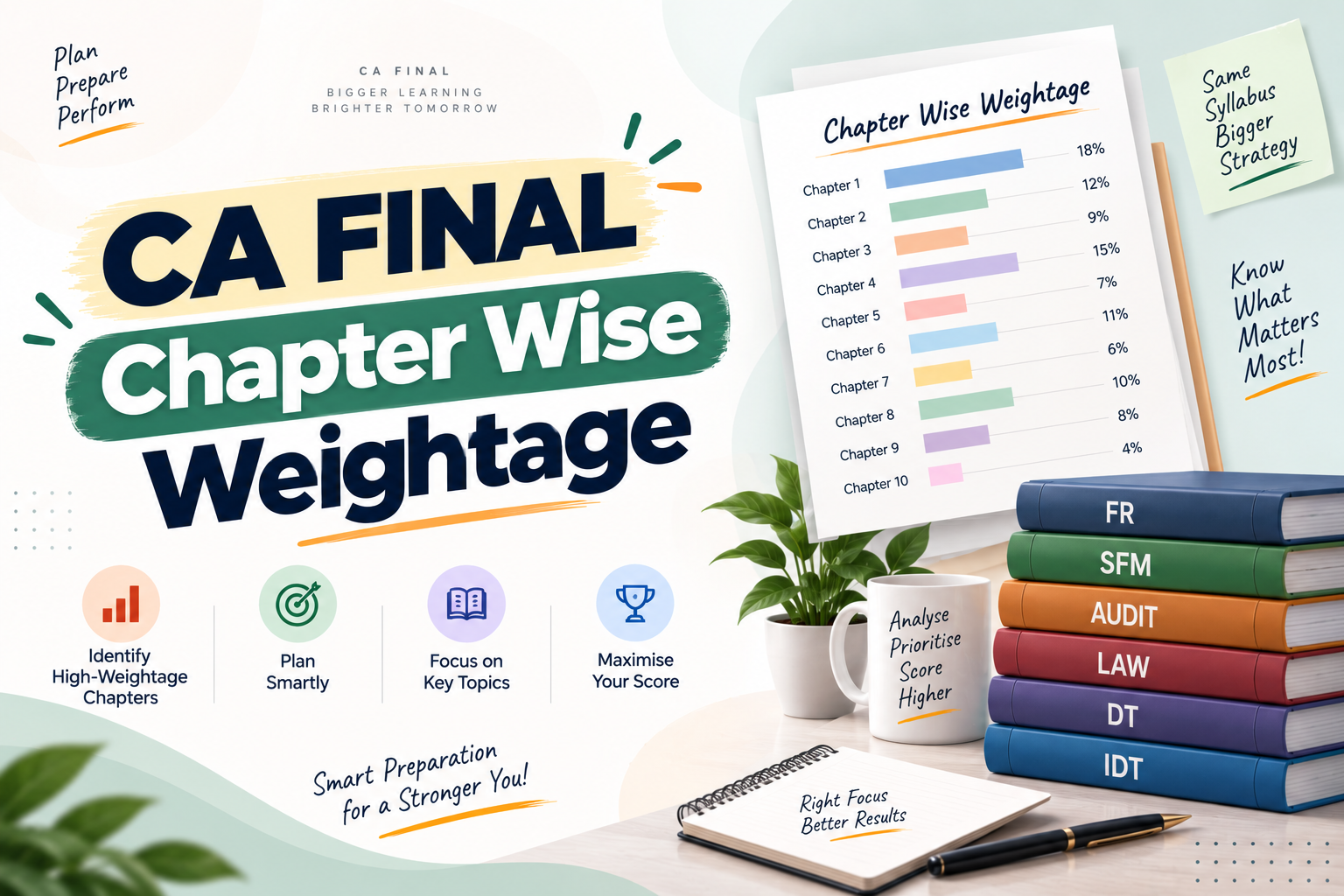
CA Final Chapter Wise Weightage Nov 2026

Preparing for the CA Final November 2026 examination is not simply about completing the syllabus once. At the Final level, the syllabus is extensive, questions are application-oriented, and students have to balance conceptual understanding with revision and exam practice.

One question that naturally comes to every CA Final student is:

“Which chapters should I study first, and how much weightage can I expect from each topic?”

This is where chapter-wise and section-wise weightage becomes useful.

However, there is an important point students should understand before using any weightage table: ICAI does not guarantee fixed marks for individual chapters in the CA Final paper. ICAI provides section-wise weightage ranges for the syllabus, while chapter-level priorities are generally derived from the syllabus structure, previous examination trends, RTPs, MTPs and repeated areas of testing.

Therefore, the weightage given in this article should be treated as a study-priority guide, not a prediction of the November 2026 question paper.

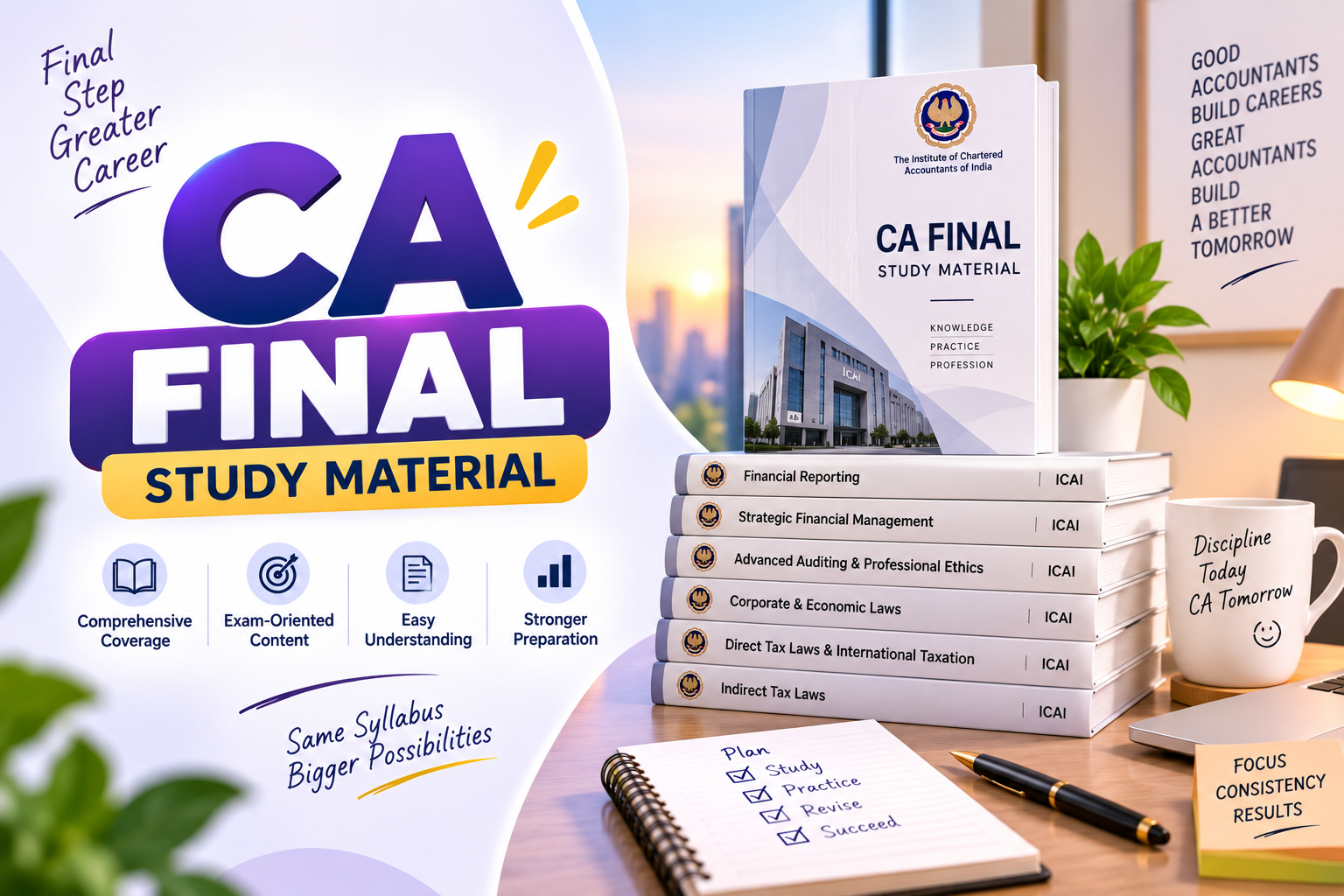
The CA Final New Scheme currently consists of six papers:

Paper Subject Marks Group
Paper 1 Financial Reporting 100 Group 1
Paper 2 Advanced Financial Management 100 Group 1
Paper 3 Advanced Auditing, Assurance & Professional Ethics 100 Group 1
Paper 4 Direct Tax Laws & International Taxation 100 Group 2
Paper 5 Indirect Tax Laws 100 Group 2
Paper 6 Integrated Business Solutions 100 Group 2

ICAI’s current examination resources confirm these six papers under the New Scheme.

Is CA Final Chapter Wise Weightage Nov 2026 Official?

This is probably the most important clarification for students.

There is no fixed official chapter-wise marks guarantee from ICAI.

For example, if a website says:

“Chapter X will definitely carry 15 marks in CA Final Nov 2026”

you should not treat that statement as an ICAI prediction.

ICAI’s framework provides section-wise weightage ranges, while actual marks can move from one chapter or area to another depending on the paper.

That is why the best approach is to combine:

  • ICAI’s prescribed section-wise weightage
  • Previous CA Final question papers
  • RTPs
  • MTPs
  • ICAI study material
  • Amendments and applicable updates
  • Recent examination trends
  • Your own strengths and weaknesses

ICAI itself encourages students to use the specified weightages to allocate study time efficiently rather than treating weightage as a substitute for complete preparation.

CA Final Paper 1: Financial Reporting Weightage Nov 2026

Financial Reporting is one of the most concept-intensive papers in CA Final. Instead of trying to memorize every Ind AS independently, students should understand how different standards interact with financial statements.

Indicative Section-Wise Weightage

Area Indicative Weightage Priority
Financial Reporting Framework & Conceptual Framework 10–15% High
Ind AS 115 – Revenue 5–10% High
Assets & Liabilities 15–25% Very High
Presentation & Disclosure-related Ind AS 15–20% High
Financial Instruments 10–15% Very High
Group Accounting & Consolidation 10–20% Very High
Other reporting areas Balance Medium

The exact paper can vary within these ranges.

High-Priority FR Chapters

Students should give special attention to:

  • Conceptual Framework
  • Ind AS 1, 7 and 34
  • Ind AS 115
  • Ind AS 2
  • Ind AS 16
  • Ind AS 23
  • Ind AS 36
  • Ind AS 38
  • Ind AS 40
  • Ind AS 105
  • Ind AS 116
  • Ind AS 19
  • Ind AS 37
  • Financial Instruments
  • Ind AS 32, 109 and 107
  • Consolidation
  • Business Combinations
  • Analysis of Financial Statements
  • Share-Based Payments

Recent chapter-trend analyses also place assets, financial instruments, consolidation and financial statement analysis among the areas deserving particularly strong preparation.

FR Preparation Tip

Do not prepare FR by reading standards repeatedly without solving questions.

A better sequence is:

Concept → ICAI illustration → Past question → RTP/MTP → Timed practice.

CA Final Paper 2: Advanced Financial Management Weightage Nov 2026

AFM rewards students who can apply financial concepts to numerical situations.

Some students make the mistake of preparing only the chapters they find easy. That can become risky because ICAI can combine concepts in a single question.

High-Priority AFM Areas

Topic Priority
Financial Policy & Corporate Strategy Medium
Risk Management High
Security Analysis High
Security Valuation Very High
Portfolio Management Very High
Mutual Funds High
International Financial Management High
Foreign Exchange & Risk Management Very High
Interest Rate Risk Management High
Derivatives Analysis & Valuation Very High
Corporate Valuation Very High
Mergers, Acquisitions & Corporate Restructuring Very High
Startup Finance Medium
Securitization Medium

Recent trend-based analyses consistently identify foreign exchange, security valuation, mergers and acquisitions, derivatives and portfolio management as important preparation areas.

How to Prepare AFM

AFM is not a subject where simply watching lectures guarantees marks.

After completing a concept, solve enough questions to become comfortable with:

  • Formula selection
  • Calculation speed
  • Interpretation
  • Presentation
  • Working notes
  • Calculator usage
  • Time management

Maintain a formula and mistake notebook. Before every revision, revise the mistakes rather than rereading the entire chapter.

CA Final Paper 3: Advanced Auditing, Assurance & Professional Ethics

Audit can become a high-scoring paper when preparation is structured correctly.

The biggest mistake students make is treating Audit as a purely theoretical subject and trying to memorize every line.

Instead, focus on concept + keywords + application + answer presentation.

Important Audit Areas for Nov 2026

Area Priority
Quality Control & Engagement Standards Very High
Professional Ethics Very High
Audit Planning, Strategy & Execution Medium
Risk Assessment & Internal Control High
Audit in Automated Environment High
Audit Reports High
Company Audit High
Audit Committee & Corporate Governance High
Consolidated Financial Statements Audit High
Audit of Banks Very High
Audit of Insurance Companies High
Audit of PSU High
Internal Audit Medium
Due Diligence, Investigation & Forensic Audit High
ESG / Sustainability Assurance High
Professional Ethics Very High

Recent CA Final Audit analyses identify Quality Control/Engagement Standards and Professional Ethics as particularly important areas, with company audit, governance, fiscal-law audit, forensic audit and sector-specific audits also requiring serious attention.

Audit Answer-Writing Strategy

For every major question, train yourself to write:

Provision → Explanation → Application → Conclusion

Use appropriate technical terms from ICAI study material.

Do not fill pages just to increase the length of your answer. In CA Final Audit, relevant points and proper presentation matter more than unnecessary repetition.

CA Final Paper 4: Direct Tax Laws & International Taxation

Direct Tax is one of the papers where understanding the overall structure of the syllabus makes preparation significantly easier.

For November 2026, the broad official section-wise structure is particularly useful.

Section Area Indicative Weightage
Section I Computation of Tax Liability 40–45%
Section II Tax Administration 20–30%
Section III International Taxation 30–35%

These ranges mean that Computation of Tax Liability and International Taxation together can account for a substantial portion of the paper, making both areas important for serious preparation.

Important Direct Tax Topics

Computation of Tax Liability

Focus strongly on:

  • Computation of total income
  • Heads of income
  • Set-off and carry-forward of losses
  • Deductions
  • Special provisions for companies
  • Tax planning
  • Charitable and religious trusts
  • Political parties
  • Business trusts
  • GAAR
  • Taxation of digital transactions

Tax Administration

Give attention to:

  • TDS and TCS
  • Assessment procedures
  • Income-tax authorities
  • Appeals and revision
  • Dispute resolution
  • Penalties
  • Offences and prosecution
  • Tax audit
  • Undisclosed income

International Taxation

Important areas include:

  • Transfer Pricing
  • Non-resident taxation
  • Double Taxation Relief
  • Tax treaties
  • OECD Model Convention
  • UN Model Convention
  • BEPS
  • Treaty interpretation
  • Advance Rulings

DT Preparation Tip

Do not postpone amendments until the last few days.

For tax papers, the applicable statutory amendments, notifications, circulars and examination-specific material should be checked carefully before the examination.

CA Final Paper 5: Indirect Tax Laws Weightage Nov 2026

Indirect Tax Laws covers two major areas:

  1. GST
  2. Customs & Foreign Trade Policy

The GST portion requires a strong understanding of both substantive and procedural provisions.

High-Priority GST Areas

GST Area Priority
Supply Very High
Charge of GST & Reverse Charge Very High
Exemptions High
Place of Supply Very High
Time of Supply High
Value of Supply Very High
Input Tax Credit Very High
Computation of GST Liability Very High
Registration Medium
Tax Invoice & Documentation Medium
Returns & Payment High
Refund High
Assessment & Audit High
Demand & Recovery High
Appeals High
Offences & Penalties High

ICAI’s own study guidance emphasizes beginning GST preparation with substantive provisions such as supply, charge, classification, exemptions, place/time/value of supply and input tax credit before moving into procedural and enforcement provisions.

Customs & FTP

Students should particularly focus on:

  • Levy and exemptions
  • Classification
  • Valuation
  • Types of customs duties
  • Import and export procedures
  • Warehousing
  • Refund
  • Foreign Trade Policy
  • Export promotion schemes

IDT Strategy

Keep the Bare Act and relevant rules accessible while studying.

After completing each major topic, solve practical questions instead of only reading provisions.

CA Final Paper 6: Integrated Business Solutions

IBS is different from the traditional CA Final papers.

It is an open-book, case-study-based paper designed to test multidisciplinary application rather than isolated chapter memory.

ICAI has specified that Paper 6 is assessed through five case studies of 25 marks each, of which students attempt four. The assessment comprises 40% MCQs and 60% descriptive questions within the case studies, and the examination duration is four hours.

Major IBS Knowledge Areas

IBS can integrate knowledge from:

  • Financial Reporting
  • Advanced Financial Management
  • Audit
  • Direct Tax
  • Indirect Tax
  • Corporate and Economic Laws
  • Strategic Cost and Performance Management
  • Strategic Management

How to Prepare IBS

The biggest mistake would be to leave IBS entirely for the last week.

Instead:

  1. Understand the case-study format.
  2. Practice identifying the issue.
  3. Identify which subject concepts are involved.
  4. Read the facts carefully.
  5. Apply the relevant provisions.
  6. Practice answering under time pressure.

The goal is not merely to “find the answer in the book.”

The real skill is knowing where to look, what to apply and how to present the conclusion.

CA Final Nov 2026: Overall Chapter Priority

If you want a quick revision framework, use the following classification.

Priority What It Means Study Approach
A – Very High Frequently tested / conceptually important Complete + revise + multiple questions
B – High Strong scoring potential Complete + practice
C – Medium Can contribute marks Complete once + revise
D – Lower Priority Smaller/less predictable areas Do not completely skip; revise selectively

A student preparing for November 2026 should not interpret “lower priority” as “skip this chapter.”

CA Final is unpredictable enough that selective study can backfire.

How to Use CA Final Chapter Wise Weightage Correctly

Weightage should answer one question:

“Where should I spend more of my limited preparation time?”

It should not answer:

“Which chapters can I leave?”

Suppose you have 10 hours available for FR.

Instead of spending 1 hour on every chapter, you can allocate additional time to areas such as financial instruments, assets, consolidation and business combinations while still covering the remaining syllabus.

The same principle applies to Audit, AFM, DT and IDT.

A Practical 3-Level Preparation Model

Level 1 – Coverage

Complete the entire syllabus at least once.

Level 2 – Priority Revision

Spend additional time on high-priority areas identified through official weightage and past-paper analysis.

Level 3 – Exam Simulation

Solve RTPs, MTPs and previous papers under actual time constraints.

This three-step system is much safer than trying to predict the exact questions.

CA Final Nov 2026 Preparation Strategy for the Last Few Weeks

If you are approaching the November 2026 examination with limited time, follow this approach.

Step 1: Finish the Remaining Syllabus

Do not wait for “perfect preparation.”

Complete pending chapters quickly and move into revision.

Step 2: Build a Priority List

Mark every chapter as:

  • Strong
  • Average
  • Weak

Then combine this with weightage.

Your first revision should focus on high-weightage + weak areas.

Step 3: Solve ICAI Material

Do not rely only on coaching notes.

ICAI study material, RTPs, MTPs and previous examination papers should form the core of your final revision.

ICAI’s Board of Studies provides study material, revision test papers, mock tests, lectures and other examination resources through its student resources.

Step 4: Practice Full-Length Papers

At least several full papers should be attempted before the examination.

This helps identify:

  • Slow calculation speed
  • Poor answer presentation
  • Lack of revision
  • Weak chapters
  • Time-management problems

Step 5: Track Your Mistakes

After every mock test, maintain a simple table:

Mistake Reason Solution
Concept error Concept unclear Revise theory
Calculation error Carelessness Slow down
Forgot provision Poor revision Add to revision list
Time shortage Poor planning Practice timed papers
Presentation issue Lack of answer practice Improve format

This small habit can make your final revision much more effective.

Why You Should Not Rely Only on Weightage

Imagine a student studies only the “top 5 chapters” and ignores everything else.

What happens if ICAI changes the distribution of questions?

That student immediately loses flexibility.

A much stronger strategy is:

100% syllabus coverage + weightage-based priority + repeated practice.

This is especially important because CA Final questions are increasingly designed to test application, analysis and integration, rather than straightforward recall.

The May 2026 result also demonstrates how demanding the Final examination remains: ICAI reported a 12% pass rate for Group I, 20.49% for Group II and 14.07% for candidates appearing for both groups.

The takeaway is simple: there is no safe shortcut based only on predicted weightage.

CA Final Chapter Wise Weightage Nov 2026: Quick Revision Table

Paper Highest-Priority Areas
Financial Reporting Assets, Financial Instruments, Consolidation, Business Combinations, Analysis of FS
Advanced Financial Management Forex, Security Valuation, Derivatives, Portfolio, M&A, Corporate Valuation
Advanced Audit Quality Control, Professional Ethics, Reporting, Company Audit, Bank Audit, Forensic Audit
Direct Tax Computation, Tax Administration, Transfer Pricing, International Taxation, DTAA
Indirect Tax Supply, ITC, Valuation, Place of Supply, GST Liability, Customs
Integrated Business Solutions Multidisciplinary Case Studies, Strategic Management, Integrated application

Remember: these are preparation priorities, not guaranteed marks.

Final Words for CA Final Students

The November 2026 CA Final attempt should not be approached with a “guess the paper” mindset.

Weightage can help you decide where to spend more time, but concept clarity, complete syllabus coverage, ICAI material, amendments, question practice and revision are what ultimately build exam readiness.

If you are preparing with limited time, do not panic after seeing the size of the syllabus. Break it into manageable targets.

Finish one topic.

Solve questions.

Revise it.

Move to the next.

And when you return for your second and third revisions, the syllabus will feel much smaller than it did at the beginning.

For additional guidance, study planning and CA preparation support, students can explore CA Mentoring Program.

The goal should not be to predict exactly what ICAI will ask in November 2026.

The goal should be to become prepared enough that whatever ICAI asks from the syllabus, you can attempt it confidently.

CA Intermediate Chapter Wise Weightage January 2027: Subject-Wise Marks, Important Chapters & Preparation Strategy

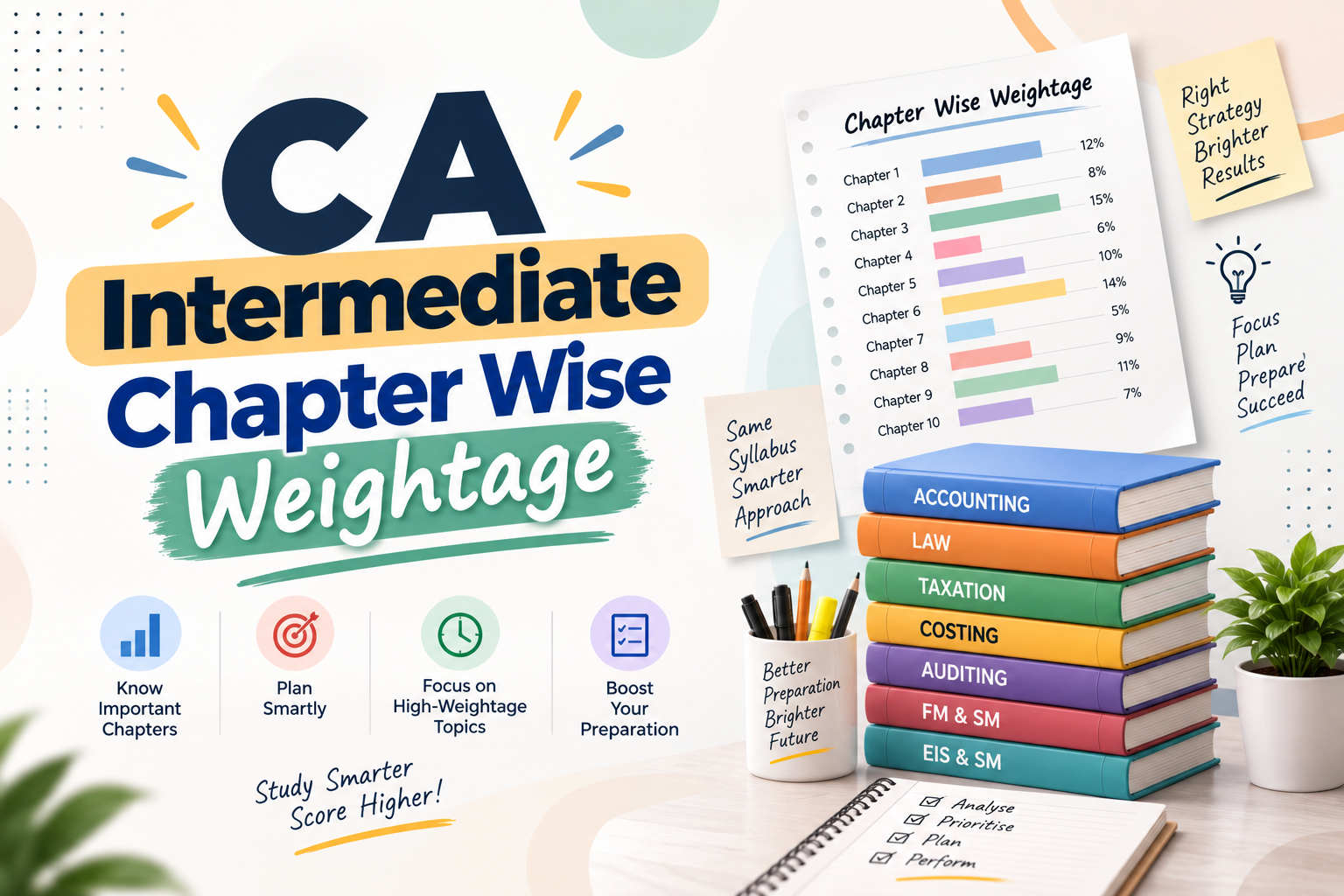
CA Intermediate Chapter Wise Weightage January 2027

Preparing for CA Intermediate is not just about completing the syllabus. Once you reach Intermediate, the real challenge is deciding where to spend your time, how deeply to prepare each chapter, and how much question practice is actually required.

This is exactly why students search for CA Intermediate Chapter Wise Weightage January 2027.

But there is one important thing you should know before looking at any weightage table: ICAI does not guarantee a fixed number of marks from an individual chapter in every examination. The Institute provides section-wise weightage ranges, while the actual distribution of questions may vary.

So, this guide does not treat weightage as a shortcut or a prediction of the question paper. Instead, it uses the official weightage framework to identify high-priority areas, followed by a practical chapter-wise preparation strategy.

The current CA Intermediate New Scheme has six papers divided into two groups: Advanced Accounting, Corporate and Other Laws, Taxation, Cost and Management Accounting, Auditing and Ethics, and Financial Management and Strategic Management.

If you are preparing for January 2027, the smartest approach is simple:

Understand the weightage → identify priority chapters → complete the entire syllabus → practise ICAI questions → revise repeatedly.

What Does CA Intermediate Chapter Wise Weightage Actually Mean?

There is often confusion between official weightage and chapter-wise expected marks.

These two things are not exactly the same.

Term Meaning
Official Weightage Weightage range specified by ICAI for a section or group of topics
Chapter Priority Practical priority given to a chapter based on its importance and question potential
Expected Marks Approximate marks inferred from previous papers or trends
High-Priority Chapter An area that deserves more preparation time
Low-Weightage Area An area that may require comparatively less time, but should not automatically be skipped

This distinction matters.

For example, if a section has a higher official weightage, you should naturally give it more preparation time. But that does not mean that a particular chapter from that section will definitely appear for a fixed number of marks.

ICAI’s official Board of Studies resources provide section-wise and skill-wise weightages and also caution students to consider the current syllabus, applicable amendments and subject weightage while using examination resources.

CA Intermediate January 2027 Subject-Wise Weightage

Before going chapter by chapter, let’s look at the six papers.

Group Paper Subject Maximum Marks
Group 1 Paper 1 Advanced Accounting 100
Group 1 Paper 2 Corporate and Other Laws 100
Group 1 Paper 3 Taxation 100
Group 2 Paper 4 Cost and Management Accounting 100
Group 2 Paper 5 Auditing and Ethics 100
Group 2 Paper 6 Financial Management and Strategic Management 100
Total Six Papers 600

Each paper requires a different approach.

Accounting and Costing demand regular numerical practice.

Law and Audit require conceptual understanding, retention and answer-writing practice.

Taxation needs concepts, practical application and the correct applicable provisions.

Financial Management requires problem-solving speed, while Strategic Management needs repeated revision and conceptual clarity.

That is why a single timetable for all six subjects usually doesn’t work very well.

Paper 1: CA Intermediate Advanced Accounting Chapter Wise Weightage

Advanced Accounting is one of the subjects where students can improve significantly through repeated practice.

The applicable ICAI material includes Accounting Standards and several areas covering company accounts, financial reporting and other accounting topics. ICAI’s current study-material portal separately identifies material applicable for different examination cycles, so January 2027 students should always verify the material applicable to their attempt.

Advanced Accounting Priority Table

Area Practical Priority Preparation Approach
Accounting Standards Very High Concept + illustrations + exam questions
Company Accounts Very High Detailed practice
Reorganisation / Reconstruction High Practical questions
Consolidated Financial Statements High Repeated numerical practice
Partnership-related topics Medium-High Concept + practical questions
Branch / other applicable topics Medium Complete and revise

What Should You Study First?

If your preparation time is limited, start with Accounting Standards and major company-accounting areas.

Do not make the mistake of simply reading Accounting Standards.

Read the concept, understand the accounting treatment and then solve questions.

For example:

Concept → Illustration → ICAI Question → Timed Practice → Revision

This approach is far more useful than reading the same chapter three times without solving questions.

Paper 2: CA Intermediate Corporate and Other Laws Weightage

Law is often considered a difficult subject because students try to memorise everything word-for-word.

That approach becomes exhausting.

The better strategy is to understand the provision first and then learn how to present the answer in an examination.

Corporate Laws Priority

Area Priority What to Focus On
Company Law – Major Chapters Very High Provisions + application
Incorporation & Related Matters High Concepts and provisions
Share Capital & Debentures Very High Provisions + practical scenarios
Management & Administration High Important provisions
Accounts, Audit & Related Provisions Very High Conceptual clarity
Other Laws High Provision-based preparation

For Other Laws, students should also pay attention to the applicable portions of laws such as the Indian Contract Act, Negotiable Instruments Act, General Clauses Act and Interpretation of Statutes, as applicable to the examination syllabus.

A Simple Law Revision Method

Instead of trying to revise an entire chapter every time, create a one-page revision sheet containing:

  • Important sections
  • Key definitions
  • Conditions
  • Exceptions
  • Time limits
  • Penalties, wherever applicable
  • Frequently confused provisions

This makes the final revision much faster.

Paper 3: CA Intermediate Taxation Chapter Wise Weightage

Taxation is different from most CA Intermediate papers because applicability matters.

The paper covers Income-tax Law and GST. ICAI maintains examination-specific material and statutory updates, so students should not blindly use notes prepared for a later attempt. The Board of Studies specifically provides statutory updates and examination-specific resources.

Income-tax Law: Important Areas

Area Priority Why It Matters
Basic Concepts & Residential Status High Foundation for computation
Heads of Income Very High Major practical area
Profits & Gains of Business/Profession Very High Extensive practical application
Capital Gains Very High Regular practice required
Income from Other Sources High Important for computation
Clubbing of Income High Concept + application
Set-off & Carry Forward High Frequently integrated into computations
Deductions Very High Important for final tax computation
TDS/TCS & Advance Tax High Provision-based + practical
Return Filing & Self-Assessment Medium-High Important for complete preparation

The Best Way to Prepare Tax

Do not study Income Tax as if it were only a theory subject.

For every chapter, ask yourself:

Can I solve a question from this chapter without looking at the solution?

If the answer is no, the chapter is not yet exam-ready.

GST: Important Areas

GST is another area where conceptual clarity makes a huge difference.

GST Area Priority
Supply Very High
Charge of GST High
Place of Supply High
Time of Supply High
Value of Supply Very High
Input Tax Credit Very High
Registration Medium-High
Tax Invoice Medium
E-Way Bill Medium
Payment of Tax Medium-High
Returns Medium-High

For January 2027 preparation, always verify the latest applicable ICAI study material and statutory updates rather than relying on an old GST summary.

Paper 4: Cost and Management Accounting Chapter Wise Weightage

Costing is one subject where students often underestimate the importance of practice.

You may understand a formula today and still forget how to apply it two weeks later.

That is normal.

The solution is repeated question solving.

Costing Priority Guide

Topic / Area Priority Preparation Style
Material Cost High Numerical practice
Employee Cost High Concepts + practical questions
Overheads Very High Detailed numerical practice
Activity Based Costing High Problem solving
Cost Sheet Very High Regular practice
Job / Batch Costing High Numerical practice
Process Costing Very High Extensive practice
Joint Products & By-products High Practical questions
Service Costing Medium-High Numerical practice
Standard Costing Very High Variance practice
Marginal Costing Very High Numerical + concepts
Budgetary Control Very High Problem solving

Costing Rule That Actually Works

For every numerical chapter, follow this sequence:

Learn the concept → understand the format → solve ICAI illustration → solve without seeing solution → attempt exam-level questions → revise after a few days.

If you only watch lectures and highlight your notes, Costing will feel familiar but may still become difficult in the examination.

Paper 5: Auditing and Ethics Chapter Wise Weightage

Auditing is a subject where students often say:

“I understand everything when I read it, but I forget it during revision.”

The problem is usually not intelligence. It is revision technique.

Audit requires active recall.

Auditing Priority Guide

Area Priority Best Preparation Method
Nature, Objective & Scope of Audit High Conceptual revision
Audit Planning & Strategy High Concepts + questions
Risk Assessment & Internal Control Very High Concept + application
Audit Evidence Very High Repeated revision
Audit of Items Very High Chapter-wise practice
Audit Documentation High Revision
Completion & Review High Conceptual clarity
Reporting Very High Detailed revision
Ethics High Short notes + repeated revision

Do not try to memorise every sentence.

Understand the meaning of the provision first.

Then learn the keywords that should appear in your answer.

Paper 6: Financial Management and Strategic Management Weightage

Paper 6 combines two subjects that require completely different preparation styles:

  • Financial Management
  • Strategic Management

Financial Management requires numerical confidence.

Strategic Management requires conceptual retention.

Financial Management Priority

Area Priority
Financial Decision Making High
Ratio Analysis High
Cost of Capital Very High
Capital Structure High
Leverage Very High
Capital Budgeting Very High
Working Capital Management Very High
Dividend Decisions High

For FM, don’t wait until the final month to start solving questions.

Numerical speed develops gradually.

Strategic Management Priority

Area Priority
Strategic Management Concepts High
Business Environment High
Strategic Analysis Very High
Strategic Choices Very High
Strategy Implementation High
Strategic Evaluation & Control High

SM can become a scoring area if you revise it regularly.

Instead of reading 50 pages repeatedly, convert chapters into:

Concept → Keyword → Example → Short Revision Note

CA Intermediate Chapter Wise Weightage: High-Priority Areas at a Glance

If you want a quick revision of the entire article, use this table.

Paper High-Priority Areas
Advanced Accounting Accounting Standards, Company Accounts, Consolidation, Reorganisation
Corporate & Other Laws Company Law, Share Capital, Management & Administration, Other Laws
Taxation Heads of Income, PGBP, Capital Gains, Deductions, GST Supply, ITC
Costing Overheads, Cost Sheet, Process Costing, Standard Costing, Marginal Costing, Budgets
Auditing Internal Control, Audit Evidence, Audit of Items, Reporting, Ethics
Financial Management Cost of Capital, Leverage, Capital Budgeting, Working Capital
Strategic Management Strategic Analysis, Strategic Choices, Implementation, Evaluation

Remember: High priority does not mean “study only these chapters.”

It means give these areas more time and more rounds of revision.

Should You Skip Low-Weightage Chapters?

No.

This is probably the biggest mistake students make after finding a weightage chart online.

Suppose a chapter historically receives comparatively less attention. That does not mean ICAI cannot ask a meaningful question from it.

Section-wise weightage itself is expressed through ranges, not guaranteed fixed marks. Therefore, treating a weightage table as a list of chapters to skip can create unnecessary risk. ICAI’s official resources should remain the final reference for the applicable syllabus and weightage.

A better approach is:

High-weightage chapter: Study deeply.

Medium-weightage chapter: Study properly.

Low-weightage chapter: Cover efficiently.

This way, you are using weightage to manage time rather than using it as an excuse to leave the syllabus incomplete.

How to Use CA Intermediate Weightage for January 2027 Preparation

Here is a practical approach that works much better than randomly following a chapter list.

Step 1: Complete the Syllabus Map

Create a spreadsheet or notebook with all six papers.

Against every chapter, mark:

  • Not Started
  • Lectures Completed
  • First Revision Done
  • Questions Practised
  • Second Revision Done
  • Exam Ready

This immediately tells you where you stand.

Step 2: Give More Time to High-Priority Areas

A simple time allocation can be:

Priority Approx. Study Time
High Priority 50–60%
Medium Priority 25–30%
Remaining Topics 15–20%

This is not an ICAI rule. It is simply a practical way to allocate preparation time.

Step 3: Use ICAI Material as Your Base

The ICAI Board of Studies Knowledge Portal provides study materials, revision test papers, mock test papers, previous question papers, suggested answers and other academic resources.

Do not collect ten different sources before completing the primary material.

Too many books often create the illusion of preparation without actually improving retention.

Step 4: Practise Previous Questions

After completing a chapter, solve questions from:

  • ICAI Study Material
  • RTPs
  • MTPs
  • Previous examination papers
  • Suggested Answers

This tells you whether you actually understand the chapter.

Step 5: Maintain a Mistake Book

This is especially useful for:

  • Accounting
  • Taxation
  • Costing
  • FM

Whenever you make a repeated mistake, write it down.

Your final revision should include your mistakes—not just your notes.

30-Day Revision Strategy for CA Intermediate January 2027

If you have approximately one month before the examination, you can structure your revision like this.

Days Main Focus
1–10 High-priority chapters
11–17 Remaining major chapters
18–23 ICAI questions + RTP/MTP practice
24–27 Full-length mock papers
28–30 Final revision + mistakes + formulas

For numerical subjects, spend more time solving.

For theory subjects, use active recall.

For example, close your book and try to explain a topic in your own words. If you cannot explain it, you probably need another revision.

Why Weightage Alone Cannot Guarantee Your CA Intermediate Score

There is a reason serious CA students do not depend completely on weightage predictions.

The paper setter can test:

  • Different chapters
  • Integrated concepts
  • Application-based situations
  • Less frequently tested areas
  • Multiple concepts in one question

So, a student who studies only five “high-weightage” chapters can still struggle if the paper moves away from expectations.

The safer formula is:

Weightage + Complete Syllabus + ICAI Questions + Revision + Mock Tests

That combination is much more reliable.

Final Words: How to Use CA Intermediate Chapter Wise Weightage January 2027

CA Intermediate Chapter Wise Weightage January 2027 can be extremely useful when used correctly.

It can help you answer questions such as:

  • Which chapters should I study first?
  • Where should I spend more revision time?
  • Which topics need more question practice?
  • Which subjects need daily practice?
  • How should I plan my final revision?

But weightage should never become your entire preparation strategy.

The goal should not be to predict the question paper.

The goal should be to become comfortable with the syllabus even when the question paper is unexpected.

For January 2027, start with the applicable ICAI material, identify the high-priority sections, practise questions consistently and keep revising the areas where you make mistakes.

And if you are preparing through a structured learning environment, CA Mentoring Program can be a useful resource for keeping your preparation focused and organised. You can explore the platform at CA Mentoring Program.

At the end of the day, remember one thing:

Weightage tells you where to focus more. It does not tell you what you are allowed to skip.

That difference can make a big impact on your CA Intermediate preparation.

CA Foundation Chapter Wise Weightage Jan 2027: Subject-Wise Marks, Important Chapters & Preparation Strategy

Preparing for the CA Foundation January 2027 examination and wondering which chapters deserve the most attention? You are not alone.

One of the first things students search for before starting serious preparation is CA Foundation Chapter Wise Weightage Jan 2027. Knowing the weightage helps you understand which portions of the syllabus carry greater importance and how you should distribute your preparation time.

However, there is one important point every student should understand: ICAI does not guarantee a fixed chapter-wise number of questions for every examination. The Institute publishes section-wise weightages, and the actual paper can vary within the prescribed framework. Therefore, the best strategy is not to completely skip low-weightage chapters, but to give additional preparation time to high-weightage areas.

For the January 2027 attempt, students should primarily follow the applicable ICAI syllabus, study material, RTPs, MTPs, previous question papers and official updates. ICAI’s official section-wise weightage document covers all four Foundation papers and permits a deviation of up to ±5% in specified section-wise weightage.

CA Foundation Chapter Wise Weightage Jan 2027 – Quick Overview

The CA Foundation course currently consists of four papers:

Paper Subject Marks Nature
Paper 1 Accounting 100 Numerical + Conceptual
Paper 2 Business Laws 100 Theory + Application
Paper 3 Quantitative Aptitude 100 Mathematics + LR + Statistics
Paper 4 Business Economics 100 Conceptual + MCQ-based

The official ICAI Foundation syllabus contains these four papers. Quantitative Aptitude is divided into Business Mathematics, Logical Reasoning and Statistics.

The most important thing is to understand that weightage should guide your priorities, not replace complete syllabus preparation.

CA Foundation Paper 1 Accounting Chapter Wise Weightage Jan 2027

Accounting is one of the papers where consistent practice can make a major difference. The official ICAI weightage places significant emphasis on the Accounting Process, Final Accounts, Partnership & LLP Accounts and Company Accounts.

Accounting Weightage

Section / Chapters Official Weightage Priority
Theoretical Framework 5%–10% Medium
Accounting Process 30%–35% Very High
Final Accounts + NPO + Incomplete Records 20%–25% Very High
Partnership & LLP Accounts 15%–20% High
Company Accounts 15%–25% Very High

These are the official section-wise weightages prescribed by ICAI.

1. Theoretical Framework

This section includes accounting concepts, principles, conventions, capital and revenue expenditure, accounting policies, estimates and Accounting Standards.

It carries a comparatively smaller weightage, but students should not ignore it.

The good thing about this area is that it can often be revised quickly. Make short notes and revise the important concepts repeatedly instead of spending excessive time here during the first round.

2. Accounting Process

This is one of the highest-priority areas in CA Foundation Accounting.

It includes:

  • Journal
  • Ledger
  • Subsidiary Books
  • Cash Book
  • Trial Balance
  • Rectification of Errors
  • Basic accounting procedures

With an official weightage of 30%–35%, this section deserves serious attention.

Students should solve questions rather than simply reading solved examples.

3. Final Accounts, NPO and Incomplete Records

This section carries 20%–25% official weightage.

Final Accounts of Sole Proprietors should be treated as a core chapter because it tests your understanding of several accounting adjustments together.

You should become comfortable with:

  • Trading Account
  • Profit & Loss Account
  • Balance Sheet
  • Adjustments
  • Manufacturing Accounts
  • Not-for-Profit Organisation Accounts
  • Incomplete Records

4. Partnership and LLP Accounts

Partnership and LLP Accounts carry 15%–20% weightage.

Important areas include admission, retirement and death of a partner, goodwill, dissolution and final accounts.

Do not postpone this portion until the last few days. These chapters require numerical practice.

5. Company Accounts

Company Accounts carry 15%–25% weightage, making them another high-priority area.

Focus on:

  • Issue of Shares
  • Forfeiture and Reissue
  • Issue of Debentures
  • Redemption of Preference Shares
  • Redemption of Debentures
  • Bonus Issue
  • Rights Issue

Accounting Preparation Tip

If you are short on time, do not completely skip smaller chapters. Instead, make sure the 30%–35% Accounting Process section and other high-weightage sections receive multiple rounds of practice.

CA Foundation Paper 2 Business Laws Chapter Wise Weightage Jan 2027

Business Laws can look theoretical at first, but the paper is not simply about memorising provisions.

You need to understand the law, identify the relevant provision and apply it correctly to the situation given in the question.

Business Laws Weightage

Chapter / Section Official Weightage Priority
Indian Regulatory Framework 0%–5% Medium
Indian Contract Act, 1872 20%–30% Very High
Sale of Goods Act, 1930 15%–20% High
Indian Partnership Act, 1932 15%–20% High
Limited Liability Partnership Act, 2008 5%–10% Medium
Companies Act, 2013 15%–20% High
Negotiable Instruments Act, 1881 10%–15% High

ICAI’s official weightage document provides these section-wise ranges.

Indian Contract Act

The Contract Act is one of the most important areas because it has the highest official weightage range of 20%–30%.

Focus on:

  • Essentials of a Valid Contract
  • Consideration
  • Capacity
  • Free Consent
  • Performance
  • Breach
  • Contingent Contracts
  • Quasi Contracts
  • Indemnity
  • Guarantee
  • Bailment
  • Pledge
  • Agency

Do not learn these as isolated definitions. Try to understand how each provision works in a practical business situation.

Sale of Goods Act

This section carries 15%–20% weightage.

Pay particular attention to:

  • Conditions and Warranties
  • Transfer of Ownership
  • Delivery of Goods
  • Unpaid Seller
  • Formation of Contract of Sale

Partnership Act

Partnership carries another 15%–20%.

Important areas include:

  • Rights and Duties of Partners
  • Registration
  • Reconstitution
  • Dissolution
  • General Nature of Partnership

Companies Act

Companies Act carries 15%–20%.

Students should understand the basic structure and essential features of companies, classes of companies, incorporation, share capital, MOA, AOA and doctrine of indoor management.

Negotiable Instruments Act

This section carries 10%–15%.

It may not have the highest weightage, but it should not be left for the last minute.

CA Foundation Paper 3 Quantitative Aptitude Chapter Wise Weightage Jan 2027

Quantitative Aptitude is different because it combines three areas:

  1. Business Mathematics
  2. Logical Reasoning
  3. Statistics

ICAI’s syllabus officially divides the paper into these three broad areas.

Business Mathematics

Section Official Weightage
Ratio, Proportion, Indices, Logarithms + Equations + Linear Inequalities 20%–30%
Mathematics of Finance 30%–40%
P&C, Sequence & Series, Sets, Functions, Calculus 30%–50%

The official document groups these chapters into sections, rather than assigning a guaranteed percentage to every individual chapter.

Important Mathematics Topics

Give additional practice to:

  • Ratio and Proportion
  • Equations
  • Mathematics of Finance
  • Permutations and Combinations
  • Sequence and Series
  • Sets, Relations and Functions
  • Differential Calculus
  • Integral Calculus

Mathematics of Finance deserves particular attention because its official section has a 30%–40% weightage.

Logical Reasoning

Logical Reasoning carries 20 marks within the 100-mark paper.

The syllabus includes:

  • Number Series
  • Coding and Decoding
  • Odd Man Out
  • Direction Tests
  • Seating Arrangements
  • Blood Relations

Each listed Logical Reasoning area is placed within the prescribed section framework by ICAI.

The best way to prepare LR is simple: practice.

You do not need to spend hours reading theory. Learn the approach, solve questions and improve your speed.

Statistics

Statistics carries 40 marks.

Important areas include:

  • Statistical Representation of Data
  • Sampling
  • Measures of Central Tendency
  • Dispersion
  • Probability
  • Theoretical Distributions
  • Correlation and Regression
  • Index Numbers

The official weightage gives 45%–50% to the section covering Statistical Description of Data and Measures of Central Tendency and Dispersion, 25%–30% to Probability and Theoretical Distributions, and 10%–15% each to Correlation & Regression and Index Numbers.

CA Foundation Paper 4 Business Economics Chapter Wise Weightage Jan 2027

Business Economics can become a scoring paper if your concepts are clear and you revise regularly.

The official ICAI weightage is particularly useful here because several chapters have clearly defined 5%, 10% or 15% allocations.

Chapter Official Weightage
Introduction to Business Economics 5%
Theory of Demand and Supply 10%
Theory of Production and Cost 10%
Price Determination in Different Markets 15%
Determination of National Income 15%
Business Cycles 5%
Public Finance 10%
Money Market 10%
International Trade 10%
Indian Economy 10%

These weightages are given in ICAI’s official Foundation section-wise weightage document.

High-Priority Economics Chapters

If you are planning your revision order, pay special attention to:

Price Determination in Different Markets – 15%

Understand perfect competition, monopoly, monopolistic competition and oligopoly.

Determination of National Income – 15%

This is another major section. Practise the concepts and numerical/application-based questions carefully.

Theory of Demand and Supply – 10%

Focus on determinants, elasticity, consumer behaviour, supply and market equilibrium.

Public Finance, Money Market, International Trade and Indian Economy – 10% each

These sections can collectively contribute significantly to your final score, so they should be included in every revision cycle.

CA Foundation Chapter Wise Weightage Jan 2027 – Overall Priority List

Instead of simply asking, “Which chapter has the highest weightage?”, create three levels of priority.

Priority What to Study Approach
Tier 1 High-weightage sections Multiple revisions + extensive practice
Tier 2 Medium-weightage chapters Strong conceptual preparation + practice
Tier 3 Low-weightage chapters Complete first reading + focused revision

This approach is much safer than studying only the chapters that appear important on a weightage chart.

Remember, weightage is a preparation tool, not a question-paper guarantee.

How to Use CA Foundation Weightage for January 2027 Preparation

Suppose you have 90 days.

Instead of giving every chapter equal time, divide your study hours according to three factors:

Weightage + Difficulty + Your Weakness

For example, if Accounting Process has high weightage and you are weak in it, it should receive significantly more practice time.

On the other hand, if a smaller Economics chapter is easy for you, you may complete it faster and move to a difficult area.

A Practical Study Cycle

First Reading:
Understand every chapter and complete the syllabus.

Second Reading:
Focus on important concepts and solve ICAI illustrations/questions.

Third Reading:
Start timed practice, RTPs, MTPs and mock tests.

Final Revision:
Revise formulas, provisions, concepts, mistakes and frequently tested areas.

Should You Skip Low-Weightage Chapters?

No.

This is one of the biggest mistakes students make after seeing a chapter-wise weightage chart.

A 5% chapter can still be the difference between:

  • 38 and 40 marks
  • 48 and 50 marks
  • 58 and 60 marks

More importantly, ICAI allows variation around prescribed section-wise weightage. The official document specifically notes that a deviation of maximum ±5% in the specified section-wise weightage is permitted.

So, use weightage to decide how much time to spend, not what to completely ignore.

CA Foundation January 2027 Preparation Strategy

If you are starting preparation now, keep your strategy simple.

Step 1: Complete the Syllabus

Do not spend weeks perfecting one chapter while the rest of the syllabus remains untouched.

Step 2: Prioritise High-Weightage Areas

Once your first reading is underway, dedicate additional practice time to high-weightage sections.

Step 3: Solve ICAI Material

Your preparation should revolve around the applicable ICAI study material and official examination resources.

ICAI’s Board of Studies provides study material, revision test papers, suggested answers, mock test resources and other student resources.

Step 4: Maintain an Error Book

This is especially useful for Accounting and Quantitative Aptitude.

Write down:

  • Questions you got wrong
  • Formulas you forgot
  • Repeated calculation mistakes
  • Concepts you misunderstood
  • Time-management problems

Revise this notebook every week.

Step 5: Take Mock Tests

Do not wait until the final week.

Start with chapter tests, move to subject tests and finally attempt full-length papers under exam conditions.

A 30-Day Revision Strategy for CA Foundation January 2027

If you have already completed the syllabus, the final month should not be about watching endless new lectures.

Your focus should shift towards revision + practice + testing.

Period Main Focus
Days 1–10 High-weightage chapters + weak areas
Days 11–20 Full syllabus revision + question practice
Days 21–25 RTP/MTP + mock papers
Days 26–28 Error correction + important concepts
Days 29–30 Quick revision + formulas + final notes

The exact number of days can be changed according to your preparation level.

CA Foundation Weightage Is a Roadmap, Not a Shortcut

There is a common mindset among students:

“Tell me the most important chapters and I will study only those.”

That approach may feel convenient, but it is risky.

The better question is:

“Which chapters should I prioritise while still completing the full syllabus?”

That small change in thinking can completely improve your preparation.

The January 2027 attempt should be approached with a balanced strategy. Complete the syllabus first, understand the official weightage, identify high-priority sections, practise questions and then use mock tests to measure your preparation.

ICAI has already announced the commencement of Live Virtual Classes for students appearing in the January 2027 Foundation examination, which is another indication that students targeting this attempt should now be in active preparation mode.

Final Takeaway: CA Foundation Chapter Wise Weightage Jan 2027

The most important takeaway is simple:

Do not study CA Foundation according to weightage alone. Study according to weightage, difficulty, previous performance and practice requirements.

For Accounting, give extra attention to Accounting Process, Final Accounts, Partnership & LLP and Company Accounts.

For Business Laws, prioritise the Contract Act, Sale of Goods Act, Partnership Act, Companies Act and Negotiable Instruments Act.

For Quantitative Aptitude, Mathematics of Finance, Statistics and the broader Mathematics sections deserve consistent practice.

For Business Economics, Price Determination and National Income are among the highest-weightage areas, while the 10% chapters should also receive proper revision.

Most importantly, keep checking the latest ICAI updates and applicable study material rather than relying on an old weightage chart.

For students preparing with structured guidance, CA Mentoring Program can be a useful resource for building a focused preparation strategy around concepts, revision and exam practice.

Remember: weightage tells you where to focus first. Practice decides how well you perform in the exam.

CA Chapter Wise Weightage January 2027: Subject-Wise & Chapter Priority Guide

CA Chapter Wise Weightage January 2027

Preparing for a CA examination is not simply about completing every chapter and hoping the paper goes well. The smarter approach is to understand where the syllabus carries more weight, which areas require repeated practice, and where your preparation time can produce the best return.

For students appearing in the CA January 2027 examination, chapter-wise weightage is therefore an important part of planning. It helps you decide which chapters should receive more revision time, which topics need intensive question practice, and which smaller areas can be covered through shorter revision cycles.

However, there is one thing every CA student should understand before using any weightage table: ICAI does not guarantee a fixed number of marks for an individual chapter in every examination. The Institute provides section-wise weightage ranges, and the actual paper can vary within the prescribed framework. ICAI itself states that section-wise weightages are communicated so students can plan their studies in a structured manner.

So, instead of treating weightage as a prediction of the question paper, use it as a study-priority tool.

This guide from CA Mentoring Program explains the January 2027 preparation approach for CA Foundation and CA Intermediate students and highlights the chapters and areas that deserve greater attention.

What Does CA Chapter Wise Weightage Actually Mean?

CA chapter-wise weightage refers to the relative importance of different portions of a subject based on the weightage assigned by ICAI and the nature of questions generally asked from those areas.

There is an important distinction between official weightage and chapter priority.

Term Meaning
Official Weightage Weightage range prescribed by ICAI for a section
Chapter Priority Practical priority assigned to individual chapters for preparation
Expected Marks Approximate analysis based on past papers and trends, not a guarantee
High-Weightage Chapter A chapter falling within a section carrying comparatively higher weight
Exam Strategy The way students distribute study and revision time

For example, in CA Foundation Accounting, ICAI assigns 30%–35% to the Accounting Process section. This makes it one of the most important areas of the paper. Similarly, Final Accounts carries 20%–25%, while Company Accounts carries 15%–25%.

This is much more reliable than claiming that one particular chapter will definitely carry exactly 10 or 15 marks.

CA Foundation Chapter Wise Weightage January 2027

CA Foundation consists of four papers:

  1. Accounting
  2. Business Laws
  3. Quantitative Aptitude
  4. Business Economics

ICAI’s current Foundation syllabus and section-wise weightage provide useful ranges for each paper.

Paper 1: Accounting

Accounting is a subject where conceptual understanding and regular numerical practice go hand in hand.

CA Foundation Accounting Weightage

Section / Major Area ICAI Weightage Priority
Theoretical Framework 5%–10% Medium
Accounting Process 30%–35% Very High
Final Accounts & NPO / Incomplete Records 20%–25% High
Partnership & LLP Accounts 15%–20% High
Company Accounts 15%–25% High

The Accounting Process deserves special attention because it carries the highest official range in the paper. Final Accounts, Partnership and LLP Accounts, and Company Accounts should also be included in repeated practice cycles.

High-Priority Accounting Topics

Students should give additional practice to:

  • Journal and subsidiary books
  • Ledger and trial balance
  • Rectification of errors
  • Bank reconciliation statement
  • Inventory valuation
  • Depreciation and amortisation
  • Final accounts
  • Not-for-profit organisation accounts
  • Partnership accounts
  • Admission, retirement and death of partner
  • Dissolution
  • Company accounts
  • Issue and forfeiture of shares
  • Redemption-related concepts

Preparation tip: Do not just read Accounting. Solve it. A chapter that looks easy while reading can become difficult when you have to complete a full question under time pressure.

Paper 2: Business Laws

Business Laws is often underestimated by students because it does not involve lengthy calculations. In reality, marks depend heavily on conceptual clarity, legal provisions and the ability to present answers properly.

CA Foundation Business Laws Weightage

Section Major Coverage ICAI Weightage
I Indian Regulatory Framework 0%–5%
II Indian Contract Act 20%–30%
III Sale of Goods Act 15%–20%
IV Partnership Act + LLP Act 15%–20%
V Companies Act 15%–20%
VI Negotiable Instruments Act 10%–15%

The Indian Contract Act is one of the most important portions of the paper, with an official weightage range of 20%–30%. Sale of Goods, Partnership/LLP, Companies Act and Negotiable Instruments also deserve systematic revision.

High-Priority Law Areas

Focus particularly on:

  • Essentials of a valid contract
  • Offer and acceptance
  • Consideration
  • Performance and breach of contract
  • Indemnity and guarantee
  • Bailment and pledge
  • Agency
  • Conditions and warranties
  • Transfer of ownership
  • Unpaid seller
  • Partnership and dissolution
  • LLP basics
  • Company incorporation
  • Memorandum and Articles of Association
  • Negotiable instruments

A good Law strategy is simple: read → understand → revise → write.

Paper 3: Quantitative Aptitude

Quantitative Aptitude is divided into Business Mathematics, Logical Reasoning and Statistics.

CA Foundation Quantitative Aptitude Weightage

Area Major Weightage / Coverage
Business Mathematics 40 marks
Logical Reasoning 20 marks
Statistics 40 marks

Within Business Mathematics, Mathematics of Finance is particularly important, while the broader mathematics section also includes equations, ratios, permutations and combinations, sequence and series, sets, functions and calculus.

In Statistics, Measures of Central Tendency and Dispersion carries a substantial official range, while probability and theoretical distributions also require strong practice.

High-Priority Topics

Business Mathematics

  • Ratio and proportion
  • Equations
  • Mathematics of Finance
  • Permutations and Combinations
  • Sequence and Series
  • Sets, Relations and Functions
  • Basic Calculus

Logical Reasoning

  • Number series
  • Coding-decoding
  • Direction tests
  • Seating arrangements
  • Blood relations

Statistics

  • Measures of Central Tendency
  • Measures of Dispersion
  • Probability
  • Theoretical Distributions
  • Correlation and Regression
  • Index Numbers

The best way to improve QA is not by reading formulas repeatedly. Make a formula sheet and spend most of your preparation time solving questions.

Paper 4: Business Economics

Business Economics contains several conceptual areas where students can score well if they understand the underlying logic.

CA Foundation Business Economics Weightage

Major Area ICAI Weightage
Introduction to Business Economics 5%
Theory of Demand and Supply 10%
Theory of Production and Cost 10%
Price Determination in Different Markets 15%
Determination of National Income 15%
Business Cycles 5%
Public Finance 10%
Money Market 10%
International Trade 10%
Indian Economy 10%

Price Determination and National Income are particularly important because each carries a 15% official weightage.

Students should also revise Money Market, Public Finance, International Trade and Indian Economy regularly rather than leaving them for the final week.

CA Intermediate Chapter Wise Weightage January 2027

CA Intermediate requires a different preparation strategy because the syllabus becomes significantly deeper and more application-oriented.

The current ICAI Intermediate course consists of six papers:

Group I

  1. Advanced Accounting
  2. Corporate and Other Laws
  3. Taxation

Group II

  1. Cost and Management Accounting
  2. Auditing and Ethics
  3. Financial Management and Strategic Management

ICAI’s official Intermediate syllabus confirms these six papers and their current structure.

Paper 1: Advanced Accounting

Advanced Accounting has a very clear weightage structure.

Section Major Coverage ICAI Weightage
Section I Accounting Standards and related framework 55%–65%
Section II Company Accounts 30%–35%
Section III Branch Accounting 5%–10%

This makes Accounting Standards and related areas the biggest preparation priority in the paper. Company Accounts should be the second major focus, while Branch Accounting should not be ignored despite its comparatively smaller range.

Priority Areas

  • Accounting Standards
  • Financial statement preparation
  • Company accounts
  • Reconstruction
  • Buy-back
  • Branch accounts

The key here is application. Knowing the standard is not enough; you should be comfortable applying it to practical problems.

Paper 2: Corporate and Other Laws

Corporate and Other Laws is divided into Company Law and Other Laws.

Company Law

Section ICAI Weightage
Companies Act – Part I 20%–30%
Companies Act – Part II 20%–30%
Companies Act – Part III 30%–35%
LLP Act 15%–20%

Other Laws

Area ICAI Weightage
General Clauses Act 35%–40%
Interpretation of Statutes 25%–30%
FEMA 30%–40%

For January 2027 preparation, students should build a strong command over Companies Act provisions, General Clauses Act, Interpretation of Statutes and FEMA.

Paper 3: Taxation

Taxation requires both conceptual knowledge and problem-solving speed.

For Income-tax Law, ICAI assigns:

Major Area ICAI Weightage
Basic Concepts & Residential Status 10%–20%
Heads of Income 25%–30%
Clubbing, Set-off, Carry Forward & Deductions 15%–20%
Advance Tax, TDS & TCS 15%–20%
Return Filing & Tax Computation 20%–25%

Heads of Income is therefore one of the most important areas. Students should also give serious attention to deductions, set-off and carry-forward provisions, TDS/TCS and tax computation.

For the January 2027 attempt, always check the latest ICAI study material and applicability guidelines before studying tax amendments. ICAI’s current resources specifically identify tax material applicable to January 2027 examinations.

What About CA Final Chapter Wise Weightage?

Students searching for CA Chapter Wise Weightage January 2027 should be careful with Final-related information.

ICAI has published section-wise weightages for the Final Course as part of its official New Scheme resources.

However, the current ICAI 2026–27 announcements show Final classes for the May 2027 and November 2027 examinations, while Foundation and Intermediate have January 2027-related announcements.

Therefore, students should not blindly copy an old “January 2027 Final chapter-wise weightage” table from an outdated website.

The safest approach is to check the applicable ICAI syllabus, study material, amendments and examination announcement for the exact attempt.

How to Use Chapter-Wise Weightage for January 2027 Preparation

Weightage should help you allocate time, not decide what to skip.

A practical approach is to divide chapters into three categories.

Category Preparation Approach
A – High Priority Concept clarity + detailed notes + multiple question practices
B – Medium Priority Complete study + regular revision + selected practice
C – Lower Priority Complete syllabus coverage + short revision cycles

For example, if you have 10 days to revise a subject, do not automatically spend eight days on the chapters with the highest weightage.

Instead:

60% of your time → high-priority areas

25% → medium-priority areas

15% → remaining syllabus and weak topics

This creates a much safer preparation strategy.

Why You Should Not Skip Low-Weightage Chapters

This is probably the most important point in this entire article.

A low-weightage section does not mean a low-value section.

ICAI’s official weightage is expressed as a range, and the Institute permits variation in the specified section-wise distribution. For Foundation, for example, the official document notes that a deviation of up to ±5% in specified section-wise weightage is permitted.

That means students should never prepare a strategy like:

“This chapter has low weightage, so I will completely leave it.”

Instead, use this approach:

High weightage = study deeply

Medium weightage = study properly

Low weightage = cover efficiently

That small change can protect you from unexpected questions.

30-Day Strategy Based on CA Chapter Weightage

If your exam is approaching and you have around one month, divide preparation into four phases.

Days 1–15: Complete High-Priority Chapters

Focus on chapters belonging to the highest-weightage sections.

Do not simply watch lectures or read notes. Solve ICAI illustrations, practice questions and previous examination questions.

Days 16–22: Medium-Weightage Areas

Complete the remaining important chapters and identify weak concepts.

This is also the right time to revisit chapters that you studied earlier but cannot solve confidently.

Days 23–27: Full-Length Practice

Start attempting complete papers under examination conditions.

Do not stop the paper whenever you get stuck. Learn how to manage time, select questions and move forward.

Days 28–30: Final Revision

Revise:

  • Formulas
  • Important provisions
  • Accounting treatments
  • Tax provisions
  • Formats
  • Amendments
  • Mistake notebook
  • Frequently tested concepts

At this stage, learning completely new chapters should not be your main objective.

How CA Mentoring Program Can Help With Your Preparation

Understanding weightage is useful, but knowing how to convert that information into a daily study plan is even more important.

At CA Mentoring Program, students can use a structured preparation approach instead of studying randomly. The focus should be on understanding the syllabus, identifying weak areas, maintaining consistency and using practice to improve exam performance.

You can explore the platform here:

CA Mentoring Program

The objective should not be to chase a predicted question paper. The real objective is to build enough command over the syllabus that changes in the actual paper do not disturb your preparation.

Final Takeaway: How to Think About CA Weightage January 2027

CA chapter-wise weightage can make your preparation more organised, but it should never become a shortcut for avoiding the syllabus.

The best strategy for January 2027 is:

Understand the official ICAI weightage → identify high-priority areas → complete the entire syllabus → practise questions → analyse mistakes → revise repeatedly.

Remember that ICAI’s official documents provide section-wise weightage ranges, while exact chapter-level marks can change from one examination to another.

So, if you are preparing for CA Foundation January 2027, give special attention to areas such as Accounting Process, Final Accounts, Partnership, Company Accounts, Contract Act, Quantitative Aptitude’s major mathematical/statistical areas, Price Determination and National Income.

For CA Intermediate January 2027, focus strongly on Accounting Standards, Company Accounts, Companies Act, Income-tax Heads of Income, Costing, Auditing, Financial Management and Strategic Management while ensuring that the complete syllabus is covered.

Weightage tells you where to spend more time. Your preparation determines what you finally score.

CA Final Syllabus Nov 2026: Complete Subject-Wise Guide, Papers, Marks & Preparation Strategy

If you are preparing for the CA Final November 2026 examination, one of the first things you should do is understand the complete syllabus before creating your study plan.

CA Final is not a course where simply completing lectures means your preparation is complete. At this level, you need to combine conceptual understanding, ICAI study material, question practice, revision, amendments, mock tests and proper answer-writing skills.

Under the ICAI New Scheme of Education and Training, the CA Final course consists of six papers divided into two groups. Each paper carries 100 marks. The six papers cover Financial Reporting, Advanced Financial Management, Advanced Auditing, Assurance and Professional Ethics, Direct Tax Laws & International Taxation, Indirect Tax Laws, and Integrated Business Solutions.

For students appearing in CA Final Nov 2026, knowing the syllabus is only the beginning. The bigger question is: How should you actually prepare each subject?

This guide explains the CA Final Syllabus Nov 2026, subject-wise paper structure, preparation approach, study material strategy and practical tips that can help you prepare more effectively.

CA Final Syllabus Nov 2026 at a Glance

The CA Final syllabus under the current New Scheme is divided into Group I and Group II, with three papers in each group.

Group Paper Subject Marks
Group I Paper 1 Financial Reporting 100
Group I Paper 2 Advanced Financial Management 100
Group I Paper 3 Advanced Auditing, Assurance and Professional Ethics 100
Group II Paper 4 Direct Tax Laws & International Taxation 100
Group II Paper 5 Indirect Tax Laws 100
Group II Paper 6 Integrated Business Solutions – Multidisciplinary Case Study with Strategic Management 100

The most important thing to understand is that these six papers are not identical in nature. Some require extensive numerical practice, some require strong conceptual and writing skills, while Paper 6 demands the ability to analyse and apply concepts across business situations.

That is why preparing every subject in exactly the same way is usually not a good strategy.

CA Final Group 1 Syllabus Nov 2026

Group I contains three papers:

  • Financial Reporting
  • Advanced Financial Management
  • Advanced Auditing, Assurance and Professional Ethics

Let’s understand what each subject demands from a student.

1. Financial Reporting

Financial Reporting (FR) is one of the most important practical subjects in CA Final.

At this level, you are expected to move beyond basic accounting concepts and understand how accounting principles are applied to complex financial reporting situations.

The subject requires a combination of conceptual clarity and problem-solving ability.

Major areas to prepare in Financial Reporting include:

  • Indian Accounting Standards (Ind AS)
  • Conceptual framework for financial reporting
  • Presentation of financial statements
  • Accounting policies, estimates and errors
  • Revenue recognition
  • Financial instruments
  • Consolidated financial statements
  • Business combinations
  • Corporate financial reporting
  • Other advanced financial reporting concepts

The exact applicability of study material and amendments should always be checked against the ICAI material applicable to the November 2026 attempt.

How to Prepare for Financial Reporting

One of the biggest mistakes students make in FR is trying to remember accounting treatments without understanding the reasoning behind them.

Instead, follow this approach:

Concept → Accounting Treatment → Illustration → ICAI Questions → Revision

Whenever you complete a topic, solve questions without immediately checking the solution.

Maintain a small error notebook containing:

  • Accounting treatments you forget
  • Questions you got wrong
  • Concepts that take longer to understand
  • Important adjustments
  • Frequently used formulas or rules

This notebook can become extremely useful during your final revision.

2. Advanced Financial Management

Advanced Financial Management (AFM) is another highly practical CA Final subject.

Unlike subjects where reading plays a major role, AFM demands regular numerical practice. You may understand the concept today but still struggle in the examination if you have not practised enough questions.

Major areas covered in the current Final Course include topics such as:

  • Financial policy and corporate strategy
  • Risk management
  • Advanced capital budgeting
  • Security analysis
  • Security valuation
  • Portfolio management
  • Securitisation
  • Mutual funds
  • Derivatives
  • Foreign exchange exposure
  • International financial management
  • Interest rate risk management
  • Business valuation
  • Mergers and acquisitions
  • Corporate restructuring
  • Startup finance

Best Way to Study AFM

Don’t wait until the end of the syllabus to start solving questions.

A simple study cycle works well:

Learn the concept → Understand the formula → Solve illustrations → Practise ICAI questions → Attempt exam-level questions

Try to maintain a concise formula and concept sheet. There is no benefit in creating a 50-page formula book that you never revise.

The objective should be quick recall and correct application.

3. Advanced Auditing, Assurance and Professional Ethics

Advanced Auditing is very different from FR and AFM.

Here, understanding the concept is important, but answer presentation and professional language can make a major difference to your performance.

Important areas include:

  • Quality control
  • General auditing principles
  • Audit planning
  • Audit strategy and execution
  • Materiality
  • Risk assessment
  • Internal controls
  • Audit evidence
  • Audit completion and review
  • Audit reporting
  • Digital auditing and assurance
  • Group audits
  • Bank and NBFC audits
  • Internal audit
  • Investigation and forensic accounting
  • ESG assurance
  • Professional ethics

How Should You Study Audit?

Do not simply read the same chapter five times.

Instead, after reading a topic, close your book and try to recall the important points.

While practising questions, use this structure:

Requirement → Relevant Principle → Application → Conclusion

For case-based questions, avoid writing everything you remember about the chapter.

The examiner is looking for an answer to the specific question asked.

Also focus on important keywords. Your answer should demonstrate that you understand the relevant auditing principle rather than simply reproducing memorised paragraphs.

CA Final Group 2 Syllabus Nov 2026

Group II consists of:

  • Direct Tax Laws & International Taxation
  • Indirect Tax Laws
  • Integrated Business Solutions – Multidisciplinary Case Study with Strategic Management

Group II can feel challenging because taxation requires regular updates and Paper 6 requires a different style of preparation altogether.

4. Direct Tax Laws & International Taxation

Direct Tax Laws & International Taxation is a dynamic subject.

This is particularly important because tax provisions, amendments and applicable provisions can change with time. Therefore, students preparing for November 2026 should not blindly depend on old books, old notes or previous-attempt material.

Important areas include:

  • Basic concepts of income tax
  • Residential status
  • Heads of income
  • Computation of total income
  • Tax liability
  • Assessment procedures
  • Appeals and revisions
  • Penalties and prosecution
  • International taxation
  • Transfer pricing
  • Double taxation relief
  • Tax treaties
  • Cross-border taxation

How to Prepare for Direct Tax

A useful approach is:

Understand → Apply → Practise → Revise

After completing a chapter, solve practical questions.

Don’t postpone question practice until the entire syllabus is complete.

Also maintain a separate list of amendments and important changes applicable to your attempt.

This becomes particularly useful during the last revision.

5. Indirect Tax Laws

Indirect Tax is another subject where conceptual understanding and practical application go hand in hand.

The preparation generally requires strong understanding of GST and Customs-related provisions included in the applicable ICAI syllabus.

Important areas students should focus on include:

  • Supply
  • Time of supply
  • Place of supply
  • Input tax credit
  • Registration
  • Returns
  • Valuation
  • Payment of tax
  • Refunds
  • Compliance provisions
  • Customs-related concepts

Instead of memorising provisions in isolation, try to understand how they work in a real business transaction.

For example, while studying Input Tax Credit, don’t just remember the conditions. Ask yourself:

When can a business claim ITC? What conditions apply? What restrictions exist? What happens in practical situations?

That approach makes revision much easier.

6. Integrated Business Solutions – Multidisciplinary Case Study with Strategic Management

Paper 6 is perhaps the most different paper in the CA Final structure.

Integrated Business Solutions (IBS) is designed around multidisciplinary case-study-based application and Strategic Management.

Students should not prepare for this paper like a conventional theory subject.

Instead, you need to develop the ability to:

  • Read a business case carefully
  • Identify the actual problem
  • Connect relevant concepts
  • Analyse alternatives
  • Apply professional judgement
  • Reach a logical conclusion
  • Present your answer clearly

Why Is Paper 6 Different?

Imagine a case involving a company facing financial, taxation, strategic and operational challenges.

You may know each individual concept separately, but the real test is whether you can identify which concepts are relevant to the case and use them appropriately.

That is why simply memorising notes is not enough.

How to Prepare for IBS

Start case-study practice early.

For every case, ask yourself:

  • What is the main problem?
  • What information is relevant?
  • Which concepts apply?
  • What alternatives are available?
  • What are the risks?
  • What would be the most appropriate solution?
  • Can I justify my conclusion?

The more cases you solve, the more comfortable you become with this style of examination.

CA Final Syllabus Nov 2026: Subject-Wise Preparation Approach

One strategy does not work equally well for all six subjects.

Subject Nature of Subject Main Focus
Financial Reporting Practical + Conceptual Ind AS + Problem Solving
Advanced Financial Management Practical Numerical Practice + Concepts
Advanced Auditing Theory + Application Concepts + Answer Writing
Direct Tax Laws Practical + Theory Provisions + Amendments + Practice
Indirect Tax Laws Practical + Theory GST/Customs + Application
Integrated Business Solutions Case Study Analysis + Application + Case Practice

This table is useful when preparing your weekly timetable.

For example, spending five hours reading Audit and then ignoring question practice for FR and AFM may not give you the balance required for CA Final.

Your preparation should reflect the nature of each paper.

How to Complete the CA Final Nov 2026 Syllabus

A common mistake among CA Final students is confusing syllabus completion with exam preparation.

You may finish every lecture and still not be ready for the examination.

Why?

Because preparation has multiple stages.

Phase 1: Concept Building

During your first study cycle, focus on understanding.

Don’t worry if one difficult chapter takes more time than expected.

Ask yourself:

“Can I explain this concept without looking at my notes?”

If the answer is yes, you are moving in the right direction.

Phase 2: Question Practice

After understanding the concept, solve questions.

For practical subjects, this is compulsory.

For theory subjects, practise writing structured answers.

The objective is to convert passive knowledge into active recall.

Phase 3: First Revision

Don’t leave revision until the entire syllabus is completed.

If you study a chapter today and don’t look at it for two months, you may have to learn a large part of it again.

Use short revision cycles.

For example:

Study → Revise → Practise → Revisit

This keeps older chapters alive in your memory.

Phase 4: Mock Tests

Mock tests should not be treated as an activity you do only after completing 100% of the syllabus.

They help you identify weaknesses.

After every test, analyse:

  • Questions you could not attempt
  • Questions where you made calculation mistakes
  • Concepts you misunderstood
  • Questions that consumed too much time
  • Presentation issues
  • Topics requiring another revision

A mock test without analysis is only half useful.

ICAI Study Material for CA Final Nov 2026

For CA Final preparation, ICAI study material should remain your primary academic reference.

ICAI provides study material under the New Scheme along with examination-oriented resources.

Students should be careful while using PDFs, notes and videos found online. An older resource may contain content that is not applicable to your November 2026 attempt.

A practical resource hierarchy can be:

Priority Resource Purpose
1 ICAI Study Material Primary syllabus coverage
2 Applicable Amendments/Updates Latest changes
3 RTPs Exam-oriented practice
4 MTPs Examination simulation
5 Previous Exam Questions Pattern + practice
6 Revision Notes Quick revision
7 Mock Tests Time management

Before your final revision, always verify the latest applicable material and amendments from ICAI.

CA Final Nov 2026 Preparation Strategy for Working Students

A large number of CA Final students are simultaneously handling articleship, employment or other responsibilities.

If you are one of them, don’t create a timetable that looks impressive but is impossible to follow.

A realistic plan is better.

Example Daily Study Framework

Study Session Suggested Activity
Session 1 New concept / lecture
Session 2 Practical question practice
Session 3 Second subject
Session 4 Revision
Session 5 Test / active recall
End of Day Check actual progress

You don’t necessarily need to study for 12–14 hours every day.

Consistency matters more.

If you can genuinely complete three focused hours every day, that can be more valuable than planning ten hours and repeatedly failing to follow the timetable.

How to Revise the CA Final Syllabus Effectively

Revision should not mean reading the entire book again.

Your revision method should become faster with every cycle.

First Revision

Focus on understanding and identifying weak areas.

Second Revision

Focus on recall, questions and important concepts.

Final Revision

Focus on:

  • Important provisions
  • Formulas
  • Amendments
  • Frequently tested concepts
  • Mistakes
  • Case studies
  • Short notes
  • Difficult questions

The final revision should not be the first time you are seeing a chapter.

Common Mistakes Students Make While Preparing for CA Final Nov 2026

Even hardworking students can make avoidable mistakes.

1. Studying Only One Subject

Completing one subject completely before touching another may not always be practical.

A balanced study schedule can help maintain continuity.

2. Ignoring ICAI Material

Coaching notes can be useful, but students should not completely ignore ICAI material.

3. Delaying Revision

“I’ll revise after completing the syllabus” is one of the most common traps.

4. Avoiding Mock Tests

Some students don’t take tests because they are afraid of getting low marks.

Remember: a low score during practice is much better than discovering the same weakness in the actual examination.

5. Using Outdated Material

This is particularly risky for taxation and other dynamic areas.

6. Memorising Without Understanding

CA Final increasingly demands application.

Understanding the reason behind a provision is generally more useful than memorising isolated lines.

CA Final Nov 2026: A Practical Study Formula

If you are confused about where to start, use this simple framework:

Learn → Practise → Revise → Test → Analyse → Improve

Repeat this cycle throughout your preparation.

For practical subjects:

Concept + Questions + Repetition

For theory subjects:

Concept + Recall + Answer Writing

For IBS:

Concept + Case Analysis + Application

There is no shortcut that can replace these three things: consistency, practice and revision.

How CA Mentoring Can Help During Final Preparation

A good CA preparation plan is not only about knowing the syllabus.

Many students know what they have to study but struggle with:

  • Deciding daily targets
  • Maintaining consistency
  • Tracking study hours
  • Completing revisions
  • Avoiding procrastination
  • Identifying weak subjects
  • Staying accountable

This is where structured mentoring can be helpful.

CA Mentoring Program offers guidance-oriented support for CA students, including study planning, daily targets, progress tracking and follow-up. Its mentoring program is designed to provide structured guidance throughout the preparation journey.

However, mentorship should support your preparation—not replace your own effort.

The actual result still depends on how consistently you study, practise, revise and test yourself.

Final Checklist for CA Final Nov 2026 Students

Before entering the final preparation phase, make sure you have:

  • Completed the applicable ICAI study material
  • Covered all six papers
  • Completed question practice
  • Revised every major topic
  • Prepared amendment notes where applicable
  • Solved previous examination questions
  • Attempted RTPs and MTPs
  • Taken full-length mock tests
  • Analysed your mistakes
  • Practised answer writing
  • Created a realistic final revision schedule

If you can tick most of these boxes, your preparation is moving in the right direction.

Final Words

The CA Final Syllabus Nov 2026 may look huge when you see all six papers together.

But don’t look at it as one massive syllabus.

Break it down into:

6 Papers → Chapters → Topics → Weekly Targets → Daily Tasks

That makes the preparation much more manageable.

Remember that CA Final is not won by studying one exceptionally long day. It is built through hundreds of ordinary days where you sit down, complete the planned work, revise what you studied and keep moving forward.

Use ICAI material as your foundation. Practise questions instead of only watching lectures. Revise before you forget. Take mock tests before the actual examination. And when your preparation goes off track—which it probably will at some point—don’t waste another week feeling guilty about it.

Simply restart.

Your goal for November 2026 should not be to say, “I have studied everything.”

Your goal should be to reach the examination hall thinking:

“I have studied it, revised it, practised it and tested myself on it.”

That difference can matter enormously in CA Final.

CA Intermediate Syllabus January 2027: Complete Subject-Wise Guide

CA Intermediate Syllabus January 2027

If you are planning to appear for the CA Intermediate January 2027 examination, understanding the syllabus should be one of the first things on your preparation checklist.

CA Intermediate is very different from Foundation. At this stage, simply attending classes or reading study material is not enough. You need to understand what each paper demands, which topics require numerical practice, which subjects require repeated revision, and where amendments or updated study material can affect your preparation.

Under the ICAI New Scheme of Education and Training, CA Intermediate consists of six papers divided into two groups. Group 1 contains Advanced Accounting, Corporate and Other Laws, and Taxation, while Group 2 consists of Cost and Management Accounting, Auditing and Ethics, and Financial Management and Strategic Management. ICAI’s official Intermediate resources confirm this six-paper structure.

For January 2027 aspirants, one important point should not be missed: do not blindly use study material meant for later attempts. ICAI has separately identified Taxation material applicable for May 2026, September 2026 and January 2027, while newer material is marked for May 2027 onwards.

This guide explains the CA Intermediate January 2027 syllabus subject by subject and, more importantly, tells you how to approach each paper.

CA Intermediate January 2027 Subjects at a Glance

Here is the complete paper structure you need to know before starting your preparation:

Group Paper Subject Marks
Group 1 Paper 1 Advanced Accounting 100
Group 1 Paper 2 Corporate and Other Laws 100
Group 1 Paper 3 Taxation 100
Group 2 Paper 4 Cost and Management Accounting 100
Group 2 Paper 5 Auditing and Ethics 100
Group 2 Paper 6 Financial Management and Strategic Management 100

Therefore, students preparing for CA Intermediate January 2027 have six papers and 600 marks in total across the two groups.

The right way to look at these papers is not simply as six separate subjects. Each paper requires a different preparation method.

For example, Accounting and Costing need extensive question practice. Law and Audit need strong conceptual understanding, retention and answer presentation. Taxation requires concepts as well as updated provisions. FM needs numerical practice, while Strategic Management requires repeated revision and proper understanding of concepts.

That difference should influence your timetable.

CA Intermediate Group 1 Syllabus January 2027

Group 1 consists of three papers:

  1. Advanced Accounting
  2. Corporate and Other Laws
  3. Taxation

Let’s understand each paper in detail.

CA Intermediate Advanced Accounting Syllabus January 2027

Advanced Accounting is Paper 1 of CA Intermediate.

This is one of the subjects where students often make the same mistake: they read the concepts repeatedly but don’t solve enough questions.

Accounting is not a subject that becomes strong through reading alone. Your preparation should move from understanding → illustration practice → question solving → revision.

Major Areas to Prepare

Your preparation should cover areas such as:

  • Accounting Standards
  • Financial statements and related accounting treatments
  • Partnership-related accounting
  • Company accounts
  • Amalgamation and reconstruction-related concepts
  • Branch and departmental accounting
  • Other applicable advanced accounting topics prescribed by ICAI

The exact chapter-wise applicability should always be checked against the ICAI study material applicable to your examination attempt.

How to Prepare Advanced Accounting

A practical approach is:

Step 1: Understand the concept.

Step 2: Study ICAI illustrations carefully.

Step 3: Solve the illustration without looking at the answer.

Step 4: Attempt additional questions.

Step 5: Mark questions where you made mistakes.

Step 6: Revisit those questions during revision.

One simple rule can make a big difference:

Don’t measure your Accounting preparation by the number of chapters you have read. Measure it by the number of questions you can solve independently.

CA Intermediate Corporate and Other Laws Syllabus January 2027

Corporate and Other Laws is Paper 2 of Group 1.

Unlike Accounting, Law does not require you to solve dozens of numerical questions. But that does not mean it is easier.

The challenge in Law is remembering provisions and presenting the answer appropriately in the examination.

Students should focus on:

  • Important definitions
  • Provisions and conditions
  • Legal requirements
  • Exceptions
  • Time limits
  • Consequences and penalties
  • Practical application of provisions
  • Important keywords
  • Answer-writing technique

How to Study Law Effectively

Don’t try to memorise every line of the chapter.

Instead, first understand what the provision actually means.

Then create short notes containing:

What to Remember Why It Matters
Definition Helps identify the provision
Main provision Forms the core of the answer
Conditions Often tested through practical situations
Exceptions Easy marks when remembered correctly
Time limits Frequently important in application-based questions
Penalties/consequences Important for complete answers
Keywords Improve answer presentation

A good Law revision notebook can be extremely useful.

Whenever you come across a provision that you repeatedly forget, write it down in your own words and revise it regularly.

CA Intermediate Taxation Syllabus January 2027

Taxation is Paper 3 and is divided into two sections:

  • Section A – Income-tax Law
  • Section B – Goods and Services Tax (GST)

This is one paper, but you need to prepare for two different areas.

Income-tax Law

For January 2027, ICAI has specifically listed Income-tax Law study material applicable for May 2026, September 2026 and January 2027 examinations.

The official material includes areas such as:

  • Basic Concepts
  • Residence and Scope of Total Income
  • Heads of Income
    • Salaries
    • Income from House Property
    • Profits and Gains of Business or Profession
    • Capital Gains
    • Income from Other Sources
  • Income of Other Persons included in Assessee’s Total Income
  • Aggregation of Income
  • Set-off and Carry Forward of Losses
  • Deductions from Gross Total Income
  • Advance Tax
  • Tax Deduction at Source and Tax Collection at Source
  • Filing of Return of Income and Self Assessment
  • Computation and Optimisation of Income Tax Liability

GST

The January 2027 applicable GST material includes topics such as:

  • GST in India – An Introduction
  • Supply under GST
  • Charge of GST
  • Place of Supply
  • Exemptions
  • Time of Supply
  • Value of Supply
  • Input Tax Credit
  • Registration
  • Tax Invoice
  • Credit and Debit Notes
  • Accounts and Records
  • E-Way Bill
  • Payment of Tax
  • TDS and TCS
  • Returns

Important Taxation Warning for January 2027 Students

This is something every student should understand.

ICAI has separately announced the applicability of the Income-tax Act, 2025 from May 2027 CA examinations onwards. Therefore, students appearing in January 2027 should not automatically shift to material specifically designed for May 2027 onwards.

Always check the applicability mentioned by ICAI before buying a new book, joining a course or downloading updated notes.

CA Intermediate Group 2 Syllabus January 2027

Group 2 consists of:

  1. Cost and Management Accounting
  2. Auditing and Ethics
  3. Financial Management and Strategic Management

Let’s understand how to approach these subjects.

CA Intermediate Cost and Management Accounting Syllabus January 2027

Cost and Management Accounting is Paper 4.

This is a practice-oriented subject. If you are uncomfortable with numerical questions, the solution is not to avoid them. You need to practise gradually.

The current ICAI Intermediate Cost and Management Accounting structure includes topics such as:

  • Introduction to Cost and Management Accounting
  • Material Cost
  • Employee Cost and Direct Expenses
  • Overheads – Absorption Costing
  • Activity Based Costing
  • Cost Sheet
  • Cost Accounting Systems
  • Unit and Batch Costing
  • Job Costing
  • Process and Operation Costing
  • Joint Products and By-Products
  • Service Costing
  • Standard Costing
  • Marginal Costing
  • Budgets and Budgetary Control

Best Way to Prepare Costing

Don’t wait until the end of the syllabus to start practising.

For every chapter:

Concept → Formula → Illustration → Basic Questions → Exam-Level Questions → Revision

Maintain a separate formula sheet.

Also maintain a mistake book.

For example, if you repeatedly make mistakes in:

  • Formula selection
  • Unit conversion
  • Calculation
  • Treatment of overheads
  • Interpretation of the question

write the mistake down.

During the final revision, this small notebook can become more useful than reading an entire chapter again.

CA Intermediate Auditing and Ethics Syllabus January 2027

Auditing and Ethics is Paper 5.

This subject can feel difficult in the beginning because students often try to memorise it without understanding the reasoning behind audit procedures.

Instead, ask yourself:

Why is this procedure required?

What risk is the auditor trying to address?

What evidence would the auditor need?

Once you understand the logic, remembering the concepts becomes easier.

Important Preparation Areas

Your preparation should focus on:

  • Basic concepts of auditing
  • Audit planning
  • Risk assessment
  • Internal control
  • Audit evidence
  • Documentation
  • Audit procedures
  • Reporting
  • Professional responsibilities
  • Ethics
  • Practical application of auditing concepts

For Audit, ICAI language and terminology matter.

That doesn’t mean you should reproduce entire paragraphs blindly. But important technical terms should be used correctly in your answers.

A Practical Audit Revision Method

Try this three-level revision system:

Revision 1: Understand the chapter.

Revision 2: Create short notes and keywords.

Revision 3: Practise questions and revise repeatedly.

This is much more effective than reading the same chapter for hours without testing yourself.

CA Intermediate Financial Management and Strategic Management Syllabus January 2027

Paper 6 combines two different areas:

  • Section A – Financial Management
  • Section B – Strategic Management

That means your preparation strategy should also be divided.

Financial Management

FM is calculation-oriented and requires regular practice.

Focus on understanding concepts and then solving questions.

Common areas of preparation include:

  • Financial management concepts
  • Financial decision-making
  • Financing decisions
  • Investment decisions
  • Working capital
  • Cost of capital
  • Capital structure
  • Leverage
  • Ratio-based financial analysis
  • Other prescribed financial management concepts

The exact applicable study material should be checked with ICAI before beginning your final preparation.

Strategic Management

Strategic Management is more theory-oriented.

Here, understanding the concept is important, but revision is equally important.

Students should focus on:

  • Strategic concepts
  • Business environment
  • Strategic analysis
  • Strategy formulation
  • Strategy implementation
  • Competitive strategies
  • Functional and operational strategies
  • Strategic evaluation and related concepts

A common mistake is studying SM only once.

You should revise it multiple times because retention plays a major role.

CA Intermediate January 2027 Syllabus: Group-Wise Preparation Strategy

Knowing the syllabus is only half the job.

The next question is: How should you actually complete it?

A practical preparation framework can look like this:

Preparation Stage Main Focus
Stage 1 Understand concepts
Stage 2 Complete lectures/study material
Stage 3 Solve ICAI illustrations
Stage 4 Practise questions
Stage 5 First revision
Stage 6 RTP/MTP and past exam questions
Stage 7 Full-length mock tests
Stage 8 Final revision

Don’t wait until the last month to start testing yourself.

Tests should be part of your preparation from the middle stage itself.

How Much Time Should You Give to Each CA Intermediate Subject?

There is no universal timetable that works for every student.

Someone who is strong in Accounting may need less time for it than a student who has always struggled with practical questions.

Still, you can use the following framework:

Subject Preparation Priority Main Requirement
Advanced Accounting High Question Practice
Corporate & Other Laws High Understanding + Revision
Taxation Very High Concepts + Updates + Practice
Cost & Management Accounting High Numerical Practice
Auditing & Ethics High Revision + Answer Writing
FM & SM High Numericals + Concept Revision

The goal is not to study every subject for exactly the same number of hours.

The goal is to give each subject the type of preparation it actually needs.

ICAI Study Material vs Other Books: What Should You Follow?

For CA Intermediate, students often get confused after seeing hundreds of books, notes and PDFs online.

The safest approach is to keep ICAI material at the centre of your preparation.

Then use additional resources for:

  • Concept explanation
  • Question practice
  • Revision
  • Mock tests
  • Difficult topics

Don’t collect five different books for one subject if you cannot complete even one properly.

A simple resource strategy is:

ICAI Material + One Reliable Learning Resource + Practice Material + Tests

That is generally much better than resource overload.

Students can also use learning and mentoring resources from platforms such as CA Mentoring Program when they need structured guidance, conceptual support and a more organised preparation approach.

Common Mistakes Students Make While Preparing for CA Intermediate

1. Starting with Too Many Resources

More books do not automatically mean better preparation.

2. Watching Lectures Without Practising

Completing lectures can create a false sense of preparation.

3. Ignoring ICAI Material

For a professional examination conducted by ICAI, the official study material should not be treated as optional reading.

4. Leaving Revision for the End

Revision should start while you are still completing the syllabus.

5. Ignoring Writing Practice

Especially in Law and Audit, knowing the concept and being able to present it properly are two different things.

6. Using Outdated Tax Material

Taxation is particularly sensitive to applicability and amendments. January 2027 students should verify whether their material is actually applicable to their attempt. ICAI’s own material pages clearly separate January 2027 applicability from May 2027 onwards in relevant areas.

7. Not Analysing Mock Tests

A mock test is useful only if you understand why you lost marks.

A Smart Revision Plan for CA Intermediate January 2027

A strong revision plan can be divided into three cycles.

First Revision – Understanding

Your objective should be to cover the entire syllabus and identify weak chapters.

Don’t spend an entire day trying to perfect one topic.

Second Revision – Practice

Now focus heavily on:

  • Questions
  • RTPs
  • MTPs
  • Previous examination questions
  • Difficult concepts
  • Weak areas

Final Revision – Exam Mode

At this stage, your preparation should become fast and selective.

Revise:

  • Formulas
  • Sections
  • Keywords
  • Important concepts
  • Amendments
  • Mistakes
  • Frequently asked areas
  • Marked questions

The final revision should not feel like the first time you are seeing the syllabus.

How CA Mentoring Program Can Help with Your CA Intermediate Preparation

Preparing for CA Intermediate can become confusing when you are trying to manage lectures, study material, revision, tests and daily targets at the same time.

This is where proper guidance can make the preparation process more structured.

Instead of constantly asking:

“What should I study today?”

you should ideally have a clear answer to:

“What am I studying, why am I studying it, and how will I test myself?”

That is the kind of structured preparation approach students should look for when choosing a learning or mentoring platform.

At CA Mentoring Program, students can explore learning support designed around the CA journey rather than treating preparation as simply completing lectures.

Final Checklist for CA Intermediate January 2027 Aspirants

Before you consider yourself exam-ready, check whether you can honestly say “yes” to these questions:

  • Have I completed all six papers applicable to my attempt?
  • Am I following the correct ICAI study material?
  • Have I checked Taxation applicability for January 2027?
  • Have I solved ICAI illustrations?
  • Have I practised exam-oriented questions?
  • Have I completed at least two serious revisions?
  • Have I attempted mock tests?
  • Have I analysed my mistakes?
  • Can I write Law and Audit answers properly?
  • Can I solve numerical questions within the required time?
  • Have I revised formulas and important provisions?
  • Have I kept my final study material concise?

If most answers are yes, you are moving in the right direction.

Remember, CA Intermediate is not won by studying for one extremely long day. It is cleared through consistent study, repeated revision, question practice and smart exam preparation.

Conclusion

The CA Intermediate Syllabus January 2027 consists of six papers divided equally between Group 1 and Group 2: Advanced Accounting, Corporate and Other Laws, Taxation, Cost and Management Accounting, Auditing and Ethics, and Financial Management and Strategic Management.

But knowing the names of the subjects is not enough.

Every paper needs a different strategy. Accounting and Costing demand practice. Law and Audit demand conceptual clarity and revision. Taxation requires particular attention to applicability and updates. FM needs numerical confidence, while SM rewards repeated revision and understanding.

Most importantly, January 2027 students should avoid mixing material from different examination cycles. ICAI has explicitly separated the material applicable for January 2027 from newer material applicable from May 2027 onwards in several subjects.

So, keep your preparation simple:

Follow the applicable ICAI material → understand the concepts → practise questions → revise repeatedly → take mocks → analyse mistakes.

You don’t need to study everything available on the internet.

You need to study the right things consistently.

CA Foundation Syllabus January 2027: Complete Subject-Wise Syllabus, Exam Pattern & Preparation Guide

CA Foundation Syllabus January 2027

If you are planning to appear for the CA Foundation January 2027 examination, one of the first things you should do is understand the syllabus properly.

CA Foundation is the entry-level stage of the Chartered Accountancy course, but that does not mean students can prepare for it casually. The syllabus covers four different subjects, and each paper requires a different preparation approach.

Under the current scheme, the four CA Foundation papers are:

  1. Paper 1 – Accounting
  2. Paper 2 – Business Laws
  3. Paper 3 – Quantitative Aptitude
  4. Paper 4 – Business Economics

ICAI’s official Foundation syllabus page confirms these four papers under the New Scheme of Education and Training.

For students targeting January 2027, the most important point is to study from the latest applicable ICAI study material, rather than relying on old books, videos or notes prepared under the previous syllabus.

The good news is that you do not need to make your preparation complicated. Once you know exactly what is included in each paper, you can divide your time, identify your strong and weak areas and create a realistic study plan.

CA Foundation Syllabus January 2027: Quick Details

Particular Details
Course CA Foundation
Attempt January 2027
Conducting Body Institute of Chartered Accountants of India (ICAI)
Number of Papers 4
Paper 1 Accounting
Paper 2 Business Laws
Paper 3 Quantitative Aptitude
Paper 4 Business Economics
Marks per Paper 100
Total Marks 400
Paper 1 & 2 Subjective
Paper 3 & 4 Objective
Negative Marking Applicable in objective papers
Passing Requirement Minimum 40% in each paper and 50% aggregate

ICAI’s student FAQ states that Foundation has four 100-mark papers. Papers 1 and 2 are subjective, while Papers 3 and 4 are objective, with 0.25 negative marking for every wrong answer in the objective papers. Students need at least 40% in each paper and 50% overall to pass.

CA Foundation Syllabus 2027 Subject-Wise

Let’s now look at the syllabus paper by paper.

Paper 1: Accounting

Accounting is the first paper of CA Foundation and is generally a combination of conceptual understanding and practical problem-solving.

Students coming from a commerce background may find the subject familiar, but that does not mean they should underestimate it. The real improvement comes from solving questions regularly instead of simply watching lectures.

The current ICAI Foundation Accounting material includes areas such as the theoretical framework, accounting process, bank reconciliation, inventories, depreciation, bills of exchange, final accounts, not-for-profit organisations, incomplete records, partnership and LLP accounts, and company accounts.

Major Topics in Accounting

Area Important Topics
Theoretical Framework Accounting concepts, principles, conventions, policies, accounting standards
Accounting Process Journal, Ledger, Trial Balance, Subsidiary Books, Cash Book
Errors Rectification of Errors
Bank Reconciliation Bank Reconciliation Statement
Inventories Inventory-related accounting
Depreciation Depreciation and Amortisation
Bills Bills of Exchange and Promissory Notes
Final Accounts Sole Proprietors, Manufacturing and Non-Manufacturing Entities
NPO Accounts Financial Statements of Not-for-Profit Organisations
Incomplete Records Accounts from Incomplete Records
Partnership Partnership and LLP Accounts
Company Accounts Shares, Debentures and related accounting

How to Prepare Accounting

Do not make the mistake of reading Accounting like a theory subject.

A better approach is:

Understand the concept → Study illustrations → Solve questions → Check mistakes → Practise again.

If you are weak in basic accounting, spend additional time on journal entries, ledger posting, trial balance and final accounts before moving towards more advanced chapters.

Paper 2: Business Laws

Business Laws is the second CA Foundation paper.

This subject is different from Accounting because simply memorising paragraphs is not enough. You need to understand the legal principle and learn how to apply it to a practical situation.

The current ICAI study material includes the Indian Regulatory Framework, Indian Contract Act, Sale of Goods Act, Indian Partnership Act, Limited Liability Partnership Act, Companies Act and Negotiable Instruments Act.

Major Topics in Business Laws

Chapter Major Areas
Indian Regulatory Framework Basic regulatory framework
Indian Contract Act, 1872 Nature of Contracts, Consideration, Essential Elements
Contract Performance Performance, Breach and Remedies
Special Contracts Contingent Contracts, Quasi Contracts, Indemnity, Guarantee
Bailment & Pledge Rights, duties and related concepts
Agency Creation and functioning of agency
Sale of Goods Act, 1930 Formation, Conditions, Warranties
Sale of Goods Transfer of Ownership, Delivery, Unpaid Seller
Partnership Act, 1932 Nature, Relations, Registration and Dissolution
LLP Act, 2008 Limited Liability Partnership
Companies Act, 2013 Basic company law concepts
Negotiable Instruments Act, 1881 Negotiable instruments and related provisions

How to Prepare Business Laws

The biggest mistake students make in Law is trying to memorise everything from day one.

Instead, first understand why a particular provision exists.

For example, when studying a contract, ask:

  • What makes an agreement a contract?
  • What happens if consideration is missing?
  • What happens when a party fails to perform?
  • What remedies are available?
  • How would the provision apply to a real situation?

This approach makes revision much easier.

Also, develop the habit of using legal keywords in your answers. Good presentation can make a noticeable difference in a subjective paper.

Paper 3: Quantitative Aptitude

Quantitative Aptitude can become a high-scoring paper if you practise consistently.

It is divided into three major sections:

  1. Business Mathematics
  2. Logical Reasoning
  3. Statistics

ICAI’s current study material lists eight chapters under Business Mathematics, four under Logical Reasoning and six broad statistical chapters/areas, including Index Numbers.

Part A – Business Mathematics

The major topics include:

  • Ratio and Proportion
  • Indices and Logarithms
  • Equations
  • Linear Inequalities
  • Mathematics of Finance
  • Permutations and Combinations
  • Sequence and Series
  • Sets, Relations and Functions
  • Basics of Limits and Continuity
  • Differential Calculus
  • Integral Calculus
  • Applications of Calculus in Business and Economics

Part B – Logical Reasoning

The syllabus includes:

  • Number Series
  • Coding and Decoding
  • Odd Man Out
  • Direction Sense Test
  • Seating Arrangements
  • Blood Relations

Part C – Statistics

Major areas include:

  • Statistical Description of Data
  • Sampling
  • Measures of Central Tendency
  • Dispersion
  • Probability
  • Theoretical Distributions
  • Correlation and Regression
  • Index Numbers

How to Prepare Quantitative Aptitude

The formula for this subject is simple:

Less passive learning + more question practice.

Keep a separate formula notebook. Whenever you learn a new formula, solve at least a few questions based on it.

Also, do not ignore Logical Reasoning and Statistics just because Mathematics feels more important. The three sections together form the paper, so balanced preparation matters.

Paper 4: Business Economics

Business Economics is the fourth CA Foundation paper.

It is a conceptual subject, but students often underestimate the amount of revision required. You may understand a chapter today and still forget important terms after two weeks if you do not revise.

The current ICAI material covers ten major chapters, from the nature and scope of Business Economics to the Indian Economy.

Business Economics Syllabus

Chapter Major Topics
Chapter 1 Nature & Scope of Business Economics
Chapter 2 Theory of Demand and Supply
Chapter 3 Theory of Production and Cost
Chapter 4 Price Determination in Different Markets
Chapter 5 Business Cycles
Chapter 6 Determination of National Income
Chapter 7 Public Finance
Chapter 8 Money Market
Chapter 9 International Trade
Chapter 10 Indian Economy

Some chapters are further divided into detailed units. For example, Demand and Supply covers elasticity, consumer behaviour and supply, while International Trade includes trade theories, trade policy, negotiations, exchange rates and international capital movements.

How to Prepare Business Economics

Do not study Economics only by highlighting your book.

Try to connect concepts with real life.

For example:

  • Why do prices increase when demand rises?
  • Why does a government impose taxes?
  • How does inflation affect consumers?
  • Why do exchange rates matter to businesses?
  • What happens during different phases of a business cycle?

When concepts make sense, remembering them becomes much easier.

CA Foundation January 2027 Exam Pattern

Understanding the syllabus is only half the job. You should also know how the papers are assessed.

Paper Subject Marks Nature
Paper 1 Accounting 100 Subjective
Paper 2 Business Laws 100 Subjective
Paper 3 Quantitative Aptitude 100 Objective
Paper 4 Business Economics 100 Objective
Total 4 Papers 400

Papers 3 and 4 are objective papers and carry negative marking of 0.25 mark for each incorrect answer, according to ICAI’s Foundation FAQ.

That means accuracy matters.

If you are unsure about an answer in an objective paper, blindly guessing can hurt your score.

What Is the Passing Criteria for CA Foundation?

A student needs to satisfy both conditions:

  • At least 40% marks in each paper
  • At least 50% marks in aggregate

For four papers carrying 100 marks each, the total is 400 marks, so the aggregate requirement is 200 marks, while the individual paper requirement is 40 marks.

This is important because scoring very high in one paper cannot completely compensate for failing another paper.

For example, if you score:

Paper Marks
Accounting 65
Business Laws 45
Quantitative Aptitude 60
Business Economics 30
Total 200

Even though the aggregate is 50%, the student would not satisfy the passing requirement because Business Economics is below 40%.

So your preparation strategy should always aim for minimum safety in every subject first, followed by higher scoring.

How to Prepare for CA Foundation January 2027

One of the biggest advantages January 2027 students have is time.

Instead of waiting for the final few months, divide your preparation into three stages.

Stage 1: Complete the First Reading

Your first goal should be syllabus completion.

Do not worry too much about achieving perfect marks during the first reading.

Focus on:

  • Understanding concepts
  • Completing chapters
  • Making short notes
  • Marking difficult questions
  • Identifying weak areas

The objective is to reach the point where you can say, “I have studied the entire syllabus at least once.”

Stage 2: Revision and Question Practice

Once your first reading is complete, start solving questions.

This is where your actual preparation becomes stronger.

For Accounting and Quantitative Aptitude, practise questions regularly.

For Business Laws and Economics, focus on:

  • Revision
  • Keywords
  • Concepts
  • MCQs
  • Previous questions
  • Self-testing

Do not keep postponing revision until the final month.

Stage 3: Mock Tests and Final Revision

The final stage should be exam-oriented.

Attempt full-length tests under exam-like conditions.

After every test, do not just check your marks.

Analyse:

  • Which questions were wrong?
  • Why were they wrong?
  • Was it a conceptual mistake?
  • Did you forget a formula?
  • Did you misunderstand the question?
  • Did you make a calculation error?
  • Did you waste too much time?

Your mistakes are one of the best sources of improvement.

Suggested Study Plan for CA Foundation January 2027

Here is a simple structure students can adapt.

Preparation Phase Main Focus
First Phase Complete concepts and first reading
Second Phase Chapter-wise question practice
Third Phase First full revision
Fourth Phase MTP/RTP/PYQ practice
Final Phase Mock tests + rapid revision

ICAI’s BoS Knowledge Portal provides students access to study materials, revision test papers, mock test papers, lectures and other academic resources.

This is why students should not depend entirely on random online PDFs. Keep the latest ICAI material at the centre of your preparation.

Should You Join CA Foundation Coaching for January 2027?

There is no single answer for every student.

Some students are comfortable with self-study. Others understand concepts faster when a faculty member explains them.

Before joining a course, ask yourself:

  • Do I understand the concepts without external help?
  • Can I maintain a daily study routine?
  • Can I solve questions independently?
  • Do I need someone to keep me accountable?
  • Do I struggle with particular subjects?
  • Will recorded lectures or live classes suit my routine better?

A good learning system should not simply give you hundreds of hours of lectures. It should help you understand the syllabus, practise questions, revise effectively and identify your weaknesses.

This is also where a structured mentoring approach can be useful.

CA Mentoring Program can help students approach their CA Foundation preparation with better direction, consistency and exam-focused planning.

Common Mistakes to Avoid in CA Foundation Preparation

1. Starting Without Checking the Latest Syllabus

Do not blindly follow an old YouTube playlist or book.

Always verify that your material matches the applicable syllabus.

2. Collecting Too Many Books

More books do not automatically mean better preparation.

One reliable primary source plus quality practice material is usually better than ten incomplete resources.

3. Ignoring ICAI Material

The ICAI BoS Knowledge Portal provides official academic resources, including study material and examination-oriented resources.

4. Studying Only Favourite Subjects

You may love Economics and dislike Accounts, but the examination does not allow you to choose only the subjects you enjoy.

Every paper matters.

5. Delaying Mock Tests

Do not wait until the last week to discover that you cannot complete a paper within the required time.

Practise early.

6. Ignoring Mistakes

Simply solving 100 questions is less useful if you never analyse the 30 you got wrong.

Why Understanding the CA Foundation Syllabus Matters

The syllabus is not just a list of chapters.

It tells you what you need to learn, what you need to practise and where your preparation should be directed.

For a January 2027 student, having a clear syllabus roadmap can prevent three common problems:

Over-preparation: Spending weeks studying unnecessary material.

Under-preparation: Missing important chapters.

Unstructured preparation: Studying randomly without knowing whether the syllabus is actually complete.

A simple syllabus checklist can solve all three.

Final Checklist for CA Foundation January 2027

Before entering the final revision phase, make sure you can tick these boxes:

  • Accounting first reading completed
  • Business Laws first reading completed
  • Quantitative Aptitude concepts completed
  • Business Economics first reading completed
  • ICAI study material covered
  • Important questions practised
  • Weak chapters identified
  • Short notes/formula sheets prepared
  • Revision completed
  • Mock tests attempted
  • Mistakes analysed
  • Previous examination questions practised
  • Final revision schedule prepared

If you can honestly tick most of these boxes, you are moving in the right direction.

Conclusion

The CA Foundation Syllabus January 2027 is manageable when you stop looking at it as one huge syllabus and divide it into four smaller targets.

Accounting needs consistent numerical practice. Business Laws requires conceptual clarity and proper answer presentation. Quantitative Aptitude improves with repeated problem-solving, while Business Economics becomes easier through understanding and revision.

The most important thing is not to chase every resource available online. Start with the latest applicable ICAI syllabus and study material, build a realistic timetable and keep testing yourself throughout your preparation.

ICAI has also announced the commencement of Live Virtual Classes for students appearing in the January 2027 Foundation examination, showing that academic support for this attempt is already underway.

If you are preparing for January 2027, this is the right time to get serious about your study plan rather than waiting for the exam to get closer.

Know your syllabus. Build your strategy. Practise consistently. Revise repeatedly. Test yourself.

And most importantly, remember that CA Foundation is not about studying everything in one night. It is about doing the right things consistently for several months.

CA Final Study Material Nov 2026: Paper-Wise ICAI Study Material, Preparation Strategy & Important Resources

CA Final Study Material Nov 2026: What Students Should Actually Study

Preparing for CA Final is not simply about collecting more books.

In fact, one of the biggest mistakes students make before the examination is downloading every possible PDF, buying multiple reference books and saving hundreds of videos—only to become confused about what they should actually study.

For the November 2026 CA Final examination, the starting point should be clear: understand the applicable ICAI syllabus, identify the official study material, keep amendments and exam-specific updates in the preparation cycle, and then supplement the ICAI material with question practice and revision resources.

The Institute of Chartered Accountants of India (ICAI) has published the Board of Studies study-material information for the Final Course, November 2026 Examination. (ICAI BoS)

This guide from CA Mentoring Program explains how to use the CA Final Study Material for Nov 2026 effectively, what each paper demands, which resources should be kept in your preparation stack, and how to turn the study material into an actual exam strategy.

Because honestly, having the material is one thing.

Knowing how to use it is what makes the difference.

CA Final Papers for November 2026

Under the current CA Final scheme, there are six papers divided equally between two groups.

Group Paper Subject Marks
Group I Paper 1 Financial Reporting 100
Group I Paper 2 Advanced Financial Management 100
Group I Paper 3 Advanced Auditing, Assurance & Professional Ethics 100
Group II Paper 4 Direct Tax Laws & International Taxation 100
Group II Paper 5 Indirect Tax Laws 100
Group II Paper 6 Integrated Business Solutions 100

ICAI’s official CA Final course page lists these six papers, with Paper 6 covering Integrated Business Solutions through a multidisciplinary case-study approach with Strategic Management. (ICAI)

That means your preparation cannot be based purely on traditional chapter-by-chapter reading.

The new pattern requires a combination of:

  • Conceptual understanding
  • Practical application
  • Question-solving ability
  • Case-study analysis
  • Revision
  • Presentation skills
  • Current amendments and applicable updates

What Is CA Final Study Material for Nov 2026?

CA Final Study Material refers primarily to the academic material provided by ICAI through its Board of Studies.

It is designed around the syllabus and provides the conceptual and practical foundation required for the respective Final papers.

For the November 2026 attempt, students should not blindly depend on an older attempt’s material. The applicable edition, amendments, RTPs, updates and other examination-specific resources need to be checked carefully.

For example, ICAI has separately published Paper 4 study material applicable for May 2026 and November 2026, along with related updates/corrigendum resources. (ICAI)

This is why students should always verify the applicability of a resource for their particular attempt before making it the foundation of preparation.

Paper-Wise CA Final Study Material Nov 2026

Let’s understand what you should focus on for each paper.

1. Financial Reporting

Financial Reporting is one of those subjects where simply reading the material repeatedly may not be enough.

You need to understand the accounting treatment and then practise applying it.

Major areas include:

  • Ind AS
  • Financial statement presentation
  • Measurement and recognition principles
  • Assets and liabilities
  • Revenue recognition
  • Financial instruments
  • Business combinations
  • Consolidated financial statements
  • First-time adoption of Ind AS
  • Analysis of financial statements
  • Professional and ethical duties
  • Accounting and technology

The best approach is to combine concept reading + illustrations + practical questions + revision.

How to use FR study material

Start with the ICAI material to understand the basic framework.

Then:

  1. Read the concept.
  2. Understand the accounting treatment.
  3. Solve illustrations without looking at the solution.
  4. Mark difficult adjustments.
  5. Practise exam-level questions.
  6. Revisit mistakes during revision.

Do not turn FR into a reading subject.

FR improves when you solve.

2. Advanced Financial Management

AFM can become a high-scoring subject if you build strong conceptual clarity and practise consistently.

The syllabus covers areas such as:

  • Financial policy and corporate strategy
  • Risk management
  • Capital budgeting
  • Security analysis
  • Security valuation
  • Portfolio management
  • Securitisation
  • Mutual funds
  • Derivatives
  • Foreign exchange exposure
  • International financial management
  • Interest rate risk management
  • Business valuation
  • Mergers and acquisitions
  • Startup finance

The mistake many students make is studying AFM only during the final few weeks.

That usually creates unnecessary pressure.

A better AFM strategy

Maintain a separate formula and concept notebook.

Every time you solve a difficult problem, ask yourself:

“Why did I use this formula or approach?”

That question is more valuable than memorising another formula.

Try to solve a few problems every day rather than keeping the entire subject for one long weekend session.

3. Advanced Auditing, Assurance & Professional Ethics

Audit is different from FR and AFM.

Here, understanding the language of the subject matters enormously.

Important areas include:

  • Quality control
  • General auditing principles
  • Audit planning
  • Risk assessment
  • Internal controls
  • Audit evidence
  • Completion and review
  • Reporting
  • Specialized areas
  • Related services
  • Review engagements
  • Assurance services
  • Digital auditing
  • Group audits
  • Bank and NBFC audits
  • Public sector undertakings
  • Internal audit
  • Due diligence
  • Investigation and forensic accounting
  • ESG assurance
  • Professional ethics

For Audit, don’t make the mistake of highlighting entire pages.

Instead, identify:

  • Key provisions
  • Important terms
  • Reporting requirements
  • Exceptions
  • Conditions
  • Lists
  • Practical situations

During revision, your marked study material should become much smaller and easier to revise.

4. Direct Tax Laws & International Taxation

Taxation is highly dependent on the applicability of provisions and updates.

Therefore, students preparing for November 2026 should pay particular attention to the applicable study material, statutory changes, judicial updates and ICAI examination resources rather than relying on an old set of notes.

ICAI’s Paper 4 page specifically identifies the Final Paper 4 material applicable to May 2026 and November 2026 and provides associated update resources. (ICAI)

Your preparation should cover:

  • Core concepts
  • Computation-based questions
  • Case-based application
  • International taxation
  • Relevant amendments
  • Judicial developments
  • Exam-oriented questions

Tax preparation rule

Don’t wait until revision time to understand amendments.

Create an “Amendments + Important Updates” section from the beginning.

That small habit can save a lot of time before the examination.

5. Indirect Tax Laws

Indirect Tax requires a combination of conceptual clarity and application.

Your preparation should cover the applicable areas under:

  • GST
  • Customs
  • Relevant procedural provisions
  • Practical computations
  • Case-based questions
  • Applicable amendments and updates

For GST, don’t just memorise sections.

Try to understand the sequence:

Transaction → Supply → Taxability → Place of Supply → Time of Supply → Value → Input Tax Credit → Liability → Compliance

Once this chain becomes clear, solving application-based questions becomes much easier.

6. Integrated Business Solutions

Paper 6 is different from the traditional preparation style.

It is built around a multidisciplinary case-study approach with Strategic Management. (ICAI)

This means students need to learn how different concepts connect with each other.

For this paper, don’t restrict yourself to isolated chapter reading.

Instead, practise:

  • Case studies
  • Integrated questions
  • Application-based problems
  • Strategic analysis
  • Interpretation of business situations
  • Linking concepts from different papers

The official BoS material for the Final course also indicates that Integrated Business Solutions uses inputs from the core Final papers along with SPOM-related material and IBS case-study resources. (ICAI BoS)

So, Paper 6 preparation should gradually happen alongside your preparation for the other papers, rather than being treated as something you will completely start after finishing everything else.

CA Final Study Material Nov 2026: Resources You Should Keep

A good preparation system does not require 20 different resources.

Instead, create a focused resource stack.

Resource Purpose Priority
ICAI Study Material Core concepts & syllabus Very High
RTP Exam-oriented practice & updates Very High
MTP Exam simulation Very High
Previous Question Papers Understand question trends Very High
Amendments/Updates Applicable changes Very High
ICAI Mock Tests Practice under exam conditions High
Revision Notes Quick revision High
Reference Books Additional explanation/practice Moderate
Test Series Writing & performance analysis High

ICAI has also announced Mock Test Papers Series I & II for CA Final students appearing in November 2026, demonstrating the importance of attempting examination-oriented practice before the actual attempt. (ICAI)

Is ICAI Study Material Enough for CA Final Nov 2026?

This is one of the most common questions students ask.

The answer is:

ICAI Study Material should be the foundation of your preparation, but your complete preparation should not stop at reading the study material.

You also need to practise questions, revise, analyse mock tests and keep up with applicable updates.

Think about it this way:

Study Material = Learning

RTP = Application

MTP = Practice

Past Papers = Pattern Understanding

Mock Tests/Test Series = Exam Performance

You need all of these pieces to build a complete preparation strategy.

The ICAI BoS Knowledge Portal itself is designed as a central repository for study content including syllabus, study material, revision test papers, mock test papers, lectures and announcements. (ICAI)

How to Study CA Final Study Material Without Getting Overwhelmed

Here’s a practical approach.

Step 1: Start with the applicable ICAI material

Don’t begin with five different teachers’ notes.

First understand what ICAI expects.

Step 2: Make your first reading fast

The first reading is about understanding the subject.

Don’t try to memorise everything.

Step 3: Mark important areas

Use minimal highlighting.

Mark:

  • Difficult concepts
  • Important provisions
  • Frequently forgotten points
  • Questions you couldn’t solve
  • Important adjustments

Step 4: Start question practice early

Don’t wait until you finish 100% of the syllabus.

After completing a topic, practise questions from it.

Step 5: Create revision material

Your second revision should be faster than your first.

Your third revision should be faster than your second.

If every revision takes the same amount of time, your notes are probably too bulky.

How Many Revisions Are Ideal for CA Final?

There is no magical number that guarantees success.

But a practical target is:

First Revision

Understand the complete syllabus again.

Second Revision

Focus on important concepts, marked questions and weak areas.

Third Revision

Focus on exam-oriented questions, amendments, formulas and memory-based areas.

Final Revision

Keep it extremely selective.

At this stage, you should not be learning entire chapters from scratch.

CA Final Nov 2026 Study Plan Using ICAI Material

If you are preparing seriously, divide your preparation into four phases.

Phase Main Objective What to Do
Phase 1 Concept Building Complete first reading
Phase 2 Question Practice Solve ICAI/RTP/MTP/PYQs
Phase 3 Revision Revise + identify weak areas
Phase 4 Exam Mode Full-length tests + final revision

A common mistake is spending too much time in Phase 1.

Students keep watching lectures and reading books because it feels productive.

But CA Final preparation becomes exam-ready only when you start writing answers and solving problems.

How CA Mentoring Program Can Help With CA Final Preparation

The role of a mentoring platform should not be to add another layer of confusion.

At CA Mentoring Program, the focus should be on helping students bring structure to their preparation.

CA Mentoring Program

A student preparing for CA Final Nov 2026 should ideally have clarity about:

  • What to study
  • When to study
  • What to revise
  • What to practise
  • Where mistakes are happening
  • How much syllabus is actually completed
  • Whether exam writing speed is improving

Mentoring becomes particularly valuable when students are unable to judge their own preparation.

You may feel that you’ve studied a chapter three times.

But if you cannot solve an exam question from it independently, the chapter isn’t really exam-ready yet.

That’s where objective performance tracking becomes important.

CA Final Study Material Nov 2026: Common Mistakes to Avoid

1. Using outdated material

Always verify applicability for the November 2026 examination.

2. Collecting too many books

More resources don’t automatically mean better preparation.

3. Ignoring RTP and MTP

These should be part of your exam preparation, not optional extras.

4. Only watching lectures

Watching a 3-hour lecture is not the same as being able to solve a 3-hour paper.

5. Not practising answer presentation

Especially in theory-heavy papers, presentation matters.

6. Leaving revision for the last month

Revision should start before the entire syllabus feels “perfect.”

7. Ignoring weak chapters

Students naturally keep revising what they already know.

Your marks improve faster when you fix what you don’t know.

Final Checklist for CA Final November 2026

Before the examination, ask yourself:

  • Have I completed the applicable ICAI Study Material?
  • Have I checked the latest applicable updates?
  • Have I completed RTPs?
  • Have I attempted MTPs?
  • Have I solved previous exam papers?
  • Have I taken full-length mock tests?
  • Can I complete papers within the required time?
  • Have I revised every subject at least twice?
  • Have I created a short revision resource?
  • Do I know my weakest chapters?
  • Have I practised case-based questions?
  • Can I reproduce important concepts without looking at the book?

If most of these answers are “yes”, your preparation is moving in the right direction.

Final Words

CA Final is not cleared by finding the perfect book.

It is cleared by using the right material consistently.

For the CA Final November 2026 attempt, keep ICAI’s applicable study material at the centre of your preparation. Add RTPs, MTPs, previous papers, applicable amendments and mock-test practice around it. ICAI’s own resources for November 2026 include examination guidance, mock tests and BoS academic resources, so students should keep checking official updates rather than relying entirely on old PDFs or third-party summaries. (ICAI)

And remember one thing:

You don’t need to study everything available on the internet. You need to study the right things repeatedly and learn how to reproduce them in the examination.

That is the difference between preparation that feels busy and preparation that actually moves you towards a CA Final result.

For structured guidance and mentoring support, students can explore CA Mentoring Program and build a preparation strategy around their individual strengths, weaknesses and target attempt.

Visit CA Mentoring Program

CA Intermediate Study Material January 2027: Complete Subject-Wise Guide for Students

Preparing for CA Intermediate is not just about collecting books, PDFs, notes and question banks. The real challenge is knowing what to study, when to study it and which material deserves your maximum attention.

If you are appearing for the CA Intermediate January 2027 examination, your preparation should be based on the latest applicable ICAI study material rather than random notes available online.

The ICAI Board of Studies provides official study material along with Revision Test Papers (RTPs), Mock Test Papers (MTPs), Suggested Answers, question papers, Saransh and other learning resources. ICAI describes its BoS Knowledge Portal as a repository where students can access study material and other examination-oriented resources.

For January 2027 students, the CA Intermediate course under the New Scheme consists of six papers divided into two groups. Group 1 includes Advanced Accounting, Corporate and Other Laws, and Taxation. Group 2 includes Cost and Management Accounting, Auditing and Ethics, and Financial Management and Strategic Management.

This guide explains the CA Intermediate Study Material January 2027, subject-wise resources, how to use ICAI material effectively, what additional resources you should consider and how to build a practical preparation plan.

CA Intermediate January 2027: Subject-Wise Study Material

The first thing every student should understand is the structure of the course.

Group Paper Subject Marks
Group 1 Paper 1 Advanced Accounting 100
Group 1 Paper 2 Corporate and Other Laws 100
Group 1 Paper 3 Taxation 100
Group 2 Paper 4 Cost and Management Accounting 100
Group 2 Paper 5 Auditing and Ethics 100
Group 2 Paper 6 Financial Management and Strategic Management 100

Taxation is divided into Income-tax Law and GST, while Paper 6 is divided into Financial Management and Strategic Management.

This means your preparation should not be based on only one type of resource. You need a combination of concept learning, question practice, revision and exam-oriented testing.

1. CA Intermediate Advanced Accounting Study Material January 2027

Advanced Accounting is one of the subjects where conceptual clarity and regular problem-solving go hand in hand.

Reading the chapter once is not enough. You need to understand the accounting treatment, study the illustrations and then solve questions without looking at the solution.

For January 2027, students should use the applicable ICAI study material and then supplement it with revision-oriented resources.

How to Study Advanced Accounting

A practical sequence would be:

  1. Read the concept from the ICAI material.
  2. Understand the illustrations given after the concept.
  3. Solve the questions yourself.
  4. Mark questions where you made mistakes.
  5. Revise those questions after a few days.
  6. Practise RTP, MTP and previous examination questions.
  7. Attempt full-length papers before the examination.

The biggest mistake students make in Accounting is spending too much time reading and too little time writing.

Accounting is a practice subject.

If you understand a chapter today but do not solve questions for the next two weeks, your confidence may disappear when you sit down with a fresh question.

2. CA Intermediate Corporate and Other Laws Study Material January 2027

Corporate and Other Laws requires a different preparation approach.

Here, students need to balance understanding, provisions, keywords and answer presentation.

The official ICAI material should be your starting point because the applicable provisions and study content can change. ICAI currently lists separate Intermediate Corporate and Other Laws study material under the New Scheme and identifies the applicable examination cycle for updated editions.

How to Prepare Law

Do not try to memorise every paragraph word-for-word.

Instead, focus on:

  • Meaning of the provision
  • Important conditions
  • Exceptions
  • Time limits
  • Definitions
  • Penalties and consequences
  • Important keywords
  • Practical application
  • Exam-oriented questions

A good technique is to maintain a Law Revision Notebook.

Keep important provisions, difficult sections and commonly confused points in one place. During your final revision, this notebook can save a significant amount of time.

3. CA Intermediate Taxation Study Material January 2027

Taxation is divided into two parts:

  • Section A – Income-tax Law
  • Section B – Goods and Services Tax (GST)

For January 2027, students should be particularly careful about applicability and amendments.

Do not assume that an old taxation book or an old YouTube lecture automatically remains valid for your attempt.

ICAI’s official Taxation material identifies the applicable cycle for Income-tax Law and GST for the January 2027 examination.

Income Tax Preparation

Income Tax requires a mixture of:

  • Conceptual understanding
  • Provisions
  • Computation practice
  • Practical questions
  • Amendments
  • Repeated revision

Do not simply read solved examples. Cover the solution and try to calculate the answer yourself.

GST Preparation

GST becomes much easier when you understand the logic behind the provisions.

Prepare topics systematically and create short revision notes for:

  • Definitions
  • Supply
  • Time of supply
  • Place of supply
  • Input Tax Credit
  • Registration
  • Returns
  • Payment of tax
  • Relevant procedural provisions

Most importantly, keep your material updated according to the applicability prescribed for your examination.

4. CA Intermediate Cost and Management Accounting Study Material January 2027

Cost and Management Accounting is a subject where practice directly affects performance.

You may understand a formula today, but unless you solve enough questions, it is difficult to apply it quickly during the examination.

The ICAI’s current Intermediate Paper 4 material contains modules covering topics such as Material Cost, Employee Cost, Overheads, Activity Based Costing, Cost Sheet, Cost Accounting Systems, Unit and Batch Costing, Job Costing, Process Costing, Standard Costing, Marginal Costing and Budgets.

Best Approach for Costing

Create three categories of questions:

Category What to Do
Easy Solve quickly during revision
Moderate Practise regularly
Difficult Mark and revisit multiple times

Maintain a separate Formula + Mistake Book.

Whenever you make an error, write down why you made it. Was it a formula problem? Calculation mistake? Conceptual confusion? Wrong interpretation?

This small habit can make your final revision much more effective.

5. CA Intermediate Auditing and Ethics Study Material January 2027

Auditing is often considered a theory-heavy subject, but simply memorising paragraphs is not a reliable strategy.

The better approach is to understand why an audit procedure exists and what the auditor is expected to do.

Your preparation should include:

  • ICAI Study Material
  • Important concepts
  • Definitions
  • Standards and principles
  • Practical situations
  • RTPs
  • MTPs
  • Previous exam questions
  • Suggested Answers

How to Score Better in Audit

While revising, focus on important words and phrases.

For example, if a question asks about a specific responsibility, your answer should clearly address the requirement instead of writing a generic paragraph about auditing.

Practise writing answers within a time limit.

A student who knows the answer but cannot complete the paper on time can still lose marks.

6. CA Intermediate Financial Management and Strategic Management Study Material January 2027

Paper 6 consists of two sections:

Section A – Financial Management

Section B – Strategic Management

These two subjects require different preparation methods.

Financial Management

FM needs regular numerical practice.

Your preparation should include:

  • Formula revision
  • Concept understanding
  • Practical questions
  • Calculator speed
  • Mixed-question practice
  • Mock papers

Do not wait until the final month to start solving FM questions.

Strategic Management

SM requires structured revision.

Focus on:

  • Concepts
  • Keywords
  • Headings
  • Frameworks
  • Practical application
  • Question-answer practice

One useful technique is to convert long chapters into one-page revision sheets.

When the examination approaches, these short sheets become extremely useful.

What Is Included in ICAI CA Intermediate Study Material?

The official ICAI learning ecosystem contains much more than just the main textbook.

Students can use resources such as:

  • Study Material
  • Revision Test Papers
  • Suggested Answers
  • Mock Test Papers
  • Previous Year Question Papers
  • Saransh – Last Mile Referencer
  • Subject-specific capsules
  • Case studies and case scenarios
  • Amendments and developments
  • BoS announcements

ICAI’s Board of Studies specifically states that its academic work includes study material, RTPs, MTPs, Suggested Answers, practice questions and case studies. Its study material is also designed with learning aids such as diagrams, tables, flowcharts, illustrations and questions for practice.

That is why students should not treat the main textbook as the only resource.

ICAI Study Material vs Private Notes: What Should You Follow?

This is one of the most common questions among CA Intermediate students.

The answer is simple:

Use ICAI Study Material as your foundation and coaching notes as a support system.

Resource Main Purpose Priority
ICAI Study Material Concepts + official content Very High
Coaching Notes Simplified explanation High
RTP Revision + exam-oriented practice Very High
MTP Exam simulation Very High
Suggested Answers Answer presentation Very High
Previous Papers Understanding question trends High
Short Notes Fast revision High
Random PDFs Additional practice Low

The problem is not using multiple resources.

The problem is using too many resources without completing any of them properly.

How to Download CA Intermediate Study Material for January 2027?

Students should always check the latest material through the official ICAI Board of Studies resources.

ICAI maintains a dedicated Study Material section under the New Scheme and also provides its BoS Knowledge Portal for students.

Before downloading or studying any PDF, check:

  1. The subject name.
  2. The applicable examination attempt.
  3. Whether amendments are applicable.
  4. Whether the material is from the official ICAI source.
  5. Whether an updated version has been released.

This is especially important for subjects such as Taxation and Law, where changes can affect examination applicability.

CA Intermediate January 2027 Preparation Strategy

Having the right material is only half the job.

The other half is using it properly.

Phase 1: Concept Building

During your first study cycle, concentrate on understanding.

Do not worry too much about speed.

Your objective should be:

“Can I explain this concept to someone else?”

If yes, move ahead.

If not, revise before continuing.

Phase 2: Question Practice

After completing a chapter, immediately solve questions.

For practical subjects, this is non-negotiable.

For theory subjects, write answers rather than only reading them.

Phase 3: Revision

Your second revision should be faster.

This is where:

  • Short notes
  • Marked questions
  • Formulas
  • Important provisions
  • Charts
  • Tables

become useful.

Phase 4: RTP + MTP + Previous Papers

This phase should be treated seriously.

ICAI’s Mock Test Papers are specifically intended to help students assess preparation under examination-like conditions and identify weak areas.

Try to replicate the actual examination environment.

Sit for the complete duration.

Do not pause the paper.

Do not check answers midway.

Then evaluate your performance honestly.

How Many Times Should You Revise CA Intermediate Study Material?

There is no magical number.

Three effective revisions are usually better than six rushed revisions.

A practical approach can look like this:

Revision Objective
1st Understand the entire syllabus
2nd Strengthen weak concepts
3rd Exam-oriented revision
Final Rapid recall + important questions

Your final revision should not feel like the first time you are seeing the chapter.

If that happens, your earlier revisions were probably too passive.

Common Mistakes Students Make With CA Inter Study Material

1. Collecting Too Many Books

More PDFs do not automatically mean more preparation.

2. Ignoring ICAI Material

For CA examinations, students should not completely depend on private notes.

3. Avoiding Question Practice

Especially dangerous for Accounting, Costing, FM and Taxation.

4. Delaying Revision

Finishing the syllabus once is not the same as being exam-ready.

5. Ignoring Suggested Answers

Suggested Answers help students understand how answers are presented and evaluated.

6. Not Checking Applicability

Old material can create confusion, particularly in subjects affected by amendments.

7. Taking Mock Tests Too Late

Mock papers should be used before the final days, not only after completing everything.

How CA Mentoring Program Can Help With Your Preparation

Good study material gives you the content.

But many students still struggle with one question:

“What should I do next?”

That is where proper academic guidance can make a difference.

CA Mentoring Program can be used as a supportive platform for students who want more structured guidance during their CA preparation.

A mentor-oriented approach can help students identify weak areas, improve consistency, plan revisions and avoid wasting time on resources that do not contribute meaningfully to their preparation.

The goal should not be to study for 14 hours one day and then do nothing for two days.

A sustainable plan is much more useful.

CA Intermediate January 2027: Suggested Daily Study Structure

Every student’s schedule will be different, but a balanced day could look like this:

Study Block Focus
Morning Practical Subject
Midday Theory Subject
Evening Second Practical/Theory Subject
Night Revision + MCQs/Questions

You can also follow a 3 + 2 + 1 approach:

  • 3 hours – Main subject
  • 2 hours – Second subject
  • 1 hour – Revision/practice

The exact number of hours matters less than consistency.

If you have six hours available, use six hours properly.

If you have eight hours, use eight properly.

Do not compare your study hours with someone else’s timetable.

Final Checklist for CA Intermediate Study Material January 2027

Before entering your final preparation phase, make sure you have:

☐ Latest applicable ICAI Study Material
☐ Completed all six papers or your selected group
☐ Updated Taxation material
☐ Completed chapter-wise question practice
☐ Revised important Law provisions
☐ Practised Accounting, Costing and FM numericals
☐ Revised Audit and SM multiple times
☐ Completed applicable RTPs
☐ Attempted MTPs
☐ Solved previous examination questions
☐ Checked Suggested Answers
☐ Prepared short revision notes
☐ Taken full-length mock examinations

Final Thoughts

The CA Intermediate Study Material January 2027 should not be treated as just a collection of PDFs or books.

Your real study material ecosystem should include the ICAI Study Material + RTPs + MTPs + Suggested Answers + previous examination questions + your own revision notes.

ICAI’s current New Scheme resources provide students with a comprehensive set of academic and examination-oriented materials, while the BoS Knowledge Portal brings many of these resources together in one place.

The smartest approach is not to keep searching for a “secret book” that guarantees marks.

There isn’t one.

What works is much simpler: use the right material, complete it properly, revise it repeatedly and practise writing answers under exam conditions.

If you are preparing for January 2027, start by identifying the exact material applicable to your attempt. Then create a realistic timetable and stick to it.

And remember one thing: CA Intermediate preparation is a long game. You do not need to be perfect every day. You need to be consistent enough for the next several months.

That consistency—more than the number of books on your desk—can ultimately make the difference.