CA Ravi Agarwal - CA Mentoring Program - Page 6

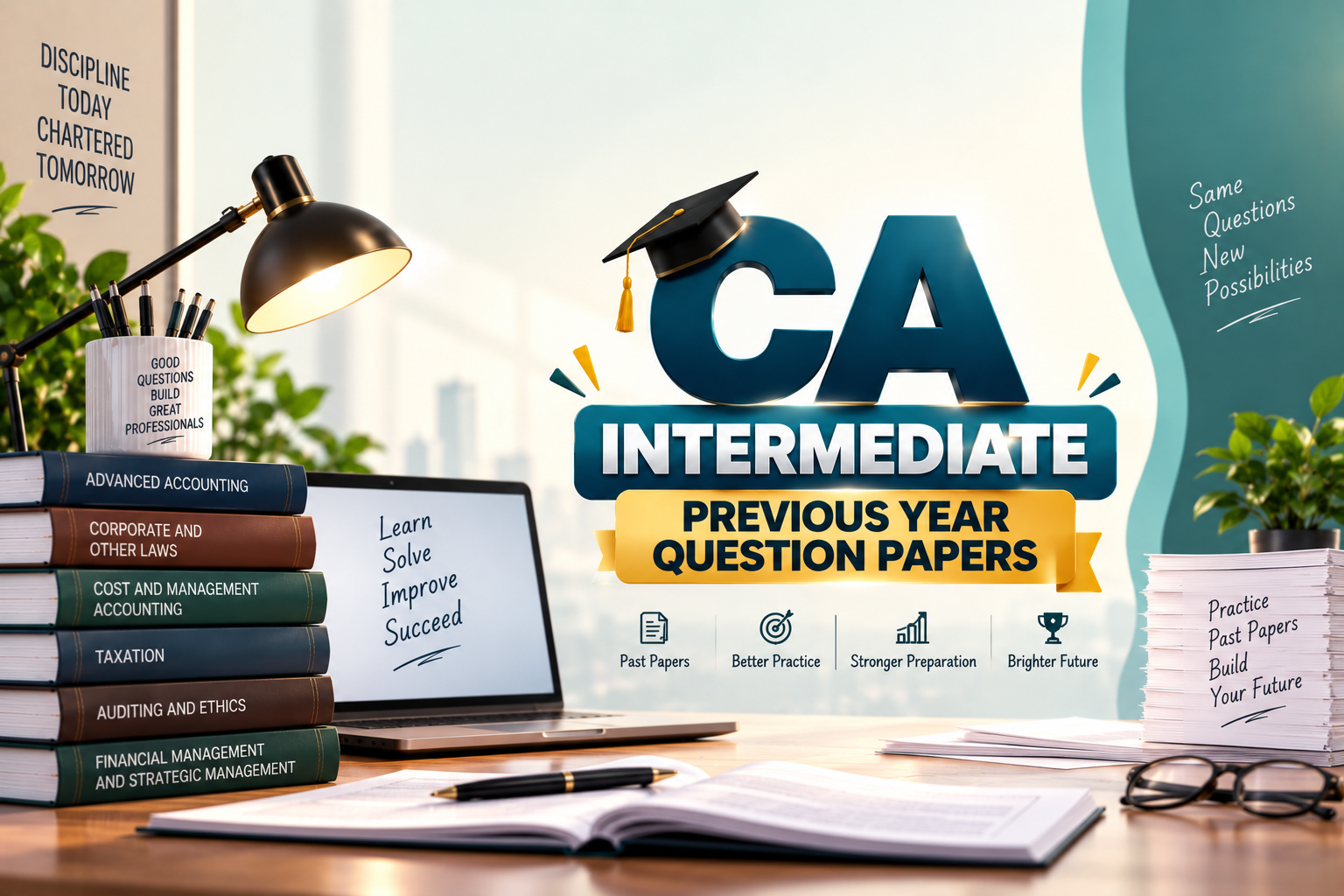
CA Intermediate Previous Year Question Papers: Download Latest Papers & Prepare Smartly

Preparing for CA Intermediate is not just about completing the syllabus. At this level, students need to understand how concepts are actually tested in the examination.

You may read a chapter several times, watch lectures, make detailed notes and still feel uncertain when you see a full question paper.

That is exactly where CA Intermediate Previous Year Question Papers become important.

Previous year papers give you a realistic idea of how ICAI frames questions, how concepts are applied, how much time different questions can consume and where students commonly make mistakes.

But there is one thing to remember: PYQs are useful only when you analyse them properly. Simply downloading 20 PDFs and keeping them in a folder will not improve your preparation.

In this guide, you will find the latest CA Intermediate question papers available up to September 2026, direct links to the official ICAI papers, subject-wise preparation strategies, a practical PYQ-solving method, and tips to use previous papers along with RTPs and mock tests.

What Are CA Intermediate Previous Year Question Papers?

CA Intermediate Previous Year Question Papers are the actual examination papers conducted by the Institute of Chartered Accountants of India (ICAI) in earlier attempts.

These are different from:

  • Mock Test Papers
  • Revision Test Papers
  • Coaching institute test series
  • Practice question banks
  • Sample papers

A mock test may be designed to resemble the ICAI examination, but a previous year paper is an actual paper from a real examination attempt.

That makes PYQs extremely valuable for understanding the examination from a student’s perspective.

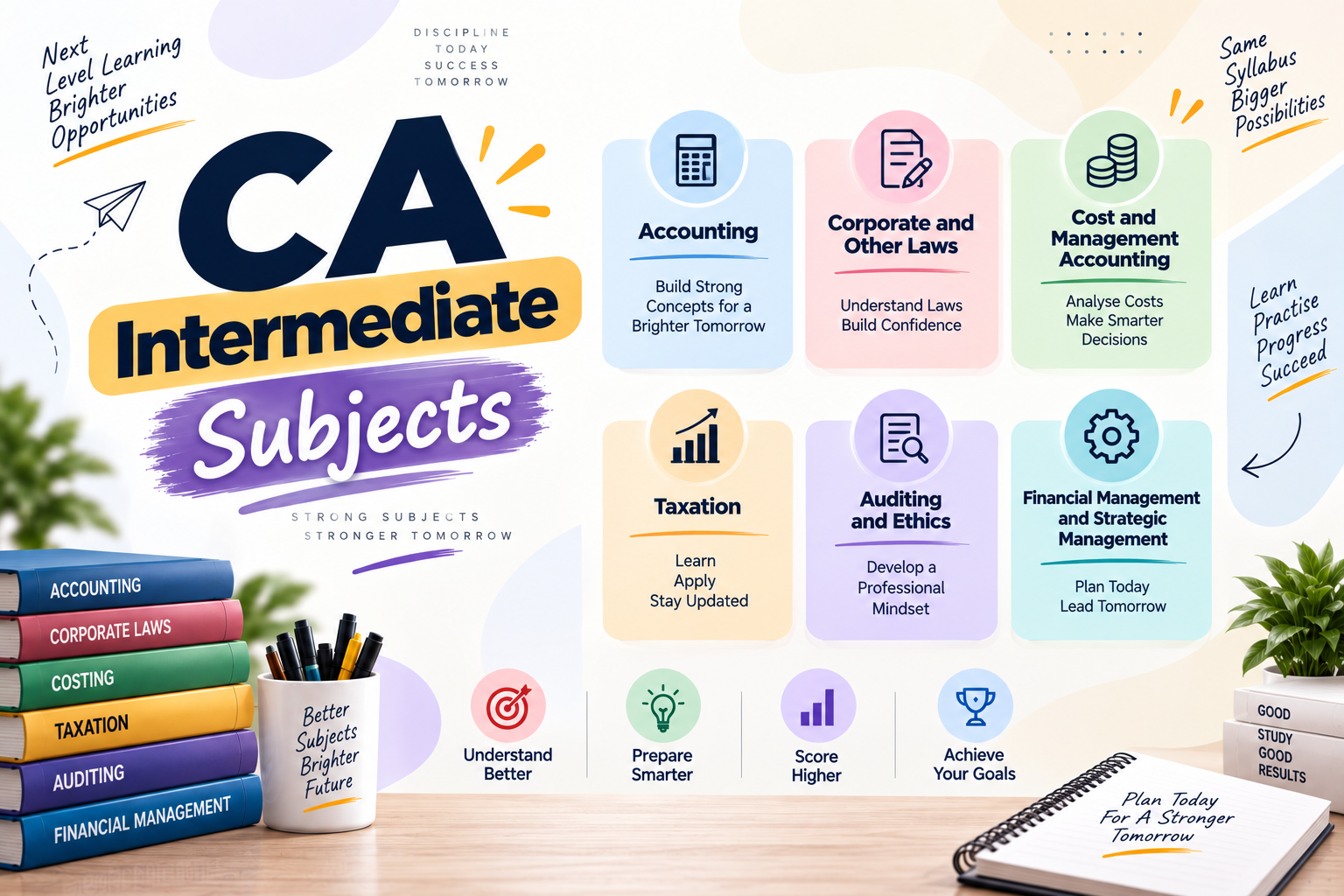
Under the current New Scheme, CA Intermediate consists of six papers:

Group Paper Subject
Group I Paper 1 Advanced Accounting
Group I Paper 2 Corporate and Other Laws
Group I Paper 3 Taxation
Group II Paper 4 Cost and Management Accounting
Group II Paper 5 Auditing and Ethics
Group II Paper 6 Financial Management and Strategic Management

ICAI’s official Intermediate question-paper page currently provides papers for multiple examination attempts, including September 2026, May 2026, January 2026, September 2025 and May 2025.

CA Intermediate Previous Year Question Papers – Last 5 Available Attempts

If you are preparing for the upcoming CA Intermediate examination, it makes sense to begin with the most recent papers.

The following are the five latest available examination attempts up to September 2026:

  1. September 2026
  2. May 2026
  3. January 2026
  4. September 2025
  5. May 2025

The official ICAI page also lists older attempts such as January 2025, September 2024 and May 2024.

CA Intermediate September 2026 Question Papers

September 2026 is the latest examination attempt listed on ICAI’s official Intermediate question-paper page.

At the time of this update, ICAI has listed Paper 1 – Advanced Accounting and Paper 2 – Corporate and Other Laws for September 2026.

Paper Question Paper Official Link
Paper 1 Advanced Accounting – September 2026 Download September 2026 Paper 1 – Advanced Accounting
Paper 2 Corporate and Other Laws – September 2026 Download September 2026 Paper 2 – Corporate and Other Laws

Important: Paper 3, Paper 4, Paper 5 and Paper 6 are not currently listed on ICAI’s official question-paper page for September 2026. Students should check the official ICAI page for future updates instead of relying on unofficial links.

CA Intermediate May 2026 Question Papers

The May 2026 examination is particularly useful for students because ICAI has listed all six Intermediate papers for this attempt.

Paper Question Paper Official Link
Paper 1 Advanced Accounting – May 2026 Download May 2026 Paper 1
Paper 2 Corporate and Other Laws – May 2026 Download May 2026 Paper 2
Paper 3 Taxation – May 2026 Download May 2026 Paper 3
Paper 4 Cost and Management Accounting – May 2026 Download May 2026 Paper 4
Paper 5 Auditing and Ethics – May 2026 Download May 2026 Paper 5
Paper 6 Financial Management and Strategic Management – May 2026 Download May 2026 Paper 6

All six papers are listed on ICAI’s official Intermediate question-paper page.

CA Intermediate January 2026 Question Papers

January 2026 is another important recent attempt and contains all six Intermediate papers on the official ICAI page.

Paper Question Paper Official Link
Paper 1 Advanced Accounting – January 2026 Download January 2026 Paper 1
Paper 2 Corporate and Other Laws – January 2026 Download January 2026 Paper 2
Paper 3 Taxation – January 2026 Download January 2026 Paper 3
Paper 4 Cost and Management Accounting – January 2026 Download January 2026 Paper 4
Paper 5 Auditing and Ethics – January 2026 Download January 2026 Paper 5
Paper 6 Financial Management and Strategic Management – January 2026 Download January 2026 Paper 6

Students preparing for the next attempt can use these papers after completing the relevant portion of their syllabus.

CA Intermediate September 2025 Question Papers

The September 2025 attempt is another excellent source of recent practice.

All six papers are listed on the ICAI official question-paper page.

Paper Question Paper Official Link
Paper 1 Advanced Accounting – September 2025 Download September 2025 Paper 1
Paper 2 Corporate and Other Laws – September 2025 Download September 2025 Paper 2
Paper 3 Taxation – September 2025 Download September 2025 Paper 3
Paper 4 Cost and Management Accounting – September 2025 Download September 2025 Paper 4
Paper 5 Auditing and Ethics – September 2025 Download September 2025 Paper 5
Paper 6 Financial Management and Strategic Management – September 2025 Download September 2025 Paper 6

These papers can be particularly useful once you have covered most of the current syllabus.

CA Intermediate May 2025 Question Papers

The fifth latest available attempt in this list is May 2025.

ICAI lists all six Intermediate papers for this attempt.

Paper Question Paper Official Link
Paper 1 Advanced Accounting – May 2025 Download May 2025 Paper 1
Paper 2 Corporate and Other Laws – May 2025 Download May 2025 Paper 2
Paper 3 Taxation – May 2025 Download May 2025 Paper 3
Paper 4 Cost and Management Accounting – May 2025 Download May 2025 Paper 4
Paper 5 Auditing and Ethics – May 2025 Download May 2025 Paper 5
Paper 6 Financial Management and Strategic Management – May 2025 Download May 2025 Paper 6

Official ICAI CA Intermediate Question Paper Page

Students should bookmark the official ICAI page because it is the most reliable place to check for new question papers.

Official ICAI CA Intermediate Question Papers:
View All CA Intermediate Question Papers on ICAI

The official page currently lists September 2026, May 2026, January 2026, September 2025, May 2025 and earlier Intermediate attempts.

This is particularly important for students because ICAI may update the page as new examination papers become available.

Why Should You Solve CA Intermediate Previous Year Question Papers?

There is a major difference between studying a topic and knowing how that topic appears in an examination.

A chapter may look easy while reading your notes. The same chapter can feel completely different when ICAI combines two or three concepts into one question.

Previous year papers help you understand this difference.

1. Understand ICAI’s Question Style

PYQs show you how ICAI converts concepts into questions.

You start becoming familiar with:

  • Question wording
  • Practical application
  • Case-based questions
  • Numerical problems
  • Theory questions
  • Integrated concepts
  • Time-consuming questions

This familiarity is extremely valuable.

2. Identify Your Weak Areas

Suppose you solve a previous paper and score 58%.

Instead of simply feeling disappointed, analyse the result.

Maybe:

  • 10 marks were lost because of calculation errors.
  • 8 marks were lost because of one weak chapter.
  • 6 marks were lost because you couldn’t manage time.

Now you know exactly what needs improvement.

3. Improve Speed

CA Intermediate is not only about knowing the answer.

You need to know it quickly enough to write it within the examination.

Regular timed practice helps develop that ability.

4. Build Confidence

The more actual papers you solve, the less unfamiliar the examination environment becomes.

You start developing your own strategy for:

  • Question selection
  • Time allocation
  • Numerical questions
  • Theory answers
  • Revision
  • Checking answers

Subject-Wise Strategy for CA Intermediate PYQs

Advanced Accounting

Accounting requires practice rather than passive reading.

When solving PYQs, compare your complete working with the solution.

Focus on:

  • Accounting treatment
  • Adjustments
  • Journal entries
  • Working notes
  • Calculations
  • Presentation

A correct final answer with incorrect working is still a warning sign.

Corporate and Other Laws

Law questions should be approached conceptually.

Instead of memorising an old answer, understand:

  • The relevant provision
  • Conditions
  • Exceptions
  • Application
  • Legal reasoning
  • Important keywords

If the facts of the question change, your understanding should still allow you to answer.

Taxation

Taxation requires special care when using old question papers.

A previous year question can still be useful for understanding the concept, but tax provisions, amendments and applicable assessment years can change.

Therefore, always cross-check an old Taxation question against the applicable ICAI study material and statutory updates for your examination attempt.

Never assume that an old tax answer is automatically valid for your current examination.

Cost and Management Accounting

For Costing, practice is the key.

Maintain a notebook for:

  • Formula mistakes
  • Calculation errors
  • Wrong methods
  • Questions taking too much time
  • Chapters requiring revision

Try to solve questions independently before looking at the solution.

Auditing and Ethics

Auditing requires conceptual understanding and answer-writing practice.

When analysing PYQs, pay attention to:

  • Keywords
  • Provisions
  • Conceptual differences
  • Question requirements
  • Answer structure

Don’t write everything you know.

Write what the question actually asks.

Financial Management and Strategic Management

This paper requires two different approaches.

For Financial Management, focus on numerical practice, formulas and speed.

For Strategic Management, focus on:

  • Concepts
  • Keywords
  • Application
  • Structured answers
  • Understanding the question requirement

PYQs help you understand the difference between merely knowing a topic and actually applying it.

How Many CA Intermediate Previous Year Papers Should You Solve?

There is no magic number.

Solving five papers properly is much more useful than downloading twenty-five papers and never analysing them.

A practical approach is:

Preparation Stage PYQ Strategy
Less than 40% syllabus Topic-wise PYQs
40–60% syllabus Chapter-wise PYQs
60–80% syllabus Mixed PYQs
80–100% syllabus Full-length papers
Final revision Recent PYQs + Mocks + Mistake Book

Start with recent papers and gradually move backwards.

How to Solve CA Intermediate PYQs Correctly

Step 1: Attempt Without Notes

Keep your study material aside.

Don’t search for solutions.

Try the paper honestly.

Step 2: Use a Timer

Timed practice is essential for full-length papers.

Step 3: Check Every Answer

Don’t only calculate the final score.

Analyse individual questions.

Step 4: Record Your Mistakes

Use a simple tracker:

Mistake Reason Action
Concept error Topic not clear Revise concept
Calculation error Carelessness More practice
Memory error Provision forgotten Revise notes
Time issue Question took too long Improve selection
Reading error Misunderstood requirement Read carefully

Step 5: Reattempt Difficult Questions

After revision, solve the question again.

This is where real improvement happens.

PYQs vs Mock Tests: Which Is Better?

You should not choose one over the other.

Use both.

PYQs Mock Tests
Actual past exam papers Practice examination
Show ICAI’s historical approach Test present preparation
Help understand question style Help test time management
Useful for concept analysis Useful for exam simulation
Based on actual attempts Created for practice

Think of PYQs as your learning tool and mock tests as your performance test.

Don’t Ignore ICAI Revision Test Papers

Previous year papers are important, but they should not become your only source of practice.

The ICAI Board of Studies provides a wider student-resource ecosystem that includes Previous Year Question Papers, Revision Test Papers, Suggested Answers, Mock Test Papers and other academic resources.

A strong preparation combination is:

ICAI Study Material + RTPs + PYQs + Mock Tests + Revision + Mistake Analysis

This gives you a much stronger preparation base than relying on a single question bank.

How to Use PYQs in the Last 30 Days

If your syllabus is substantially complete, your final month should increasingly move towards testing and revision.

Days Focus
1–7 Weak chapters + topic-wise PYQs
8–14 Recent PYQs
15–21 Full-length timed papers
22–25 Mistake analysis
26–28 More full papers
29–30 Final revision

Don’t follow this schedule blindly if your syllabus is incomplete.

If you still have major chapters left, completing the concepts should remain your priority.

Should You Solve Old CA Intermediate Question Papers?

Yes, but carefully.

Older papers can be excellent for:

  • Concept practice
  • Numerical practice
  • Answer-writing practice
  • Understanding question framing

However, always check:

  • Current syllabus
  • Applicable amendments
  • Applicable accounting standards
  • Tax provisions
  • Current paper structure

This is particularly important for Taxation.

An old question can be useful for practice while its old legal position may no longer apply.

How CA Mentoring Program Can Help

Solving a paper is only half the process.

The other half is understanding what your score is telling you.

If you score 55 in one paper and 68 in another, don’t just look at the difference.

Ask:

  • Which chapters caused the difference?
  • Did you make fewer calculation errors?
  • Did you manage your time better?
  • Did you attempt more questions?
  • Which mistakes are repeating?

Students looking for additional academic guidance and mentoring support can explore CA Mentoring Program at CA Mentoring Program.

The objective should not be to complete the largest number of papers.

The objective should be to become better after every paper.

Common Mistakes Students Make While Solving PYQs

1. Solving Without a Timer

This can give you an unrealistic idea of your preparation.

2. Looking at Solutions Too Quickly

Give yourself enough time to think.

3. Memorising Old Answers

Understand the concept instead.

4. Ignoring Small Mistakes

A repeated “silly mistake” can cost significant marks across a full examination.

5. Using Outdated Tax Questions Blindly

Always check current applicability.

6. Focusing Only on Marks

Your score matters, but your mistake pattern matters more during preparation.

A Simple Weekly CA Intermediate PYQ Routine

A simple routine can make PYQs much easier to manage.

Monday to Thursday

Study the planned topics and solve related PYQs.

Friday

Review mistakes from the week.

Saturday

Attempt a mixed test or selected PYQs under time pressure.

Sunday

Analyse the test and prepare your next revision list.

As the examination gets closer, gradually increase full-length paper practice.

Final Takeaway

CA Intermediate Previous Year Question Papers are not simply PDFs that you download before the examination.

They are one of the best ways to understand how your preparation performs under real examination conditions.

Start with the latest papers.

Use the official ICAI links.

Attempt papers honestly.

Use a timer.

Analyse every mistake.

Revise the weak areas.

Then reattempt difficult questions.

Most importantly, don’t try to predict the next ICAI paper simply by looking at repeated questions.

The purpose of PYQs is not to tell you exactly what will appear.

The purpose is to make you comfortable with how ICAI tests concepts.

If you combine official ICAI study material, Revision Test Papers, previous year papers, mock tests and consistent revision, your preparation becomes much more structured.

For the latest official question papers, always check the ICAI Intermediate question-paper page because new papers and resources may be added as they become available.

Your target should not be:

“I solved 20 papers.”

Your target should be:

“Every paper I solved made me better than the previous one.”

That is the real value of CA Intermediate Previous Year Question Papers.
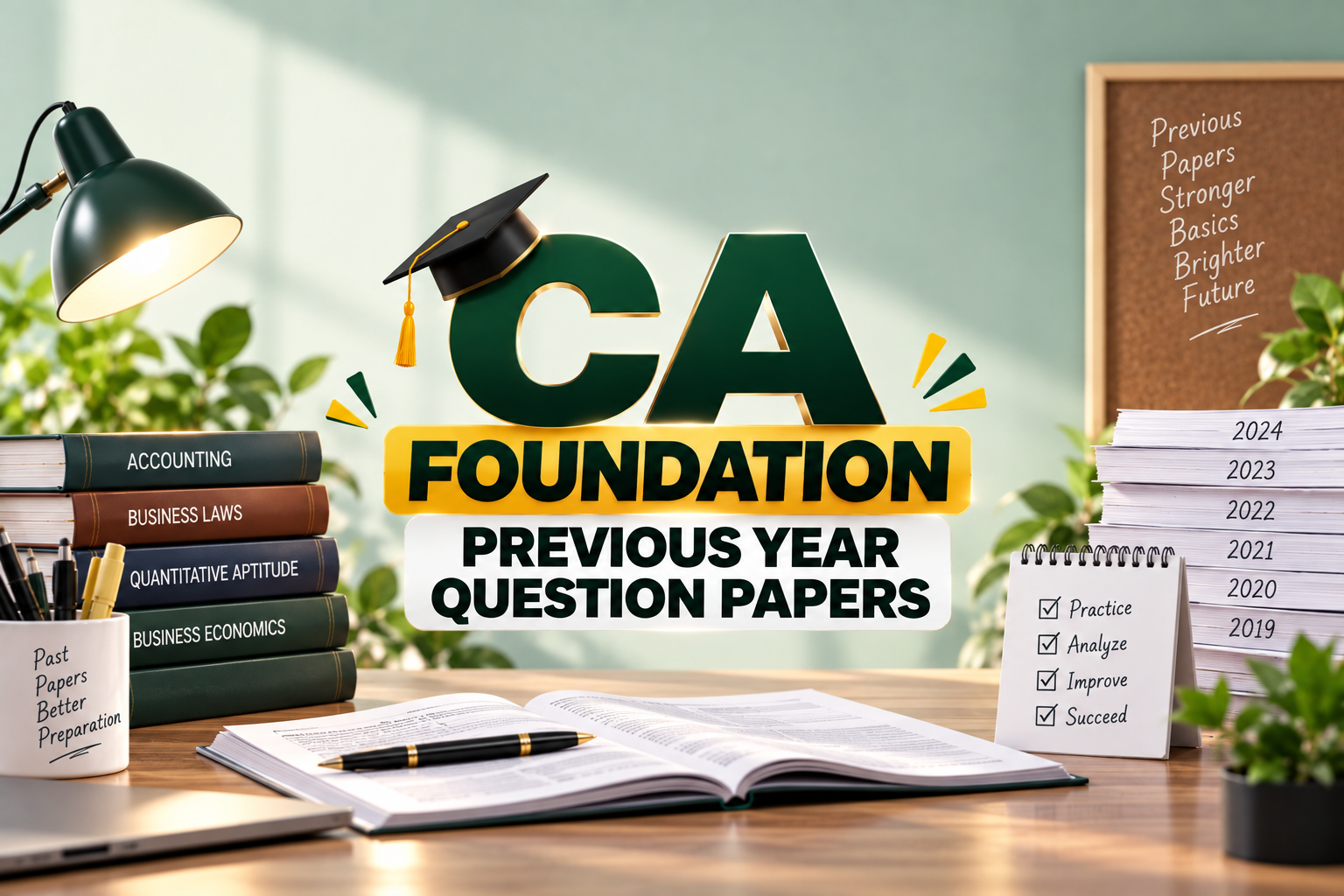
CA Foundation Previous Year Question Papers: Download Latest Papers & Prepare Smarter

Preparing for CA Foundation is not just about completing the syllabus. It is about understanding how well you can apply what you have studied when you are sitting in the examination hall.

This is where CA Foundation Previous Year Question Papers become extremely important.

A student may spend months watching lectures, reading study material and making notes, but still feel nervous when the actual question paper is placed in front of them. Previous year papers help remove that uncertainty. They show you how questions are framed, how concepts are tested and how much speed and accuracy you need during the examination.

If you are preparing for CA Foundation, don’t treat previous year question papers as something to solve only during the last week. They should become a regular part of your preparation strategy.

In this guide, you will find the latest available CA Foundation question papers, official ICAI links, a practical method to use PYQs, subject-wise strategies, common mistakes students make and a simple plan to get maximum benefit from previous papers.

What Are CA Foundation Previous Year Question Papers?

CA Foundation Previous Year Question Papers are the actual examination papers released for previous Foundation attempts.

These papers are valuable because they represent the real examination rather than questions created only for practice.

The Institute of Chartered Accountants of India (ICAI) maintains an official question-paper section where students can access Foundation papers from different examination attempts.

As of September 2026, the official ICAI page lists Foundation papers for September 2026, May 2026, January 2026, September 2025, May 2025, January 2025, September 2024 and June 2024.

For a student, this means you do not need to depend entirely on random PDF websites to find previous papers.

You can start with the official source.

View the Official ICAI CA Foundation Question Papers

Latest CA Foundation Previous Year Question Papers

If your goal is to practise the most recent papers first, the following attempts should be your priority.

CA Foundation September 2026 Question Papers

The September 2026 papers are currently the latest Foundation papers listed on the ICAI official question-paper page.

Subject Paper Official ICAI Link
Accounting Paper 1 – September 2026 Download from ICAI
Business Laws Paper 2 – September 2026 Download from ICAI
Quantitative Aptitude Paper 3 – September 2026 Download from ICAI

Important: At the time of this update, ICAI’s official page lists these three September 2026 papers. Paper 4 – Business Economics is not currently listed on that page. Students should use the official ICAI page for any later updates.

CA Foundation May 2026 Question Papers

May 2026 is another highly relevant attempt for students preparing for upcoming examinations.

Subject Paper Official ICAI Link
Accounting Paper 1 – May 2026 Download from ICAI
Business Laws Paper 2 – May 2026 Download from ICAI

These papers are linked from the official ICAI Foundation question-paper section.

CA Foundation January 2026 Question Papers

The January 2026 papers are also useful for understanding recent question framing.

Subject Paper Official ICAI Link
Accounting Paper 1 – January 2026 Download from ICAI
Business Laws Paper 2 – January 2026 Download from ICAI

If you have already completed most of your syllabus, these recent papers should be included in your timed practice schedule.

CA Foundation September 2025 Question Papers

September 2025 papers can help you understand how recent concepts were tested before the latest 2026 attempts.

Subject Paper Official ICAI Link
Accounting Paper 1 – September 2025 Download from ICAI
Business Laws Paper 2 – September 2025 Download from ICAI

The September 2025 papers are listed on ICAI’s official Foundation question-paper page.

CA Foundation May 2025 Question Papers

May 2025 is another useful recent attempt for PYQ practice.

Subject Paper Official ICAI Link
Accounting Paper 1 – May 2025 Download from ICAI
Business Laws Paper 2 – May 2025 Download from ICAI

Rather than simply downloading these papers, try to solve them under examination conditions and analyse your mistakes afterwards.

Official ICAI CA Foundation Question Paper Page

If you are searching for the latest CA Foundation previous year papers, it is worth bookmarking the official ICAI page.

Official ICAI – CA Foundation Question Papers

The official page currently provides links for Foundation attempts from June 2024 onwards, including September 2026, May 2026, January 2026, September 2025, May 2025, January 2025, September 2024 and June 2024.

This is especially useful because ICAI can update the page when additional papers or examination-session resources become available.

CA Foundation Previous Year Papers: Quick Download Guide

Here is a quick view of the recent attempts currently relevant to students:

Examination Latest Status on ICAI Page Priority
September 2026 Papers currently listed Very High
May 2026 Papers currently listed Very High
January 2026 Papers currently listed Very High
September 2025 Papers currently listed High
May 2025 Papers currently listed High
January 2025 Papers listed Moderate
September 2024 Papers listed Moderate
June 2024 Papers listed Reference

For the complete and updated list, always refer to the official ICAI question-paper page.

Why Are CA Foundation Previous Year Question Papers Important?

There is a reason experienced students and teachers repeatedly recommend solving PYQs.

It is because reading a chapter and solving an examination question are two different skills.

1. You Understand ICAI’s Question Style

Previous papers help you understand how ICAI converts a concept into an examination question.

You start noticing:

  • How questions are worded
  • Which concepts require application
  • How numerical questions are structured
  • How options can create confusion
  • How much detail is expected
  • Which areas require more attention

That familiarity can make the actual examination feel less unfamiliar.

2. You Discover Your Weak Areas

Suppose you believe that your Accounting preparation is strong.

You solve a previous paper and discover that you repeatedly make mistakes in one particular type of question.

That is useful information.

Instead of revising the entire subject again, you can focus on the specific weakness.

3. You Improve Speed

Knowing an answer is not enough.

You must be able to reach that answer within the available examination time.

Regular PYQ practice helps you become faster at:

  • Reading questions
  • Identifying the concept
  • Selecting the right method
  • Calculating
  • Eliminating options
  • Moving away from time-consuming questions

4. You Build Examination Confidence

The first full paper can feel difficult.

The second becomes slightly more comfortable.

After several properly analysed papers, you begin to understand your own strengths and weaknesses.

That confidence is valuable during the final days before the examination.

How to Solve CA Foundation Previous Year Papers Effectively

Don’t make the common mistake of opening a paper, solving a few questions and immediately checking the answer.

Use a proper process.

Step 1: Attempt It Like a Real Exam

Keep your books and notes away.

Set a timer.

Sit at a desk.

Attempt the paper without external help.

The purpose is to find out what you can actually do on your own.

Step 2: Check Your Answers

Once you finish, compare your answers with the appropriate solution or Suggested Answer.

Do not only calculate your total marks.

Analyse each wrong question.

Ask yourself:

Why did I get this wrong?

That question is more important than the score itself.

Step 3: Categorise Your Mistakes

Maintain a simple mistake tracker.

Type of Mistake What It Means
Conceptual You need to revise the topic
Calculation You need more numerical practice
Reading You misunderstood the question
Memory You forgot a provision/formula
Time You need better question selection
Silly mistake You need greater concentration

After solving several papers, patterns will start appearing.

Step 4: Reattempt the Wrong Questions

After revising the relevant topic, solve the question again.

If you get it right this time, move ahead.

If you make the same mistake again, the underlying concept needs more attention.

This simple Attempt → Analyse → Revise → Reattempt cycle can make PYQ practice much more effective.

Subject-Wise Strategy for CA Foundation PYQs

Different subjects need different approaches.

Accounting

For Accounting, don’t focus only on the final answer.

Compare your complete working.

Pay attention to:

  • Journal entries
  • Adjustments
  • Calculations
  • Accounting treatment
  • Presentation
  • Time taken

If your final answer is correct but your working contains conceptual mistakes, fix them before the examination.

Business Laws

Business Laws requires understanding rather than blind memorisation.

While solving PYQs, look for:

  • Important provisions
  • Definitions
  • Conditions
  • Exceptions
  • Case-based applications
  • Legal reasoning

If you memorise a previous answer word-for-word, you may struggle when ICAI changes the facts in a new question.

Understand the provision first.

Quantitative Aptitude

For Quantitative Aptitude, practice is everything.

Maintain a formula and mistake notebook.

Record:

  • Formulas you forget
  • Questions taking too long
  • Calculation errors
  • Topics where you guess answers
  • Repeated mistakes

The aim should be to make familiar question types almost automatic.

Business Economics

Economics requires conceptual clarity.

While practising objective questions, don’t simply remember the correct option.

Ask:

Why is this option correct?

And more importantly:

Why are the other options incorrect?

This approach prepares you for questions where the wording is changed.

Should You Solve Previous Papers Before Completing the Syllabus?

Yes—but selectively.

You don’t have to wait until 100% of the syllabus is complete.

If you have finished a particular chapter, start solving questions related to that chapter.

For example:

Chapter completed → Revise → Solve PYQs → Analyse mistakes → Continue

However, full-length papers should ideally be introduced once you have covered most of the syllabus.

There is little value in taking a complete paper when large portions of the syllabus are still untouched.

How Many CA Foundation Previous Year Papers Should You Solve?

There is no universal number.

Solving five papers properly is much better than downloading twenty papers and barely looking at them.

A practical approach is:

Preparation Stage Recommended PYQ Practice
Early preparation Topic-wise questions
Mid preparation Chapter-wise PYQs
70–80% syllabus Mixed PYQs
Syllabus completed Full-length papers
Final revision Recent PYQs + mocks + mistakes

Start with the latest papers and then move backwards.

This keeps your practice closer to the current examination environment.

PYQs vs Mock Tests: What Should You Practise?

Both are useful, but they serve different purposes.

PYQs Mock Tests
Actual previous examination papers Practice examinations
Show real past question framing Test your current readiness
Help understand ICAI style Help simulate exam conditions
Useful for historical comparison Useful for performance measurement
Best for analysing concepts Best for testing speed and strategy

A strong preparation plan should include both PYQs and mock tests.

Don’t Ignore ICAI Suggested Answers

Question papers tell you what was asked.

Suggested Answers help you understand the expected approach.

ICAI maintains a separate official Suggested Answers page for the Foundation course under the New Scheme. It currently lists Suggested Answers for May 2026, January 2026, September 2025, May 2025, January 2025, September 2024 and June 2024.

View Official ICAI Foundation Suggested Answers

When analysing a PYQ, don’t just ask whether your answer is correct.

Compare your approach with the official solution wherever applicable.

This is particularly useful for understanding presentation, reasoning and the expected method.

Common Mistakes Students Make While Using PYQs

Mistake 1: Solving PYQs Only in the Last Week

PYQs should be used throughout preparation.

Mistake 2: Memorising Old Questions

A previous question is not necessarily a prediction of the next paper.

Mistake 3: Checking Solutions Immediately

First attempt the question honestly.

Mistake 4: Ignoring Mistakes After Checking Marks

Your mistakes contain some of the most valuable information about your preparation.

Mistake 5: Using Outdated Papers Without Checking the Syllabus

Older papers may contain questions that are not relevant to your current examination.

Always check the applicable syllabus and study material.

Mistake 6: Solving Without a Timer

At least your full-paper practice should be timed.

A 30-Day CA Foundation PYQ Strategy

If your syllabus is substantially complete, you can use a simple 30-day PYQ-focused plan.

Period Focus
Days 1–7 Topic-wise PYQs + weak chapters
Days 8–14 Recent subject-wise papers
Days 15–21 Full-length timed papers
Days 22–25 Mistake analysis + revision
Days 26–28 More full papers
Days 29–30 Final revision + selected PYQs

Don’t blindly follow this timetable if your syllabus is incomplete.

Your preparation level should determine the balance between learning and testing.

How CA Mentoring Program Can Help With Your Preparation

Previous year papers are most useful when you know how to analyse them.

Students often solve a paper, check the score and move on.

The better approach is to identify:

  • Why marks were lost
  • Which chapters need revision
  • Which question types consume time
  • Where repeated mistakes occur
  • Whether your preparation strategy is actually working

For students looking for additional preparation guidance, mentoring and exam-oriented support, CA Mentoring Program can be explored as part of the overall CA Foundation preparation journey.

The goal should not be to solve papers simply for the sake of increasing the number of papers completed.

The goal is to become more accurate, faster and more confident with every paper you solve.

Final Takeaway

CA Foundation Previous Year Question Papers are much more than downloadable PDFs.

They are a practical way to understand the examination, test your preparation and identify the areas where you need to improve.

Start with the latest available papers.

Solve them without looking at the answers.

Check your performance honestly.

Maintain a mistake notebook.

Revise the weak areas.

Then solve the questions again.

Most importantly, use the official ICAI question-paper resources whenever possible. ICAI’s official page currently provides Foundation question papers across multiple recent attempts, including September 2026, May 2026, January 2026, September 2025 and May 2025.

Don’t try to predict the next CA Foundation paper from old questions.

Instead, learn from the way ICAI has tested concepts in the past.

That mindset will make your preparation much stronger.

And when you finally enter the examination hall, the paper may still contain new questions—but the process of reading, analysing and solving them won’t feel new anymore.

CA Final Exam Pattern Nov 2026: Paper Pattern, Marks, Duration, Syllabus & Passing Criteria

CA Final Exam Pattern Nov 2026: An Overview

The CA Final examination is the last major academic stage of the Chartered Accountancy journey, and by the time students reach this level, preparation is no longer about simply completing chapters. The real challenge is understanding how ICAI expects you to apply concepts in the examination hall.

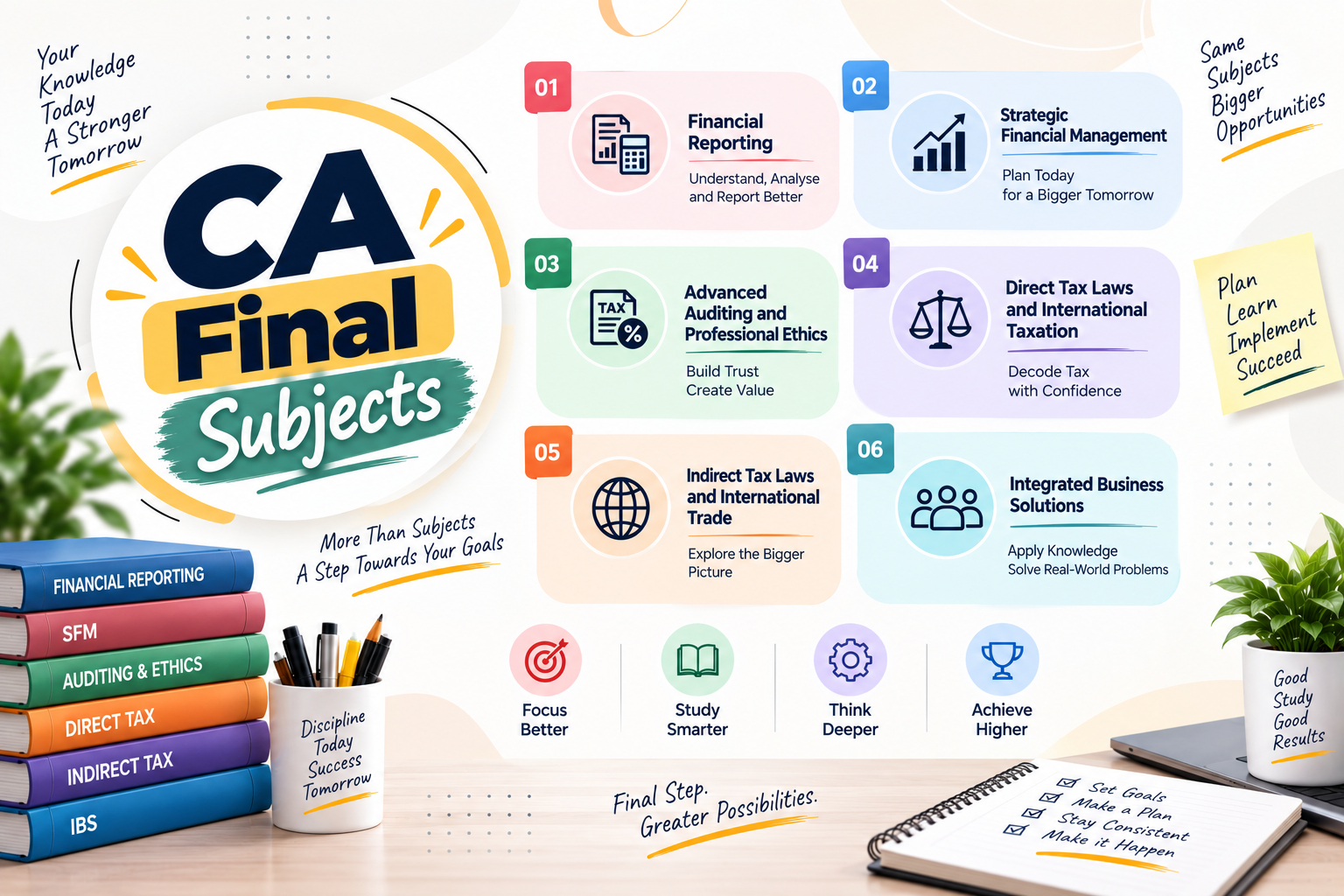
For students appearing in CA Final November 2026, knowing the exact exam pattern is particularly important because the New Scheme has changed the structure of the Final course. The current CA Final course consists of six papers divided into two groups, with three papers in each group. ICAI’s current New Scheme lists Financial Reporting, Advanced Financial Management, Advanced Auditing, Assurance and Professional Ethics, Direct Tax Laws & International Taxation, Indirect Tax Laws, and Integrated Business Solutions as the Final papers.

The November 2026 attempt will be conducted in two groups:

  • Group I: Paper 1, Paper 2 and Paper 3
  • Group II: Paper 4, Paper 5 and Paper 6

The biggest thing students should notice is that Paper 6 – Integrated Business Solutions (IBS) is different from the other papers because it is designed around multidisciplinary case studies and has a longer examination duration.

So, before you make your final revision timetable, understand the pattern first. A good strategy built around the wrong paper pattern can waste several weeks of preparation.

CA Final Exam Pattern Nov 2026: Quick Highlights

Here is the complete pattern at a glance:

Particular CA Final November 2026
Conducting Body Institute of Chartered Accountants of India (ICAI)
Course Scheme New Scheme
Total Papers 6
Number of Groups 2
Papers in Each Group 3
Total Marks 600
Marks per Paper 100
Group I Papers Paper 1, 2 & 3
Group II Papers Paper 4, 5 & 6
Paper 6 Integrated Business Solutions
Paper 6 Duration 4 Hours
Other Papers 3 Hours
Passing Requirement 40% in each paper + 50% aggregate in a group

The six-paper structure is confirmed by ICAI’s Final Course syllabus under the New Scheme.

CA Final November 2026 Exam Dates

The November 2026 CA Final examination is scheduled across two groups. The exams are conducted on alternate dates, giving students a short preparation gap between papers.

Group Paper Subject Exam Date Duration
Group I Paper 1 Financial Reporting 2 November 2026 3 Hours
Group I Paper 2 Advanced Financial Management 4 November 2026 3 Hours
Group I Paper 3 Advanced Auditing, Assurance & Professional Ethics 6 November 2026 3 Hours
Group II Paper 4 Direct Tax Laws & International Taxation 9 November 2026 3 Hours
Group II Paper 5 Indirect Tax Laws 11 November 2026 3 Hours
Group II Paper 6 Integrated Business Solutions 13 November 2026 4 Hours

The November 2026 schedule reported from the ICAI examination announcement places Group I on 2, 4 and 6 November and Group II on 9, 11 and 13 November.

For students, this schedule has one important implication: you cannot afford to leave revision until the night before an exam. Your preparation should be designed so that each subject has already been revised at least once before the first paper.

CA Final Group 1 Exam Pattern Nov 2026

Group 1 consists of three papers:

  1. Financial Reporting
  2. Advanced Financial Management
  3. Advanced Auditing, Assurance and Professional Ethics

Each paper carries 100 marks.

Group 1 Paper Pattern

Paper Subject Maximum Marks Duration
Paper 1 Financial Reporting 100 3 Hours
Paper 2 Advanced Financial Management 100 3 Hours
Paper 3 Advanced Auditing, Assurance & Professional Ethics 100 3 Hours
Total 300

Paper 1: Financial Reporting

Financial Reporting tests much more than your ability to remember accounting standards. At the Final level, students are expected to understand Ind AS concepts and apply them to practical situations.

Important areas include:

  • Ind AS framework
  • Presentation of financial statements
  • Revenue recognition
  • Assets and liabilities
  • Financial instruments
  • Business combinations
  • Consolidated financial statements
  • Analysis of financial statements
  • Disclosures
  • Professional and ethical aspects

The best approach for FR is to combine concept revision with extensive question practice. Reading the chapter repeatedly without solving questions can create a false sense of preparation.

Paper 2: Advanced Financial Management

AFM is generally considered a calculation-heavy paper. However, simply memorising formulas is not enough.

Your preparation should include:

  • Financial strategy
  • Investment decisions
  • Financing decisions
  • Risk management
  • Security valuation
  • Portfolio management
  • Derivatives
  • Foreign exchange
  • Mergers and acquisitions
  • Financial restructuring
  • Other advanced financial decision-making areas

For AFM, your formula revision should be accompanied by timed practice. The objective is not only to know the formula but also to identify which formula or concept the question is actually testing.

Paper 3: Advanced Auditing, Assurance & Professional Ethics

Audit preparation requires a different approach from FR or AFM.

Students need to develop:

  • Conceptual clarity
  • Understanding of auditing procedures
  • Ability to identify relevant standards
  • Professional judgement
  • Proper presentation
  • Revision of important provisions and requirements

At Final level, Audit answers should not look like random points copied from memory. Your answer should directly address the requirement of the question.

CA Final Group 2 Exam Pattern Nov 2026

Group 2 includes:

  1. Direct Tax Laws & International Taxation
  2. Indirect Tax Laws
  3. Integrated Business Solutions
Paper Subject Maximum Marks Duration
Paper 4 Direct Tax Laws & International Taxation 100 3 Hours
Paper 5 Indirect Tax Laws 100 3 Hours
Paper 6 Integrated Business Solutions 100 4 Hours
Total 300

Paper 4: Direct Tax Laws & International Taxation

Direct Tax at CA Final level requires students to connect provisions with practical tax situations.

Preparation should cover the applicable syllabus areas, including:

  • Computation of taxable income
  • Tax provisions
  • Assessment procedures
  • Appeals and related procedures
  • Tax planning
  • International taxation
  • Transfer pricing
  • Double taxation concepts
  • Relevant amendments applicable to the examination

For November 2026, students should be particularly careful about the applicable Finance Act, notifications, circulars and amendments prescribed by ICAI for the attempt.

Don’t rely on an old amendment compilation just because it was useful for an earlier attempt.

Paper 5: Indirect Tax Laws

Indirect Tax Laws covers GST and customs-related areas under the applicable Final syllabus.

Major preparation areas include:

  • Supply
  • Input Tax Credit
  • Registration
  • Tax invoice
  • Returns
  • Payment of tax
  • Assessment
  • Refund
  • Audit
  • E-way bill
  • Inspection and enforcement
  • Appeals and penalties
  • Customs law
  • Foreign Trade Policy-related provisions

One of the most common mistakes students make in IDT is studying provisions in isolation.

Try to understand the practical flow:

Transaction → Supply → Taxability → ITC → Compliance → Payment → Return → Assessment/Refund

This approach makes revision much easier.

Paper 6: Integrated Business Solutions – The Paper You Should Not Ignore

Paper 6 is arguably the most distinctive paper under the current CA Final structure.

It is titled:

Integrated Business Solutions (Multidisciplinary Case Study with Strategic Management).

Unlike a conventional subject paper, IBS requires you to look at a business situation from multiple professional perspectives.

The paper can require integration of concepts across areas such as:

  • Financial Reporting
  • Financial Management
  • Auditing
  • Direct Tax
  • Indirect Tax
  • Strategic Management
  • Professional and business considerations

The objective is not simply to test whether you remember individual chapters. It is designed to assess how effectively you can analyse a business situation and apply multiple concepts together.

Paper 6 at a Glance

Particular Details
Paper Paper 6
Name Integrated Business Solutions
Nature Multidisciplinary Case Study
Maximum Marks 100
Duration 4 Hours
Major Skill Tested Application & Analysis
Strategic Management Integrated

The four-hour duration makes time management especially important.

Students who prepare IBS only after completing every other subject may find it difficult to adjust to case-based thinking. It is better to practise case scenarios throughout the preparation period.

ICAI’s Board of Studies specifically provides case-study resources and identifies Paper 6 as Integrated Business Solutions in its Final Course resources.

CA Final Nov 2026 Marks Distribution and Question Pattern

Under the current New Scheme, CA Final papers follow a combination of objective and descriptive assessment, while Paper 6 has its own case-study-oriented structure.

For Papers 1 to 5, the commonly followed pattern is:

Component Marks
Objective Questions / MCQs 30
Descriptive Questions 70
Total 100

This means students cannot prepare exclusively for long-form questions.

The objective component can test whether you can quickly identify the correct concept, treatment, provision or calculation.

The descriptive component, on the other hand, tests your ability to explain, calculate, analyse and present the answer properly.

Important: Students should always verify the latest ICAI question-paper instructions and attempt-specific announcements before the examination because ICAI’s instructions and paper-specific requirements take precedence over coaching summaries.

Is There Negative Marking in CA Final Nov 2026?

Students often search for this immediately before the examination.

The objective component has its own instructions, and candidates should carefully read the instructions printed on the question paper and follow the applicable ICAI guidelines.

Do not carry assumptions from another CA level or an older examination pattern into your Final examination.

ICAI maintains specific guidelines for MCQ responses for Intermediate and Final examinations on its student portal.

CA Final Passing Criteria Nov 2026

Understanding the passing criteria is just as important as understanding the paper pattern.

A student generally needs:

  • At least 40% marks in each paper, and
  • At least 50% aggregate marks in the group

For a 300-mark group, 50% means 150 marks.

Example

Suppose a student scores:

Paper Marks
Paper 1 52
Paper 2 48
Paper 3 55
Total 155

The student has crossed the 50% aggregate requirement and has also scored at least 40 marks in every paper.

Therefore, the group requirement is satisfied.

But consider another example:

Paper Marks
Paper 1 65
Paper 2 70
Paper 3 35
Total 170

Although the aggregate is above 50%, the student has not achieved 40 marks in Paper 3.

This is why students should not prepare only for an aggregate score. Every individual paper matters.

How Should You Prepare for CA Final Nov 2026 Based on the Exam Pattern?

Knowing the pattern is useful only when you convert it into a preparation strategy.

1. Start With ICAI Study Material

Your preparation should revolve around the latest applicable ICAI material.

ICAI provides New Scheme study material and Final Course resources through its official student and Board of Studies platforms.

Use coaching notes for explanation and revision, but don’t completely disconnect yourself from ICAI material.

2. Practise MCQs Separately

The objective portion can be lost through careless reading.

During revision, practise questions where you have to make a decision quickly.

Train yourself to identify:

  • What is being asked?
  • Which provision applies?
  • What information is relevant?
  • What information is irrelevant?
  • What is the most appropriate answer?

Speed matters.

3. Write Full-Length Descriptive Answers

Many CA Final students spend months studying but very little time actually writing.

That becomes a problem in the examination.

Try writing full-length papers under exam conditions.

A test is useful only when you analyse it afterwards.

Ask yourself:

  • Did I understand the question correctly?
  • Did I answer exactly what was asked?
  • Did I manage time?
  • Were my workings clear?
  • Did I leave questions incomplete?
  • Could my answer presentation be improved?

Why Test Practice Matters for CA Final Nov 2026

At Final level, mock tests are not just for checking marks.

They help you understand your exam behaviour.

For example, you may know AFM concepts but spend too much time on one difficult question. You may know Audit provisions but write excessively long answers. You may understand DT but make avoidable calculation mistakes.

These problems usually become visible only when you attempt full-length papers.

This is where a structured preparation ecosystem can help. Students preparing through CA Mentoring Program can use the exam pattern as a framework for planning revision, practice and performance analysis.

The goal should not be to simply attempt more tests. The goal should be to learn something from every test you attempt.

CA Final Nov 2026 Preparation Strategy: A Practical Approach

If your syllabus is substantially complete, divide your remaining preparation into three stages.

Stage 1: Revision

Focus on:

  • Concept revision
  • ICAI material
  • Amendments
  • Important questions
  • Formula revision
  • Case studies

Stage 2: Testing

Start with:

  • Chapter-wise tests
  • Topic-wise questions
  • MCQ practice
  • Case-study practice
  • Full-length papers

Stage 3: Final Revision

During the last phase:

  • Avoid starting too many new resources.
  • Revise short notes.
  • Revise formulas.
  • Revisit mistakes from mock tests.
  • Practise important case scenarios.
  • Review amendments.
  • Work on presentation and time management.

A simple rule works well:

Study → Practise → Test → Analyse → Improve → Repeat.

Common Mistakes Students Make in CA Final Preparation

Mistake 1: Collecting too many resources

Five different books do not automatically mean five times better preparation.

Pick your primary source and revise it multiple times.

Mistake 2: Ignoring Paper 6

IBS should not be treated as a last-week subject.

The paper requires application and integration, which takes practice.

Mistake 3: Not practising under time pressure

Knowing an answer and writing it within the available time are two different skills.

Mistake 4: Ignoring amendments

Especially for tax-related papers, applicable amendments can be crucial.

Mistake 5: Focusing only on difficult questions

You need a balanced strategy.

The goal is not to solve the toughest question in the room. The goal is to maximise your score across the entire paper.

How to Use the Exam Gap Between CA Final Papers

The November 2026 schedule gives students limited gaps between papers.

Therefore, your final revision should ideally be completed before the first paper.

For example:

Before 2 November: FR should already be revised.

After FR, don’t try to learn the entire AFM syllabus from scratch. Use the gap for:

  • Formula revision
  • Important questions
  • Mock-test mistakes
  • High-priority chapters
  • Quick concept revision

The same approach should continue for the remaining papers.

The gap between examinations is for targeted revision, not for complete preparation.

CA Final Exam Pattern Nov 2026: What Students Should Remember

If you remember only a few points from this article, remember these:

  1. CA Final under the New Scheme has 6 papers.
  2. The papers are divided into 2 groups.
  3. Each paper carries 100 marks.
  4. Group I contains Papers 1–3.
  5. Group II contains Papers 4–6.
  6. Papers 1–5 are generally 3-hour papers.
  7. Paper 6 IBS has a 4-hour duration.
  8. The examination combines objective and descriptive assessment where applicable.
  9. Passing requires 40% in each paper and 50% aggregate in a group.
  10. ICAI study material, RTPs, MTPs, amendments and previous examination questions should form the core of preparation.

ICAI has also announced Mock Test Paper Series I and II for Final students appearing in November 2026, showing the importance of structured practice before the attempt.

Final Thoughts

The CA Final Exam Pattern Nov 2026 is not difficult to understand, but understanding it early can make your preparation much more organised.

The biggest change students need to adapt to is not simply the number of papers. It is the increasing importance of application, objective questions, case-based thinking and integrated problem-solving.

If you are preparing for November 2026, don’t measure your preparation only by the number of chapters you have completed.

Instead, ask yourself:

Can I solve a question without looking at the solution?

Can I complete a paper within the time limit?

Can I explain my answer clearly?

Can I apply multiple concepts to a case study?

Do I know where I lose marks?

Those answers will tell you much more about your actual preparation level than your study hours will.

CA Final is ultimately an examination of professional-level understanding. The students who combine concept clarity + ICAI material + revision + question practice + mock tests + proper time management put themselves in a much stronger position.

For November 2026, prepare with the mindset that every revision should make your next attempt at a question faster, clearer and more accurate.

CA Intermediate Exam Pattern January 2027: Complete Paper Pattern, Marks, Passing Criteria & Preparation Strategy

CA Intermediate Exam Pattern January 2027: An Overview

If you are preparing for the CA Intermediate January 2027 examination, understanding the exam pattern should be one of the first things on your preparation checklist.

Many students make the mistake of starting their preparation by simply collecting books, watching lectures and making a timetable. But before doing all that, you should know exactly how ICAI will assess you.

Under the current New Scheme of Education and Training, CA Intermediate has six papers divided into two groups. Each paper carries 100 marks. The examination pattern includes both case-scenario/case-study based MCQs and descriptive questions. ICAI’s official guidance states that 30% of the examination comprises case-scenario/case-study based MCQs and 70% comprises descriptive questions. There is no negative marking for the MCQ portion.

This combination makes the CA Intermediate examination different from a purely theoretical or purely objective exam. You need conceptual clarity, numerical practice, answer-writing skills and the ability to understand a question quickly.

So, let’s break down the CA Intermediate Exam Pattern January 2027 in a simple and practical way.

CA Intermediate Exam Pattern January 2027 at a Glance

Particular Details
Examination CA Intermediate January 2027
Scheme New Scheme of Education and Training
Total Papers 6
Total Groups 2
Papers in Each Group 3
Marks per Paper 100
Total Marks 600
Question Types MCQs/Case Scenarios + Descriptive Questions
MCQ/Case Scenario Component 30%
Descriptive Component 70%
Negative Marking in MCQs No
Passing Marks Minimum 40% in each paper
Group Aggregate Minimum 50%
Exam Frequency January, May and September under the current cycle

ICAI’s current Intermediate resources list three papers under Group I and three papers under Group II.

CA Intermediate January 2027: Subject-Wise Paper Structure

The six papers are divided into two groups.

Group 1

  1. Advanced Accounting
  2. Corporate and Other Laws
  3. Taxation

Group 2

  1. Cost and Management Accounting
  2. Auditing and Ethics
  3. Financial Management and Strategic Management

The paper structure currently published by ICAI confirms this six-paper arrangement.

Here’s a quick overview:

Group Paper Subject Marks
Group 1 Paper 1 Advanced Accounting 100
Group 1 Paper 2 Corporate and Other Laws 100
Group 1 Paper 3 Taxation 100
Group 2 Paper 4 Cost and Management Accounting 100
Group 2 Paper 5 Auditing and Ethics 100
Group 2 Paper 6 Financial Management and Strategic Management 100
Total 6 Papers 2 Groups 600

This means that students attempting both groups are dealing with a total of 600 marks.

But don’t let the number 600 scare you. You don’t have to approach all six subjects in exactly the same way. Each paper demands a different preparation strategy.

CA Intermediate Question Paper Pattern January 2027

One of the most important things students should understand is that the current Intermediate examination is not purely descriptive.

ICAI’s official FAQ states that 30% of the marks are based on case-scenario/case-study based MCQs and 70% are descriptive questions in all six Intermediate papers. It also confirms that there is no negative marking in the MCQ-based questions.

Broad Pattern

Component Approximate Weightage
Case Scenario/Case Study Based MCQs 30%
Descriptive Questions 70%
Total 100%

This has an important implication for your preparation.

You cannot prepare only by memorising theory.

At the same time, you cannot prepare only by solving objective questions.

You need both.

For example, in Law and Audit, you need to understand provisions and apply them to situations. In Accounting, Costing and FM, you need numerical practice. In Taxation, you need both conceptual understanding and application.

Is There Negative Marking in CA Intermediate January 2027?

No. There is no negative marking in the MCQ portion of the CA Intermediate examination.

This is an important advantage for students.

According to ICAI’s official guidance, wrong answers in the MCQ-based questions do not attract negative marks.

However, “no negative marking” does not mean that you should randomly select answers.

The better strategy is:

Read → Eliminate → Analyse → Select → Move On

Don’t spend five minutes on one MCQ when you have several other questions to attempt.

CA Intermediate Passing Criteria January 2027

Understanding the passing criteria is just as important as understanding the paper pattern.

As per ICAI’s official guidance, a student generally needs to secure:

  • At least 40% marks in each paper, and
  • At least 50% aggregate marks in the group being attempted.

If a student attempts both groups, the aggregate requirement can also be considered across both groups subject to ICAI’s applicable passing provisions.

Example

Suppose a student scores:

Paper Marks
Paper 1 58
Paper 2 52
Paper 3 43
Total 153/300

The student has scored more than 40 marks in every paper and has crossed the 50% aggregate requirement.

Now consider another situation:

Paper Marks
Paper 1 70
Paper 2 68
Paper 3 35

Even though the overall marks are strong, scoring below 40 in one paper creates a problem for passing that group.

This is why you should never completely ignore your weaker subject.

CA Intermediate Group 1 Exam Pattern January 2027

Paper 1: Advanced Accounting

Advanced Accounting is the first paper of Group 1 and carries 100 marks.

This is a subject where consistent question practice can make a significant difference.

You should focus on:

  • Accounting principles and concepts
  • Accounting Standards
  • Company accounts
  • Partnership-related accounting
  • Amalgamation and reconstruction
  • Branch and departmental accounting
  • Other topics included in the applicable ICAI study material

The biggest mistake students make in Accounting is reading solutions without solving the questions themselves.

Don’t just think:

“I understood the solution, so I can solve it.”

Close the book and solve it yourself.

That’s when you actually find out whether you know the concept.

Paper 2: Corporate and Other Laws

Corporate and Other Laws is another 100-mark paper.

This paper tests your understanding of legal provisions and your ability to apply them appropriately.

Your preparation should include:

  • Important definitions
  • Legal provisions
  • Conditions and requirements
  • Exceptions
  • Practical situations
  • Penalties and consequences
  • Important legal terminology
  • Answer presentation

For Law, don’t try to memorise every sentence word-for-word.

Instead, understand the provision first.

Then remember the important keywords.

A good Law answer should make it clear that you know:

What the law says + How it applies + What the conclusion is.

Paper 3: Taxation

Taxation is Paper 3 of Group 1 and contains two sections:

Section A – Income-tax Law

Section B – Goods and Services Tax

Each area requires a different style of preparation.

For January 2027 aspirants, this subject needs special attention because ICAI has separately identified study material applicable to the January 2027 examination. ICAI’s current resources distinguish material applicable to May 2026, September 2026 and January 2027 from newer material applicable from May 2027 onwards.

Important Taxation Tip

Don’t download a random “latest tax notes” PDF from the internet and assume it is applicable to January 2027.

Always check the attempt applicability.

This one habit can save you from preparing provisions that are not relevant to your examination.

CA Intermediate Group 2 Exam Pattern January 2027

Paper 4: Cost and Management Accounting

Cost and Management Accounting carries 100 marks.

This is a practice-heavy paper.

Important preparation areas include:

  • Cost concepts
  • Material cost
  • Employee cost
  • Overheads
  • Cost sheet
  • Activity Based Costing
  • Cost accounting systems
  • Job and batch costing
  • Process costing
  • Service costing
  • Standard costing
  • Marginal costing
  • Budgetary control

For Costing, your preparation should follow:

Concept → Formula → Illustration → Practice → Test

If you only watch lectures, you may feel prepared.

The real test comes when you have to solve a question without looking at the teacher’s solution.

Paper 5: Auditing and Ethics

Auditing and Ethics is Paper 5 and carries 100 marks.

Audit is one of those subjects where repeated revision becomes extremely important.

Students often struggle because they try to memorise everything in one go.

Instead, understand the reasoning behind the concepts.

Ask yourself:

  • Why is the auditor performing this procedure?
  • What risk is being addressed?
  • What evidence is required?
  • What conclusion should be reached?
  • What professional responsibility is involved?

Once you understand the logic, revision becomes much easier.

Also, don’t ignore answer writing.

A technically correct idea can lose its impact if it is presented in a confusing manner.

Paper 6: Financial Management and Strategic Management

Paper 6 combines:

  • Section A – Financial Management
  • Section B – Strategic Management

This makes Paper 6 particularly interesting because you need two different preparation approaches.

Financial Management

FM requires regular numerical practice.

Focus on understanding:

  • Financial decisions
  • Cost of capital
  • Capital structure
  • Leverage
  • Investment decisions
  • Working capital
  • Financial analysis
  • Other applicable FM concepts

Strategic Management

SM is more theory-oriented.

You should focus on:

  • Strategic concepts
  • Business environment
  • Strategic analysis
  • Strategy formulation
  • Strategy implementation
  • Competitive strategies
  • Functional strategies
  • Strategic evaluation

For SM, repeated short revisions are generally more useful than reading the complete book again and again.

CA Intermediate Exam Pattern January 2027: Paper-Wise Summary

Paper Subject Marks Main Preparation Style
Paper 1 Advanced Accounting 100 Concepts + Numerical Practice
Paper 2 Corporate & Other Laws 100 Concepts + Revision + Answer Writing
Paper 3 Taxation 100 Concepts + Application + Updates
Paper 4 Cost & Management Accounting 100 Numerical Practice
Paper 5 Auditing & Ethics 100 Understanding + Revision
Paper 6 FM & SM 100 Numericals + Theory Revision

The key point is simple: don’t use one preparation strategy for all six papers.

How to Prepare According to the CA Intermediate Exam Pattern

The 30% objective and 70% descriptive structure should directly influence your preparation.

Step 1: Complete the Concepts

Before solving questions, make sure you understand the chapter.

Step 2: Solve ICAI Illustrations

Don’t simply read them.

Attempt them yourself.

Step 3: Practise MCQs

MCQs test whether you can identify the correct answer quickly.

Step 4: Practise Descriptive Questions

Write answers within a time limit.

Step 5: Attempt Mock Tests

A mock test tells you whether your preparation works under exam pressure.

Step 6: Analyse Your Mistakes

This is the part students often skip.

After every test, categorise your mistakes:

Mistake Type What It Means
Conceptual Error Topic needs revision
Calculation Error More practice required
Presentation Error Improve answer writing
Time Management Practise timed papers
Silly Mistake Slow down and read carefully
Memory Gap Add to revision list

This analysis is more valuable than simply checking your score.

Should You Attempt One Group or Both Groups?

There is no universal answer.

It depends on your preparation level, available time and confidence.

If you have enough preparation time and can maintain quality across six subjects, attempting both groups can be considered.

But don’t choose both groups simply because you feel that “more papers means faster progress.”

CA Intermediate requires depth.

If six subjects are causing your preparation to become superficial, you need to rethink your strategy.

A good decision should be based on:

  • Syllabus completion
  • Revision status
  • Mock test performance
  • Daily study hours
  • Strong and weak subjects
  • Previous attempt experience, if applicable

Common Mistakes to Avoid for January 2027

1. Studying Without Knowing the Pattern

You should know the 30% objective and 70% descriptive structure before starting serious preparation.

2. Ignoring MCQ Practice

MCQs are not something you should start practising only a week before the exam.

3. Avoiding Descriptive Writing

Knowing the answer mentally is not enough.

You must be able to put it on paper.

4. Using Material for the Wrong Attempt

This is particularly important for Taxation and other subjects where ICAI specifies applicability.

5. Leaving Revision Until the Last Month

Revision should happen throughout the preparation cycle.

6. Taking Mock Tests Too Late

Tests should be used as a learning tool, not just as a final formality.

How CA Mentoring Program Can Support Your Preparation

Preparing for CA Intermediate can sometimes feel overwhelming because there are too many things to manage at once—classes, ICAI study material, revisions, questions, tests, amendments and daily targets.

That is where structured guidance can be useful.

CA Mentoring Program can be explored by students looking for a more organised approach to their CA preparation.

The important thing is not simply to study for more hours.

It is to make those hours productive.

A good preparation system should help you understand:

What to study → When to study → How to practise → How to test → How to improve

That mindset can make preparation much more manageable.

Final Preparation Checklist for CA Intermediate January 2027

Before entering the final phase of preparation, ask yourself:

  • Have I completed all applicable chapters?
  • Am I following the correct ICAI study material?
  • Have I checked the January 2027 applicability?
  • Have I practised MCQs?
  • Have I practised descriptive questions?
  • Have I solved ICAI illustrations?
  • Have I attempted mock tests?
  • Have I analysed my mistakes?
  • Have I revised every subject at least twice?
  • Can I complete a paper within the required time?
  • Am I comfortable with numerical papers?
  • Can I present Law and Audit answers properly?
  • Have I revised important formulas and provisions?
  • Have I prepared a short final-revision list?

If you can answer “yes” to most of these questions, your preparation is moving in the right direction.

Conclusion

The CA Intermediate Exam Pattern January 2027 is built around six papers divided into two groups, with each paper carrying 100 marks. The current pattern combines 30% case-scenario/case-study based MCQs and 70% descriptive questions, with no negative marking for the MCQ component.

For students, this means preparation cannot be limited to reading textbooks or watching lectures.

You need a combination of:

Conceptual clarity + MCQ practice + Descriptive answer writing + Numerical practice + Revision + Mock tests.

Also remember that January 2027 aspirants should be careful about study-material applicability. ICAI’s current resources specifically identify materials relevant to the January 2027 attempt, while several newer materials are marked for May 2027 onwards.

Most importantly, don’t compare your preparation with someone else’s timetable.

One student may complete six chapters in a week but remember very little. Another may complete four chapters and retain almost everything.

Your target should not be “How much did I study today?”

Your target should be:

“How much can I reproduce correctly in the examination?”

That is the real difference between studying for CA Intermediate and preparing to clear CA Intermediate.

CA Foundation Exam Pattern Jan 2027: Papers, Marks, Duration & Passing Criteria

If you are preparing for the CA Foundation January 2027 examination, understanding the exam pattern should be one of the first things on your preparation checklist. Many students spend weeks collecting study material and watching lectures but do not pay enough attention to how the actual paper is structured.

That can become a problem during the examination.

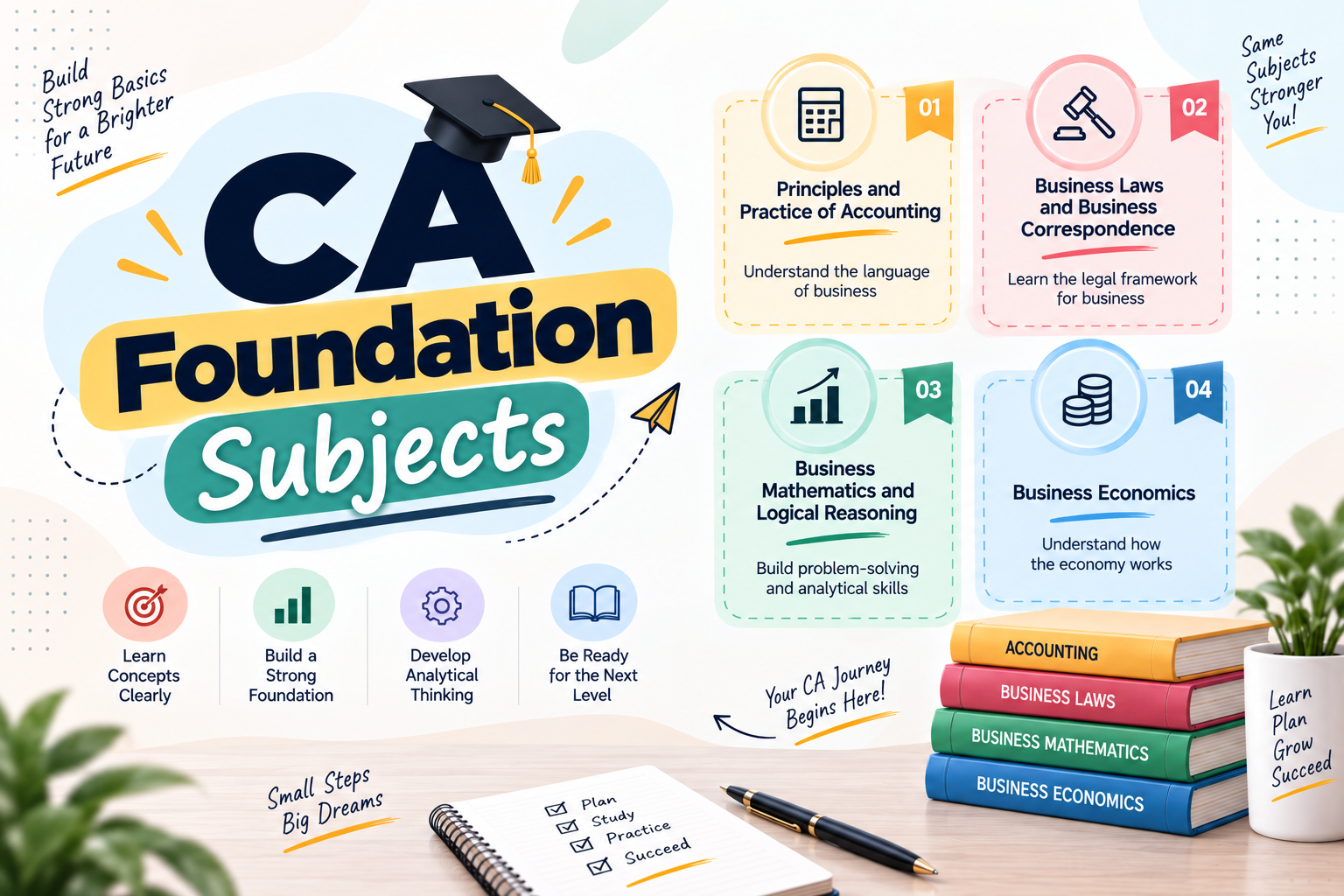
The CA Foundation exam pattern for January 2027 consists of four papers: Accounting, Business Laws, Quantitative Aptitude, and Business Economics. Each paper carries 100 marks, making the total examination worth 400 marks. However, the four papers are not tested in exactly the same way. Papers 1 and 2 are subjective, while Papers 3 and 4 are objective-type papers with negative marking.

ICAI conducts Foundation examinations three times a year — January, May and September. The Institute has also announced the commencement of Live Virtual Classes for students appearing in the January 2027 Foundation examination, confirming that January 2027 is an active Foundation examination attempt.

This guide explains the CA Foundation Exam Pattern Jan 2027, including marks distribution, paper-wise structure, exam duration, negative marking, passing criteria, and practical preparation strategies.

CA Foundation Exam Pattern Jan 2027 at a Glance

Before going into individual subjects, let us understand the complete structure.

Particular Details
Examination CA Foundation January 2027
Conducting Body Institute of Chartered Accountants of India (ICAI)
Number of Papers 4
Total Marks 400
Marks per Paper 100
Paper 1 Accounting
Paper 2 Business Laws
Paper 3 Quantitative Aptitude
Paper 4 Business Economics
Papers 1 & 2 Subjective
Papers 3 & 4 Objective
Negative Marking 0.25 mark for each wrong answer in objective papers
Minimum Marks Per Paper 40%
Minimum Aggregate 50%
Examination Frequency January, May and September

The above pattern follows the current ICAI Foundation examination framework.

Important: Students should always verify the final examination notification, timetable and instructions issued by ICAI for their particular attempt before the examination.

CA Foundation January 2027 Subjects

The CA Foundation course has four papers:

  1. Paper 1 – Accounting
  2. Paper 2 – Business Laws
  3. Paper 3 – Quantitative Aptitude
  4. Paper 4 – Business Economics

Each subject carries 100 marks.

The combination is deliberately different in nature. Accounting tests your ability to understand and solve accounting problems. Business Laws requires conceptual understanding along with proper written presentation. Quantitative Aptitude demands speed and accuracy, while Business Economics tests your understanding of economic concepts and their application.

That means preparing for all four subjects using exactly the same strategy is usually not the smartest approach.

CA Foundation Paper 1: Accounting Exam Pattern

Accounting is the first paper of the CA Foundation examination and carries 100 marks.

It is a subjective paper, which means students are required to write their answers rather than simply selecting an option.

Accounting Paper Pattern

Particular Details
Paper Accounting
Marks 100
Type Subjective
Negative Marking No
Main Requirement Conceptual understanding + practical application

Accounting is not a subject where simply reading the chapter repeatedly will be enough.

You need to understand the logic behind journal entries, ledger posting, adjustments, accounting principles and financial statements.

A common mistake among Foundation students is spending too much time watching lectures and too little time solving questions.

For January 2027, your preparation should gradually move from:

Concept → Illustration → Practice Question → Timed Test → Revision

If you can solve questions without looking at the solution, your preparation is moving in the right direction.

CA Foundation Paper 2: Business Laws Exam Pattern

Business Laws is another 100-mark subjective paper.

Unlike an MCQ-based subject, Business Laws requires you to communicate your understanding through written answers.

Business Laws Paper Pattern

Particular Details
Paper Business Laws
Marks 100
Type Subjective
Negative Marking No
Key Skills Concept clarity + legal reasoning + presentation

This paper can be scoring if you understand how to write answers.

You should not treat Business Laws like a subject that requires only memorisation.

Instead, understand:

  • What the provision says
  • What the important legal terms mean
  • How the provision applies to a situation
  • How to present your conclusion

When practising, make it a habit to answer case-based questions in a structured manner.

A simple approach is:

Provision → Facts → Application → Conclusion

Good presentation can make a significant difference because the examiner needs to clearly understand what you are trying to communicate.

CA Foundation Paper 3: Quantitative Aptitude Exam Pattern

Quantitative Aptitude is an objective-type paper carrying 100 marks.

It includes:

  • Business Mathematics
  • Logical Reasoning
  • Statistics

Quantitative Aptitude Pattern

Particular Details
Paper Quantitative Aptitude
Marks 100
Type Objective
Duration As prescribed by ICAI
Negative Marking 0.25 mark for every wrong answer
Major Areas Business Mathematics, Logical Reasoning, Statistics

ICAI’s published material confirms that Quantitative Aptitude is an MCQ-based paper and carries 0.25 negative marking for an incorrect answer.

This changes the way you should approach the paper.

In an objective paper with negative marking, attempting every question blindly is not a smart strategy.

For example, if you are unsure between two options, take a moment to evaluate whether you can eliminate one or more choices. Guessing without any basis can reduce your score.

The best strategy is to build accuracy first and speed second.

CA Foundation Paper 4: Business Economics Exam Pattern

Business Economics is also a 100-mark objective paper.

It tests your understanding of economic concepts, principles and their application.

Business Economics Pattern

Particular Details
Paper Business Economics
Marks 100
Type Objective
Negative Marking 0.25 mark per wrong answer
Total Papers 4
Weight in Total Exam 100 out of 400 marks

Business Economics may look easier compared with Accounting or Quantitative Aptitude, but students sometimes underestimate it.

The challenge is not simply remembering definitions.

Questions can test whether you actually understand the concept.

For example, if you understand a particular economic principle properly, you should be able to identify how it applies to a practical situation.

Therefore, while revising Economics, focus on:

  • Key concepts
  • Definitions
  • Differences
  • Cause-and-effect relationships
  • Practical examples
  • Important keywords
  • MCQ practice

CA Foundation Exam Pattern: Subjective vs Objective Papers

One of the most important things to remember for January 2027 is the difference between subjective and objective papers.

Paper Subject Question Type Marks
Paper 1 Accounting Subjective 100
Paper 2 Business Laws Subjective 100
Paper 3 Quantitative Aptitude Objective 100
Paper 4 Business Economics Objective 100
Total 4 Subjects Mixed Pattern 400

ICAI officially states that Papers 1 and 2 are subjective, while Papers 3 and 4 are objective.

This distinction should directly influence your preparation.

For Papers 1 and 2, you need to practise writing.

For Papers 3 and 4, you need to practise accuracy and question selection.

Is There Negative Marking in CA Foundation January 2027?

Yes.

There is 0.25 mark negative marking for every wrong answer in the objective papers.

The negative marking applies to:

  • Paper 3 – Quantitative Aptitude
  • Paper 4 – Business Economics

It does not apply to the subjective papers in the same way because Papers 1 and 2 are written-answer papers.

ICAI’s Foundation FAQ specifically confirms the 0.25-mark negative marking for wrong answers in objective-type papers.

How should you handle negative marking?

Do not enter the examination hall with the mindset:

“I have to attempt every question.”

Instead, think:

“I have to maximise my net score.”

If you know the answer, attempt it confidently.

If you can logically eliminate options, make an informed decision.

If you have absolutely no idea, blindly guessing may not be worthwhile.

Practising full-length MCQ tests before the examination is one of the best ways to develop this judgement.

CA Foundation Passing Criteria for January 2027

Clearing CA Foundation is not simply about achieving 50% of the total 400 marks.

There are two conditions.

You need:

  1. At least 40% marks in each paper, and
  2. At least 50% aggregate marks across all four papers.

ICAI confirms this passing requirement in its official Foundation FAQ.

Example

Suppose a student scores:

Paper Marks
Accounting 55
Business Laws 48
Quantitative Aptitude 42
Business Economics 55
Total 200/400

The student has:

50% aggregate

and has scored at least 40 marks in every subject.

Therefore, the student satisfies the basic passing criteria.

Now consider another student:

Paper Marks
Accounting 70
Business Laws 65
Quantitative Aptitude 35
Business Economics 40
Total 210/400

Although the aggregate is above 50%, the student has scored less than 40% in Quantitative Aptitude.

Therefore, the student does not satisfy the passing criteria.

This is why you cannot completely ignore a subject simply because you are strong in the other three.

How to Prepare According to the CA Foundation Exam Pattern Jan 2027

The biggest advantage of knowing the exam pattern early is that you can prepare according to the actual requirements of the examination.

1. Do Not Prepare All Four Papers in the Same Way

Accounting requires problem-solving.

Business Laws requires writing practice.

Quantitative Aptitude requires calculation speed and accuracy.

Economics requires conceptual understanding and MCQ practice.

Your study strategy should reflect these differences.

2. Start Solving Questions Early

Don’t wait until your syllabus is 100% complete before solving questions.

After completing a chapter, solve questions from that chapter.

For example:

Learn → Revise → Practise → Test → Analyse

This cycle is much more effective than simply watching lectures continuously.

3. Give Special Attention to Objective Papers

Papers 3 and 4 can be highly scoring, but negative marking makes accuracy important.

Try practising MCQs under time pressure.

Initially, don’t worry too much about speed.

First aim for accuracy.

Once your accuracy becomes consistent, start reducing your solving time.

4. Practise Writing for Accounting and Law

Reading a solution is not the same as writing an answer.

This is particularly important for Business Laws.

Set aside dedicated time for answer writing.

Try to write complete answers rather than only mentally preparing them.

After writing, compare your answer with the suggested answer or your study material and check:

  • Did you address the question?
  • Did you use relevant provisions?
  • Was your conclusion clear?
  • Was your presentation structured?
  • Did you miss any important point?

Why Mock Tests Matter for CA Foundation January 2027

A mock test is not only a way of checking your marks.

It is a preparation tool.

When you take a full-length test, you discover things that normal studying may hide.

For example:

  • You may know the concept but take too long to solve it.
  • You may make calculation errors.
  • You may know the law but struggle to frame the answer.
  • You may lose marks because of careless MCQ attempts.
  • You may spend too much time on one question.
  • You may become nervous when solving under exam conditions.

That is why students should not wait until the last week to start taking tests.

A practical approach is to gradually increase testing frequency as the examination approaches.

For example:

Preparation Stage Suggested Testing
Early syllabus Chapter-wise tests
Mid preparation Subject-wise tests
Syllabus completion Full-length papers
Final revision Multiple timed mock tests
Last few days Revision + selected practice

The purpose is to make the actual examination feel familiar.

Common Mistakes Students Make in CA Foundation Preparation

Even students who study hard sometimes lose marks because of avoidable mistakes.

Mistake 1: Ignoring the exam pattern

If you don’t understand the paper structure, you may spend too much time on the wrong type of preparation.

Mistake 2: Leaving tests until the end

Tests should be part of preparation, not something you start after finishing everything.

Mistake 3: Blind guessing in MCQs

Negative marking means careless attempts can hurt your score.

Mistake 4: Only reading Business Laws

Law requires writing practice.

Mistake 5: Studying only strong subjects

You need at least 40% in each paper, so weak subjects cannot be ignored.

Mistake 6: Not analysing mistakes

Getting 55 marks in a test is useful only if you understand why the other 45 marks were lost.

CA Foundation January 2027 Preparation Strategy

If you are starting your preparation now, don’t try to create a complicated timetable.

Create a realistic system that you can follow every day.

A simple weekly structure could look like this:

Activity Focus
Concept Study New chapters
Question Practice Recently completed topics
MCQs QA + Economics
Answer Writing Law + Accounting
Revision Older chapters
Test One or more timed tests
Analysis Review mistakes

The key is consistency.

Studying for 10–12 hours for two days and then losing momentum for three days is usually less effective than maintaining a manageable schedule every day.

How CA Mentoring Program Can Support Your Preparation

Preparing for CA Foundation is easier when you know what to study, how to study and where you are making mistakes.

CA Mentoring Program can be positioned as a support system for students who want more structured guidance during their CA journey.

A good preparation environment should help students focus on:

  • Understanding the syllabus
  • Creating a realistic study plan
  • Practising questions regularly
  • Improving weak subjects
  • Taking mock tests
  • Analysing performance
  • Maintaining consistency

Ultimately, the goal should not be to study more hours simply for the sake of studying.

The goal is to make every study session useful.

Final Takeaway: CA Foundation Exam Pattern Jan 2027

The CA Foundation Exam Pattern Jan 2027 is built around four papers carrying a total of 400 marks.

Accounting and Business Laws are subjective papers, while Quantitative Aptitude and Business Economics are objective papers. The objective papers have 0.25 negative marking for every wrong answer. To pass, students need at least 40% in each paper and 50% aggregate marks.

But knowing the pattern is only the first step.

Your real advantage comes from using that knowledge correctly.

Prepare Accounting through regular problem-solving. Treat Business Laws as a writing subject. Build speed and accuracy for Quantitative Aptitude. Practise conceptual MCQs for Economics. And most importantly, start testing yourself before you feel completely ready.

You do not need to know everything on Day 1.

You simply need to keep improving every week.

For a CA Foundation student targeting January 2027, that consistency can make the difference between merely completing the syllabus and actually walking into the examination hall with confidence.

Prepare with the pattern in mind, practise like the real exam, analyse every mistake, and keep moving forward.

CA Exam Pattern January 2027: Complete Paper Pattern, Marks, Subjects and Preparation Guide

CA Exam Pattern Jan 2027: What Students Need to Know

If you are preparing for the CA January 2027 examinations, understanding the exam pattern is just as important as completing the syllabus.

Many students make the mistake of studying for hours without first understanding how ICAI actually tests them. They know the subjects, collect study material, watch lectures and solve questions, but when the actual paper comes in front of them, time management becomes a problem.

That is why knowing the CA Exam Pattern Jan 2027 in advance can make your preparation much more focused.

The Institute of Chartered Accountants of India (ICAI) currently has January 2027 examination-related announcements for students at the Foundation, Intermediate and Final levels. ICAI has also published course-specific study material and applicability information for upcoming examinations.

Important: Students should always verify the final examination timetable, amendments, paper-wise applicability and examination instructions from ICAI before the examination.

CA Exam Pattern January 2027 at a Glance

The CA course is divided into three major levels:

  1. CA Foundation
  2. CA Intermediate
  3. CA Final

The paper pattern is different at each level. Therefore, a Foundation student should not prepare using an Intermediate strategy, and an Intermediate student should not blindly copy the strategy of a Final student.

Here is a broad overview:

CA Level Papers Main Question Types Preparation Focus
CA Foundation 4 Descriptive + Objective Concepts, practice & speed
CA Intermediate 6 Descriptive + MCQs Conceptual clarity + application
CA Final 6 Descriptive + MCQs/Open-book component as applicable Advanced application & case-based thinking

The exact treatment of MCQs, descriptive questions, paper duration and individual paper requirements should be checked against the latest ICAI examination instructions applicable to the January 2027 attempt.

CA Foundation Exam Pattern Jan 2027

CA Foundation is the first level of the Chartered Accountancy course. It introduces students to accounting, law, quantitative aptitude and economics.

Under the current Foundation structure, there are four papers:

Paper Subject Marks Broad Pattern
Paper 1 Accounting 100 Descriptive
Paper 2 Business Laws 100 Descriptive
Paper 3 Quantitative Aptitude 100 Objective
Paper 4 Business Economics 100 Objective

ICAI’s current Foundation course structure lists these four papers: Accounting, Business Laws, Quantitative Aptitude and Business Economics.

Paper 1: Accounting

Accounting is a 100-mark paper. Students should focus on understanding concepts rather than simply memorising formats.

Important preparation areas include:

  • Accounting principles
  • Journal and ledger
  • Trial balance
  • Financial statements
  • Depreciation
  • Partnership-related concepts
  • Company accounts
  • Rectification of errors
  • Practical numerical questions

The biggest mistake students make in Accounting is reading solutions without solving questions themselves.

For this paper, writing practice matters.

Paper 2: Business Laws

Business Laws tests your understanding of legal concepts and your ability to present an answer properly.

Students should work on:

  • Understanding provisions
  • Remembering important keywords
  • Learning how to structure answers
  • Applying provisions to practical situations
  • Practising case-based questions

Simply memorising paragraphs is not enough. A good answer should demonstrate that you understand the provision and can apply it to the situation given.

Paper 3: Quantitative Aptitude

Quantitative Aptitude is an objective paper.

It includes areas related to:

  • Business Mathematics
  • Logical Reasoning
  • Statistics

Because objective papers can include negative marking, random guessing can hurt your score.

The smart approach is to solve questions accurately first and then improve speed.

Paper 4: Business Economics

Business Economics is also objective-oriented under the current Foundation pattern.

Students should focus on:

  • Core economic concepts
  • Definitions
  • Applications
  • Graphs and interpretations
  • Important theories
  • MCQ practice

A common mistake is treating Economics as a purely theoretical subject. For an objective paper, regular question practice is extremely important.

CA Foundation Exam Pattern: Marks and Duration

The traditional ICAI examination structure provides three-hour sessions for Papers 1 and 2 and shorter two-hour sessions for Papers 3 and 4. ICAI examination guidance also distinguishes the objective papers from the descriptive papers in terms of examination duration.

Therefore, students should practise according to the actual time available rather than simply completing questions without a clock.

CA Intermediate Exam Pattern Jan 2027

CA Intermediate is considerably more application-oriented than Foundation.

Under the current scheme, CA Intermediate has six papers:

Group 1

  1. Advanced Accounting
  2. Corporate and Other Laws
  3. Taxation

Group 2

  1. Cost and Management Accounting
  2. Auditing and Ethics
  3. Financial Management and Strategic Management

ICAI’s current course information confirms this six-paper structure.

Paper Subject Marks
Paper 1 Advanced Accounting 100
Paper 2 Corporate and Other Laws 100
Paper 3 Taxation 100
Paper 4 Cost and Management Accounting 100
Paper 5 Auditing and Ethics 100
Paper 6 Financial Management and Strategic Management 100

Each group therefore represents 300 marks, while both groups together represent 600 marks.

CA Intermediate Paper Pattern

The Intermediate examination combines descriptive answering with objective questions in applicable papers.

This means your preparation should not be limited to writing long-form answers.

You need to develop three abilities:

Concept clarity + question-solving ability + time management.

For numerical subjects, solve questions repeatedly.

For theory subjects, focus on understanding the provision, identifying keywords and practising answer presentation.

For MCQs, learn how to eliminate incorrect options and avoid careless mistakes.

ICAI provides separate guidance for MCQ responses for Intermediate and Final examinations, making it important for candidates to follow the official instructions rather than relying on assumptions from older attempts.

CA Intermediate Group 1

1. Advanced Accounting

This paper requires strong conceptual and numerical preparation.

Your preparation should include:

  • Accounting standards
  • Company accounts
  • Amalgamation and reconstruction concepts
  • Branch accounts
  • Partnership-related topics
  • Practical problem solving

Do not wait until the final month to start solving full-length questions.

2. Corporate and Other Laws

This is a subject where presentation can make a significant difference.

Students should practise:

  • Provision
  • Explanation
  • Application
  • Conclusion

A simple framework can be:

Provision → Facts → Application → Conclusion

This helps make answers more structured.

3. Taxation

Taxation requires both conceptual knowledge and numerical practice.

The paper contains Income Tax and GST components under the current structure.

However, taxation is also one of the areas where students must be particularly careful about applicability.

ICAI has already published separate applicability information for upcoming examinations, including January 2027-related Taxation material.

So, don’t prepare taxation solely from an old book or old lecture.

Always verify the applicable Finance Act, amendments, notifications and ICAI material for your attempt.

CA Intermediate Group 2

4. Cost and Management Accounting

This paper requires repeated numerical practice.

Students should focus on:

  • Cost concepts
  • Material costing
  • Labour
  • Overheads
  • Cost sheet
  • Marginal costing
  • Budgeting
  • Standard costing
  • Practical application

The more questions you solve, the faster you become.

5. Auditing and Ethics

Auditing is often misunderstood as a subject that can be completed through memorisation.

It is not.

You need to understand why an audit procedure exists and how the concept applies in a practical situation.

Focus on:

  • Standards on Auditing
  • Audit planning
  • Risk assessment
  • Internal controls
  • Audit evidence
  • Company audit
  • Ethics
  • Professional responsibilities

6. Financial Management and Strategic Management

This paper combines two different styles of learning.

Financial Management requires numerical practice, while Strategic Management requires conceptual understanding and structured writing.

Therefore, divide your preparation accordingly.

CA Final Exam Pattern Jan 2027

CA Final is the highest academic level of the CA course, and its examination pattern is significantly more application-oriented.

The current Final structure consists of six papers:

Paper Subject
Paper 1 Financial Reporting
Paper 2 Advanced Financial Management
Paper 3 Advanced Auditing, Assurance and Professional Ethics
Paper 4 Direct Tax Laws & International Taxation
Paper 5 Indirect Tax Laws
Paper 6 Integrated Business Solutions

ICAI’s Career Counselling Committee currently lists these six papers under the Final course.

Paper 6 is particularly different because it follows an integrated, multidisciplinary case-study approach under the current scheme.

That means students cannot prepare for it effectively by treating every chapter as an isolated topic.

You need to learn how different areas connect with each other.

CA Final Paper 6: Why Case-Based Preparation Matters

Paper 6 is designed around integrated business solutions and strategic thinking.

This changes the preparation approach.

Instead of asking:

“Have I memorised this chapter?”

you should ask:

“Can I apply this concept when it appears inside a business situation?”

That is a major difference between basic preparation and Final-level preparation.

ICAI examination guidance also identifies Paper 6 under the open-book methodology, with candidates permitted to carry specified reference material subject to examination rules. Electronic devices are not permitted, and candidates must write answers in their own words.

Therefore, an open-book paper does not mean an easy paper.

In fact, it can test whether you know where to find relevant information and, more importantly, whether you can apply it correctly.

CA Exam Pattern Jan 2027: Passing Criteria

Understanding the paper pattern is incomplete without understanding the passing approach.

At the CA course levels, students generally need to meet both:

  • The minimum marks requirement in individual papers
  • The required aggregate percentage for the relevant group/level

A student who scores very high in one subject cannot simply compensate indefinitely for failing another subject.

That is why preparation should be balanced.

For example, spending 90% of your preparation time on your favourite subject while ignoring a difficult paper can create a serious problem on result day.

Descriptive vs Objective Questions: How Should You Prepare?

The biggest change for many students is the need to prepare for different question formats.

Question Type What It Tests Best Preparation Method
MCQs Accuracy & concept clarity Daily practice
Numerical Questions Application Repeated solving
Theory Questions Knowledge + presentation Writing practice
Case Studies Application + analysis RTP/MTP/PYQ practice
Integrated Questions Multiple concepts Case-based practice

You should therefore avoid studying only through passive reading.

Reading a chapter three times does not necessarily mean you can solve its questions.

How to Prepare for CA January 2027 Exams

A good preparation strategy should have four stages.

Stage 1: Complete the Concepts

Start with the ICAI study material and your primary learning source.

Do not rush through chapters simply to tick them off.

Make sure you understand:

  • What the concept means
  • Why it is used
  • How questions are framed
  • Which areas are frequently tested

Stage 2: Solve Questions

Once a topic is completed, solve questions immediately.

This is where the gap between “I understood the chapter” and “I can score marks from the chapter” becomes visible.

Use:

  • ICAI study material questions
  • Previous examination questions
  • Revision Test Papers
  • Mock Test Papers
  • Additional practice questions

Stage 3: Start Timed Tests

This is one area students often underestimate.

You may know the entire syllabus but still lose marks because you cannot complete the paper.

Start with chapter-wise tests.

Then move to:

  • Half-syllabus tests
  • Group-wise tests
  • Full-length mock tests

For CA students, a test series can be particularly useful because it creates an examination-like environment before the actual exam.

How Can CA Mentoring Program Help With Preparation?

Students preparing for the January 2027 attempt should not only focus on completing lectures. They also need regular revision, question practice and exam-oriented guidance.

A structured mentoring approach can help students identify:

  • Weak subjects
  • Weak chapters
  • Poor time management
  • Repeated mistakes
  • Lack of writing practice
  • Low accuracy in MCQs
  • Poor answer presentation

For students looking for additional academic guidance, you can explore CA Mentoring Program and evaluate the available preparation and mentoring support according to your individual requirements.

The goal should not be to study more hours simply for the sake of studying.

The goal should be to make every study hour productive.

CA Exam Preparation Strategy for January 2027

Here is a practical framework students can follow.

Preparation Phase Main Target
First Phase Complete concepts
Second Phase First revision
Third Phase Question practice
Fourth Phase RTP/MTP/PYQ practice
Fifth Phase Full-length tests
Final Phase Revision + mistake correction

One of the most effective habits is maintaining a mistake notebook.

Every time you make an error in a test, write down:

  1. What did I get wrong?
  2. Why did I get it wrong?
  3. What is the correct concept?
  4. How can I avoid repeating it?

After a few weeks, this notebook becomes more useful than another pile of study material.

Common Mistakes Students Make Before CA Exams

1. Studying Without a Test Plan

Students often complete the syllabus and then suddenly start searching for mock tests.

Don’t wait.

Testing should begin while preparation is still going on.

2. Ignoring ICAI Material

Private notes can be useful, but ICAI material should remain an important part of your preparation.

3. Avoiding Writing Practice

Knowing an answer mentally is different from writing it correctly within the available time.

4. Solving Only Easy Questions

Your preparation should include difficult and unfamiliar questions.

The actual examination may not look exactly like the questions you practised.

5. Ignoring Amendments

Especially for taxation and law-related areas, applicability matters.

Always check the material relevant to your examination attempt.

6. Leaving Revision for the Last Week

Revision should be planned from the beginning.

A syllabus completed once is not a syllabus mastered.

Why Understanding the CA Exam Pattern Jan 2027 Matters

Think about it this way.

Suppose two students study for 10 hours every day.

Student A spends those 10 hours watching lectures and reading notes.

Student B spends:

  • 5 hours learning concepts
  • 2 hours solving questions
  • 1 hour revising
  • 1 hour testing
  • 1 hour analysing mistakes

Both students have worked hard.

But Student B has prepared closer to the actual examination environment.

That is the real importance of understanding the exam pattern.

The exam pattern tells you how to convert knowledge into marks.

Final Preparation Checklist for CA January 2027

Before entering the final stage of preparation, make sure you can tick these boxes:

  • I have completed the applicable syllabus.
  • I have revised every subject at least once.
  • I have solved ICAI questions.
  • I have practised previous exam questions.
  • I have attempted RTPs/MTPs applicable to my attempt.
  • I have taken full-length tests.
  • I have analysed my mistakes.
  • I know the applicable amendments.
  • I can complete papers within the prescribed time.
  • I have a realistic final revision plan.

If several boxes remain unchecked, don’t panic.

You still have time to improve—but you need a structured plan instead of random studying.

Final Words

The CA Exam Pattern Jan 2027 is not something students should look at only a few days before the examination.

Your preparation strategy should be built around the way ICAI evaluates your knowledge.

For Foundation students, building strong fundamentals and improving objective-question accuracy is important.

For Intermediate students, conceptual understanding, application, numerical practice and answer presentation become increasingly important.

For Final students, the focus moves further toward professional application, case-based thinking and integrated problem solving.

Most importantly, don’t confuse completing the syllabus with completing your preparation.

Preparation is complete only when you can sit for a three-hour paper, understand what is being asked, manage your time, present your answers properly and still have enough confidence to review your work.

For January 2027 aspirants, the best approach is simple:

Learn → Revise → Practise → Test → Analyse → Improve → Repeat.

And before the examination, always cross-check the latest official ICAI notification, timetable, syllabus applicability, amendments and examination instructions because these details can change.

CA Course Fees in India: Complete Fee Structure, Expenses & Budget Guide

CA Course Fees in India: How Much Does It Really Cost to Become a Chartered Accountant?

Becoming a Chartered Accountant is one of the most respected career choices in India, but before starting the journey, one practical question comes up in almost every student’s mind:

“How much does the CA course actually cost?”

The answer is not simply one fixed number.

The CA course fees in India depend on several components, including ICAI registration fees, examination fees, coaching or classes, study resources, practical training-related expenses, revision material, test series and other personal costs.

The good thing is that the CA course itself can be relatively affordable compared with many professional courses. However, students often underestimate the additional expenses involved in preparation. A student relying primarily on ICAI study material and self-study may spend considerably less than someone taking full-fledged coaching for every subject.

Under ICAI’s New Scheme of Education and Training, the Chartered Accountancy course consists of Foundation, Intermediate and Final, along with the applicable Self-Paced Online Modules and practical training requirements.

So, if you are planning to pursue CA after Class 10, Class 12 or graduation, understanding the complete fee structure can help you create a realistic budget.

Let’s break everything down.

CA Course Fees in India at a Glance

The official ICAI registration fees for the three major levels are currently structured as follows:

CA Course Level ICAI Registration Fee What It Covers
CA Foundation ₹9,000 Registration, prospectus and Foundation study material
CA Intermediate ₹18,000 Registration for both groups
CA Final ₹22,000 Registration for both groups
Total Registration Fees ₹49,000 Across the three levels

ICAI’s published FAQ states that the Foundation Course fee is ₹9,000, while the Intermediate registration fee for both groups is ₹18,000 and Final registration for both groups is ₹22,000.

Therefore, if we consider only the basic ICAI registration fees, the total comes to approximately ₹49,000.

But this is not the total amount you should budget for your complete CA journey.

There are several other costs to consider.

CA Foundation Fees in India

CA Foundation is the entry-level stage of the Chartered Accountancy course.

Students can register for Foundation after passing Class 10, although they need to satisfy the applicable eligibility requirements before appearing in the examination.

According to ICAI’s official FAQ, the Foundation registration fee is ₹9,000. This includes the prospectus and Foundation study material.

CA Foundation Fee Structure

Expense Approximate Fee
Foundation Registration ₹9,000
Study Material Included in registration
Examination Fee Additional
Coaching Optional
Test Series Optional
Additional Books Optional

One important point is that registration fee and examination fee are different.

Students should therefore avoid assuming that paying ₹9,000 means every Foundation-related expense has been completed.

If you choose self-study, your overall preparation cost can remain comparatively low. On the other hand, classroom or online coaching can increase your budget significantly.

CA Intermediate Fees in India

After clearing CA Foundation, students move to the Intermediate level.

Students may also enter Intermediate through the Direct Entry Route, subject to ICAI’s eligibility requirements.

The current ICAI registration fee for both groups of CA Intermediate is ₹18,000.

CA Intermediate Fee Structure

Expense Approximate Cost
Intermediate Registration – Both Groups ₹18,000
Study Material Generally provided through ICAI systems
Examination Fee Additional
Coaching Optional
Test Series Optional
Revision Books Optional

CA Intermediate is usually where students start spending more on preparation because the syllabus becomes substantially more detailed.

A student may decide to take coaching for all subjects, selected subjects or no formal coaching at all.

That decision can make a major difference to the final cost of the CA journey.

CA Final Fees in India

CA Final is the last academic level of the CA course.

According to ICAI’s published FAQ, registration for both groups of the Final Course costs ₹22,000. Students registering for Final also register for the applicable Self-Paced Online Modules.

CA Final Fee Structure

Expense Approximate Cost
Final Registration – Both Groups ₹22,000
Study Material Available through ICAI
Examination Fee Additional
Coaching Optional
Test Series Optional
Revision Material Optional

CA Final preparation can become expensive if students choose premium coaching, multiple test series, several revision books and additional mentorship programmes.

However, these expenses are not compulsory ICAI fees.

That distinction is important when calculating the actual cost of the CA course.

What Is the Total CA Course Registration Fee?

If you add the basic ICAI registration fees:

Foundation = ₹9,000

Intermediate = ₹18,000

Final = ₹22,000

Total = ₹49,000

So, a student should remember:

₹49,000 is the basic registration cost across the three CA levels based on the published ICAI fee structure, not the complete cost of becoming a CA.

Your actual spending can be significantly higher depending on your study method.

What Other Expenses Should CA Students Consider?

This is where many online articles about CA course fees stop too early.

The registration fee is only one part of the financial picture.

A serious CA aspirant should consider the following expenses.

1. CA Coaching Fees

Coaching is optional, but many students prefer structured classes because the CA syllabus is extensive.

Coaching costs depend on:

  • Faculty
  • Subject
  • Level
  • Online or offline mode
  • Full course or individual subject
  • Recorded or live classes
  • Additional support and doubt-solving facilities

Some students take coaching for all subjects, while others choose individual faculties for specific subjects.

Therefore, there is no single fixed “CA coaching fee.”

2. CA Test Series Cost

A test series is another preparation expense that students should consider.

A good test series can help students understand:

  • How to manage exam time
  • How to present answers
  • Where marks are being lost
  • Whether preparation is actually exam-ready
  • Which chapters require revision

The cost varies according to the provider and level.

For students who want to keep their budget under control, selecting a focused test series rather than purchasing every available resource can be a smarter approach.

3. Books and Additional Study Material

ICAI provides study material, but many students purchase additional books.

These can include:

  • Concept books
  • Question banks
  • Revision books
  • Compiler books
  • Practice manuals
  • MCQ books
  • Previous-year question compilations

Buying everything available is not always beneficial.

A common mistake is collecting books instead of completing them.

For CA preparation, one properly completed resource is generally more valuable than five untouched books.

4. Examination Fees

Examination fees are separate from course registration fees.

This means students should keep an additional amount aside whenever they fill their examination forms.

The exact examination fee can vary depending on the examination level, group selection and the applicable ICAI notification for that attempt.

Therefore, students should always verify the examination fee for their specific attempt directly from ICAI before submitting the form.

5. Practical Training and Other Professional Expenses

The CA journey also involves practical training and other mandatory or applicable learning requirements.

Students may therefore have expenses related to:

  • Travel
  • Accommodation
  • Food
  • Training
  • Courses or modules
  • Professional development

These costs are highly dependent on the student’s city, employer and personal circumstances.

A student living at home in the same city may spend considerably less than someone who relocates for articleship or training.

Estimated CA Course Cost in India

So, what should a student actually budget?

There is no universal number because coaching and personal expenses vary widely.

A useful way to think about the cost is through three broad scenarios.

Preparation Style Possible Overall Budget*
Mostly Self-Study ₹50,000–₹80,000+
Self-Study + Selective Coaching ₹1 lakh–₹2 lakh+
Full Coaching + Additional Resources ₹2 lakh–₹4 lakh+

*These are broad planning estimates, not official ICAI fee figures. Actual expenditure can vary substantially based on coaching provider, attempts, books, travel, accommodation and other personal expenses.

This is why two students can complete the same CA course while spending very different amounts.

Is CA an Expensive Course?

Compared with many private professional and postgraduate programmes, CA can be relatively cost-effective.

The official registration component is comparatively modest.

The larger difference comes from how a student prepares.

For example, consider two students.

Student A

Student A uses:

  • ICAI study material
  • Free or low-cost online resources
  • Self-study
  • One test series
  • Limited additional books

The overall expenditure can remain comparatively low.

Student B

Student B chooses:

  • Full coaching for every subject
  • Premium classes
  • Multiple test series
  • Several books
  • Personal mentorship
  • Paid revision programmes
  • Accommodation in another city

Naturally, Student B’s total expenditure will be much higher.

Neither approach is automatically better.

The right approach depends on the student’s learning style, financial situation and ability to study independently.

How Can You Reduce CA Course Expenses?

CA preparation does not have to become unnecessarily expensive.

Here are some practical ways to control your budget.

1. Start With ICAI Material

Before purchasing multiple books, understand the official ICAI study material.

It should form the foundation of your preparation.

2. Choose Coaching Carefully

Don’t select a faculty simply because everyone on social media is talking about them.

Instead, compare:

  • Teaching methodology
  • Demo lectures
  • Student reviews
  • Course duration
  • Doubt support
  • Revision facilities
  • Study material
  • Test support

3. Don’t Buy Every Book

CA preparation is not a book-collection competition.

Choose resources based on your actual requirement.

4. Use Test Series Strategically

A test series is valuable when you actually write the tests and analyse your mistakes.

Buying three test series and attempting none of them doesn’t improve preparation.

5. Budget for the Entire Journey

Instead of looking only at Foundation fees, plan financially for:

Foundation → Intermediate → Practical Training → Final

This helps prevent financial pressure later.

Why Mentorship Can Be Valuable During CA Preparation

One expense students sometimes overlook is mentorship.

CA preparation can become confusing because students often struggle with questions such as:

  • Which subject should I study first?
  • How many hours should I study?
  • Should I attempt one group or both?
  • Why are my marks not improving?
  • How should I revise?
  • When should I start mock tests?
  • What should I do after failing an attempt?

This is where structured mentoring can help.

A mentor doesn’t replace hard work. Instead, the goal is to reduce wasted effort and provide direction.

CA Mentoring Program offers mentoring support for CA students across different examination cycles. Its current programme listings include multiple CA attempts and different fee categories based on students’ financial circumstances.

For students who feel stuck despite studying consistently, the value of mentorship may not simply be the number of classes attended. It can be the clarity that comes from having someone review the preparation strategy and identify what needs to change.

CA Course Fees vs CA Preparation Cost: Understand the Difference

This is perhaps the most important distinction in this entire topic.

CA Course Fees

These primarily refer to official registration and examination-related fees payable to ICAI.

CA Preparation Cost

This includes everything you choose to spend on preparation.

Category Mandatory? Cost Depends On
ICAI Registration Yes Official ICAI fee
Examination Fee Yes when appearing ICAI notification
ICAI Study Material Core resource Included/available as applicable
Coaching No Faculty/provider
Test Series No Provider
Additional Books No Number and publisher
Mentorship No Programme
Travel No Location
Accommodation No City and lifestyle

This table makes one thing clear:

The official CA course is not the same thing as the complete CA preparation budget.

Is CA Worth the Money?

For many students, the answer can be yes—but only if they approach it realistically.

CA is not a qualification where simply paying fees produces results.

Your return on the investment depends heavily on:

  • Consistency
  • Conceptual understanding
  • Revision
  • Exam practice
  • Answer writing
  • Time management
  • Practical exposure
  • Professional skills

A student who spends ₹3 lakh but doesn’t study consistently may struggle.

Another student who spends much less but follows a disciplined preparation strategy can perform extremely well.

So instead of asking:

“How much money do I need to become a CA?”

a better question is:

“What resources do I actually need to become exam-ready?”

That mindset can save both money and time.

A Practical Budget Plan for CA Aspirants

If you’re starting your CA journey, create a simple three-part budget.

Phase 1: Official Fees

Keep money aside for:

  • Registration
  • Examination forms
  • Applicable ICAI requirements

Phase 2: Learning Resources

Budget for:

  • Coaching, if required
  • Books
  • Test series
  • Revision resources

Phase 3: Personal Expenses

Consider:

  • Internet
  • Laptop/device
  • Travel
  • Accommodation
  • Printing
  • Stationery

This approach is much more realistic than simply searching for “CA course fees.”

Final Thoughts on CA Course Fees in India

The CA course fees in India are often misunderstood because students mix official ICAI fees with coaching and preparation expenses.

Based on ICAI’s published fee structure, the basic registration fees are currently:

  • CA Foundation – ₹9,000
  • CA Intermediate – ₹18,000 for both groups
  • CA Final – ₹22,000 for both groups

That makes the basic registration total ₹49,000 across the three levels.

But your complete CA journey can cost more depending on coaching, books, test series, mentorship, examination fees, travel and other personal expenses.

The good news is that you don’t need to spend blindly.

Build your preparation around the official ICAI material, choose coaching only where it adds genuine value, practise regularly and use tests to measure your preparation.

And remember—spending more does not automatically mean preparing better.

The smartest CA student is not necessarily the one who buys the most resources. It is the one who knows which resources to use, when to use them and how to turn them into marks.

If you’re planning your CA journey, start with a realistic budget, understand the official fee structure, and then decide where additional investment will genuinely improve your preparation.

That approach can make the CA journey financially manageable as well as academically focused.

CA Final Subjects November 2026: Complete Paper-Wise Syllabus, Groups & Preparation Strategy

If you are preparing for the CA Final November 2026 examination, one of the first things you need to get absolutely clear is the complete list of CA Final subjects, their group-wise structure, and the nature of each paper.

Under the current ICAI scheme, the CA Final course consists of six papers divided into two groups. Group 1 contains Financial Reporting, Advanced Financial Management, and Advanced Auditing, Assurance and Professional Ethics. Group 2 consists of Direct Tax Laws & International Taxation, Indirect Tax Laws, and Integrated Business Solutions.

But knowing the names of the six subjects is only the beginning.

CA Final is not an examination where simply completing lectures guarantees good marks. The syllabus is extensive, the questions require conceptual application, and your preparation needs to include revision, question practice, mock tests, and answer-writing. This becomes even more important when you are targeting the November 2026 attempt and have limited time to convert your preparation into exam-ready performance.

In this guide, we will cover the CA Final subjects for November 2026, paper-wise details, group structure, preparation strategy, important areas to focus on, and practical tips that can help you prepare more effectively.

CA Final Subjects November 2026 – Quick Overview

The CA Final examination under the current scheme has six papers.

Group Paper Subject Paper Type
Group 1 Paper 1 Financial Reporting Core Technical Paper
Group 1 Paper 2 Advanced Financial Management Numerical + Conceptual
Group 1 Paper 3 Advanced Auditing, Assurance and Professional Ethics Theory + Application
Group 2 Paper 4 Direct Tax Laws & International Taxation Technical + Practical
Group 2 Paper 5 Indirect Tax Laws Technical + Practical
Group 2 Paper 6 Integrated Business Solutions – Multidisciplinary Case Study with Strategic Management Case Study / Integrated Paper

These six papers constitute the current CA Final examination structure. ICAI’s official Career Counselling Committee also lists the same Group 1 and Group 2 subjects for the Final course.

CA Final Group 1 Subjects November 2026

Group 1 consists of three papers:

  1. Financial Reporting
  2. Advanced Financial Management
  3. Advanced Auditing, Assurance and Professional Ethics

Group 1 is often considered a demanding combination because it requires students to switch between accounting, numerical finance, and audit-oriented conceptual application.

Let’s understand each paper separately.

Paper 1 – Financial Reporting

Financial Reporting (FR) is the first paper of CA Final Group 1.

This subject builds on the accounting concepts studied at the earlier stages of the CA course and takes them to a much more advanced level.

At CA Final, you are expected not merely to know accounting standards but also to understand how they operate in practical financial reporting situations.

What makes Financial Reporting important?

FR can become a high-scoring paper for students who develop strong conceptual clarity and practice enough practical questions.

The subject generally demands:

  • Strong understanding of accounting standards
  • Conceptual clarity
  • Practical application
  • Proper working notes
  • Accurate calculations
  • Presentation skills
  • Regular revision

One common mistake students make is treating FR as a subject that can be completed by watching lectures alone. It cannot.

You need to solve questions yourself.

A good FR preparation cycle should look like:

Concept → Illustration → ICAI Questions → Revision → Mock Test → Error Analysis

The more comfortable you become with applying accounting principles to unfamiliar situations, the better prepared you will be for the actual examination.

Paper 2 – Advanced Financial Management

Advanced Financial Management (AFM) is the second paper of Group 1.

For students who enjoy practical subjects, AFM can become one of the most rewarding papers in CA Final. However, it can also become frustrating if your basics are weak or you postpone question practice.

AFM requires a combination of:

  • Conceptual understanding
  • Formula retention
  • Numerical practice
  • Interpretation
  • Speed
  • Accuracy

Simply memorising formulas is not enough.

You should understand why and where a particular formula is used.

How should you prepare for AFM?

Start by building a formula notebook or digital revision sheet.

For every chapter, maintain three things:

  1. Important formulas
  2. Typical question patterns
  3. Mistakes made while solving questions

This small habit can make revision significantly faster during the final weeks.

A practical AFM strategy

Instead of solving 50 questions randomly, solve questions chapter-wise first.

Once you become comfortable, move towards mixed practice.

For example:

Chapter-wise practice → Mixed questions → Past examination questions → Mock paper

This gradually develops the ability to identify the correct concept without being told which chapter the question belongs to.

Paper 3 – Advanced Auditing, Assurance and Professional Ethics

The third paper of Group 1 is Advanced Auditing, Assurance and Professional Ethics.

For many students, Audit is less about difficulty and more about how effectively they study and reproduce the concepts.

The challenge is that simply reading the material multiple times does not necessarily translate into marks.

You need to learn how to present an answer in a structured manner.

What should you focus on in Audit?

Your preparation should include:

  • Understanding concepts
  • Learning important provisions
  • Developing answer-writing skills
  • Practising case-based questions
  • Revising repeatedly
  • Understanding professional ethics
  • Solving ICAI study material and examination questions

A useful approach is to create short revision notes containing:

Keyword → Provision → Explanation → Practical application

During revision, these notes can save considerable time.

Don’t make this mistake in Audit

One of the biggest mistakes is waiting until the end to start writing answers.

Start answer-writing practice well before the examination.

Even if you know the answer mentally, writing it within a limited time is a different skill.

CA Final Group 2 Subjects November 2026

Group 2 contains:

  1. Direct Tax Laws & International Taxation
  2. Indirect Tax Laws
  3. Integrated Business Solutions – Multidisciplinary Case Study with Strategic Management

These subjects require a different preparation approach compared with Group 1.

Taxation requires conceptual and practical application, while Paper 6 tests your ability to analyse integrated business situations.

Paper 4 – Direct Tax Laws & International Taxation

Direct Tax Laws & International Taxation (DT) is the fourth paper of CA Final.

This is a subject where students often make the mistake of trying to memorise everything without understanding the underlying provisions.

Direct Tax requires a balance between:

  • Conceptual clarity
  • Provision-based learning
  • Practical application
  • Question practice
  • Regular revision

Tax is also highly sensitive to the applicable provisions for a particular examination attempt.

Therefore, students appearing in November 2026 should always study according to the ICAI material and applicability relevant to the November 2026 examination, rather than blindly using old notes or outdated content.

This is particularly important because ICAI has already stated that the Income-tax Act, 2025 becomes applicable from the May 2027 CA examinations onwards, which means students preparing for November 2026 should carefully follow the applicable law and study material for their own attempt.

How to study Direct Tax

Break the subject into smaller revision units.

For each topic, identify:

  • Important provisions
  • Conditions
  • Exceptions
  • Computation methodology
  • Practical questions
  • Frequently tested concepts

Then revise the same topics multiple times instead of trying to cover everything once.

Paper 5 – Indirect Tax Laws

The fifth paper is Indirect Tax Laws, which primarily requires strong understanding of GST-related concepts along with the applicable syllabus for the examination attempt.

Students often find GST confusing because several provisions appear interconnected.

The solution is not to memorise isolated sections.

Instead, understand the flow.

For example:

Supply → Time of Supply → Place of Supply → Value → ITC → Payment → Returns

When concepts are connected logically, revision becomes much easier.

How to prepare for IDT

A practical approach is:

Preparation Stage What to Do
First Reading Understand concepts
Second Reading Mark important provisions
Practice Solve ICAI questions
Revision 1 Revise chapter-wise
Revision 2 Solve mixed questions
Final Revision Focus on amendments + important areas

Always ensure that your notes and study material are aligned with the November 2026 applicability.

Paper 6 – Integrated Business Solutions

The sixth paper is Integrated Business Solutions – Multidisciplinary Case Study with Strategic Management.

This paper is different from the traditional standalone theory or numerical papers.

Instead of approaching every chapter as an isolated topic, you need to develop the ability to read a business situation, identify relevant issues, connect multiple concepts, and arrive at an appropriate solution.

The official ICAI description lists Paper 6 as an Integrated Business Solution (Multidisciplinary Case Study with Strategic Management).

Why is Paper 6 different?

Imagine receiving a case about a company that has:

  • Financial problems
  • Tax implications
  • Business risks
  • Governance concerns
  • Strategic decisions
  • Financing requirements

The question may require you to connect different areas rather than simply reproduce one chapter.

Therefore, Paper 6 preparation should focus heavily on case-study practice.

What should students practise?

Do not limit yourself to reading theoretical material.

Practise:

  • Case studies
  • Integrated questions
  • Mock examinations
  • Time-bound case analysis
  • Strategic decision-making questions
  • ICAI material and practice resources

The ability to identify what the question is actually asking becomes extremely important.

CA Final Subjects November 2026 – Group-Wise Comparison

Subject Group Major Skill Required Best Preparation Method
Financial Reporting Group 1 Accounting application Concepts + Practical Questions
Advanced Financial Management Group 1 Numerical problem-solving Formula + Practice
Advanced Auditing Group 1 Conceptual application Reading + Answer Writing
Direct Tax Laws & International Taxation Group 2 Tax application Concepts + Computation
Indirect Tax Laws Group 2 Provision application Concepts + Practical Questions
Integrated Business Solutions Group 2 Case analysis Case Studies + Mock Practice

Which CA Final Group Should You Prepare First?

There is no universal answer.

Your decision should depend on your preparation level, exemptions, previous attempts, available time, and personal strengths.

If you are appearing for both groups, avoid studying all six subjects simultaneously from day one.

Instead, create a rotation.

For example:

Phase 1 – Concept Building

Focus on two or three subjects at a time.

Phase 2 – First Revision

Start solving questions immediately after completing major portions of the syllabus.

Phase 3 – Intensive Revision

Move towards mixed questions and examination-oriented practice.

Phase 4 – Mock Tests

Attempt full-length papers under actual examination conditions.

How to Prepare for CA Final November 2026

Knowing the subjects is easy.

Finishing them properly is where the real challenge begins.

A practical preparation plan can be divided into five stages.

1. Understand the Applicable Syllabus

Before starting preparation, verify the syllabus and applicability for the November 2026 examination from ICAI.

Don’t depend entirely on old YouTube videos, previous attempt notes, Telegram PDFs, or random websites.

The CA Final syllabus is attempt-specific, especially for law and taxation-related subjects.

2. Complete Your First Reading

Your first reading should focus on understanding.

Do not try to memorise every line.

Ask yourself:

  • Do I understand the concept?
  • Can I solve a basic question?
  • Can I explain the concept in my own words?
  • Have I marked difficult areas?

This creates the foundation for your subsequent revisions.

3. Start Question Practice Early

Don’t wait until the syllabus is 100% complete.

Suppose you finish a chapter today.

Solve relevant questions tomorrow.

This immediately exposes gaps in your understanding.

For practical papers, question practice is especially important.

4. Follow a Revision Cycle

A useful revision structure is:

Revision Main Objective
Revision 1 Understand and recall
Revision 2 Improve speed
Revision 3 Strengthen weak areas
Revision 4 Exam-oriented revision

You don’t necessarily need to read every page during every revision.

The objective of revision should gradually shift from learning to recall and application.

The Importance of ICAI Material for CA Final November 2026

CA Final students should keep ICAI resources at the centre of their preparation.

ICAI has also been conducting examination-oriented programmes and mock-test initiatives for students appearing in the November 2026 Final examination. Its official search listings include Mock Test Paper Series I and II for CA Final November 2026 students and Success at CA Exam sessions scheduled for October 2026.

This is why your preparation should not stop at coaching notes.

A strong preparation stack should ideally include:

Classes + ICAI Study Material + RTP/MTP/Past Questions + Revision + Mock Tests

Each resource has a different purpose.

How CA Mentoring Program Can Help CA Final Students

Preparing for CA Final can sometimes become overwhelming.

You may know what to study but still struggle with questions such as:

  • Which subject should I study today?
  • How much should I revise?
  • Why am I completing lectures but not improving my marks?
  • How many questions should I practise?
  • When should I take mock tests?
  • What should I do if I fall behind my study plan?
  • How do I remain consistent after a failed attempt?

This is where structured mentorship can add value.

CA Mentoring Program focuses on providing students with guidance, daily accountability, study planning, regular evaluation, and exam-oriented preparation support. The program’s website highlights customized study plans, daily guidance, activity tracking, one-to-one accountability, mentorship kits, chapter-wise tests, unit-wise tests, full-syllabus tests, and ABC analysis.

For a student preparing for November 2026, this type of structured support can be particularly useful when the problem is not lack of resources but lack of consistency.

The goal should not be to study for 15 hours one day and then struggle to study for three days.

Consistency beats occasional intensity.

CA Final November 2026 Preparation: What Students Should Avoid

While preparing for CA Final, avoid these common mistakes.

1. Collecting Too Many Resources

You don’t need five different books for every subject.

Too many resources often create confusion.

2. Ignoring ICAI Questions

Coaching material is useful, but ICAI material should not be ignored.

3. Delaying Revision

Finishing lectures is not the same as completing preparation.

4. Avoiding Mock Tests

You need to know how you perform under time pressure before the actual examination.

5. Studying Only Your Favourite Subjects

It is tempting to spend extra time on subjects you enjoy.

Your weak subjects need attention too.

6. Ignoring Presentation

In theory-heavy papers, knowing the answer and presenting it properly are two different things.

A Simple Daily Study Framework for CA Final

If you are struggling to structure your day, try dividing your study time into three blocks.

Block 1 – New Learning

Study a new chapter or topic.

Block 2 – Question Practice

Solve practical or case-based questions related to what you studied.

Block 3 – Revision

Revise yesterday’s topics.

This creates a continuous loop:

Learn → Practise → Revise → Repeat

Even if your available study hours vary, maintaining this cycle can help prevent the common problem of forgetting older chapters while completing new ones.

Final Thoughts on CA Final Subjects November 2026

The six CA Final subjects for November 2026 are not equally demanding for every student.

One student may find FR difficult but enjoy AFM.

Another may be comfortable with Tax but struggle with Audit.

Someone else may understand concepts quickly but lose marks because of poor time management.

Therefore, don’t blindly copy another student’s timetable.

Instead, identify:

Your strong subjects + weak subjects + available time + revision requirements + mock-test performance.

Then build your preparation plan around those factors.

The CA Final examination is not won by completing the syllabus once.

It is won by being able to recall, apply, present, and manage time when the paper is actually in front of you.

If you are preparing for the November 2026 attempt, start treating every completed chapter as only the first step. Your real preparation begins when you revise it, solve questions from it, analyse your mistakes, and eventually reproduce the answer under exam conditions.

And if you feel that your preparation is becoming directionless, don’t hesitate to seek structured guidance. A proper mentoring system can help bring accountability and consistency into the preparation process.

For students looking for structured CA preparation support, CA Mentoring Program offers mentorship and exam-oriented resources designed around planning, accountability, revision, and testing.

Remember: CA Final is not about studying everything every day. It is about studying the right things consistently and revising them enough times to perform confidently on exam day.

CA Final Subjects November 2026 – Quick Revision Table

Group Paper No. CA Final Subject
Group 1 Paper 1 Financial Reporting
Group 1 Paper 2 Advanced Financial Management
Group 1 Paper 3 Advanced Auditing, Assurance and Professional Ethics
Group 2 Paper 4 Direct Tax Laws & International Taxation
Group 2 Paper 5 Indirect Tax Laws
Group 2 Paper 6 Integrated Business Solutions – Multidisciplinary Case Study with Strategic Management

CA Intermediate Subjects January 2027: Complete Syllabus, Papers, Marks & Preparation Guide

CA Intermediate Subjects January 2027: What Should Students Study?

If you are preparing for the CA Intermediate January 2027 examination, one of the first things you should get absolutely clear is the list of subjects you need to study.

CA Intermediate under the New Scheme has six papers divided into two groups. Group 1 contains Advanced Accounting, Corporate and Other Laws, and Taxation, while Group 2 consists of Cost and Management Accounting, Auditing and Ethics, and Financial Management and Strategic Management. ICAI’s official syllabus page confirms this six-paper structure.

But simply knowing the names of the six papers is not enough.

A common mistake students make is downloading random old PDFs, watching old lectures, or following preparation plans designed for a different examination attempt. For January 2027, students should pay attention to the applicable study material and amendments, especially in Taxation.

The good news is that ICAI’s current Last Mile Referencer specifically identifies the Income-tax and GST portions of Taxation as relevant for January 2027.

This guide explains the complete CA Intermediate Subjects January 2027, the group-wise structure, marks, what each paper covers, the examination pattern, and how you can plan your preparation without making it unnecessarily complicated.

CA Intermediate Subjects January 2027 – Quick Overview

There are six papers in CA Intermediate under the New Scheme of Education and Training.

Group Paper Subject Marks
Group 1 Paper 1 Advanced Accounting 100
Group 1 Paper 2 Corporate and Other Laws 100
Group 1 Paper 3 Taxation 100
Group 2 Paper 4 Cost and Management Accounting 100
Group 2 Paper 5 Auditing and Ethics 100
Group 2 Paper 6 Financial Management and Strategic Management 100
Total 6 Papers Both Groups 600

Each paper carries 100 marks, making the total for both groups 600 marks.

Paper 3, Taxation, has two sections: Income-tax Law and Goods and Services Tax (GST). Paper 6 also has two sections: Financial Management and Strategic Management.

CA Intermediate Group 1 Subjects January 2027

Group 1 contains three papers:

  1. Advanced Accounting
  2. Corporate and Other Laws
  3. Taxation

Let’s understand what students can expect from each subject.

1. Advanced Accounting

Paper 1 – Advanced Accounting is the first paper of CA Intermediate Group 1.

This subject takes your accounting knowledge to a higher level. At Foundation, students generally learn the fundamentals. At Intermediate, the expectation changes: you need to understand accounting treatments, standards, adjustments and practical problems in much greater depth.

Advanced Accounting requires regular question practice.

Simply reading the study material multiple times is unlikely to be enough. You should solve questions after understanding the underlying accounting treatment.

Important areas generally covered include:

  • Accounting Standards
  • Company Accounts
  • Financial Statements
  • Partnership-related accounting
  • Branch accounts
  • Amalgamation and reconstruction-related concepts
  • Accounting for different business situations
  • Other advanced accounting topics prescribed by ICAI

The exact applicable study material should always be checked from ICAI because syllabus applicability can change between examination cycles.

For January 2027 preparation, do not blindly rely on material marked for May 2027 onwards. ICAI’s search results currently distinguish the Advanced Accounting material applicable from May 2027 onwards from earlier applicable material.

How to prepare Advanced Accounting

A practical approach is:

Concept → Illustration → Question Practice → Revision → Mock Test

If a chapter takes you two hours to understand, don’t spend another three hours simply rereading it. Start solving questions.

That is where you discover whether you actually understood the concept.

2. Corporate and Other Laws

Paper 2 – Corporate and Other Laws is a theory-heavy paper, but treating it as a pure memorisation subject can make preparation much harder.

The objective should be to understand:

  • What the provision says
  • Why the provision exists
  • What conditions apply
  • What exceptions exist
  • How the provision is applied to a practical situation

Corporate law can become confusing because several provisions may look similar at first.

The best way to deal with this is to create short revision notes.

For example, instead of writing an entire chapter again, maintain a notebook containing:

  • Definitions
  • Important provisions
  • Time limits
  • Penalties
  • Exceptions
  • Important keywords
  • Practical case-based points

This becomes extremely useful during the final revision.

One important change students should watch

ICAI’s current search results show that the Corporate and Other Laws study material marked applicable from May 2027 onwards is a later applicability, so January 2027 candidates should use the material applicable to their examination attempt rather than automatically downloading the newest version.

3. Taxation

Taxation is Paper 3 of Group 1 and is divided into:

  • Section A – Income-tax Law
  • Section B – Goods and Services Tax

Both sections are important.

For many students, Taxation feels difficult because the subject combines concepts, provisions, calculations and amendments.

Income-tax Law

Income-tax preparation requires students to understand the provisions and then apply them to practical situations.

A good preparation strategy involves:

  1. Understanding the provision.
  2. Learning the conditions and exceptions.
  3. Solving illustrations.
  4. Practising examination questions.
  5. Revising amendments.
  6. Taking timed tests.

GST

GST also requires conceptual clarity.

Instead of memorising every provision separately, try to understand the overall structure:

Supply → Levy → Time → Value → Input Tax Credit → Compliance

This helps you connect different chapters.

Most important January 2027 point

Students preparing for January 2027 should be particularly careful about taxation material.

ICAI’s official Last Mile Referencer states that the Income-tax Law and GST portions listed there are relevant for May 2026, September 2026 and January 2027 examinations.

At the same time, ICAI’s search results indicate that the Income-tax Act, 2025 becomes applicable from May 2027 CA examinations onwards, meaning January 2027 students should not casually shift to material intended for May 2027.

This is one of the most important things to remember when preparing for CA Intermediate January 2027.

CA Intermediate Group 2 Subjects January 2027

Group 2 contains:

  1. Cost and Management Accounting
  2. Auditing and Ethics
  3. Financial Management and Strategic Management

These three papers are quite different from one another, which means students should avoid using the same study technique for all three.

4. Cost and Management Accounting

Paper 4 – Cost and Management Accounting is a practical subject that becomes easier once you start solving questions regularly.

Students often make one mistake here: they watch lectures but don’t solve enough questions.

That creates a false feeling of preparation.

You may understand a teacher’s solution while watching the lecture, but the real test comes when you get a new question and have to solve it yourself.

Focus areas should include:

  • Cost concepts
  • Material cost
  • Labour
  • Overheads
  • Methods of costing
  • Cost sheet
  • Marginal costing
  • Standard costing
  • Budgeting
  • Decision-making areas
  • Other topics included in the applicable ICAI study material

The exact chapter list and applicable material should be verified from ICAI for your attempt.

Best approach

Try this simple routine:

Learn the formula → Understand the logic → Solve basic questions → Solve exam-level questions → Revise mistakes

Maintain a separate mistake book.

Every time you make an error, write down:

  • What the question asked
  • Where you went wrong
  • Correct treatment
  • Formula or concept involved

Before the exam, this small notebook can become more useful than another round of reading the entire textbook.

5. Auditing and Ethics

Auditing and Ethics is Paper 5.

This subject is often underestimated because students assume that it only requires memorisation.

In reality, understanding the purpose behind an auditing procedure makes revision much easier.

For example, instead of memorising a procedure mechanically, ask:

What risk is the auditor trying to address?

Once you understand the logic, many provisions become easier to remember.

For Auditing preparation, focus on:

  • Important definitions
  • Audit procedures
  • Standards and principles
  • Auditor responsibilities
  • Professional ethics
  • Practical situations
  • Important keywords
  • Case-based questions

Writing practice is particularly important.

You may know the answer, but if you cannot present it in a structured way under exam pressure, converting that knowledge into marks becomes difficult.

A good answer generally has:

Relevant provision → Explanation → Application/conclusion

6. Financial Management and Strategic Management

Paper 6 is divided into:

  • Section A – Financial Management
  • Section B – Strategic Management

This combination makes Paper 6 unique because it includes both practical and theoretical components.

ICAI’s current material lists Financial Management and Strategic Management as the two sections of Paper 6.

Financial Management

Financial Management involves numerical and conceptual preparation.

Topics include areas such as:

  • Financial management objectives
  • Financial analysis
  • Ratio analysis
  • Cost of capital
  • Capital structure
  • Leverages
  • Investment decisions
  • Dividend decisions
  • Working capital management

ICAI’s official study material currently lists these areas across the Financial Management modules.

The best way to prepare FM is to solve questions consistently.

Don’t leave all numerical practice for the last month.

Strategic Management

Strategic Management is more theory-oriented.

The current ICAI material includes areas such as:

  • Introduction to Strategic Management
  • External environment
  • Internal environment
  • Strategic choices
  • Strategy implementation and evaluation

The biggest mistake students make in SM is trying to memorise paragraphs word-for-word.

Instead, understand the concept first and then remember the keywords.

During revision, create one-page chapter summaries containing:

  • Definitions
  • Models
  • Key points
  • Advantages/disadvantages
  • Keywords
  • Examples

This makes repeated revision much faster.

CA Intermediate January 2027 Exam Pattern

Understanding the subjects is only half the preparation.

You should also understand how ICAI expects you to answer the papers.

According to ICAI’s examination FAQ for the New Scheme, Intermediate examinations have 30% case scenario/case-study-based MCQs and 70% descriptive questions across the six papers. ICAI also states that there is no negative marking for the MCQ portion.

Component Weightage
Case Scenario / Case Study Based MCQs 30%
Descriptive Questions 70%
Total 100%
Negative Marking in MCQs No

This means your preparation should not be limited to solving descriptive questions.

You should also practise MCQs regularly.

CA Intermediate January 2027 Passing Criteria

The passing requirement is another area students should understand before planning their attempt.

Under the New Scheme, a student generally needs:

  • At least 40% marks in each paper, and
  • At least 50% aggregate in the relevant group.

Students can also pass the two groups in separate attempts, subject to the applicable examination rules. ICAI’s examination FAQ explains the group-wise and both-group passing criteria.

So don’t prepare with a mindset of simply scoring 40 marks.

If your target is to comfortably clear a group, your preparation should aim substantially higher.

Should You Prepare One Group or Both Groups?

This depends on your preparation time, academic background and ability to manage six subjects simultaneously.

Situation Suggested Approach
Strong preparation time Consider both groups
Limited daily study hours One group may be more practical
First attempt with strong Foundation base Evaluate both groups
Working/student with limited time Consider one group strategically
Repeater Analyse previous attempt before deciding
Strong in practical subjects Balance theory subjects carefully

There is no universal answer.

Some students perform better when they focus on one group. Others prefer studying both groups because it gives them more flexibility.

The important thing is to choose a strategy before your preparation becomes chaotic.

How to Prepare for CA Intermediate January 2027

A practical preparation plan can be divided into four stages.

Stage 1: Understand the Syllabus

Before watching lectures or buying multiple books, download the applicable ICAI study material.

Create a chapter checklist for all six papers.

Mark every chapter as:

  • Not Started
  • In Progress
  • Completed
  • Revised
  • Tested

This simple system can prevent a lot of last-minute panic.

Stage 2: Complete the First Reading

Your first target should be conceptual understanding.

Don’t try to memorise everything during the first reading.

For practical subjects, solve questions alongside your classes.

For theory subjects, create short notes and revise them periodically.

Stage 3: Revision and Question Practice

Once the syllabus is completed, shift your focus from learning to testing.

Solve:

  • ICAI module questions
  • Previous examination questions
  • Revision Test Papers
  • Mock Test Papers
  • Case-based MCQs

The aim is to identify weak areas before the actual examination.

Stage 4: Final Revision

During the final revision period, avoid starting ten new resources.

Use a controlled set of material.

Your priority should be:

ICAI Study Material → Amendments → RTP/MTP → Previous Questions → Personal Revision Notes

This keeps preparation focused.

A Simple Daily Study Strategy

You don’t necessarily need to study every subject every day.

For example:

Time Activity
Morning Practical subject / numerical practice
Afternoon Lecture or concept building
Evening Theory subject
Night 30–45 minute revision
Weekly Mock/test + mistake analysis

Even if you cannot follow these exact timings, the principle remains the same:

Learn → Practise → Revise → Test

That cycle matters more than simply counting study hours.

Common Mistakes to Avoid for January 2027

1. Studying from outdated material

This is particularly risky in Taxation and other subjects where applicable material changes.

2. Collecting too many books

More resources don’t automatically mean better preparation.

3. Ignoring ICAI material

Your preparation should remain closely aligned with the material and examination resources prescribed by ICAI.

4. Leaving revision for the end

Revision should start while you are completing the syllabus.

5. Avoiding mock tests

A mock test is not just for checking marks. It tells you whether you can manage time, presentation and pressure.

6. Memorising without understanding

This is especially risky for Law, Audit and Strategic Management.

7. Ignoring MCQs

With 30% of the paper based on case scenario/case-study-based MCQs, objective practice deserves proper attention.

Why the Right Guidance Matters for CA Intermediate

CA Intermediate is not difficult simply because there are six subjects.

The real challenge is managing different types of subjects at the same time.

You may be solving Advanced Accounting questions in one session, studying Corporate Law in another, and then switching to GST or Strategic Management.

That constant switching can become tiring.

This is where a structured approach helps.

At CA Mentoring Program, students can use guidance and structured preparation to avoid studying blindly. The objective should not be to study for the sake of completing hours. It should be to understand where you stand, identify weak areas and improve them consistently.

A good preparation system should answer three questions:

  1. What should I study?
  2. How should I study it?
  3. How do I know whether I am actually ready?

If your preparation system can answer these three questions, you are already ahead of many students who simply keep consuming lectures and notes without measuring progress.

Final Takeaway: CA Intermediate Subjects January 2027

The CA Intermediate January 2027 syllabus consists of six papers under the New Scheme:

Group 1

  1. Advanced Accounting
  2. Corporate and Other Laws
  3. Taxation

Group 2

  1. Cost and Management Accounting
  2. Auditing and Ethics
  3. Financial Management and Strategic Management

Each paper carries 100 marks. Paper 3 contains Income-tax Law and GST, while Paper 6 combines Financial Management and Strategic Management.

For January 2027 candidates, the most important thing is to study from the correct attempt-specific ICAI material. ICAI’s current Last Mile Referencer specifically identifies the relevant Taxation material for January 2027, while some newer study materials are marked for May 2027 onwards.

Don’t make your preparation complicated.

Pick the correct material, understand the concepts, practise questions, revise repeatedly and test yourself honestly.

And remember one thing: completing the syllabus is not the same as being exam-ready.

You become exam-ready when you can sit with a fresh question paper, manage your time, understand the questions and confidently reproduce what you have studied.

That is the level you should target for CA Intermediate January 2027.

CA Foundation Subjects January 2027: Complete Syllabus, Exam Pattern & Preparation Guide

If you are planning to appear for the CA Foundation January 2027 examination, one of the first things you should understand is the complete list of subjects, what each paper covers, how the papers are conducted, and how you should divide your preparation time.

For many students, CA Foundation is the first serious step into the Chartered Accountancy journey. The syllabus may look manageable when you see the four subject names, but the real challenge begins when you start preparing for all four papers together. Accounting requires consistent practice, Business Laws needs conceptual understanding and writing skills, Quantitative Aptitude demands speed and accuracy, while Business Economics requires both conceptual clarity and regular revision.

Under the current ICAI Foundation structure, there are four papers:

  1. Accounting
  2. Business Laws
  3. Quantitative Aptitude
  4. Business Economics

ICAI’s official Foundation resources list these four papers under the current scheme. ICAI has also announced Live Virtual Classes for students appearing in the January 2027 Foundation Examination.

If you are preparing for January 2027, this guide will help you understand the CA Foundation subjects January 2027, their structure, preparation approach, and the mistakes you should avoid.

CA Foundation Subjects January 2027

The CA Foundation examination consists of four papers. Each paper carries its own importance, and students need to score at least the required minimum in every paper while also meeting the aggregate passing requirement.

Here is a quick overview:

Paper Subject Nature of Paper Marks
Paper 1 Accounting Subjective 100
Paper 2 Business Laws Subjective 100
Paper 3 Quantitative Aptitude Objective 100
Paper 4 Business Economics Objective 100
Total 4 Papers 400

ICAI’s examination FAQs state that Papers 1 and 2 are subjective, while Papers 3 and 4 are objective. The same official guidance states that objective papers carry negative marking of 0.25 marks for every wrong answer.

This means your preparation cannot be exactly the same for all four subjects.

CA Foundation Paper 1 – Accounting

Accounting is the first paper of CA Foundation and is one of the most important subjects for students who want to build a strong base for the next levels of the CA course.

The biggest mistake students make in Accounting is treating it like a theory subject. It is not.

You may understand a concept while watching a lecture, but that does not necessarily mean you will be able to solve a question correctly in the examination.

Accounting requires repeated practice.

What should you focus on in Accounting?

Students should focus on understanding the logic behind accounting treatments rather than simply memorising formats.

Important areas generally include:

  • Accounting principles and concepts
  • Basic accounting processes
  • Journal entries
  • Ledger and trial balance
  • Bank reconciliation
  • Inventories
  • Depreciation and amortisation
  • Bills of exchange
  • Final accounts
  • Partnership-related accounting
  • Company accounts
  • Financial statement-related concepts

The exact applicable study material and amendments should always be checked against the ICAI material prescribed for your examination attempt. ICAI’s Board of Studies currently provides Foundation study material through its official portal.

How to prepare Accounting for January 2027

Do not wait until the last month to start solving practical questions.

A better approach is:

Concept → Illustration → Practice → Revision → Test

Try to solve questions without looking at the solution. If you make a mistake, identify why you made it.

For example, if you repeatedly make mistakes in journal entries, simply solving another 20 questions may not solve the problem. You first need to understand the rule behind the entry.

That is the difference between studying Accounting and actually learning Accounting.

CA Foundation Paper 2 – Business Laws

Business Laws is the second paper of CA Foundation and is a subject where students often underestimate the importance of language.

You do not necessarily need to write extremely complicated English. What matters more is whether you understand the legal concept and can present your answer logically.

The current Foundation structure identifies Paper 2 as Business Laws.

What makes Business Laws challenging?

The problem is usually not the number of chapters alone.

Students struggle because legal provisions can initially feel unfamiliar.

You may read a provision once and feel that you understand it. But when an application-based question appears, you may not know which provision to apply.

Therefore, your preparation should focus on:

  • Understanding provisions
  • Remembering important keywords
  • Practising case-based questions
  • Learning how to structure answers
  • Revising provisions regularly

A simple answer-writing approach

When practising descriptive questions, try following this structure:

Provision → Explanation → Application → Conclusion

This makes your answer easier to understand and helps you avoid writing unnecessary information.

Do not turn every answer into a long story.

In CA Foundation, clarity matters.

CA Foundation Paper 3 – Quantitative Aptitude

Quantitative Aptitude is the third paper and is an objective paper.

The subject combines different areas of quantitative ability. ICAI’s current Foundation information identifies Paper 3 as Quantitative Aptitude, with Business Mathematics, Logical Reasoning and Statistics forming its broad components.

For students who are comfortable with calculations, this paper can become a scoring opportunity. For students who have been away from Mathematics for a long time, however, it can initially feel difficult.

The good news is that improvement is possible with regular practice.

Major areas of Quantitative Aptitude

The paper broadly covers:

  • Business Mathematics
  • Logical Reasoning
  • Statistics

Each area requires a slightly different preparation method.

Business Mathematics

The key is practice.

Instead of reading formulas repeatedly, make a formula sheet and solve questions using those formulas.

Logical Reasoning

Logical Reasoning can improve considerably with practice.

Focus on understanding the pattern of questions instead of trying to memorise solutions.

Statistics

Statistics requires both conceptual understanding and calculation practice.

Make sure you understand the meaning of formulas before using them.

The biggest mistake in Quantitative Aptitude

Students often spend too much time trying to solve one difficult question.

Remember that this is an objective paper. Time management matters.

If a question is consuming too much time, move ahead and return to it later if appropriate.

CA Foundation Paper 4 – Business Economics

Business Economics is the fourth CA Foundation paper.

At first glance, students may consider Economics an easy subject because it is largely theoretical. However, scoring well requires much more than simply reading chapters once.

ICAI’s current Foundation material includes areas such as the nature and scope of business economics, demand and supply, production and cost, market structures, business cycles, national income, public finance, money market, international trade and the Indian economy.

Important areas to understand

Some broad areas include:

  • Nature and Scope of Business Economics
  • Demand and Supply
  • Consumer Behaviour
  • Production and Cost
  • Different Market Structures
  • Business Cycles
  • National Income
  • Public Finance
  • Money Market
  • International Trade
  • Indian Economy

The key to Economics is understanding relationships.

For example, do not just memorise the law of demand. Understand why demand generally changes when price changes and what factors can cause the relationship to change.

Once the concept becomes clear, revision becomes much easier.

CA Foundation January 2027 Exam Pattern

Understanding the examination pattern is just as important as understanding the syllabus.

The current Foundation examination pattern has two descriptive papers and two objective papers.

Paper Subject Type Marks Duration
Paper 1 Accounting Subjective 100 3 Hours
Paper 2 Business Laws Subjective 100 3 Hours
Paper 3 Quantitative Aptitude Objective 100 2 Hours
Paper 4 Business Economics Objective 100 2 Hours

ICAI’s official examination guidance confirms that Papers 1 and 2 are subjective and Papers 3 and 4 are objective. ICAI examination information also specifies two hours for Papers 3 and 4, while Papers 1 and 2 are conducted for three hours.

For objective papers, negative marking is applicable. ICAI states that 0.25 marks are deducted for every incorrect answer in the objective papers.

CA Foundation Passing Criteria for January 2027

One of the most important things students should understand is that simply scoring 50% overall is not enough.

According to ICAI’s examination FAQ, a student must secure:

  • At least 40% marks in each paper, and
  • At least 50% marks in aggregate across all four papers.

For example:

Paper Marks
Accounting 55
Business Laws 48
Quantitative Aptitude 52
Business Economics 50
Total 205/400

The aggregate is above 50%, but the student would still need to ensure that the individual paper requirement is satisfied.

This is why your preparation should not focus only on your strongest subject.

Which CA Foundation Subject Is the Easiest?

There is no universal answer.

A commerce student who has studied Mathematics regularly may find Quantitative Aptitude easier. Another student may find Business Economics easier because they enjoy theoretical subjects.

Your personal strengths matter.

A useful way to look at the four subjects is:

Subject Main Skill Required Preparation Style
Accounting Concept + Calculation Daily Practice
Business Laws Understanding + Presentation Reading + Writing
Quantitative Aptitude Speed + Accuracy Question Practice
Business Economics Concept + Retention Reading + Revision

Instead of asking, “Which subject is easiest?”, ask:

“Which subject needs the most improvement from me?”

That question will help you build a much better study plan.

How to Prepare for CA Foundation January 2027

If January 2027 is your target attempt, do not create a preparation strategy based purely on the number of chapters.

Create it around three stages.

Stage 1: Complete the Concepts

Your first target should be completing the syllabus properly.

Do not rush through lectures just to tick chapters off your list.

After every topic, ask yourself:

Can I solve a basic question without looking at the solution?

If the answer is no, the chapter is not really complete.

Stage 2: Practice Questions

Once concepts are clear, increase your question-solving.

For Accounting and Quantitative Aptitude, regular practice is extremely important.

For Business Laws and Economics, practise questions after completing each chapter so that you can identify what you actually remember.

Stage 3: Revision and Mock Tests

Revision should not be left for the final few days.

A better strategy is to revise multiple times.

For example:

First Revision: Within a few days of completing a topic
Second Revision: After completing the subject
Third Revision: During your final preparation
Final Revision: Short notes, formulas and important concepts

Mock tests should also be treated seriously.

Do not just check your marks.

Analyse:

  • Which questions were wrong?
  • Why were they wrong?
  • Did you make a calculation mistake?
  • Did you misunderstand the question?
  • Did you forget a concept?
  • Did you spend too much time on one question?

That analysis is often more valuable than simply taking another mock test.

Suggested Daily Study Plan for CA Foundation

A student preparing for January 2027 can divide study time according to individual strengths, but a balanced routine could look like this:

Activity Suggested Time
Accounting 2 Hours
Business Laws 1.5 Hours
Quantitative Aptitude 1.5 Hours
Business Economics 1.5 Hours
Revision/Test Practice 1 Hour
Total 7.5 Hours

This is only a sample.

If you have college, school, coaching or other responsibilities, adjust the schedule accordingly.

The important thing is consistency.

Studying for 7 hours one day and then doing almost nothing for the next two days is usually less effective than maintaining a realistic daily routine.

Best Study Material for CA Foundation January 2027

Your first priority should always be the official ICAI study material applicable to your attempt.

ICAI’s Board of Studies provides Foundation study material and examination-related resources through its official platforms.

You can supplement ICAI material with:

  • Revision Test Papers
  • Mock Test Papers
  • Previous examination questions
  • Suggested Answers
  • Your class notes
  • Short revision notes
  • Practice tests

ICAI has also published Foundation suggested answers for previous examinations, which can help students understand how answers are presented and evaluated.

For students who are taking classes or using additional learning support, the goal should not be collecting ten different resources.

The goal should be mastering the right resources.

Common Mistakes CA Foundation Students Should Avoid

1. Starting all four subjects together without a plan

This often creates confusion.

Complete subjects in a structured sequence while keeping regular revision of previously studied topics.

2. Ignoring the difficult subject

Students often spend more time on subjects they already like.

That feels productive but may not improve the final result.

3. Leaving revision for the last month

Revision is not something you do after preparation.

Revision is part of preparation.

4. Solving too few questions

Especially in Accounting and Quantitative Aptitude, watching lectures is not enough.

You need to solve questions yourself.

5. Ignoring negative marking

In objective papers, random guessing can hurt your score because incorrect answers attract negative marking.

6. Using outdated study material

This is particularly important for students preparing for a future attempt.

Always check the ICAI material applicable to your examination.

How CA Mentoring Program Can Help in Your Preparation

Preparing for CA Foundation can sometimes feel overwhelming, especially if you are studying for the course for the first time.

A structured mentoring approach can help students understand where they currently stand, identify weak areas, plan revision, and maintain consistency.

CA Mentoring Program can be explored by students looking for structured guidance and mentoring support during their CA preparation.

CA Mentoring Program

The important thing is not simply joining a course or buying study material.

Before choosing any learning support, consider whether it actually helps you with:

  • Concept clarity
  • Doubt resolution
  • Regular testing
  • Revision planning
  • Exam strategy
  • Time management
  • Performance tracking

A good learning system should make your preparation more organised rather than adding more resources and confusion.

Final Words: How to Approach CA Foundation January 2027

The CA Foundation January 2027 examination should not be treated as an exam that you can crack through last-minute studying.

The four subjects are different, and each demands a different approach.

Accounting needs practice.

Business Laws needs conceptual understanding and proper presentation.

Quantitative Aptitude needs speed and accuracy.

Business Economics needs understanding and repeated revision.

The good news is that you do not need to be perfect from Day 1.

You just need to improve consistently.

Start with the ICAI syllabus and applicable study material. Build your concepts. Practise questions. Revise regularly. Take mock tests. Analyse your mistakes. Then repeat the process.

If you stay consistent, the four subjects stop looking like four separate mountains and start becoming four manageable parts of one preparation plan.

For January 2027 aspirants, this is the right time to focus on clarity, consistency and exam-oriented practice rather than constantly searching for new resources.

Remember one simple rule:

Don’t study just to finish the syllabus. Study until you can confidently answer questions from the syllabus.

That mindset can make a major difference in your CA Foundation preparation.