CA Final Integrated Business Solutions Notes | IBS Notes

CA Final Integrated Business Solutions Notes: Complete Guide for IBS Preparation
CA Final Integrated Business Solutions (IBS) is not a subject that can be prepared effectively by simply reading one book from the first page to the last. Paper 6 is designed around multidisciplinary business case studies, where students are expected to connect knowledge from different areas of the CA Final course and use that knowledge to analyse a practical business situation.
This is also what makes IBS different from traditional CA Final papers. A case may require you to look at financial reporting, financial management, audit, direct tax, indirect tax, strategic management, risk, compliance and business decisions together. ICAI describes the objective of IBS as developing the ability to consider interconnected business issues rather than looking at individual subjects in isolation.
If you are looking for CA Final Integrated Business Solutions Notes, the right approach is therefore not to search for short theory notes alone. You need notes that help you revise concepts, identify the relevant subject area inside a case, connect multiple provisions and finally arrive at a practical business solution.
Download / Refer to Official ICAI Material
Before starting your IBS preparation, students should always check the material applicable to their examination attempt. ICAI’s Board of Studies has specified the inputs for Paper 6 and has also made case studies available through the BoS Knowledge Portal. For the applicable attempt, students should follow the latest ICAI material, amendments, updates and study guidelines rather than relying on an old compilation.
Official ICAI Resources:
- ICAI Final Course – Integrated Business Solutions / Paper 6
- ICAI BoS Study Material & Announcements
- ICAI BoS Case Studies for Paper 6
- ICAI Suggested Answers – Final May 2026
- ICAI Final Course – May 2026 BoS Material PDF
What Is CA Final Integrated Business Solutions?
Integrated Business Solutions is Paper 6 of the CA Final course under the new scheme. ICAI lists it as Integrated Business Solutions (Multidisciplinary Case Study with Strategic Management).
The word integrated is the most important part of the subject.
In your other CA Final papers, you may study a particular concept from the perspective of one subject. IBS changes that approach. A business situation can involve several professional issues at the same time.
For example, imagine that a company wants to acquire another business.
At first, it looks like a simple financial decision. But a proper analysis may require you to consider:
| Area | Possible IBS Connection |
| Financial Reporting | Accounting treatment of the transaction |
| AFM | Valuation, financing and investment decisions |
| Audit | Risk, controls and assurance considerations |
| Direct Tax | Tax implications of the transaction |
| Indirect Tax | GST and transaction-related implications |
| Strategic Management | Acquisition strategy and competitive position |
| Risk Management | Financial, operational and compliance risks |
| Governance | Board-level and stakeholder considerations |
This is the type of thinking IBS tries to develop.
Why CA Final IBS Notes Are Different From Normal Notes
A common mistake students make is preparing IBS notes exactly like FR, Audit or Tax notes.
That usually means writing long definitions, underlining provisions and making chapter-wise summaries.
That method is not enough for IBS.
Your notes should answer questions such as:
- What is the issue in the case?
- Which subject or subjects are involved?
- Which provision or concept applies?
- What additional information should be considered?
- What are the risks?
- What are the possible alternatives?
- What would be the financial impact?
- What would be the tax impact?
- What should management do?
- How should the answer be presented?
A useful IBS note is therefore more like a decision-making framework than a traditional chapter summary.
CA Final IBS Study Material: What Should You Cover?
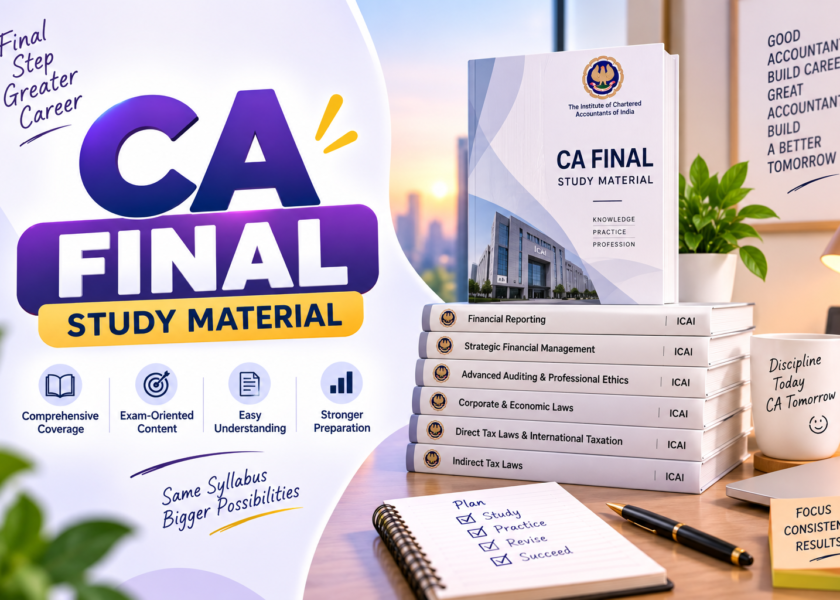
The exact material applicable to IBS depends on the examination attempt. ICAI’s BoS has specifically prescribed the relevant core-paper material, SPOM material, IBS Case Study Digests and online case studies for Paper 6.
For a student preparing IBS, the broad preparation basket should include:
1. Financial Reporting
Revise the important accounting principles and standards that can become relevant while analysing a business case.
Focus on understanding the application of accounting concepts, not just memorising individual provisions.
2. Advanced Financial Management
AFM can become relevant whenever a case involves investment, financing, valuation, risk or financial decisions.
Revise important concepts and, more importantly, understand how a financial decision affects the overall business.
3. Advanced Auditing, Assurance and Professional Ethics
Audit-related issues can appear when the case discusses internal controls, fraud risks, governance, assurance, reporting responsibilities or professional considerations.
4. Direct Tax Laws & International Taxation
Tax implications can significantly change the attractiveness of a business decision.
Students should therefore revise relevant direct-tax concepts and keep themselves updated according to the material applicable to their attempt.
5. Indirect Tax Laws
GST and customs-related considerations may also become part of a larger business decision.
Instead of treating indirect tax as a separate subject, try to understand where tax can influence a transaction.
6. Strategic Management
Strategic thinking is central to IBS.
A case may require you to understand the company’s objectives, competitive environment, business model, risks, opportunities and possible strategic alternatives.
7. SPOM and Other Applicable Inputs
Students should also cover the SPOM material prescribed by ICAI for their attempt.
For example, ICAI’s May 2026 applicability document included SPOM Set-A, SPOM Set-B, IBS Case Study Digests and online case studies as part of the Paper 6 preparation inputs.
How to Make Effective CA Final Integrated Business Solutions Notes
The best way to prepare IBS notes is to build them around connections.
Instead of creating one giant notebook, divide your notes into practical sections.
Section 1: Core Concepts
Keep short revision points for important concepts from the five core Final papers.
Section 2: Strategic Frameworks
Create quick notes for strategic management concepts that can help you analyse the business situation.
Section 3: Case-Based Issues
Whenever you solve a case, note down:
- Background of the company
- Main business problem
- Financial issues
- Accounting issues
- Tax issues
- Audit and governance issues
- Strategic issues
- Risks
- Possible alternatives
- Recommended course of action
Section 4: Important Updates
Maintain a separate section for amendments, updates and other examination-specific changes.
This becomes particularly useful because students often make the mistake of studying an older set of provisions for a newer attempt.
CA Final IBS Case Study Approach
Case studies are at the heart of IBS.
ICAI has described case studies as a vital part of Paper 6, with the objective of encouraging students to apply knowledge gathered from different areas of the Final course.
When you open a case, don’t immediately start searching for provisions.
First, understand the business.
Step 1: Read the Background
Identify:
- Nature of business
- Industry
- Business model
- Size of the company
- Key stakeholders
- Current problem
Step 2: Identify the Decision
Ask yourself:
What decision is the company trying to make?
It could be an acquisition, expansion, restructuring, investment, financing, compliance or risk-related decision.
Step 3: Identify the Issues
Make a rough list before writing.
For example:
| Issue | Relevant Area |
| Investment decision | AFM |
| Accounting treatment | FR |
| Tax impact | Direct Tax |
| GST impact | IDT |
| Internal control | Audit |
| Business expansion | Strategy |
| Risk | Risk Management |
Step 4: Connect the Issues
This is where IBS becomes different from ordinary preparation.
Don’t solve every issue independently.
Try to understand how one decision affects another.
Step 5: Build the Final Solution
Your answer should ultimately help the decision-maker understand:
- What is happening?
- What are the relevant issues?
- What are the implications?
- What are the risks?
- What options are available?
- What action should be considered?
How to Read an IBS Case Study
A practical reading method can save a lot of time.
Use the 5-question approach:
1. Who?
Who is making the decision?
2. What?
What exactly is the business problem?
3. Why?
Why has the issue arisen?
4. What are the consequences?
What financial, tax, accounting, audit or strategic consequences can arise?
5. What next?
What possible solution or course of action can be considered?
This simple framework prevents you from getting lost in a lengthy case.
How to Prepare CA Final IBS Notes in Less Time
Students preparing for CA Final often have one common problem: too many materials and too little revision time.
The solution is not necessarily adding another book.
Instead, make your existing resources easier to revise.
A practical note-making system can look like this:
| Revision Stage | What to Keep |
| First Reading | Concept understanding |
| Second Reading | Important connections |
| Case Practice | Issues and solutions |
| Revision 1 | Short notes |
| Revision 2 | Case frameworks |
| Final Revision | Keywords, provisions and common traps |
Your final notes should be considerably shorter than the original study material.
If your notes are almost as long as the textbook, they are not really revision notes.
CA Final IBS Preparation Strategy
There is no benefit in waiting until the final few days to start IBS.
Because the paper is case-based, preparation should happen alongside your core subjects.
During First Reading
Focus on understanding the concepts.
Don’t worry about memorising every possible case.
During Second Reading
Start connecting the subjects.
For example:
Business decision → Finance → Accounting → Tax → Audit → Strategy
This chain of thinking is useful when solving multidisciplinary cases.
During Revision
Solve cases instead of only reading notes.
Ask yourself:
“If I were advising the management, what would I need to check before making this decision?”
That mindset is much closer to the purpose of IBS.
IBS Open Book Examination: What Should You Actually Do?
ICAI has specified that Paper 6 is assessed as an open-book examination and is entirely case-study based.
But open book does not mean you can enter the examination without preparation.
In fact, an open-book paper creates a different challenge.
If you don’t know where information is located, you can waste valuable time searching.
Therefore, your study material should be organised before the examination.
Create a Quick Navigation System
Use:
- Tabs
- Page markers
- Short index
- Subject labels
- Important case-study references
- Separate update sections
The objective is simple:
You should know where to look before you enter the examination hall.
How to Attempt CA Final IBS Paper
The paper is designed around case studies and requires analytical application.
ICAI’s announced pattern for Paper 6 has included case-study based assessment, and ICAI has communicated the paper’s open-book and case-based nature.
During the examination:
Read Before Writing
Don’t start answering after reading only the first paragraph.
Read the complete case and understand the facts.
Mark Important Facts
Pay attention to:
- Dates
- Amounts
- Transactions
- Management decisions
- Tax details
- Accounting facts
- Risks
- Compliance requirements
Match Facts With Concepts
Once the facts are clear, connect them with the relevant provisions.
Answer the Actual Question
A common mistake is writing everything you know about a topic.
IBS rewards relevance.
If the question asks for the implications of a particular decision, focus on those implications.
Common Mistakes Students Make in IBS
Mistake 1: Studying IBS Separately From Other Subjects
IBS is integrated by design.
Your FR, AFM, Audit, DT and IDT preparation directly supports IBS preparation.
Mistake 2: Depending Only on Short Notes
Short notes are useful for revision, but they cannot replace proper understanding.
Mistake 3: Ignoring Case Studies
Reading theory without practising cases can make the actual examination feel very different.
Mistake 4: Using Outdated Material
Always verify the material applicable to your examination attempt.
ICAI periodically specifies applicable editions, RTPs, updates and other inputs.
Mistake 5: Searching Everything During the Exam
Open-book does not mean unlimited time.
You need to know your material before the examination.
Mistake 6: Writing Long But Irrelevant Answers
A professional answer should be structured and directly connected with the facts of the case.
CA Final IBS Revision Checklist
Before the examination, check whether you can confidently handle the following:
| Preparation Area | Ready? |
| Final Paper 1 concepts revised | ✓ |
| Final Paper 2 concepts revised | ✓ |
| Final Paper 3 concepts revised | ✓ |
| Final Paper 4 concepts revised | ✓ |
| Final Paper 5 concepts revised | ✓ |
| Strategic Management revised | ✓ |
| Applicable SPOM material covered | ✓ |
| IBS Case Study Digest covered | ✓ |
| ICAI online case studies practised | ✓ |
| Applicable updates checked | ✓ |
| Case-based questions practised | ✓ |
| Study material properly indexed | ✓ |
Best Way to Use CA Final Integrated Business Solutions Notes
Good notes should work differently at different stages.
First Revision
Use notes to quickly refresh concepts.
Second Revision
Use them to identify connections between subjects.
Case Practice
Use them to locate the relevant provisions quickly.
Final Revision
Use only the shortest version of your notes.
For example:
Acquisition Case
→ Strategic objective
→ Valuation
→ Funding
→ Accounting
→ Direct Tax
→ GST
→ Due diligence
→ Audit & controls
→ Risk
→ Governance
→ Final recommendation
This type of framework is far more useful than ten pages of disconnected theory.
Why ICAI Study Material Should Remain Your Primary Reference
Students often search for multiple PDFs and summaries while preparing for IBS.
That can create another problem: conflicting information.
For Paper 6 especially, the ICAI material applicable to your examination attempt should remain your primary reference.
ICAI’s BoS has specifically identified the material from the core Final papers, SPOM Set-A and Set-B, IBS Case Study Digests and online case studies as inputs for Paper 6 for relevant examination attempts.
Notes from CA Mentoring Program can be used as a revision-friendly companion, but students should always cross-check provisions and updates with the applicable ICAI material.
You can explore the broader CA Final study resources available on CA Mentoring Program.
Final Thoughts on CA Final Integrated Business Solutions Notes
CA Final IBS becomes much easier to approach when you stop treating it like another theory paper.
Think like a professional.
A company does not face accounting, tax, finance, audit and strategic problems separately. One business decision can create consequences across several areas. IBS is designed around this reality.
Your preparation should therefore follow the same philosophy.
Understand the core subjects → connect the concepts → practise case studies → organise your material → revise strategically.
Most importantly, don’t measure your IBS preparation by the number of pages you have read. Measure it by whether you can look at a business situation and identify the relevant professional issues.
If you can read a case and quickly ask:
What is the business problem? Which areas are affected? What rules apply? What are the risks? What alternatives exist? What should management consider?
then your IBS preparation is moving in the right direction.
For CA Final students, the goal is not merely to remember isolated provisions. The real objective is to develop the ability to connect knowledge and apply it to a practical business situation—which is exactly the skill Paper 6 is designed to test.