CA Foundation Syllabus January 2027: Complete Subject-Wise Syllabus, Exam Pattern & Preparation Guide
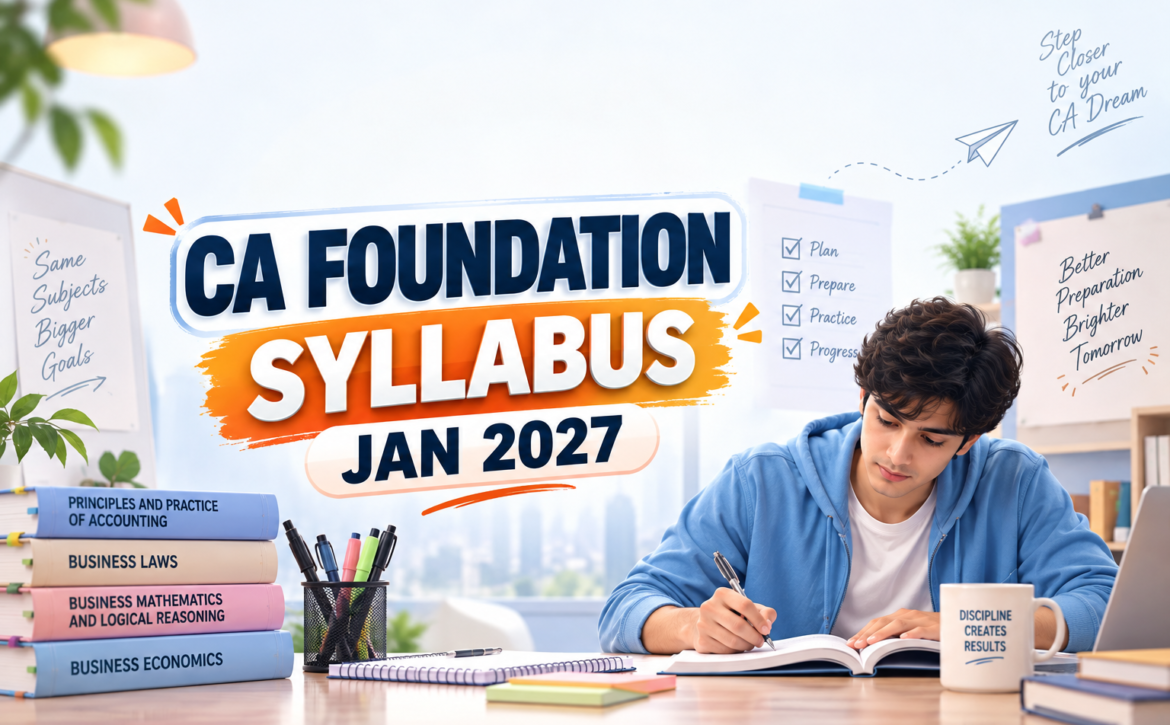
CA Foundation Syllabus January 2027
If you are planning to appear for the CA Foundation January 2027 examination, one of the first things you should do is understand the syllabus properly.
CA Foundation is the entry-level stage of the Chartered Accountancy course, but that does not mean students can prepare for it casually. The syllabus covers four different subjects, and each paper requires a different preparation approach.
Under the current scheme, the four CA Foundation papers are:
- Paper 1 – Accounting
- Paper 2 – Business Laws
- Paper 3 – Quantitative Aptitude
- Paper 4 – Business Economics
ICAI’s official Foundation syllabus page confirms these four papers under the New Scheme of Education and Training.
For students targeting January 2027, the most important point is to study from the latest applicable ICAI study material, rather than relying on old books, videos or notes prepared under the previous syllabus.
The good news is that you do not need to make your preparation complicated. Once you know exactly what is included in each paper, you can divide your time, identify your strong and weak areas and create a realistic study plan.
CA Foundation Syllabus January 2027: Quick Details
| Particular | Details |
| Course | CA Foundation |
| Attempt | January 2027 |
| Conducting Body | Institute of Chartered Accountants of India (ICAI) |
| Number of Papers | 4 |
| Paper 1 | Accounting |
| Paper 2 | Business Laws |
| Paper 3 | Quantitative Aptitude |
| Paper 4 | Business Economics |
| Marks per Paper | 100 |
| Total Marks | 400 |
| Paper 1 & 2 | Subjective |
| Paper 3 & 4 | Objective |
| Negative Marking | Applicable in objective papers |
| Passing Requirement | Minimum 40% in each paper and 50% aggregate |
ICAI’s student FAQ states that Foundation has four 100-mark papers. Papers 1 and 2 are subjective, while Papers 3 and 4 are objective, with 0.25 negative marking for every wrong answer in the objective papers. Students need at least 40% in each paper and 50% overall to pass.
CA Foundation Syllabus 2027 Subject-Wise
Let’s now look at the syllabus paper by paper.
Paper 1: Accounting
Accounting is the first paper of CA Foundation and is generally a combination of conceptual understanding and practical problem-solving.
Students coming from a commerce background may find the subject familiar, but that does not mean they should underestimate it. The real improvement comes from solving questions regularly instead of simply watching lectures.
The current ICAI Foundation Accounting material includes areas such as the theoretical framework, accounting process, bank reconciliation, inventories, depreciation, bills of exchange, final accounts, not-for-profit organisations, incomplete records, partnership and LLP accounts, and company accounts.
Major Topics in Accounting
| Area | Important Topics |
| Theoretical Framework | Accounting concepts, principles, conventions, policies, accounting standards |
| Accounting Process | Journal, Ledger, Trial Balance, Subsidiary Books, Cash Book |
| Errors | Rectification of Errors |
| Bank Reconciliation | Bank Reconciliation Statement |
| Inventories | Inventory-related accounting |
| Depreciation | Depreciation and Amortisation |
| Bills | Bills of Exchange and Promissory Notes |
| Final Accounts | Sole Proprietors, Manufacturing and Non-Manufacturing Entities |
| NPO Accounts | Financial Statements of Not-for-Profit Organisations |
| Incomplete Records | Accounts from Incomplete Records |
| Partnership | Partnership and LLP Accounts |
| Company Accounts | Shares, Debentures and related accounting |
How to Prepare Accounting
Do not make the mistake of reading Accounting like a theory subject.
A better approach is:
Understand the concept → Study illustrations → Solve questions → Check mistakes → Practise again.
If you are weak in basic accounting, spend additional time on journal entries, ledger posting, trial balance and final accounts before moving towards more advanced chapters.
Paper 2: Business Laws
Business Laws is the second CA Foundation paper.
This subject is different from Accounting because simply memorising paragraphs is not enough. You need to understand the legal principle and learn how to apply it to a practical situation.
The current ICAI study material includes the Indian Regulatory Framework, Indian Contract Act, Sale of Goods Act, Indian Partnership Act, Limited Liability Partnership Act, Companies Act and Negotiable Instruments Act.
Major Topics in Business Laws
| Chapter | Major Areas |
| Indian Regulatory Framework | Basic regulatory framework |
| Indian Contract Act, 1872 | Nature of Contracts, Consideration, Essential Elements |
| Contract Performance | Performance, Breach and Remedies |
| Special Contracts | Contingent Contracts, Quasi Contracts, Indemnity, Guarantee |
| Bailment & Pledge | Rights, duties and related concepts |
| Agency | Creation and functioning of agency |
| Sale of Goods Act, 1930 | Formation, Conditions, Warranties |
| Sale of Goods | Transfer of Ownership, Delivery, Unpaid Seller |
| Partnership Act, 1932 | Nature, Relations, Registration and Dissolution |
| LLP Act, 2008 | Limited Liability Partnership |
| Companies Act, 2013 | Basic company law concepts |
| Negotiable Instruments Act, 1881 | Negotiable instruments and related provisions |
How to Prepare Business Laws
The biggest mistake students make in Law is trying to memorise everything from day one.
Instead, first understand why a particular provision exists.
For example, when studying a contract, ask:
- What makes an agreement a contract?
- What happens if consideration is missing?
- What happens when a party fails to perform?
- What remedies are available?
- How would the provision apply to a real situation?
This approach makes revision much easier.
Also, develop the habit of using legal keywords in your answers. Good presentation can make a noticeable difference in a subjective paper.
Paper 3: Quantitative Aptitude
Quantitative Aptitude can become a high-scoring paper if you practise consistently.
It is divided into three major sections:
- Business Mathematics
- Logical Reasoning
- Statistics
ICAI’s current study material lists eight chapters under Business Mathematics, four under Logical Reasoning and six broad statistical chapters/areas, including Index Numbers.
Part A – Business Mathematics
The major topics include:
- Ratio and Proportion
- Indices and Logarithms
- Equations
- Linear Inequalities
- Mathematics of Finance
- Permutations and Combinations
- Sequence and Series
- Sets, Relations and Functions
- Basics of Limits and Continuity
- Differential Calculus
- Integral Calculus
- Applications of Calculus in Business and Economics
Part B – Logical Reasoning
The syllabus includes:
- Number Series
- Coding and Decoding
- Odd Man Out
- Direction Sense Test
- Seating Arrangements
- Blood Relations
Part C – Statistics
Major areas include:
- Statistical Description of Data
- Sampling
- Measures of Central Tendency
- Dispersion
- Probability
- Theoretical Distributions
- Correlation and Regression
- Index Numbers
How to Prepare Quantitative Aptitude
The formula for this subject is simple:
Less passive learning + more question practice.
Keep a separate formula notebook. Whenever you learn a new formula, solve at least a few questions based on it.
Also, do not ignore Logical Reasoning and Statistics just because Mathematics feels more important. The three sections together form the paper, so balanced preparation matters.
Paper 4: Business Economics
Business Economics is the fourth CA Foundation paper.
It is a conceptual subject, but students often underestimate the amount of revision required. You may understand a chapter today and still forget important terms after two weeks if you do not revise.
The current ICAI material covers ten major chapters, from the nature and scope of Business Economics to the Indian Economy.
Business Economics Syllabus
| Chapter | Major Topics |
| Chapter 1 | Nature & Scope of Business Economics |
| Chapter 2 | Theory of Demand and Supply |
| Chapter 3 | Theory of Production and Cost |
| Chapter 4 | Price Determination in Different Markets |
| Chapter 5 | Business Cycles |
| Chapter 6 | Determination of National Income |
| Chapter 7 | Public Finance |
| Chapter 8 | Money Market |
| Chapter 9 | International Trade |
| Chapter 10 | Indian Economy |
Some chapters are further divided into detailed units. For example, Demand and Supply covers elasticity, consumer behaviour and supply, while International Trade includes trade theories, trade policy, negotiations, exchange rates and international capital movements.
How to Prepare Business Economics
Do not study Economics only by highlighting your book.
Try to connect concepts with real life.
For example:
- Why do prices increase when demand rises?
- Why does a government impose taxes?
- How does inflation affect consumers?
- Why do exchange rates matter to businesses?
- What happens during different phases of a business cycle?
When concepts make sense, remembering them becomes much easier.
CA Foundation January 2027 Exam Pattern
Understanding the syllabus is only half the job. You should also know how the papers are assessed.
| Paper | Subject | Marks | Nature |
| Paper 1 | Accounting | 100 | Subjective |
| Paper 2 | Business Laws | 100 | Subjective |
| Paper 3 | Quantitative Aptitude | 100 | Objective |
| Paper 4 | Business Economics | 100 | Objective |
| Total | 4 Papers | 400 | — |
Papers 3 and 4 are objective papers and carry negative marking of 0.25 mark for each incorrect answer, according to ICAI’s Foundation FAQ.
That means accuracy matters.
If you are unsure about an answer in an objective paper, blindly guessing can hurt your score.
What Is the Passing Criteria for CA Foundation?
A student needs to satisfy both conditions:
- At least 40% marks in each paper
- At least 50% marks in aggregate
For four papers carrying 100 marks each, the total is 400 marks, so the aggregate requirement is 200 marks, while the individual paper requirement is 40 marks.
This is important because scoring very high in one paper cannot completely compensate for failing another paper.
For example, if you score:
| Paper | Marks |
| Accounting | 65 |
| Business Laws | 45 |
| Quantitative Aptitude | 60 |
| Business Economics | 30 |
| Total | 200 |
Even though the aggregate is 50%, the student would not satisfy the passing requirement because Business Economics is below 40%.
So your preparation strategy should always aim for minimum safety in every subject first, followed by higher scoring.
How to Prepare for CA Foundation January 2027
One of the biggest advantages January 2027 students have is time.
Instead of waiting for the final few months, divide your preparation into three stages.
Stage 1: Complete the First Reading
Your first goal should be syllabus completion.
Do not worry too much about achieving perfect marks during the first reading.
Focus on:
- Understanding concepts
- Completing chapters
- Making short notes
- Marking difficult questions
- Identifying weak areas
The objective is to reach the point where you can say, “I have studied the entire syllabus at least once.”
Stage 2: Revision and Question Practice
Once your first reading is complete, start solving questions.
This is where your actual preparation becomes stronger.
For Accounting and Quantitative Aptitude, practise questions regularly.
For Business Laws and Economics, focus on:
- Revision
- Keywords
- Concepts
- MCQs
- Previous questions
- Self-testing
Do not keep postponing revision until the final month.
Stage 3: Mock Tests and Final Revision
The final stage should be exam-oriented.
Attempt full-length tests under exam-like conditions.
After every test, do not just check your marks.
Analyse:
- Which questions were wrong?
- Why were they wrong?
- Was it a conceptual mistake?
- Did you forget a formula?
- Did you misunderstand the question?
- Did you make a calculation error?
- Did you waste too much time?
Your mistakes are one of the best sources of improvement.
Suggested Study Plan for CA Foundation January 2027
Here is a simple structure students can adapt.
| Preparation Phase | Main Focus |
| First Phase | Complete concepts and first reading |
| Second Phase | Chapter-wise question practice |
| Third Phase | First full revision |
| Fourth Phase | MTP/RTP/PYQ practice |
| Final Phase | Mock tests + rapid revision |
ICAI’s BoS Knowledge Portal provides students access to study materials, revision test papers, mock test papers, lectures and other academic resources.
This is why students should not depend entirely on random online PDFs. Keep the latest ICAI material at the centre of your preparation.
Should You Join CA Foundation Coaching for January 2027?
There is no single answer for every student.
Some students are comfortable with self-study. Others understand concepts faster when a faculty member explains them.
Before joining a course, ask yourself:
- Do I understand the concepts without external help?
- Can I maintain a daily study routine?
- Can I solve questions independently?
- Do I need someone to keep me accountable?
- Do I struggle with particular subjects?
- Will recorded lectures or live classes suit my routine better?
A good learning system should not simply give you hundreds of hours of lectures. It should help you understand the syllabus, practise questions, revise effectively and identify your weaknesses.
This is also where a structured mentoring approach can be useful.
CA Mentoring Program can help students approach their CA Foundation preparation with better direction, consistency and exam-focused planning.
Common Mistakes to Avoid in CA Foundation Preparation
1. Starting Without Checking the Latest Syllabus
Do not blindly follow an old YouTube playlist or book.
Always verify that your material matches the applicable syllabus.
2. Collecting Too Many Books
More books do not automatically mean better preparation.
One reliable primary source plus quality practice material is usually better than ten incomplete resources.
3. Ignoring ICAI Material
The ICAI BoS Knowledge Portal provides official academic resources, including study material and examination-oriented resources.
4. Studying Only Favourite Subjects
You may love Economics and dislike Accounts, but the examination does not allow you to choose only the subjects you enjoy.
Every paper matters.
5. Delaying Mock Tests
Do not wait until the last week to discover that you cannot complete a paper within the required time.
Practise early.
6. Ignoring Mistakes
Simply solving 100 questions is less useful if you never analyse the 30 you got wrong.
Why Understanding the CA Foundation Syllabus Matters
The syllabus is not just a list of chapters.
It tells you what you need to learn, what you need to practise and where your preparation should be directed.
For a January 2027 student, having a clear syllabus roadmap can prevent three common problems:
Over-preparation: Spending weeks studying unnecessary material.
Under-preparation: Missing important chapters.
Unstructured preparation: Studying randomly without knowing whether the syllabus is actually complete.
A simple syllabus checklist can solve all three.
Final Checklist for CA Foundation January 2027
Before entering the final revision phase, make sure you can tick these boxes:
- Accounting first reading completed
- Business Laws first reading completed
- Quantitative Aptitude concepts completed
- Business Economics first reading completed
- ICAI study material covered
- Important questions practised
- Weak chapters identified
- Short notes/formula sheets prepared
- Revision completed
- Mock tests attempted
- Mistakes analysed
- Previous examination questions practised
- Final revision schedule prepared
If you can honestly tick most of these boxes, you are moving in the right direction.
Conclusion
The CA Foundation Syllabus January 2027 is manageable when you stop looking at it as one huge syllabus and divide it into four smaller targets.
Accounting needs consistent numerical practice. Business Laws requires conceptual clarity and proper answer presentation. Quantitative Aptitude improves with repeated problem-solving, while Business Economics becomes easier through understanding and revision.
The most important thing is not to chase every resource available online. Start with the latest applicable ICAI syllabus and study material, build a realistic timetable and keep testing yourself throughout your preparation.
ICAI has also announced the commencement of Live Virtual Classes for students appearing in the January 2027 Foundation examination, showing that academic support for this attempt is already underway.
If you are preparing for January 2027, this is the right time to get serious about your study plan rather than waiting for the exam to get closer.
Know your syllabus. Build your strategy. Practise consistently. Revise repeatedly. Test yourself.
And most importantly, remember that CA Foundation is not about studying everything in one night. It is about doing the right things consistently for several months.