CA Intermediate Syllabus January 2027: Complete Subject-Wise Guide
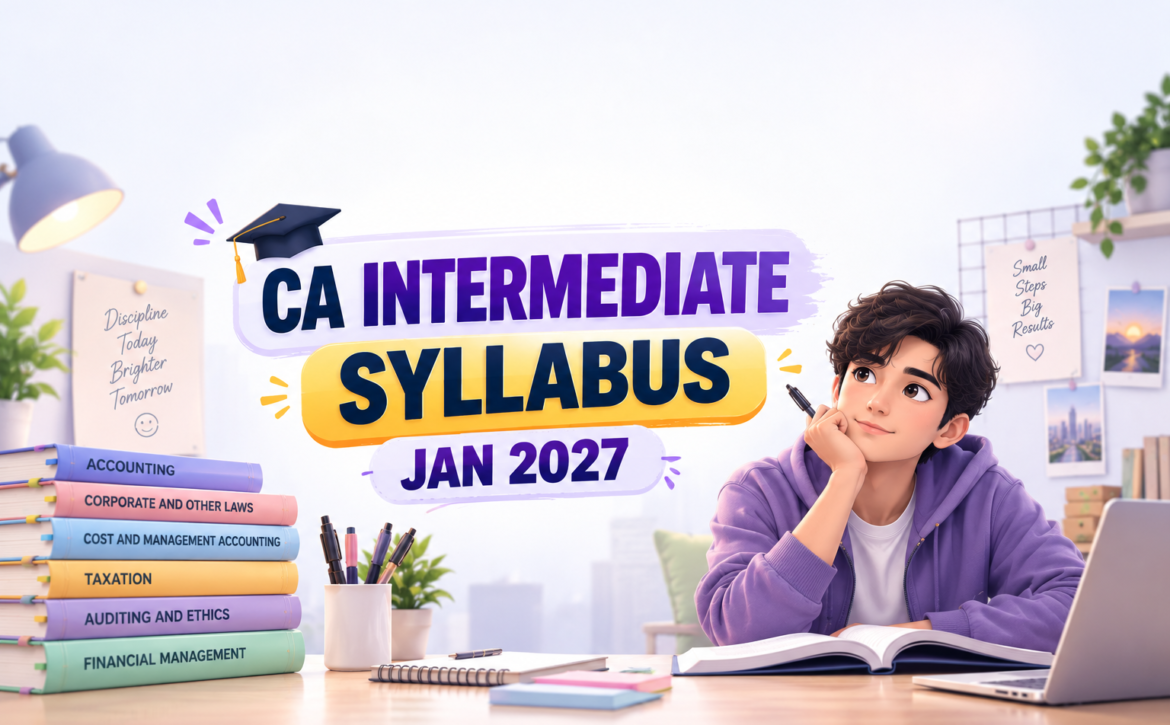
CA Intermediate Syllabus January 2027
If you are planning to appear for the CA Intermediate January 2027 examination, understanding the syllabus should be one of the first things on your preparation checklist.
CA Intermediate is very different from Foundation. At this stage, simply attending classes or reading study material is not enough. You need to understand what each paper demands, which topics require numerical practice, which subjects require repeated revision, and where amendments or updated study material can affect your preparation.
Under the ICAI New Scheme of Education and Training, CA Intermediate consists of six papers divided into two groups. Group 1 contains Advanced Accounting, Corporate and Other Laws, and Taxation, while Group 2 consists of Cost and Management Accounting, Auditing and Ethics, and Financial Management and Strategic Management. ICAI’s official Intermediate resources confirm this six-paper structure.
For January 2027 aspirants, one important point should not be missed: do not blindly use study material meant for later attempts. ICAI has separately identified Taxation material applicable for May 2026, September 2026 and January 2027, while newer material is marked for May 2027 onwards.
This guide explains the CA Intermediate January 2027 syllabus subject by subject and, more importantly, tells you how to approach each paper.
CA Intermediate January 2027 Subjects at a Glance
Here is the complete paper structure you need to know before starting your preparation:
| Group | Paper | Subject | Marks |
| Group 1 | Paper 1 | Advanced Accounting | 100 |
| Group 1 | Paper 2 | Corporate and Other Laws | 100 |
| Group 1 | Paper 3 | Taxation | 100 |
| Group 2 | Paper 4 | Cost and Management Accounting | 100 |
| Group 2 | Paper 5 | Auditing and Ethics | 100 |
| Group 2 | Paper 6 | Financial Management and Strategic Management | 100 |
Therefore, students preparing for CA Intermediate January 2027 have six papers and 600 marks in total across the two groups.
The right way to look at these papers is not simply as six separate subjects. Each paper requires a different preparation method.
For example, Accounting and Costing need extensive question practice. Law and Audit need strong conceptual understanding, retention and answer presentation. Taxation requires concepts as well as updated provisions. FM needs numerical practice, while Strategic Management requires repeated revision and proper understanding of concepts.
That difference should influence your timetable.
CA Intermediate Group 1 Syllabus January 2027
Group 1 consists of three papers:
- Advanced Accounting
- Corporate and Other Laws
- Taxation
Let’s understand each paper in detail.
CA Intermediate Advanced Accounting Syllabus January 2027
Advanced Accounting is Paper 1 of CA Intermediate.
This is one of the subjects where students often make the same mistake: they read the concepts repeatedly but don’t solve enough questions.
Accounting is not a subject that becomes strong through reading alone. Your preparation should move from understanding → illustration practice → question solving → revision.
Major Areas to Prepare
Your preparation should cover areas such as:
- Accounting Standards
- Financial statements and related accounting treatments
- Partnership-related accounting
- Company accounts
- Amalgamation and reconstruction-related concepts
- Branch and departmental accounting
- Other applicable advanced accounting topics prescribed by ICAI
The exact chapter-wise applicability should always be checked against the ICAI study material applicable to your examination attempt.
How to Prepare Advanced Accounting
A practical approach is:
Step 1: Understand the concept.
Step 2: Study ICAI illustrations carefully.
Step 3: Solve the illustration without looking at the answer.
Step 4: Attempt additional questions.
Step 5: Mark questions where you made mistakes.
Step 6: Revisit those questions during revision.
One simple rule can make a big difference:
Don’t measure your Accounting preparation by the number of chapters you have read. Measure it by the number of questions you can solve independently.
CA Intermediate Corporate and Other Laws Syllabus January 2027
Corporate and Other Laws is Paper 2 of Group 1.
Unlike Accounting, Law does not require you to solve dozens of numerical questions. But that does not mean it is easier.
The challenge in Law is remembering provisions and presenting the answer appropriately in the examination.
Students should focus on:
- Important definitions
- Provisions and conditions
- Legal requirements
- Exceptions
- Time limits
- Consequences and penalties
- Practical application of provisions
- Important keywords
- Answer-writing technique
How to Study Law Effectively
Don’t try to memorise every line of the chapter.
Instead, first understand what the provision actually means.
Then create short notes containing:
| What to Remember | Why It Matters |
| Definition | Helps identify the provision |
| Main provision | Forms the core of the answer |
| Conditions | Often tested through practical situations |
| Exceptions | Easy marks when remembered correctly |
| Time limits | Frequently important in application-based questions |
| Penalties/consequences | Important for complete answers |
| Keywords | Improve answer presentation |
A good Law revision notebook can be extremely useful.
Whenever you come across a provision that you repeatedly forget, write it down in your own words and revise it regularly.
CA Intermediate Taxation Syllabus January 2027
Taxation is Paper 3 and is divided into two sections:
- Section A – Income-tax Law
- Section B – Goods and Services Tax (GST)
This is one paper, but you need to prepare for two different areas.
Income-tax Law
For January 2027, ICAI has specifically listed Income-tax Law study material applicable for May 2026, September 2026 and January 2027 examinations.
The official material includes areas such as:
- Basic Concepts
- Residence and Scope of Total Income
- Heads of Income
- Salaries
- Income from House Property
- Profits and Gains of Business or Profession
- Capital Gains
- Income from Other Sources
- Income of Other Persons included in Assessee’s Total Income
- Aggregation of Income
- Set-off and Carry Forward of Losses
- Deductions from Gross Total Income
- Advance Tax
- Tax Deduction at Source and Tax Collection at Source
- Filing of Return of Income and Self Assessment
- Computation and Optimisation of Income Tax Liability
GST
The January 2027 applicable GST material includes topics such as:
- GST in India – An Introduction
- Supply under GST
- Charge of GST
- Place of Supply
- Exemptions
- Time of Supply
- Value of Supply
- Input Tax Credit
- Registration
- Tax Invoice
- Credit and Debit Notes
- Accounts and Records
- E-Way Bill
- Payment of Tax
- TDS and TCS
- Returns
Important Taxation Warning for January 2027 Students
This is something every student should understand.
ICAI has separately announced the applicability of the Income-tax Act, 2025 from May 2027 CA examinations onwards. Therefore, students appearing in January 2027 should not automatically shift to material specifically designed for May 2027 onwards.
Always check the applicability mentioned by ICAI before buying a new book, joining a course or downloading updated notes.
CA Intermediate Group 2 Syllabus January 2027
Group 2 consists of:
- Cost and Management Accounting
- Auditing and Ethics
- Financial Management and Strategic Management
Let’s understand how to approach these subjects.
CA Intermediate Cost and Management Accounting Syllabus January 2027
Cost and Management Accounting is Paper 4.
This is a practice-oriented subject. If you are uncomfortable with numerical questions, the solution is not to avoid them. You need to practise gradually.
The current ICAI Intermediate Cost and Management Accounting structure includes topics such as:
- Introduction to Cost and Management Accounting
- Material Cost
- Employee Cost and Direct Expenses
- Overheads – Absorption Costing
- Activity Based Costing
- Cost Sheet
- Cost Accounting Systems
- Unit and Batch Costing
- Job Costing
- Process and Operation Costing
- Joint Products and By-Products
- Service Costing
- Standard Costing
- Marginal Costing
- Budgets and Budgetary Control
Best Way to Prepare Costing
Don’t wait until the end of the syllabus to start practising.
For every chapter:
Concept → Formula → Illustration → Basic Questions → Exam-Level Questions → Revision
Maintain a separate formula sheet.
Also maintain a mistake book.
For example, if you repeatedly make mistakes in:
- Formula selection
- Unit conversion
- Calculation
- Treatment of overheads
- Interpretation of the question
write the mistake down.
During the final revision, this small notebook can become more useful than reading an entire chapter again.
CA Intermediate Auditing and Ethics Syllabus January 2027
Auditing and Ethics is Paper 5.
This subject can feel difficult in the beginning because students often try to memorise it without understanding the reasoning behind audit procedures.
Instead, ask yourself:
Why is this procedure required?
What risk is the auditor trying to address?
What evidence would the auditor need?
Once you understand the logic, remembering the concepts becomes easier.
Important Preparation Areas
Your preparation should focus on:
- Basic concepts of auditing
- Audit planning
- Risk assessment
- Internal control
- Audit evidence
- Documentation
- Audit procedures
- Reporting
- Professional responsibilities
- Ethics
- Practical application of auditing concepts
For Audit, ICAI language and terminology matter.
That doesn’t mean you should reproduce entire paragraphs blindly. But important technical terms should be used correctly in your answers.
A Practical Audit Revision Method
Try this three-level revision system:
Revision 1: Understand the chapter.
Revision 2: Create short notes and keywords.
Revision 3: Practise questions and revise repeatedly.
This is much more effective than reading the same chapter for hours without testing yourself.
CA Intermediate Financial Management and Strategic Management Syllabus January 2027
Paper 6 combines two different areas:
- Section A – Financial Management
- Section B – Strategic Management
That means your preparation strategy should also be divided.
Financial Management
FM is calculation-oriented and requires regular practice.
Focus on understanding concepts and then solving questions.
Common areas of preparation include:
- Financial management concepts
- Financial decision-making
- Financing decisions
- Investment decisions
- Working capital
- Cost of capital
- Capital structure
- Leverage
- Ratio-based financial analysis
- Other prescribed financial management concepts
The exact applicable study material should be checked with ICAI before beginning your final preparation.
Strategic Management
Strategic Management is more theory-oriented.
Here, understanding the concept is important, but revision is equally important.
Students should focus on:
- Strategic concepts
- Business environment
- Strategic analysis
- Strategy formulation
- Strategy implementation
- Competitive strategies
- Functional and operational strategies
- Strategic evaluation and related concepts
A common mistake is studying SM only once.
You should revise it multiple times because retention plays a major role.
CA Intermediate January 2027 Syllabus: Group-Wise Preparation Strategy
Knowing the syllabus is only half the job.
The next question is: How should you actually complete it?
A practical preparation framework can look like this:
| Preparation Stage | Main Focus |
| Stage 1 | Understand concepts |
| Stage 2 | Complete lectures/study material |
| Stage 3 | Solve ICAI illustrations |
| Stage 4 | Practise questions |
| Stage 5 | First revision |
| Stage 6 | RTP/MTP and past exam questions |
| Stage 7 | Full-length mock tests |
| Stage 8 | Final revision |
Don’t wait until the last month to start testing yourself.
Tests should be part of your preparation from the middle stage itself.
How Much Time Should You Give to Each CA Intermediate Subject?
There is no universal timetable that works for every student.
Someone who is strong in Accounting may need less time for it than a student who has always struggled with practical questions.
Still, you can use the following framework:
| Subject | Preparation Priority | Main Requirement |
| Advanced Accounting | High | Question Practice |
| Corporate & Other Laws | High | Understanding + Revision |
| Taxation | Very High | Concepts + Updates + Practice |
| Cost & Management Accounting | High | Numerical Practice |
| Auditing & Ethics | High | Revision + Answer Writing |
| FM & SM | High | Numericals + Concept Revision |
The goal is not to study every subject for exactly the same number of hours.
The goal is to give each subject the type of preparation it actually needs.
ICAI Study Material vs Other Books: What Should You Follow?
For CA Intermediate, students often get confused after seeing hundreds of books, notes and PDFs online.
The safest approach is to keep ICAI material at the centre of your preparation.
Then use additional resources for:
- Concept explanation
- Question practice
- Revision
- Mock tests
- Difficult topics
Don’t collect five different books for one subject if you cannot complete even one properly.
A simple resource strategy is:
ICAI Material + One Reliable Learning Resource + Practice Material + Tests
That is generally much better than resource overload.
Students can also use learning and mentoring resources from platforms such as CA Mentoring Program when they need structured guidance, conceptual support and a more organised preparation approach.
Common Mistakes Students Make While Preparing for CA Intermediate
1. Starting with Too Many Resources
More books do not automatically mean better preparation.
2. Watching Lectures Without Practising
Completing lectures can create a false sense of preparation.
3. Ignoring ICAI Material
For a professional examination conducted by ICAI, the official study material should not be treated as optional reading.
4. Leaving Revision for the End
Revision should start while you are still completing the syllabus.
5. Ignoring Writing Practice
Especially in Law and Audit, knowing the concept and being able to present it properly are two different things.
6. Using Outdated Tax Material
Taxation is particularly sensitive to applicability and amendments. January 2027 students should verify whether their material is actually applicable to their attempt. ICAI’s own material pages clearly separate January 2027 applicability from May 2027 onwards in relevant areas.
7. Not Analysing Mock Tests
A mock test is useful only if you understand why you lost marks.
A Smart Revision Plan for CA Intermediate January 2027
A strong revision plan can be divided into three cycles.
First Revision – Understanding
Your objective should be to cover the entire syllabus and identify weak chapters.
Don’t spend an entire day trying to perfect one topic.
Second Revision – Practice
Now focus heavily on:
- Questions
- RTPs
- MTPs
- Previous examination questions
- Difficult concepts
- Weak areas
Final Revision – Exam Mode
At this stage, your preparation should become fast and selective.
Revise:
- Formulas
- Sections
- Keywords
- Important concepts
- Amendments
- Mistakes
- Frequently asked areas
- Marked questions
The final revision should not feel like the first time you are seeing the syllabus.
How CA Mentoring Program Can Help with Your CA Intermediate Preparation
Preparing for CA Intermediate can become confusing when you are trying to manage lectures, study material, revision, tests and daily targets at the same time.
This is where proper guidance can make the preparation process more structured.
Instead of constantly asking:
“What should I study today?”
you should ideally have a clear answer to:
“What am I studying, why am I studying it, and how will I test myself?”
That is the kind of structured preparation approach students should look for when choosing a learning or mentoring platform.
At CA Mentoring Program, students can explore learning support designed around the CA journey rather than treating preparation as simply completing lectures.
Final Checklist for CA Intermediate January 2027 Aspirants
Before you consider yourself exam-ready, check whether you can honestly say “yes” to these questions:
- Have I completed all six papers applicable to my attempt?
- Am I following the correct ICAI study material?
- Have I checked Taxation applicability for January 2027?
- Have I solved ICAI illustrations?
- Have I practised exam-oriented questions?
- Have I completed at least two serious revisions?
- Have I attempted mock tests?
- Have I analysed my mistakes?
- Can I write Law and Audit answers properly?
- Can I solve numerical questions within the required time?
- Have I revised formulas and important provisions?
- Have I kept my final study material concise?
If most answers are yes, you are moving in the right direction.
Remember, CA Intermediate is not won by studying for one extremely long day. It is cleared through consistent study, repeated revision, question practice and smart exam preparation.
Conclusion
The CA Intermediate Syllabus January 2027 consists of six papers divided equally between Group 1 and Group 2: Advanced Accounting, Corporate and Other Laws, Taxation, Cost and Management Accounting, Auditing and Ethics, and Financial Management and Strategic Management.
But knowing the names of the subjects is not enough.
Every paper needs a different strategy. Accounting and Costing demand practice. Law and Audit demand conceptual clarity and revision. Taxation requires particular attention to applicability and updates. FM needs numerical confidence, while SM rewards repeated revision and understanding.
Most importantly, January 2027 students should avoid mixing material from different examination cycles. ICAI has explicitly separated the material applicable for January 2027 from newer material applicable from May 2027 onwards in several subjects.
So, keep your preparation simple:
Follow the applicable ICAI material → understand the concepts → practise questions → revise repeatedly → take mocks → analyse mistakes.
You don’t need to study everything available on the internet.
You need to study the right things consistently.