
CA Inter MCQ Practice Online: Subject-Wise Questions, Mock Tests and Preparation Tips
Preparing for CA Intermediate is not just about completing the syllabus. Students also need to understand how questions are framed, how concepts are tested and how to manage their time during an examination. Even after studying a chapter thoroughly, many students struggle when they encounter a question that presents the same concept in a different way.
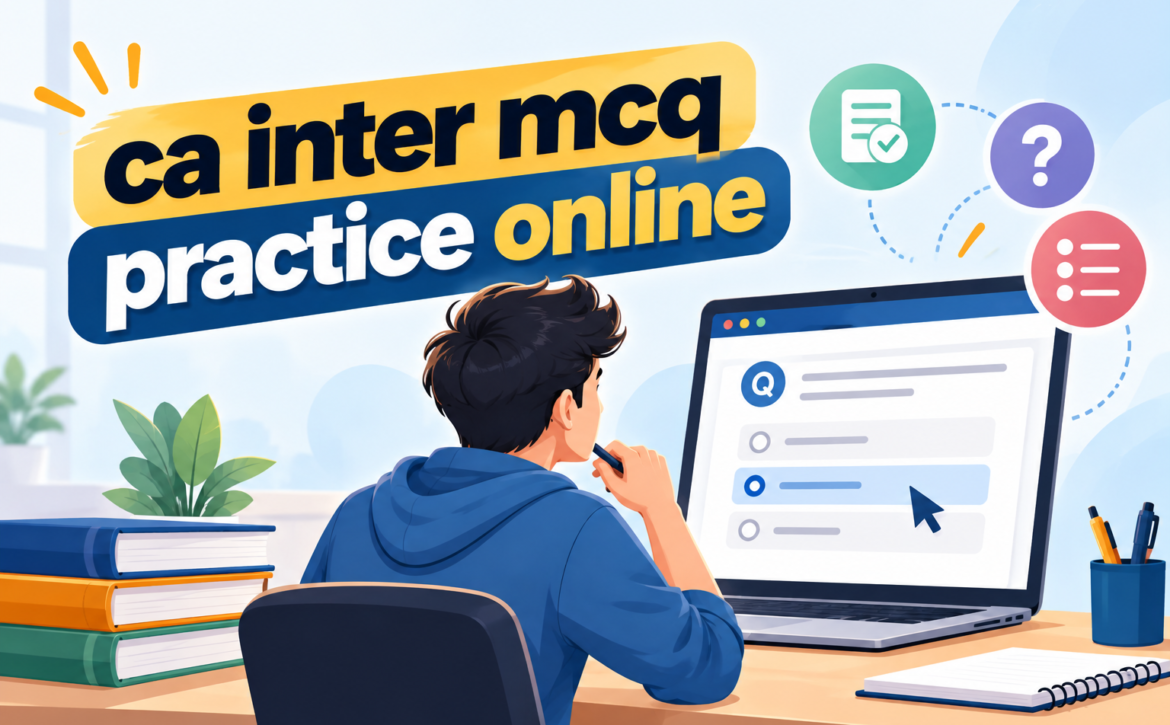
This is where CA Inter MCQ practice online becomes useful. Regular multiple-choice question practice helps you check your understanding, identify weak topics and become more comfortable with objective questions before the actual examination.
For example, you may understand a provision in Corporate and Other Laws while reading your notes. However, when a question presents a practical situation with four possible answers, you must identify the relevant provision and apply it correctly. Simply memorising the chapter may not be enough.
At CA Mentoring Program, the aim is to help CA students approach preparation in a more organised and practical way. Online MCQ practice can become part of that process, alongside ICAI study material, revision, descriptive answer writing and mock examinations.
What Is CA Inter MCQ Practice Online?
CA Inter MCQ practice online means solving multiple-choice questions through a digital platform instead of relying only on printed question banks. Depending on the platform, students may practise individual chapters, complete subject-wise tests or attempt timed mock tests.
A typical MCQ includes a question, four possible answer choices and one correct answer, although the format may vary depending on the question type.
Online practice can help you move beyond passive reading. Instead of simply reviewing a chapter, you actively recall concepts, compare possible answers and apply what you have learned.
Useful online practice resources may include:
- Chapter-wise MCQ question banks.
- Subject-wise practice tests.
- Case scenario-based questions.
- Timed quizzes and mock tests.
- Answer keys and explanations.
- Official ICAI MCQ question booklets and model test papers.
The quality of the practice material matters. Questions should match the applicable syllabus, study material and examination attempt. A large number of outdated questions will not necessarily improve your preparation.
Why Is MCQ Practice Important for CA Intermediate?
The CA Intermediate examination under ICAI’s New Scheme includes objective-type questions in applicable papers. Students should check the latest official examination guidance for the precise paper pattern and attempt-specific requirements.
You can find official examination resources on the ICAI Examination website and course resources on the ICAI Intermediate Course page.
Regular MCQ practice is useful for several reasons.
1. It Tests Conceptual Understanding
Reading a concept and applying it to a question are two different tasks. MCQs can reveal whether you understand the principle or have only memorised a definition.
If you repeatedly select incorrect options in a particular chapter, revisit the underlying concept before attempting another test.
2. It Improves Question-Reading Skills
Some questions contain qualifying words, exceptions, conditions or multiple facts. Missing one important detail can lead to the wrong answer.
Practising carefully helps you develop the habit of reading the complete question before selecting an option.
3. It Helps You Identify Weak Areas
Suppose you score well in Accounting but consistently make mistakes in Taxation questions involving provisions or calculations. Your practice results can help you decide where to spend your next revision session.
The purpose of a test is not merely to produce a score. It is to show you what needs improvement.
4. It Builds Exam Confidence
Students often feel anxious when they encounter unfamiliar question formats. Regular practice exposes you to different ways of testing the same concept.
With time, you can become more comfortable analysing options and deciding when to move on from a difficult question.
5. It Supports Better Time Management
Timed practice helps you understand how long you spend on different question types. You can then work on avoiding unnecessary calculations, repeated reading and prolonged attempts at one question.
Speed should come from familiarity and accuracy, not from rushing.
CA Inter Subjects for Online MCQ Practice
Under the New Scheme, CA Intermediate has six papers divided into two groups. The following table provides a practical way to organise your MCQ preparation.
| Group | Paper | Subject | MCQ Practice Focus |
| Group I | Paper 1 | Advanced Accounting | Accounting concepts, adjustments and numerical applications |
| Group I | Paper 2 | Corporate and Other Laws | Legal provisions, conditions, exceptions and case-based application |
| Group I | Paper 3 | Taxation | Income-tax Law and GST concepts, calculations and applicable provisions |
| Group II | Paper 4 | Cost and Management Accounting | Costing methods, formulas and numerical problems |
| Group II | Paper 5 | Auditing and Ethics | Audit concepts, professional requirements and scenario-based application |
| Group II | Paper 6 | Financial Management and Strategic Management | Financial calculations, decision-making concepts and strategic analysis |
The table is a study-planning guide, not a substitute for the official syllabus. Before beginning a question bank, confirm the syllabus and applicable material for your examination attempt.
1. Advanced Accounting MCQ Practice
Advanced Accounting requires conceptual clarity as well as regular numerical practice. Questions may test your understanding of accounting standards, adjustments and the treatment of transactions.
While practising, focus on the reason behind an accounting treatment rather than memorising the final answer.
A useful approach is to:
- Revise the relevant accounting concept.
- Solve a small set of chapter-wise MCQs.
- Write down the reason for every incorrect answer.
- Reattempt difficult questions after revision.
- Practise longer numerical questions separately.
MCQs should complement your descriptive accounting practice. They cannot replace working notes, complete solutions or the ability to present a numerical answer properly.
2. Corporate and Other Laws MCQ Practice
Corporate and Other Laws requires careful reading and application of legal provisions. A student may remember the general rule but miss a condition or exception mentioned in the question.
For effective practice, pay attention to the exact wording of the question, the relevant provision and the facts given in the situation.
After answering a question, check why the selected option is correct and why the other options are incorrect. This method is particularly helpful when two options appear similar.
Use the applicable ICAI study material and amendments for your attempt. Do not rely on old law questions without checking whether the relevant provision has changed.
3. Taxation MCQ Practice
Taxation requires both conceptual understanding and calculation practice. Depending on the question, you may need to identify an applicable provision, interpret a situation or calculate a tax-related amount.
For Income-tax Law and GST, organise your practice by chapter and question type.
A practical routine is to revise the provision, solve a few direct questions, move to application-based questions and then review calculation errors.
Keep a separate list of mistakes involving incorrect assumptions, missed conditions, calculation errors and confusion between similar provisions.
Important: Taxation questions and explanations must match the provisions, amendments and statutory updates applicable to your examination attempt. Confirm the relevant ICAI material before relying on any online question bank.
4. Cost and Management Accounting MCQ Practice
Cost and Management Accounting becomes easier to manage when you practise numerical questions regularly.
Start with the basic formula or method, then solve questions with different figures and conditions. Avoid relying only on memorised steps because a small change in the question can require a different approach.
After every practice session, identify whether your mistakes came from selecting the wrong formula, making a calculation error or misunderstanding the question.
Maintain a formula sheet for revision, but make sure you understand when each formula should be used.
5. Auditing and Ethics MCQ Practice
Auditing often tests the application of concepts, professional responsibilities and relevant requirements. Two options may sound reasonable, but only one may best fit the facts and applicable guidance.
Read each question carefully and identify what it is actually asking. Then connect the situation with the relevant concept or requirement.
Practise a mix of direct concept questions and case scenario-based MCQs. For incorrect answers, revise the underlying topic rather than simply memorising the answer key.
Use study material and updates applicable to your specific attempt, particularly where standards, guidance or syllabus coverage may differ.
6. Financial Management and Strategic Management MCQ Practice
Financial Management involves numerical application and interpretation, while Strategic Management requires a clear understanding of concepts, frameworks and business situations.
For Financial Management, practise calculations step by step and check whether you have used the correct formula and figures.
For Strategic Management, focus on understanding the meaning, purpose and application of concepts. Memorising headings without understanding how they relate to a situation may make application-based questions harder.
Keep separate practice targets for both sections so that one does not receive all your attention at the expense of the other.
How to Choose the Right CA Inter Online MCQ Practice Platform
Not every online question bank is suitable for every student. Before selecting a platform, check whether its content matches your syllabus and whether it helps you understand mistakes.
| Feature | What to Look For | Why It Matters |
| Syllabus coverage | Questions organised according to the applicable syllabus | Helps prevent irrelevant practice |
| Chapter-wise tests | Questions grouped by topic | Makes targeted revision easier |
| Case scenario MCQs | Questions based on practical situations | Builds application skills |
| Answer explanations | Clear reasoning for correct and incorrect options | Improves conceptual understanding |
| Timed practice | Tests with a time limit | Helps assess pace and accuracy |
| Performance review | Scores or topic-level feedback, where available | Helps identify weak areas |
| Updated content | Material relevant to the intended attempt | Reduces the risk of practising outdated provisions |
| Easy accessibility | A simple interface that works on your device | Makes regular practice more convenient |
Before paying for a question bank or test series, check its sample questions, subject coverage, answer explanations and update policy. Avoid choosing a resource only because it advertises a large number of questions.
You can also combine suitable online practice resources with official ICAI materials instead of depending on one source for everything.
Official ICAI MCQ Resources for CA Intermediate Students
Students should not overlook the resources provided by ICAI. Official examination pages publish MCQ question booklets and answer keys for relevant examination sessions, subject to availability.
Start with these resources:
- ICAI Examination Department: Check examination-related announcements, guidance and available MCQ resources.
- ICAI Intermediate Course Resources: Review the subjects, course information and available model test papers.
- ICAI MCQ Questions and Keys: Explore the listed May 2026 MCQ booklets and answer keys as practice references, where relevant.
Use older question booklets carefully. They can help you understand question styles, but they may not reflect every change in syllabus, law, amendments or examination requirements for a later attempt.
The best approach is to confirm applicability first and then use the questions that remain relevant to your preparation.
How to Practise CA Inter MCQs Online Effectively
Simply attempting hundreds of questions is not enough. The value of practice depends on what you learn from your answers.
Step 1: Revise the Chapter First
Before beginning a test, spend some time reviewing the chapter. Read the key concepts, provisions, formulas or working methods relevant to that topic.
If you attempt questions without understanding the basics, you may repeatedly guess answers without improving your knowledge.
Step 2: Start with Chapter-Wise Questions
Begin with a manageable set of questions from one chapter. This makes it easier to identify whether your understanding is strong enough to move forward.
Once you can answer the basic questions accurately, introduce more complex and application-based questions.
Step 3: Attempt Questions Before Checking Answers
Do not look at the answer key after every question unless you are using a learning mode designed for immediate feedback.
During a practice test, answer independently. This gives you a more realistic picture of your current preparation.
Step 4: Review Every Incorrect Answer
For each wrong answer, record the topic, the reason for the mistake and the action needed to correct it.
Your mistake may involve a forgotten provision, a wrong formula, a calculation error, a misread condition or an unsupported guess.
The correction should address the cause, not merely the answer.
Step 5: Reattempt Difficult Questions
Return to incorrect and marked questions after revising the relevant topic. Reattempting them helps you check whether the concept has actually improved.
If you remember the answer but cannot explain why it is correct, revisit the concept again.
Step 6: Move to Timed Tests
After chapter-wise practice, attempt mixed-topic tests under a time limit. This helps you switch between concepts and manage your time more realistically.
As the examination approaches, use full-length mock tests and review both your objective and descriptive performance.
A Practical 30-Day CA Inter MCQ Practice Plan
The following plan is a flexible example. Adjust it according to the time remaining before your examination, your completed syllabus and the subjects in which you need the most improvement.
| Period | Main Activity | Suggested Practice |
| Days 1–7 | Chapter revision and basic practice | Short chapter-wise sets across your selected subjects |
| Days 8–14 | Application-based questions | Mixed difficulty and case scenario questions |
| Days 15–21 | Revision of weak topics | Reattempt incorrect questions and take timed tests |
| Days 22–26 | Subject-wise assessment | Timed subject tests followed by detailed review |
| Days 27–30 | Mock tests and final review | Attempt suitable mocks and revise the error notebook |
The number of questions you attempt each day should depend on their difficulty. Ten carefully reviewed numerical MCQs may be more useful than fifty questions answered without understanding the mistakes.
Example Daily Study Routine
| Activity | Suggested Time |
| Revision of concepts | 30 minutes |
| Chapter-wise MCQ practice | 30 minutes |
| Review of incorrect answers | 20 minutes |
| Revision of weak concepts | 20 minutes |
| Total | 100 minutes |
This is only an example, not a compulsory timetable. On days when you have classes, college commitments or extensive descriptive practice, you can shorten the session and maintain consistency.
Common Mistakes to Avoid During CA Inter MCQ Practice
Students often lose the benefit of online practice by focusing only on scores. Watch out for these common mistakes.
- Guessing without reviewing: Guessing may occasionally produce a correct answer, but it does not prove that you understand the concept. Mark uncertain answers for review.
- Using outdated questions without checking applicability: This is especially important for law and taxation. Always verify the applicable study material and amendments.
- Practising only easy questions: Basic questions help build confidence, but you also need application-based and case scenario questions.
- Ignoring descriptive preparation: MCQs are only one part of your preparation. Continue practising complete answers, working notes and explanations wherever required.
- Repeating the same questions without learning: A repeated score does not necessarily mean your understanding has improved. Explain the reasoning behind your answer.
- Taking too many tests without revision: Practice tests are useful only when you act on their results. Reserve time to correct mistakes and revisit difficult concepts.
- Comparing your scores with everyone else: Use your own progress as the main measure. Focus on improved accuracy, stronger understanding and fewer repeated mistakes.
How CA Mentoring Program Can Fit into Your Preparation
CA Mentoring Program can serve as a resource for students looking to organise their CA preparation and explore relevant study guidance.
When using the website for your preparation, focus on the resources that match your current stage, syllabus and examination attempt. A useful preparation routine should connect concept learning, revision, MCQ practice, mock tests and descriptive answer writing.
You can visit CA Mentoring Program to explore the website and its available CA preparation resources.
For students building a study plan, the most useful next step is to identify the subjects that require attention, choose relevant practice material and follow a realistic weekly schedule. If a practice resource provides explanations or performance feedback, use that information to guide your next revision session.
Do not treat online MCQ practice as a shortcut around studying the syllabus. Treat it as a way to check whether your preparation is translating into correct application.
Final Thoughts
CA Inter MCQ practice online can make your preparation more structured when you use it with a clear purpose. It helps you test your understanding, recognise weak areas, practise applying concepts and become familiar with objective questions.
Start with chapter-wise questions, review incorrect answers, revise the concepts behind your mistakes and gradually move towards timed tests. Use official ICAI resources alongside suitable practice material, and always check the applicability of the content for your examination attempt.
Most importantly, measure progress by how well you understand the questions—not simply by how many you complete.
A consistent routine that combines MCQs, revision, mock examinations and descriptive practice is more useful than last-minute question solving without a plan. With regular review and focused preparation, you can approach your CA Intermediate examination with a clearer understanding of your strengths and the areas that still need work.
Suggested Internal Links for CA Mentoring Program
Add these links where they fit naturally in the article, provided the corresponding pages are live and relevant:
- CA Inter Best Books: Link to the existing CA Intermediate books guide.
- CA Intermediate Preparation Strategy: Link to a relevant preparation or study-planning article.
- CA Inter Mock Test or Test Series: Link to a relevant test-series page, if available.
- CA Inter Previous Year Question Papers: Link to a relevant question-paper resource, if available.
- CA Intermediate Exam Updates: Link to a page covering official examination announcements, where available.
Use descriptive anchor text that accurately reflects the destination page. Avoid adding links to pages that do not exist or forcing the same keyword into every link.