CA Foundation - CA Mentoring Program - Page 2

Category: CA Foundation

CA Foundation Previous Year Question Papers: Download Latest Papers & Prepare Smarter

Preparing for CA Foundation is not just about completing the syllabus. It is about understanding how well you can apply what you have studied when you are sitting in the examination hall.

This is where CA Foundation Previous Year Question Papers become extremely important.

A student may spend months watching lectures, reading study material and making notes, but still feel nervous when the actual question paper is placed in front of them. Previous year papers help remove that uncertainty. They show you how questions are framed, how concepts are tested and how much speed and accuracy you need during the examination.

If you are preparing for CA Foundation, don’t treat previous year question papers as something to solve only during the last week. They should become a regular part of your preparation strategy.

In this guide, you will find the latest available CA Foundation question papers, official ICAI links, a practical method to use PYQs, subject-wise strategies, common mistakes students make and a simple plan to get maximum benefit from previous papers.

What Are CA Foundation Previous Year Question Papers?

CA Foundation Previous Year Question Papers are the actual examination papers released for previous Foundation attempts.

These papers are valuable because they represent the real examination rather than questions created only for practice.

The Institute of Chartered Accountants of India (ICAI) maintains an official question-paper section where students can access Foundation papers from different examination attempts.

As of September 2026, the official ICAI page lists Foundation papers for September 2026, May 2026, January 2026, September 2025, May 2025, January 2025, September 2024 and June 2024.

For a student, this means you do not need to depend entirely on random PDF websites to find previous papers.

You can start with the official source.

View the Official ICAI CA Foundation Question Papers

Latest CA Foundation Previous Year Question Papers

If your goal is to practise the most recent papers first, the following attempts should be your priority.

CA Foundation September 2026 Question Papers

The September 2026 papers are currently the latest Foundation papers listed on the ICAI official question-paper page.

Subject Paper Official ICAI Link
Accounting Paper 1 – September 2026 Download from ICAI
Business Laws Paper 2 – September 2026 Download from ICAI
Quantitative Aptitude Paper 3 – September 2026 Download from ICAI

Important: At the time of this update, ICAI’s official page lists these three September 2026 papers. Paper 4 – Business Economics is not currently listed on that page. Students should use the official ICAI page for any later updates.

CA Foundation May 2026 Question Papers

May 2026 is another highly relevant attempt for students preparing for upcoming examinations.

Subject Paper Official ICAI Link
Accounting Paper 1 – May 2026 Download from ICAI
Business Laws Paper 2 – May 2026 Download from ICAI

These papers are linked from the official ICAI Foundation question-paper section.

CA Foundation January 2026 Question Papers

The January 2026 papers are also useful for understanding recent question framing.

Subject Paper Official ICAI Link
Accounting Paper 1 – January 2026 Download from ICAI
Business Laws Paper 2 – January 2026 Download from ICAI

If you have already completed most of your syllabus, these recent papers should be included in your timed practice schedule.

CA Foundation September 2025 Question Papers

September 2025 papers can help you understand how recent concepts were tested before the latest 2026 attempts.

Subject Paper Official ICAI Link
Accounting Paper 1 – September 2025 Download from ICAI
Business Laws Paper 2 – September 2025 Download from ICAI

The September 2025 papers are listed on ICAI’s official Foundation question-paper page.

CA Foundation May 2025 Question Papers

May 2025 is another useful recent attempt for PYQ practice.

Subject Paper Official ICAI Link
Accounting Paper 1 – May 2025 Download from ICAI
Business Laws Paper 2 – May 2025 Download from ICAI

Rather than simply downloading these papers, try to solve them under examination conditions and analyse your mistakes afterwards.

Official ICAI CA Foundation Question Paper Page

If you are searching for the latest CA Foundation previous year papers, it is worth bookmarking the official ICAI page.

Official ICAI – CA Foundation Question Papers

The official page currently provides links for Foundation attempts from June 2024 onwards, including September 2026, May 2026, January 2026, September 2025, May 2025, January 2025, September 2024 and June 2024.

This is especially useful because ICAI can update the page when additional papers or examination-session resources become available.

CA Foundation Previous Year Papers: Quick Download Guide

Here is a quick view of the recent attempts currently relevant to students:

Examination Latest Status on ICAI Page Priority
September 2026 Papers currently listed Very High
May 2026 Papers currently listed Very High
January 2026 Papers currently listed Very High
September 2025 Papers currently listed High
May 2025 Papers currently listed High
January 2025 Papers listed Moderate
September 2024 Papers listed Moderate
June 2024 Papers listed Reference

For the complete and updated list, always refer to the official ICAI question-paper page.

Why Are CA Foundation Previous Year Question Papers Important?

There is a reason experienced students and teachers repeatedly recommend solving PYQs.

It is because reading a chapter and solving an examination question are two different skills.

1. You Understand ICAI’s Question Style

Previous papers help you understand how ICAI converts a concept into an examination question.

You start noticing:

  • How questions are worded
  • Which concepts require application
  • How numerical questions are structured
  • How options can create confusion
  • How much detail is expected
  • Which areas require more attention

That familiarity can make the actual examination feel less unfamiliar.

2. You Discover Your Weak Areas

Suppose you believe that your Accounting preparation is strong.

You solve a previous paper and discover that you repeatedly make mistakes in one particular type of question.

That is useful information.

Instead of revising the entire subject again, you can focus on the specific weakness.

3. You Improve Speed

Knowing an answer is not enough.

You must be able to reach that answer within the available examination time.

Regular PYQ practice helps you become faster at:

  • Reading questions
  • Identifying the concept
  • Selecting the right method
  • Calculating
  • Eliminating options
  • Moving away from time-consuming questions

4. You Build Examination Confidence

The first full paper can feel difficult.

The second becomes slightly more comfortable.

After several properly analysed papers, you begin to understand your own strengths and weaknesses.

That confidence is valuable during the final days before the examination.

How to Solve CA Foundation Previous Year Papers Effectively

Don’t make the common mistake of opening a paper, solving a few questions and immediately checking the answer.

Use a proper process.

Step 1: Attempt It Like a Real Exam

Keep your books and notes away.

Set a timer.

Sit at a desk.

Attempt the paper without external help.

The purpose is to find out what you can actually do on your own.

Step 2: Check Your Answers

Once you finish, compare your answers with the appropriate solution or Suggested Answer.

Do not only calculate your total marks.

Analyse each wrong question.

Ask yourself:

Why did I get this wrong?

That question is more important than the score itself.

Step 3: Categorise Your Mistakes

Maintain a simple mistake tracker.

Type of Mistake What It Means
Conceptual You need to revise the topic
Calculation You need more numerical practice
Reading You misunderstood the question
Memory You forgot a provision/formula
Time You need better question selection
Silly mistake You need greater concentration

After solving several papers, patterns will start appearing.

Step 4: Reattempt the Wrong Questions

After revising the relevant topic, solve the question again.

If you get it right this time, move ahead.

If you make the same mistake again, the underlying concept needs more attention.

This simple Attempt → Analyse → Revise → Reattempt cycle can make PYQ practice much more effective.

Subject-Wise Strategy for CA Foundation PYQs

Different subjects need different approaches.

Accounting

For Accounting, don’t focus only on the final answer.

Compare your complete working.

Pay attention to:

  • Journal entries
  • Adjustments
  • Calculations
  • Accounting treatment
  • Presentation
  • Time taken

If your final answer is correct but your working contains conceptual mistakes, fix them before the examination.

Business Laws

Business Laws requires understanding rather than blind memorisation.

While solving PYQs, look for:

  • Important provisions
  • Definitions
  • Conditions
  • Exceptions
  • Case-based applications
  • Legal reasoning

If you memorise a previous answer word-for-word, you may struggle when ICAI changes the facts in a new question.

Understand the provision first.

Quantitative Aptitude

For Quantitative Aptitude, practice is everything.

Maintain a formula and mistake notebook.

Record:

  • Formulas you forget
  • Questions taking too long
  • Calculation errors
  • Topics where you guess answers
  • Repeated mistakes

The aim should be to make familiar question types almost automatic.

Business Economics

Economics requires conceptual clarity.

While practising objective questions, don’t simply remember the correct option.

Ask:

Why is this option correct?

And more importantly:

Why are the other options incorrect?

This approach prepares you for questions where the wording is changed.

Should You Solve Previous Papers Before Completing the Syllabus?

Yes—but selectively.

You don’t have to wait until 100% of the syllabus is complete.

If you have finished a particular chapter, start solving questions related to that chapter.

For example:

Chapter completed → Revise → Solve PYQs → Analyse mistakes → Continue

However, full-length papers should ideally be introduced once you have covered most of the syllabus.

There is little value in taking a complete paper when large portions of the syllabus are still untouched.

How Many CA Foundation Previous Year Papers Should You Solve?

There is no universal number.

Solving five papers properly is much better than downloading twenty papers and barely looking at them.

A practical approach is:

Preparation Stage Recommended PYQ Practice
Early preparation Topic-wise questions
Mid preparation Chapter-wise PYQs
70–80% syllabus Mixed PYQs
Syllabus completed Full-length papers
Final revision Recent PYQs + mocks + mistakes

Start with the latest papers and then move backwards.

This keeps your practice closer to the current examination environment.

PYQs vs Mock Tests: What Should You Practise?

Both are useful, but they serve different purposes.

PYQs Mock Tests
Actual previous examination papers Practice examinations
Show real past question framing Test your current readiness
Help understand ICAI style Help simulate exam conditions
Useful for historical comparison Useful for performance measurement
Best for analysing concepts Best for testing speed and strategy

A strong preparation plan should include both PYQs and mock tests.

Don’t Ignore ICAI Suggested Answers

Question papers tell you what was asked.

Suggested Answers help you understand the expected approach.

ICAI maintains a separate official Suggested Answers page for the Foundation course under the New Scheme. It currently lists Suggested Answers for May 2026, January 2026, September 2025, May 2025, January 2025, September 2024 and June 2024.

View Official ICAI Foundation Suggested Answers

When analysing a PYQ, don’t just ask whether your answer is correct.

Compare your approach with the official solution wherever applicable.

This is particularly useful for understanding presentation, reasoning and the expected method.

Common Mistakes Students Make While Using PYQs

Mistake 1: Solving PYQs Only in the Last Week

PYQs should be used throughout preparation.

Mistake 2: Memorising Old Questions

A previous question is not necessarily a prediction of the next paper.

Mistake 3: Checking Solutions Immediately

First attempt the question honestly.

Mistake 4: Ignoring Mistakes After Checking Marks

Your mistakes contain some of the most valuable information about your preparation.

Mistake 5: Using Outdated Papers Without Checking the Syllabus

Older papers may contain questions that are not relevant to your current examination.

Always check the applicable syllabus and study material.

Mistake 6: Solving Without a Timer

At least your full-paper practice should be timed.

A 30-Day CA Foundation PYQ Strategy

If your syllabus is substantially complete, you can use a simple 30-day PYQ-focused plan.

Period Focus
Days 1–7 Topic-wise PYQs + weak chapters
Days 8–14 Recent subject-wise papers
Days 15–21 Full-length timed papers
Days 22–25 Mistake analysis + revision
Days 26–28 More full papers
Days 29–30 Final revision + selected PYQs

Don’t blindly follow this timetable if your syllabus is incomplete.

Your preparation level should determine the balance between learning and testing.

How CA Mentoring Program Can Help With Your Preparation

Previous year papers are most useful when you know how to analyse them.

Students often solve a paper, check the score and move on.

The better approach is to identify:

  • Why marks were lost
  • Which chapters need revision
  • Which question types consume time
  • Where repeated mistakes occur
  • Whether your preparation strategy is actually working

For students looking for additional preparation guidance, mentoring and exam-oriented support, CA Mentoring Program can be explored as part of the overall CA Foundation preparation journey.

The goal should not be to solve papers simply for the sake of increasing the number of papers completed.

The goal is to become more accurate, faster and more confident with every paper you solve.

Final Takeaway

CA Foundation Previous Year Question Papers are much more than downloadable PDFs.

They are a practical way to understand the examination, test your preparation and identify the areas where you need to improve.

Start with the latest available papers.

Solve them without looking at the answers.

Check your performance honestly.

Maintain a mistake notebook.

Revise the weak areas.

Then solve the questions again.

Most importantly, use the official ICAI question-paper resources whenever possible. ICAI’s official page currently provides Foundation question papers across multiple recent attempts, including September 2026, May 2026, January 2026, September 2025 and May 2025.

Don’t try to predict the next CA Foundation paper from old questions.

Instead, learn from the way ICAI has tested concepts in the past.

That mindset will make your preparation much stronger.

And when you finally enter the examination hall, the paper may still contain new questions—but the process of reading, analysing and solving them won’t feel new anymore.
CA Foundation Exam Pattern Jan 2027: Papers, Marks, Duration & Passing Criteria

If you are preparing for the CA Foundation January 2027 examination, understanding the exam pattern should be one of the first things on your preparation checklist. Many students spend weeks collecting study material and watching lectures but do not pay enough attention to how the actual paper is structured.

That can become a problem during the examination.

The CA Foundation exam pattern for January 2027 consists of four papers: Accounting, Business Laws, Quantitative Aptitude, and Business Economics. Each paper carries 100 marks, making the total examination worth 400 marks. However, the four papers are not tested in exactly the same way. Papers 1 and 2 are subjective, while Papers 3 and 4 are objective-type papers with negative marking.

ICAI conducts Foundation examinations three times a year — January, May and September. The Institute has also announced the commencement of Live Virtual Classes for students appearing in the January 2027 Foundation examination, confirming that January 2027 is an active Foundation examination attempt.

This guide explains the CA Foundation Exam Pattern Jan 2027, including marks distribution, paper-wise structure, exam duration, negative marking, passing criteria, and practical preparation strategies.

CA Foundation Exam Pattern Jan 2027 at a Glance

Before going into individual subjects, let us understand the complete structure.

Particular Details
Examination CA Foundation January 2027
Conducting Body Institute of Chartered Accountants of India (ICAI)
Number of Papers 4
Total Marks 400
Marks per Paper 100
Paper 1 Accounting
Paper 2 Business Laws
Paper 3 Quantitative Aptitude
Paper 4 Business Economics
Papers 1 & 2 Subjective
Papers 3 & 4 Objective
Negative Marking 0.25 mark for each wrong answer in objective papers
Minimum Marks Per Paper 40%
Minimum Aggregate 50%
Examination Frequency January, May and September

The above pattern follows the current ICAI Foundation examination framework.

Important: Students should always verify the final examination notification, timetable and instructions issued by ICAI for their particular attempt before the examination.

CA Foundation January 2027 Subjects

The CA Foundation course has four papers:

  1. Paper 1 – Accounting
  2. Paper 2 – Business Laws
  3. Paper 3 – Quantitative Aptitude
  4. Paper 4 – Business Economics

Each subject carries 100 marks.

The combination is deliberately different in nature. Accounting tests your ability to understand and solve accounting problems. Business Laws requires conceptual understanding along with proper written presentation. Quantitative Aptitude demands speed and accuracy, while Business Economics tests your understanding of economic concepts and their application.

That means preparing for all four subjects using exactly the same strategy is usually not the smartest approach.

CA Foundation Paper 1: Accounting Exam Pattern

Accounting is the first paper of the CA Foundation examination and carries 100 marks.

It is a subjective paper, which means students are required to write their answers rather than simply selecting an option.

Accounting Paper Pattern

Particular Details
Paper Accounting
Marks 100
Type Subjective
Negative Marking No
Main Requirement Conceptual understanding + practical application

Accounting is not a subject where simply reading the chapter repeatedly will be enough.

You need to understand the logic behind journal entries, ledger posting, adjustments, accounting principles and financial statements.

A common mistake among Foundation students is spending too much time watching lectures and too little time solving questions.

For January 2027, your preparation should gradually move from:

Concept → Illustration → Practice Question → Timed Test → Revision

If you can solve questions without looking at the solution, your preparation is moving in the right direction.

CA Foundation Paper 2: Business Laws Exam Pattern

Business Laws is another 100-mark subjective paper.

Unlike an MCQ-based subject, Business Laws requires you to communicate your understanding through written answers.

Business Laws Paper Pattern

Particular Details
Paper Business Laws
Marks 100
Type Subjective
Negative Marking No
Key Skills Concept clarity + legal reasoning + presentation

This paper can be scoring if you understand how to write answers.

You should not treat Business Laws like a subject that requires only memorisation.

Instead, understand:

  • What the provision says
  • What the important legal terms mean
  • How the provision applies to a situation
  • How to present your conclusion

When practising, make it a habit to answer case-based questions in a structured manner.

A simple approach is:

Provision → Facts → Application → Conclusion

Good presentation can make a significant difference because the examiner needs to clearly understand what you are trying to communicate.

CA Foundation Paper 3: Quantitative Aptitude Exam Pattern

Quantitative Aptitude is an objective-type paper carrying 100 marks.

It includes:

  • Business Mathematics
  • Logical Reasoning
  • Statistics

Quantitative Aptitude Pattern

Particular Details
Paper Quantitative Aptitude
Marks 100
Type Objective
Duration As prescribed by ICAI
Negative Marking 0.25 mark for every wrong answer
Major Areas Business Mathematics, Logical Reasoning, Statistics

ICAI’s published material confirms that Quantitative Aptitude is an MCQ-based paper and carries 0.25 negative marking for an incorrect answer.

This changes the way you should approach the paper.

In an objective paper with negative marking, attempting every question blindly is not a smart strategy.

For example, if you are unsure between two options, take a moment to evaluate whether you can eliminate one or more choices. Guessing without any basis can reduce your score.

The best strategy is to build accuracy first and speed second.

CA Foundation Paper 4: Business Economics Exam Pattern

Business Economics is also a 100-mark objective paper.

It tests your understanding of economic concepts, principles and their application.

Business Economics Pattern

Particular Details
Paper Business Economics
Marks 100
Type Objective
Negative Marking 0.25 mark per wrong answer
Total Papers 4
Weight in Total Exam 100 out of 400 marks

Business Economics may look easier compared with Accounting or Quantitative Aptitude, but students sometimes underestimate it.

The challenge is not simply remembering definitions.

Questions can test whether you actually understand the concept.

For example, if you understand a particular economic principle properly, you should be able to identify how it applies to a practical situation.

Therefore, while revising Economics, focus on:

  • Key concepts
  • Definitions
  • Differences
  • Cause-and-effect relationships
  • Practical examples
  • Important keywords
  • MCQ practice

CA Foundation Exam Pattern: Subjective vs Objective Papers

One of the most important things to remember for January 2027 is the difference between subjective and objective papers.

Paper Subject Question Type Marks
Paper 1 Accounting Subjective 100
Paper 2 Business Laws Subjective 100
Paper 3 Quantitative Aptitude Objective 100
Paper 4 Business Economics Objective 100
Total 4 Subjects Mixed Pattern 400

ICAI officially states that Papers 1 and 2 are subjective, while Papers 3 and 4 are objective.

This distinction should directly influence your preparation.

For Papers 1 and 2, you need to practise writing.

For Papers 3 and 4, you need to practise accuracy and question selection.

Is There Negative Marking in CA Foundation January 2027?

Yes.

There is 0.25 mark negative marking for every wrong answer in the objective papers.

The negative marking applies to:

  • Paper 3 – Quantitative Aptitude
  • Paper 4 – Business Economics

It does not apply to the subjective papers in the same way because Papers 1 and 2 are written-answer papers.

ICAI’s Foundation FAQ specifically confirms the 0.25-mark negative marking for wrong answers in objective-type papers.

How should you handle negative marking?

Do not enter the examination hall with the mindset:

“I have to attempt every question.”

Instead, think:

“I have to maximise my net score.”

If you know the answer, attempt it confidently.

If you can logically eliminate options, make an informed decision.

If you have absolutely no idea, blindly guessing may not be worthwhile.

Practising full-length MCQ tests before the examination is one of the best ways to develop this judgement.

CA Foundation Passing Criteria for January 2027

Clearing CA Foundation is not simply about achieving 50% of the total 400 marks.

There are two conditions.

You need:

  1. At least 40% marks in each paper, and
  2. At least 50% aggregate marks across all four papers.

ICAI confirms this passing requirement in its official Foundation FAQ.

Example

Suppose a student scores:

Paper Marks
Accounting 55
Business Laws 48
Quantitative Aptitude 42
Business Economics 55
Total 200/400

The student has:

50% aggregate

and has scored at least 40 marks in every subject.

Therefore, the student satisfies the basic passing criteria.

Now consider another student:

Paper Marks
Accounting 70
Business Laws 65
Quantitative Aptitude 35
Business Economics 40
Total 210/400

Although the aggregate is above 50%, the student has scored less than 40% in Quantitative Aptitude.

Therefore, the student does not satisfy the passing criteria.

This is why you cannot completely ignore a subject simply because you are strong in the other three.

How to Prepare According to the CA Foundation Exam Pattern Jan 2027

The biggest advantage of knowing the exam pattern early is that you can prepare according to the actual requirements of the examination.

1. Do Not Prepare All Four Papers in the Same Way

Accounting requires problem-solving.

Business Laws requires writing practice.

Quantitative Aptitude requires calculation speed and accuracy.

Economics requires conceptual understanding and MCQ practice.

Your study strategy should reflect these differences.

2. Start Solving Questions Early

Don’t wait until your syllabus is 100% complete before solving questions.

After completing a chapter, solve questions from that chapter.

For example:

Learn → Revise → Practise → Test → Analyse

This cycle is much more effective than simply watching lectures continuously.

3. Give Special Attention to Objective Papers

Papers 3 and 4 can be highly scoring, but negative marking makes accuracy important.

Try practising MCQs under time pressure.

Initially, don’t worry too much about speed.

First aim for accuracy.

Once your accuracy becomes consistent, start reducing your solving time.

4. Practise Writing for Accounting and Law

Reading a solution is not the same as writing an answer.

This is particularly important for Business Laws.

Set aside dedicated time for answer writing.

Try to write complete answers rather than only mentally preparing them.

After writing, compare your answer with the suggested answer or your study material and check:

  • Did you address the question?
  • Did you use relevant provisions?
  • Was your conclusion clear?
  • Was your presentation structured?
  • Did you miss any important point?

Why Mock Tests Matter for CA Foundation January 2027

A mock test is not only a way of checking your marks.

It is a preparation tool.

When you take a full-length test, you discover things that normal studying may hide.

For example:

  • You may know the concept but take too long to solve it.
  • You may make calculation errors.
  • You may know the law but struggle to frame the answer.
  • You may lose marks because of careless MCQ attempts.
  • You may spend too much time on one question.
  • You may become nervous when solving under exam conditions.

That is why students should not wait until the last week to start taking tests.

A practical approach is to gradually increase testing frequency as the examination approaches.

For example:

Preparation Stage Suggested Testing
Early syllabus Chapter-wise tests
Mid preparation Subject-wise tests
Syllabus completion Full-length papers
Final revision Multiple timed mock tests
Last few days Revision + selected practice

The purpose is to make the actual examination feel familiar.

Common Mistakes Students Make in CA Foundation Preparation

Even students who study hard sometimes lose marks because of avoidable mistakes.

Mistake 1: Ignoring the exam pattern

If you don’t understand the paper structure, you may spend too much time on the wrong type of preparation.

Mistake 2: Leaving tests until the end

Tests should be part of preparation, not something you start after finishing everything.

Mistake 3: Blind guessing in MCQs

Negative marking means careless attempts can hurt your score.

Mistake 4: Only reading Business Laws

Law requires writing practice.

Mistake 5: Studying only strong subjects

You need at least 40% in each paper, so weak subjects cannot be ignored.

Mistake 6: Not analysing mistakes

Getting 55 marks in a test is useful only if you understand why the other 45 marks were lost.

CA Foundation January 2027 Preparation Strategy

If you are starting your preparation now, don’t try to create a complicated timetable.

Create a realistic system that you can follow every day.

A simple weekly structure could look like this:

Activity Focus
Concept Study New chapters
Question Practice Recently completed topics
MCQs QA + Economics
Answer Writing Law + Accounting
Revision Older chapters
Test One or more timed tests
Analysis Review mistakes

The key is consistency.

Studying for 10–12 hours for two days and then losing momentum for three days is usually less effective than maintaining a manageable schedule every day.

How CA Mentoring Program Can Support Your Preparation

Preparing for CA Foundation is easier when you know what to study, how to study and where you are making mistakes.

CA Mentoring Program can be positioned as a support system for students who want more structured guidance during their CA journey.

A good preparation environment should help students focus on:

  • Understanding the syllabus
  • Creating a realistic study plan
  • Practising questions regularly
  • Improving weak subjects
  • Taking mock tests
  • Analysing performance
  • Maintaining consistency

Ultimately, the goal should not be to study more hours simply for the sake of studying.

The goal is to make every study session useful.

Final Takeaway: CA Foundation Exam Pattern Jan 2027

The CA Foundation Exam Pattern Jan 2027 is built around four papers carrying a total of 400 marks.

Accounting and Business Laws are subjective papers, while Quantitative Aptitude and Business Economics are objective papers. The objective papers have 0.25 negative marking for every wrong answer. To pass, students need at least 40% in each paper and 50% aggregate marks.

But knowing the pattern is only the first step.

Your real advantage comes from using that knowledge correctly.

Prepare Accounting through regular problem-solving. Treat Business Laws as a writing subject. Build speed and accuracy for Quantitative Aptitude. Practise conceptual MCQs for Economics. And most importantly, start testing yourself before you feel completely ready.

You do not need to know everything on Day 1.

You simply need to keep improving every week.

For a CA Foundation student targeting January 2027, that consistency can make the difference between merely completing the syllabus and actually walking into the examination hall with confidence.

Prepare with the pattern in mind, practise like the real exam, analyse every mistake, and keep moving forward.

CA Foundation Subjects January 2027: Complete Syllabus, Exam Pattern & Preparation Guide

If you are planning to appear for the CA Foundation January 2027 examination, one of the first things you should understand is the complete list of subjects, what each paper covers, how the papers are conducted, and how you should divide your preparation time.

For many students, CA Foundation is the first serious step into the Chartered Accountancy journey. The syllabus may look manageable when you see the four subject names, but the real challenge begins when you start preparing for all four papers together. Accounting requires consistent practice, Business Laws needs conceptual understanding and writing skills, Quantitative Aptitude demands speed and accuracy, while Business Economics requires both conceptual clarity and regular revision.

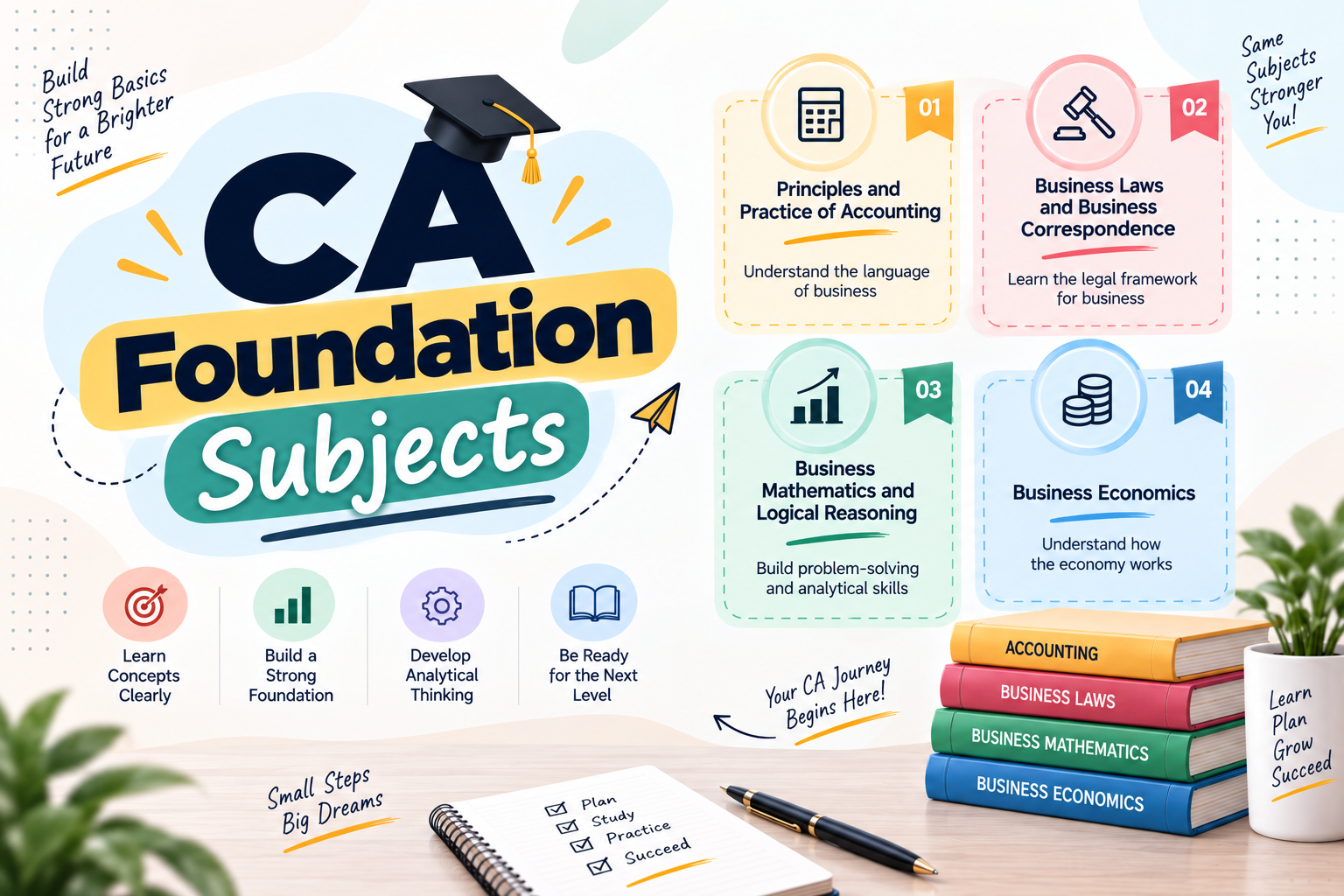
Under the current ICAI Foundation structure, there are four papers:

  1. Accounting
  2. Business Laws
  3. Quantitative Aptitude
  4. Business Economics

ICAI’s official Foundation resources list these four papers under the current scheme. ICAI has also announced Live Virtual Classes for students appearing in the January 2027 Foundation Examination.

If you are preparing for January 2027, this guide will help you understand the CA Foundation subjects January 2027, their structure, preparation approach, and the mistakes you should avoid.

CA Foundation Subjects January 2027

The CA Foundation examination consists of four papers. Each paper carries its own importance, and students need to score at least the required minimum in every paper while also meeting the aggregate passing requirement.

Here is a quick overview:

Paper Subject Nature of Paper Marks
Paper 1 Accounting Subjective 100
Paper 2 Business Laws Subjective 100
Paper 3 Quantitative Aptitude Objective 100
Paper 4 Business Economics Objective 100
Total 4 Papers 400

ICAI’s examination FAQs state that Papers 1 and 2 are subjective, while Papers 3 and 4 are objective. The same official guidance states that objective papers carry negative marking of 0.25 marks for every wrong answer.

This means your preparation cannot be exactly the same for all four subjects.

CA Foundation Paper 1 – Accounting

Accounting is the first paper of CA Foundation and is one of the most important subjects for students who want to build a strong base for the next levels of the CA course.

The biggest mistake students make in Accounting is treating it like a theory subject. It is not.

You may understand a concept while watching a lecture, but that does not necessarily mean you will be able to solve a question correctly in the examination.

Accounting requires repeated practice.

What should you focus on in Accounting?

Students should focus on understanding the logic behind accounting treatments rather than simply memorising formats.

Important areas generally include:

  • Accounting principles and concepts
  • Basic accounting processes
  • Journal entries
  • Ledger and trial balance
  • Bank reconciliation
  • Inventories
  • Depreciation and amortisation
  • Bills of exchange
  • Final accounts
  • Partnership-related accounting
  • Company accounts
  • Financial statement-related concepts

The exact applicable study material and amendments should always be checked against the ICAI material prescribed for your examination attempt. ICAI’s Board of Studies currently provides Foundation study material through its official portal.

How to prepare Accounting for January 2027

Do not wait until the last month to start solving practical questions.

A better approach is:

Concept → Illustration → Practice → Revision → Test

Try to solve questions without looking at the solution. If you make a mistake, identify why you made it.

For example, if you repeatedly make mistakes in journal entries, simply solving another 20 questions may not solve the problem. You first need to understand the rule behind the entry.

That is the difference between studying Accounting and actually learning Accounting.

CA Foundation Paper 2 – Business Laws

Business Laws is the second paper of CA Foundation and is a subject where students often underestimate the importance of language.

You do not necessarily need to write extremely complicated English. What matters more is whether you understand the legal concept and can present your answer logically.

The current Foundation structure identifies Paper 2 as Business Laws.

What makes Business Laws challenging?

The problem is usually not the number of chapters alone.

Students struggle because legal provisions can initially feel unfamiliar.

You may read a provision once and feel that you understand it. But when an application-based question appears, you may not know which provision to apply.

Therefore, your preparation should focus on:

  • Understanding provisions
  • Remembering important keywords
  • Practising case-based questions
  • Learning how to structure answers
  • Revising provisions regularly

A simple answer-writing approach

When practising descriptive questions, try following this structure:

Provision → Explanation → Application → Conclusion

This makes your answer easier to understand and helps you avoid writing unnecessary information.

Do not turn every answer into a long story.

In CA Foundation, clarity matters.

CA Foundation Paper 3 – Quantitative Aptitude

Quantitative Aptitude is the third paper and is an objective paper.

The subject combines different areas of quantitative ability. ICAI’s current Foundation information identifies Paper 3 as Quantitative Aptitude, with Business Mathematics, Logical Reasoning and Statistics forming its broad components.

For students who are comfortable with calculations, this paper can become a scoring opportunity. For students who have been away from Mathematics for a long time, however, it can initially feel difficult.

The good news is that improvement is possible with regular practice.

Major areas of Quantitative Aptitude

The paper broadly covers:

  • Business Mathematics
  • Logical Reasoning
  • Statistics

Each area requires a slightly different preparation method.

Business Mathematics

The key is practice.

Instead of reading formulas repeatedly, make a formula sheet and solve questions using those formulas.

Logical Reasoning

Logical Reasoning can improve considerably with practice.

Focus on understanding the pattern of questions instead of trying to memorise solutions.

Statistics

Statistics requires both conceptual understanding and calculation practice.

Make sure you understand the meaning of formulas before using them.

The biggest mistake in Quantitative Aptitude

Students often spend too much time trying to solve one difficult question.

Remember that this is an objective paper. Time management matters.

If a question is consuming too much time, move ahead and return to it later if appropriate.

CA Foundation Paper 4 – Business Economics

Business Economics is the fourth CA Foundation paper.

At first glance, students may consider Economics an easy subject because it is largely theoretical. However, scoring well requires much more than simply reading chapters once.

ICAI’s current Foundation material includes areas such as the nature and scope of business economics, demand and supply, production and cost, market structures, business cycles, national income, public finance, money market, international trade and the Indian economy.

Important areas to understand

Some broad areas include:

  • Nature and Scope of Business Economics
  • Demand and Supply
  • Consumer Behaviour
  • Production and Cost
  • Different Market Structures
  • Business Cycles
  • National Income
  • Public Finance
  • Money Market
  • International Trade
  • Indian Economy

The key to Economics is understanding relationships.

For example, do not just memorise the law of demand. Understand why demand generally changes when price changes and what factors can cause the relationship to change.

Once the concept becomes clear, revision becomes much easier.

CA Foundation January 2027 Exam Pattern

Understanding the examination pattern is just as important as understanding the syllabus.

The current Foundation examination pattern has two descriptive papers and two objective papers.

Paper Subject Type Marks Duration
Paper 1 Accounting Subjective 100 3 Hours
Paper 2 Business Laws Subjective 100 3 Hours
Paper 3 Quantitative Aptitude Objective 100 2 Hours
Paper 4 Business Economics Objective 100 2 Hours

ICAI’s official examination guidance confirms that Papers 1 and 2 are subjective and Papers 3 and 4 are objective. ICAI examination information also specifies two hours for Papers 3 and 4, while Papers 1 and 2 are conducted for three hours.

For objective papers, negative marking is applicable. ICAI states that 0.25 marks are deducted for every incorrect answer in the objective papers.

CA Foundation Passing Criteria for January 2027

One of the most important things students should understand is that simply scoring 50% overall is not enough.

According to ICAI’s examination FAQ, a student must secure:

  • At least 40% marks in each paper, and
  • At least 50% marks in aggregate across all four papers.

For example:

Paper Marks
Accounting 55
Business Laws 48
Quantitative Aptitude 52
Business Economics 50
Total 205/400

The aggregate is above 50%, but the student would still need to ensure that the individual paper requirement is satisfied.

This is why your preparation should not focus only on your strongest subject.

Which CA Foundation Subject Is the Easiest?

There is no universal answer.

A commerce student who has studied Mathematics regularly may find Quantitative Aptitude easier. Another student may find Business Economics easier because they enjoy theoretical subjects.

Your personal strengths matter.

A useful way to look at the four subjects is:

Subject Main Skill Required Preparation Style
Accounting Concept + Calculation Daily Practice
Business Laws Understanding + Presentation Reading + Writing
Quantitative Aptitude Speed + Accuracy Question Practice
Business Economics Concept + Retention Reading + Revision

Instead of asking, “Which subject is easiest?”, ask:

“Which subject needs the most improvement from me?”

That question will help you build a much better study plan.

How to Prepare for CA Foundation January 2027

If January 2027 is your target attempt, do not create a preparation strategy based purely on the number of chapters.

Create it around three stages.

Stage 1: Complete the Concepts

Your first target should be completing the syllabus properly.

Do not rush through lectures just to tick chapters off your list.

After every topic, ask yourself:

Can I solve a basic question without looking at the solution?

If the answer is no, the chapter is not really complete.

Stage 2: Practice Questions

Once concepts are clear, increase your question-solving.

For Accounting and Quantitative Aptitude, regular practice is extremely important.

For Business Laws and Economics, practise questions after completing each chapter so that you can identify what you actually remember.

Stage 3: Revision and Mock Tests

Revision should not be left for the final few days.

A better strategy is to revise multiple times.

For example:

First Revision: Within a few days of completing a topic
Second Revision: After completing the subject
Third Revision: During your final preparation
Final Revision: Short notes, formulas and important concepts

Mock tests should also be treated seriously.

Do not just check your marks.

Analyse:

  • Which questions were wrong?
  • Why were they wrong?
  • Did you make a calculation mistake?
  • Did you misunderstand the question?
  • Did you forget a concept?
  • Did you spend too much time on one question?

That analysis is often more valuable than simply taking another mock test.

Suggested Daily Study Plan for CA Foundation

A student preparing for January 2027 can divide study time according to individual strengths, but a balanced routine could look like this:

Activity Suggested Time
Accounting 2 Hours
Business Laws 1.5 Hours
Quantitative Aptitude 1.5 Hours
Business Economics 1.5 Hours
Revision/Test Practice 1 Hour
Total 7.5 Hours

This is only a sample.

If you have college, school, coaching or other responsibilities, adjust the schedule accordingly.

The important thing is consistency.

Studying for 7 hours one day and then doing almost nothing for the next two days is usually less effective than maintaining a realistic daily routine.

Best Study Material for CA Foundation January 2027

Your first priority should always be the official ICAI study material applicable to your attempt.

ICAI’s Board of Studies provides Foundation study material and examination-related resources through its official platforms.

You can supplement ICAI material with:

  • Revision Test Papers
  • Mock Test Papers
  • Previous examination questions
  • Suggested Answers
  • Your class notes
  • Short revision notes
  • Practice tests

ICAI has also published Foundation suggested answers for previous examinations, which can help students understand how answers are presented and evaluated.

For students who are taking classes or using additional learning support, the goal should not be collecting ten different resources.

The goal should be mastering the right resources.

Common Mistakes CA Foundation Students Should Avoid

1. Starting all four subjects together without a plan

This often creates confusion.

Complete subjects in a structured sequence while keeping regular revision of previously studied topics.

2. Ignoring the difficult subject

Students often spend more time on subjects they already like.

That feels productive but may not improve the final result.

3. Leaving revision for the last month

Revision is not something you do after preparation.

Revision is part of preparation.

4. Solving too few questions

Especially in Accounting and Quantitative Aptitude, watching lectures is not enough.

You need to solve questions yourself.

5. Ignoring negative marking

In objective papers, random guessing can hurt your score because incorrect answers attract negative marking.

6. Using outdated study material

This is particularly important for students preparing for a future attempt.

Always check the ICAI material applicable to your examination.

How CA Mentoring Program Can Help in Your Preparation

Preparing for CA Foundation can sometimes feel overwhelming, especially if you are studying for the course for the first time.

A structured mentoring approach can help students understand where they currently stand, identify weak areas, plan revision, and maintain consistency.

CA Mentoring Program can be explored by students looking for structured guidance and mentoring support during their CA preparation.

CA Mentoring Program

The important thing is not simply joining a course or buying study material.

Before choosing any learning support, consider whether it actually helps you with:

  • Concept clarity
  • Doubt resolution
  • Regular testing
  • Revision planning
  • Exam strategy
  • Time management
  • Performance tracking

A good learning system should make your preparation more organised rather than adding more resources and confusion.

Final Words: How to Approach CA Foundation January 2027

The CA Foundation January 2027 examination should not be treated as an exam that you can crack through last-minute studying.

The four subjects are different, and each demands a different approach.

Accounting needs practice.

Business Laws needs conceptual understanding and proper presentation.

Quantitative Aptitude needs speed and accuracy.

Business Economics needs understanding and repeated revision.

The good news is that you do not need to be perfect from Day 1.

You just need to improve consistently.

Start with the ICAI syllabus and applicable study material. Build your concepts. Practise questions. Revise regularly. Take mock tests. Analyse your mistakes. Then repeat the process.

If you stay consistent, the four subjects stop looking like four separate mountains and start becoming four manageable parts of one preparation plan.

For January 2027 aspirants, this is the right time to focus on clarity, consistency and exam-oriented practice rather than constantly searching for new resources.

Remember one simple rule:

Don’t study just to finish the syllabus. Study until you can confidently answer questions from the syllabus.

That mindset can make a major difference in your CA Foundation preparation.

CA Foundation Chapter Wise Weightage Jan 2027: Subject-Wise Marks, Important Chapters & Preparation Strategy

Preparing for the CA Foundation January 2027 examination and wondering which chapters deserve the most attention? You are not alone.

One of the first things students search for before starting serious preparation is CA Foundation Chapter Wise Weightage Jan 2027. Knowing the weightage helps you understand which portions of the syllabus carry greater importance and how you should distribute your preparation time.

However, there is one important point every student should understand: ICAI does not guarantee a fixed chapter-wise number of questions for every examination. The Institute publishes section-wise weightages, and the actual paper can vary within the prescribed framework. Therefore, the best strategy is not to completely skip low-weightage chapters, but to give additional preparation time to high-weightage areas.

For the January 2027 attempt, students should primarily follow the applicable ICAI syllabus, study material, RTPs, MTPs, previous question papers and official updates. ICAI’s official section-wise weightage document covers all four Foundation papers and permits a deviation of up to ±5% in specified section-wise weightage.

CA Foundation Chapter Wise Weightage Jan 2027 – Quick Overview

The CA Foundation course currently consists of four papers:

Paper Subject Marks Nature
Paper 1 Accounting 100 Numerical + Conceptual
Paper 2 Business Laws 100 Theory + Application
Paper 3 Quantitative Aptitude 100 Mathematics + LR + Statistics
Paper 4 Business Economics 100 Conceptual + MCQ-based

The official ICAI Foundation syllabus contains these four papers. Quantitative Aptitude is divided into Business Mathematics, Logical Reasoning and Statistics.

The most important thing is to understand that weightage should guide your priorities, not replace complete syllabus preparation.

CA Foundation Paper 1 Accounting Chapter Wise Weightage Jan 2027

Accounting is one of the papers where consistent practice can make a major difference. The official ICAI weightage places significant emphasis on the Accounting Process, Final Accounts, Partnership & LLP Accounts and Company Accounts.

Accounting Weightage

Section / Chapters Official Weightage Priority
Theoretical Framework 5%–10% Medium
Accounting Process 30%–35% Very High
Final Accounts + NPO + Incomplete Records 20%–25% Very High
Partnership & LLP Accounts 15%–20% High
Company Accounts 15%–25% Very High

These are the official section-wise weightages prescribed by ICAI.

1. Theoretical Framework

This section includes accounting concepts, principles, conventions, capital and revenue expenditure, accounting policies, estimates and Accounting Standards.

It carries a comparatively smaller weightage, but students should not ignore it.

The good thing about this area is that it can often be revised quickly. Make short notes and revise the important concepts repeatedly instead of spending excessive time here during the first round.

2. Accounting Process

This is one of the highest-priority areas in CA Foundation Accounting.

It includes:

  • Journal
  • Ledger
  • Subsidiary Books
  • Cash Book
  • Trial Balance
  • Rectification of Errors
  • Basic accounting procedures

With an official weightage of 30%–35%, this section deserves serious attention.

Students should solve questions rather than simply reading solved examples.

3. Final Accounts, NPO and Incomplete Records

This section carries 20%–25% official weightage.

Final Accounts of Sole Proprietors should be treated as a core chapter because it tests your understanding of several accounting adjustments together.

You should become comfortable with:

  • Trading Account
  • Profit & Loss Account
  • Balance Sheet
  • Adjustments
  • Manufacturing Accounts
  • Not-for-Profit Organisation Accounts
  • Incomplete Records

4. Partnership and LLP Accounts

Partnership and LLP Accounts carry 15%–20% weightage.

Important areas include admission, retirement and death of a partner, goodwill, dissolution and final accounts.

Do not postpone this portion until the last few days. These chapters require numerical practice.

5. Company Accounts

Company Accounts carry 15%–25% weightage, making them another high-priority area.

Focus on:

  • Issue of Shares
  • Forfeiture and Reissue
  • Issue of Debentures
  • Redemption of Preference Shares
  • Redemption of Debentures
  • Bonus Issue
  • Rights Issue

Accounting Preparation Tip

If you are short on time, do not completely skip smaller chapters. Instead, make sure the 30%–35% Accounting Process section and other high-weightage sections receive multiple rounds of practice.

CA Foundation Paper 2 Business Laws Chapter Wise Weightage Jan 2027

Business Laws can look theoretical at first, but the paper is not simply about memorising provisions.

You need to understand the law, identify the relevant provision and apply it correctly to the situation given in the question.

Business Laws Weightage

Chapter / Section Official Weightage Priority
Indian Regulatory Framework 0%–5% Medium
Indian Contract Act, 1872 20%–30% Very High
Sale of Goods Act, 1930 15%–20% High
Indian Partnership Act, 1932 15%–20% High
Limited Liability Partnership Act, 2008 5%–10% Medium
Companies Act, 2013 15%–20% High
Negotiable Instruments Act, 1881 10%–15% High

ICAI’s official weightage document provides these section-wise ranges.

Indian Contract Act

The Contract Act is one of the most important areas because it has the highest official weightage range of 20%–30%.

Focus on:

  • Essentials of a Valid Contract
  • Consideration
  • Capacity
  • Free Consent
  • Performance
  • Breach
  • Contingent Contracts
  • Quasi Contracts
  • Indemnity
  • Guarantee
  • Bailment
  • Pledge
  • Agency

Do not learn these as isolated definitions. Try to understand how each provision works in a practical business situation.

Sale of Goods Act

This section carries 15%–20% weightage.

Pay particular attention to:

  • Conditions and Warranties
  • Transfer of Ownership
  • Delivery of Goods
  • Unpaid Seller
  • Formation of Contract of Sale

Partnership Act

Partnership carries another 15%–20%.

Important areas include:

  • Rights and Duties of Partners
  • Registration
  • Reconstitution
  • Dissolution
  • General Nature of Partnership

Companies Act

Companies Act carries 15%–20%.

Students should understand the basic structure and essential features of companies, classes of companies, incorporation, share capital, MOA, AOA and doctrine of indoor management.

Negotiable Instruments Act

This section carries 10%–15%.

It may not have the highest weightage, but it should not be left for the last minute.

CA Foundation Paper 3 Quantitative Aptitude Chapter Wise Weightage Jan 2027

Quantitative Aptitude is different because it combines three areas:

  1. Business Mathematics
  2. Logical Reasoning
  3. Statistics

ICAI’s syllabus officially divides the paper into these three broad areas.

Business Mathematics

Section Official Weightage
Ratio, Proportion, Indices, Logarithms + Equations + Linear Inequalities 20%–30%
Mathematics of Finance 30%–40%
P&C, Sequence & Series, Sets, Functions, Calculus 30%–50%

The official document groups these chapters into sections, rather than assigning a guaranteed percentage to every individual chapter.

Important Mathematics Topics

Give additional practice to:

  • Ratio and Proportion
  • Equations
  • Mathematics of Finance
  • Permutations and Combinations
  • Sequence and Series
  • Sets, Relations and Functions
  • Differential Calculus
  • Integral Calculus

Mathematics of Finance deserves particular attention because its official section has a 30%–40% weightage.

Logical Reasoning

Logical Reasoning carries 20 marks within the 100-mark paper.

The syllabus includes:

  • Number Series
  • Coding and Decoding
  • Odd Man Out
  • Direction Tests
  • Seating Arrangements
  • Blood Relations

Each listed Logical Reasoning area is placed within the prescribed section framework by ICAI.

The best way to prepare LR is simple: practice.

You do not need to spend hours reading theory. Learn the approach, solve questions and improve your speed.

Statistics

Statistics carries 40 marks.

Important areas include:

  • Statistical Representation of Data
  • Sampling
  • Measures of Central Tendency
  • Dispersion
  • Probability
  • Theoretical Distributions
  • Correlation and Regression
  • Index Numbers

The official weightage gives 45%–50% to the section covering Statistical Description of Data and Measures of Central Tendency and Dispersion, 25%–30% to Probability and Theoretical Distributions, and 10%–15% each to Correlation & Regression and Index Numbers.

CA Foundation Paper 4 Business Economics Chapter Wise Weightage Jan 2027

Business Economics can become a scoring paper if your concepts are clear and you revise regularly.

The official ICAI weightage is particularly useful here because several chapters have clearly defined 5%, 10% or 15% allocations.

Chapter Official Weightage
Introduction to Business Economics 5%
Theory of Demand and Supply 10%
Theory of Production and Cost 10%
Price Determination in Different Markets 15%
Determination of National Income 15%
Business Cycles 5%
Public Finance 10%
Money Market 10%
International Trade 10%
Indian Economy 10%

These weightages are given in ICAI’s official Foundation section-wise weightage document.

High-Priority Economics Chapters

If you are planning your revision order, pay special attention to:

Price Determination in Different Markets – 15%

Understand perfect competition, monopoly, monopolistic competition and oligopoly.

Determination of National Income – 15%

This is another major section. Practise the concepts and numerical/application-based questions carefully.

Theory of Demand and Supply – 10%

Focus on determinants, elasticity, consumer behaviour, supply and market equilibrium.

Public Finance, Money Market, International Trade and Indian Economy – 10% each

These sections can collectively contribute significantly to your final score, so they should be included in every revision cycle.

CA Foundation Chapter Wise Weightage Jan 2027 – Overall Priority List

Instead of simply asking, “Which chapter has the highest weightage?”, create three levels of priority.

Priority What to Study Approach
Tier 1 High-weightage sections Multiple revisions + extensive practice
Tier 2 Medium-weightage chapters Strong conceptual preparation + practice
Tier 3 Low-weightage chapters Complete first reading + focused revision

This approach is much safer than studying only the chapters that appear important on a weightage chart.

Remember, weightage is a preparation tool, not a question-paper guarantee.

How to Use CA Foundation Weightage for January 2027 Preparation

Suppose you have 90 days.

Instead of giving every chapter equal time, divide your study hours according to three factors:

Weightage + Difficulty + Your Weakness

For example, if Accounting Process has high weightage and you are weak in it, it should receive significantly more practice time.

On the other hand, if a smaller Economics chapter is easy for you, you may complete it faster and move to a difficult area.

A Practical Study Cycle

First Reading:
Understand every chapter and complete the syllabus.

Second Reading:
Focus on important concepts and solve ICAI illustrations/questions.

Third Reading:
Start timed practice, RTPs, MTPs and mock tests.

Final Revision:
Revise formulas, provisions, concepts, mistakes and frequently tested areas.

Should You Skip Low-Weightage Chapters?

No.

This is one of the biggest mistakes students make after seeing a chapter-wise weightage chart.

A 5% chapter can still be the difference between:

  • 38 and 40 marks
  • 48 and 50 marks
  • 58 and 60 marks

More importantly, ICAI allows variation around prescribed section-wise weightage. The official document specifically notes that a deviation of maximum ±5% in the specified section-wise weightage is permitted.

So, use weightage to decide how much time to spend, not what to completely ignore.

CA Foundation January 2027 Preparation Strategy

If you are starting preparation now, keep your strategy simple.

Step 1: Complete the Syllabus

Do not spend weeks perfecting one chapter while the rest of the syllabus remains untouched.

Step 2: Prioritise High-Weightage Areas

Once your first reading is underway, dedicate additional practice time to high-weightage sections.

Step 3: Solve ICAI Material

Your preparation should revolve around the applicable ICAI study material and official examination resources.

ICAI’s Board of Studies provides study material, revision test papers, suggested answers, mock test resources and other student resources.

Step 4: Maintain an Error Book

This is especially useful for Accounting and Quantitative Aptitude.

Write down:

  • Questions you got wrong
  • Formulas you forgot
  • Repeated calculation mistakes
  • Concepts you misunderstood
  • Time-management problems

Revise this notebook every week.

Step 5: Take Mock Tests

Do not wait until the final week.

Start with chapter tests, move to subject tests and finally attempt full-length papers under exam conditions.

A 30-Day Revision Strategy for CA Foundation January 2027

If you have already completed the syllabus, the final month should not be about watching endless new lectures.

Your focus should shift towards revision + practice + testing.

Period Main Focus
Days 1–10 High-weightage chapters + weak areas
Days 11–20 Full syllabus revision + question practice
Days 21–25 RTP/MTP + mock papers
Days 26–28 Error correction + important concepts
Days 29–30 Quick revision + formulas + final notes

The exact number of days can be changed according to your preparation level.

CA Foundation Weightage Is a Roadmap, Not a Shortcut

There is a common mindset among students:

“Tell me the most important chapters and I will study only those.”

That approach may feel convenient, but it is risky.

The better question is:

“Which chapters should I prioritise while still completing the full syllabus?”

That small change in thinking can completely improve your preparation.

The January 2027 attempt should be approached with a balanced strategy. Complete the syllabus first, understand the official weightage, identify high-priority sections, practise questions and then use mock tests to measure your preparation.

ICAI has already announced the commencement of Live Virtual Classes for students appearing in the January 2027 Foundation examination, which is another indication that students targeting this attempt should now be in active preparation mode.

Final Takeaway: CA Foundation Chapter Wise Weightage Jan 2027

The most important takeaway is simple:

Do not study CA Foundation according to weightage alone. Study according to weightage, difficulty, previous performance and practice requirements.

For Accounting, give extra attention to Accounting Process, Final Accounts, Partnership & LLP and Company Accounts.

For Business Laws, prioritise the Contract Act, Sale of Goods Act, Partnership Act, Companies Act and Negotiable Instruments Act.

For Quantitative Aptitude, Mathematics of Finance, Statistics and the broader Mathematics sections deserve consistent practice.

For Business Economics, Price Determination and National Income are among the highest-weightage areas, while the 10% chapters should also receive proper revision.

Most importantly, keep checking the latest ICAI updates and applicable study material rather than relying on an old weightage chart.

For students preparing with structured guidance, CA Mentoring Program can be a useful resource for building a focused preparation strategy around concepts, revision and exam practice.

Remember: weightage tells you where to focus first. Practice decides how well you perform in the exam.

CA Foundation Syllabus January 2027: Complete Subject-Wise Syllabus, Exam Pattern & Preparation Guide

CA Foundation Syllabus January 2027

If you are planning to appear for the CA Foundation January 2027 examination, one of the first things you should do is understand the syllabus properly.

CA Foundation is the entry-level stage of the Chartered Accountancy course, but that does not mean students can prepare for it casually. The syllabus covers four different subjects, and each paper requires a different preparation approach.

Under the current scheme, the four CA Foundation papers are:

  1. Paper 1 – Accounting
  2. Paper 2 – Business Laws
  3. Paper 3 – Quantitative Aptitude
  4. Paper 4 – Business Economics

ICAI’s official Foundation syllabus page confirms these four papers under the New Scheme of Education and Training.

For students targeting January 2027, the most important point is to study from the latest applicable ICAI study material, rather than relying on old books, videos or notes prepared under the previous syllabus.

The good news is that you do not need to make your preparation complicated. Once you know exactly what is included in each paper, you can divide your time, identify your strong and weak areas and create a realistic study plan.

CA Foundation Syllabus January 2027: Quick Details

Particular Details
Course CA Foundation
Attempt January 2027
Conducting Body Institute of Chartered Accountants of India (ICAI)
Number of Papers 4
Paper 1 Accounting
Paper 2 Business Laws
Paper 3 Quantitative Aptitude
Paper 4 Business Economics
Marks per Paper 100
Total Marks 400
Paper 1 & 2 Subjective
Paper 3 & 4 Objective
Negative Marking Applicable in objective papers
Passing Requirement Minimum 40% in each paper and 50% aggregate

ICAI’s student FAQ states that Foundation has four 100-mark papers. Papers 1 and 2 are subjective, while Papers 3 and 4 are objective, with 0.25 negative marking for every wrong answer in the objective papers. Students need at least 40% in each paper and 50% overall to pass.

CA Foundation Syllabus 2027 Subject-Wise

Let’s now look at the syllabus paper by paper.

Paper 1: Accounting

Accounting is the first paper of CA Foundation and is generally a combination of conceptual understanding and practical problem-solving.

Students coming from a commerce background may find the subject familiar, but that does not mean they should underestimate it. The real improvement comes from solving questions regularly instead of simply watching lectures.

The current ICAI Foundation Accounting material includes areas such as the theoretical framework, accounting process, bank reconciliation, inventories, depreciation, bills of exchange, final accounts, not-for-profit organisations, incomplete records, partnership and LLP accounts, and company accounts.

Major Topics in Accounting

Area Important Topics
Theoretical Framework Accounting concepts, principles, conventions, policies, accounting standards
Accounting Process Journal, Ledger, Trial Balance, Subsidiary Books, Cash Book
Errors Rectification of Errors
Bank Reconciliation Bank Reconciliation Statement
Inventories Inventory-related accounting
Depreciation Depreciation and Amortisation
Bills Bills of Exchange and Promissory Notes
Final Accounts Sole Proprietors, Manufacturing and Non-Manufacturing Entities
NPO Accounts Financial Statements of Not-for-Profit Organisations
Incomplete Records Accounts from Incomplete Records
Partnership Partnership and LLP Accounts
Company Accounts Shares, Debentures and related accounting

How to Prepare Accounting

Do not make the mistake of reading Accounting like a theory subject.

A better approach is:

Understand the concept → Study illustrations → Solve questions → Check mistakes → Practise again.

If you are weak in basic accounting, spend additional time on journal entries, ledger posting, trial balance and final accounts before moving towards more advanced chapters.

Paper 2: Business Laws

Business Laws is the second CA Foundation paper.

This subject is different from Accounting because simply memorising paragraphs is not enough. You need to understand the legal principle and learn how to apply it to a practical situation.

The current ICAI study material includes the Indian Regulatory Framework, Indian Contract Act, Sale of Goods Act, Indian Partnership Act, Limited Liability Partnership Act, Companies Act and Negotiable Instruments Act.

Major Topics in Business Laws

Chapter Major Areas
Indian Regulatory Framework Basic regulatory framework
Indian Contract Act, 1872 Nature of Contracts, Consideration, Essential Elements
Contract Performance Performance, Breach and Remedies
Special Contracts Contingent Contracts, Quasi Contracts, Indemnity, Guarantee
Bailment & Pledge Rights, duties and related concepts
Agency Creation and functioning of agency
Sale of Goods Act, 1930 Formation, Conditions, Warranties
Sale of Goods Transfer of Ownership, Delivery, Unpaid Seller
Partnership Act, 1932 Nature, Relations, Registration and Dissolution
LLP Act, 2008 Limited Liability Partnership
Companies Act, 2013 Basic company law concepts
Negotiable Instruments Act, 1881 Negotiable instruments and related provisions

How to Prepare Business Laws

The biggest mistake students make in Law is trying to memorise everything from day one.

Instead, first understand why a particular provision exists.

For example, when studying a contract, ask:

  • What makes an agreement a contract?
  • What happens if consideration is missing?
  • What happens when a party fails to perform?
  • What remedies are available?
  • How would the provision apply to a real situation?

This approach makes revision much easier.

Also, develop the habit of using legal keywords in your answers. Good presentation can make a noticeable difference in a subjective paper.

Paper 3: Quantitative Aptitude

Quantitative Aptitude can become a high-scoring paper if you practise consistently.

It is divided into three major sections:

  1. Business Mathematics
  2. Logical Reasoning
  3. Statistics

ICAI’s current study material lists eight chapters under Business Mathematics, four under Logical Reasoning and six broad statistical chapters/areas, including Index Numbers.

Part A – Business Mathematics

The major topics include:

  • Ratio and Proportion
  • Indices and Logarithms
  • Equations
  • Linear Inequalities
  • Mathematics of Finance
  • Permutations and Combinations
  • Sequence and Series
  • Sets, Relations and Functions
  • Basics of Limits and Continuity
  • Differential Calculus
  • Integral Calculus
  • Applications of Calculus in Business and Economics

Part B – Logical Reasoning

The syllabus includes:

  • Number Series
  • Coding and Decoding
  • Odd Man Out
  • Direction Sense Test
  • Seating Arrangements
  • Blood Relations

Part C – Statistics

Major areas include:

  • Statistical Description of Data
  • Sampling
  • Measures of Central Tendency
  • Dispersion
  • Probability
  • Theoretical Distributions
  • Correlation and Regression
  • Index Numbers

How to Prepare Quantitative Aptitude

The formula for this subject is simple:

Less passive learning + more question practice.

Keep a separate formula notebook. Whenever you learn a new formula, solve at least a few questions based on it.

Also, do not ignore Logical Reasoning and Statistics just because Mathematics feels more important. The three sections together form the paper, so balanced preparation matters.

Paper 4: Business Economics

Business Economics is the fourth CA Foundation paper.

It is a conceptual subject, but students often underestimate the amount of revision required. You may understand a chapter today and still forget important terms after two weeks if you do not revise.

The current ICAI material covers ten major chapters, from the nature and scope of Business Economics to the Indian Economy.

Business Economics Syllabus

Chapter Major Topics
Chapter 1 Nature & Scope of Business Economics
Chapter 2 Theory of Demand and Supply
Chapter 3 Theory of Production and Cost
Chapter 4 Price Determination in Different Markets
Chapter 5 Business Cycles
Chapter 6 Determination of National Income
Chapter 7 Public Finance
Chapter 8 Money Market
Chapter 9 International Trade
Chapter 10 Indian Economy

Some chapters are further divided into detailed units. For example, Demand and Supply covers elasticity, consumer behaviour and supply, while International Trade includes trade theories, trade policy, negotiations, exchange rates and international capital movements.

How to Prepare Business Economics

Do not study Economics only by highlighting your book.

Try to connect concepts with real life.

For example:

  • Why do prices increase when demand rises?
  • Why does a government impose taxes?
  • How does inflation affect consumers?
  • Why do exchange rates matter to businesses?
  • What happens during different phases of a business cycle?

When concepts make sense, remembering them becomes much easier.

CA Foundation January 2027 Exam Pattern

Understanding the syllabus is only half the job. You should also know how the papers are assessed.

Paper Subject Marks Nature
Paper 1 Accounting 100 Subjective
Paper 2 Business Laws 100 Subjective
Paper 3 Quantitative Aptitude 100 Objective
Paper 4 Business Economics 100 Objective
Total 4 Papers 400

Papers 3 and 4 are objective papers and carry negative marking of 0.25 mark for each incorrect answer, according to ICAI’s Foundation FAQ.

That means accuracy matters.

If you are unsure about an answer in an objective paper, blindly guessing can hurt your score.

What Is the Passing Criteria for CA Foundation?

A student needs to satisfy both conditions:

  • At least 40% marks in each paper
  • At least 50% marks in aggregate

For four papers carrying 100 marks each, the total is 400 marks, so the aggregate requirement is 200 marks, while the individual paper requirement is 40 marks.

This is important because scoring very high in one paper cannot completely compensate for failing another paper.

For example, if you score:

Paper Marks
Accounting 65
Business Laws 45
Quantitative Aptitude 60
Business Economics 30
Total 200

Even though the aggregate is 50%, the student would not satisfy the passing requirement because Business Economics is below 40%.

So your preparation strategy should always aim for minimum safety in every subject first, followed by higher scoring.

How to Prepare for CA Foundation January 2027

One of the biggest advantages January 2027 students have is time.

Instead of waiting for the final few months, divide your preparation into three stages.

Stage 1: Complete the First Reading

Your first goal should be syllabus completion.

Do not worry too much about achieving perfect marks during the first reading.

Focus on:

  • Understanding concepts
  • Completing chapters
  • Making short notes
  • Marking difficult questions
  • Identifying weak areas

The objective is to reach the point where you can say, “I have studied the entire syllabus at least once.”

Stage 2: Revision and Question Practice

Once your first reading is complete, start solving questions.

This is where your actual preparation becomes stronger.

For Accounting and Quantitative Aptitude, practise questions regularly.

For Business Laws and Economics, focus on:

  • Revision
  • Keywords
  • Concepts
  • MCQs
  • Previous questions
  • Self-testing

Do not keep postponing revision until the final month.

Stage 3: Mock Tests and Final Revision

The final stage should be exam-oriented.

Attempt full-length tests under exam-like conditions.

After every test, do not just check your marks.

Analyse:

  • Which questions were wrong?
  • Why were they wrong?
  • Was it a conceptual mistake?
  • Did you forget a formula?
  • Did you misunderstand the question?
  • Did you make a calculation error?
  • Did you waste too much time?

Your mistakes are one of the best sources of improvement.

Suggested Study Plan for CA Foundation January 2027

Here is a simple structure students can adapt.

Preparation Phase Main Focus
First Phase Complete concepts and first reading
Second Phase Chapter-wise question practice
Third Phase First full revision
Fourth Phase MTP/RTP/PYQ practice
Final Phase Mock tests + rapid revision

ICAI’s BoS Knowledge Portal provides students access to study materials, revision test papers, mock test papers, lectures and other academic resources.

This is why students should not depend entirely on random online PDFs. Keep the latest ICAI material at the centre of your preparation.

Should You Join CA Foundation Coaching for January 2027?

There is no single answer for every student.

Some students are comfortable with self-study. Others understand concepts faster when a faculty member explains them.

Before joining a course, ask yourself:

  • Do I understand the concepts without external help?
  • Can I maintain a daily study routine?
  • Can I solve questions independently?
  • Do I need someone to keep me accountable?
  • Do I struggle with particular subjects?
  • Will recorded lectures or live classes suit my routine better?

A good learning system should not simply give you hundreds of hours of lectures. It should help you understand the syllabus, practise questions, revise effectively and identify your weaknesses.

This is also where a structured mentoring approach can be useful.

CA Mentoring Program can help students approach their CA Foundation preparation with better direction, consistency and exam-focused planning.

Common Mistakes to Avoid in CA Foundation Preparation

1. Starting Without Checking the Latest Syllabus

Do not blindly follow an old YouTube playlist or book.

Always verify that your material matches the applicable syllabus.

2. Collecting Too Many Books

More books do not automatically mean better preparation.

One reliable primary source plus quality practice material is usually better than ten incomplete resources.

3. Ignoring ICAI Material

The ICAI BoS Knowledge Portal provides official academic resources, including study material and examination-oriented resources.

4. Studying Only Favourite Subjects

You may love Economics and dislike Accounts, but the examination does not allow you to choose only the subjects you enjoy.

Every paper matters.

5. Delaying Mock Tests

Do not wait until the last week to discover that you cannot complete a paper within the required time.

Practise early.

6. Ignoring Mistakes

Simply solving 100 questions is less useful if you never analyse the 30 you got wrong.

Why Understanding the CA Foundation Syllabus Matters

The syllabus is not just a list of chapters.

It tells you what you need to learn, what you need to practise and where your preparation should be directed.

For a January 2027 student, having a clear syllabus roadmap can prevent three common problems:

Over-preparation: Spending weeks studying unnecessary material.

Under-preparation: Missing important chapters.

Unstructured preparation: Studying randomly without knowing whether the syllabus is actually complete.

A simple syllabus checklist can solve all three.

Final Checklist for CA Foundation January 2027

Before entering the final revision phase, make sure you can tick these boxes:

  • Accounting first reading completed
  • Business Laws first reading completed
  • Quantitative Aptitude concepts completed
  • Business Economics first reading completed
  • ICAI study material covered
  • Important questions practised
  • Weak chapters identified
  • Short notes/formula sheets prepared
  • Revision completed
  • Mock tests attempted
  • Mistakes analysed
  • Previous examination questions practised
  • Final revision schedule prepared

If you can honestly tick most of these boxes, you are moving in the right direction.

Conclusion

The CA Foundation Syllabus January 2027 is manageable when you stop looking at it as one huge syllabus and divide it into four smaller targets.

Accounting needs consistent numerical practice. Business Laws requires conceptual clarity and proper answer presentation. Quantitative Aptitude improves with repeated problem-solving, while Business Economics becomes easier through understanding and revision.

The most important thing is not to chase every resource available online. Start with the latest applicable ICAI syllabus and study material, build a realistic timetable and keep testing yourself throughout your preparation.

ICAI has also announced the commencement of Live Virtual Classes for students appearing in the January 2027 Foundation examination, showing that academic support for this attempt is already underway.

If you are preparing for January 2027, this is the right time to get serious about your study plan rather than waiting for the exam to get closer.

Know your syllabus. Build your strategy. Practise consistently. Revise repeatedly. Test yourself.

And most importantly, remember that CA Foundation is not about studying everything in one night. It is about doing the right things consistently for several months.

CA Foundation Course January 2027: Complete Preparation Guide, Syllabus, Strategy & Study Plan

CA Foundation Course January 2027: Complete Preparation Guide, Syllabus, Strategy & Study Plan

For many students, starting CA Foundation preparation feels exciting for the first few days. Then reality hits.

There are four subjects, a large amount of study material, multiple revisions to complete, questions to practise, and the constant pressure of thinking, “Am I preparing enough?”

If you are targeting the CA Foundation Course January 2027 examination, the good news is that you do not need to study everything at once. What you need is a practical strategy, consistency, proper revision and regular testing.

The CA Foundation level is your first major step into the Chartered Accountancy journey. It is not simply about passing four papers. It is about developing the habits that will help you throughout CA Intermediate and CA Final.

The Institute of Chartered Accountants of India (ICAI) currently lists four Foundation papers under the new scheme: Accounting, Business Laws, Quantitative Aptitude and Business Economics.

And with ICAI announcing the commencement of Live Virtual Classes for students appearing in the January 2027 Foundation examination on September 2, 2026, students targeting this attempt should already be thinking seriously about their preparation schedule.

Why CA Foundation January 2027 Requires a Proper Study Plan

One of the most common mistakes Foundation students make is confusing long study hours with effective preparation.

Studying for eight hours does not automatically mean that you have studied effectively. You may spend three hours watching lectures, two hours making notes and another hour revising something you already know.

A better approach is to divide your preparation into four activities:

  1. Learning concepts
  2. Practising questions
  3. Revision
  4. Testing yourself

A strong CA Foundation preparation plan should give space to all four.

The January 2027 attempt can be especially important for students who want to move forward without unnecessarily delaying their CA journey. The earlier you complete your first reading, the more time you have for revision and exam-oriented practice.

CA Foundation Course January 2027 Subjects

The Foundation course consists of four papers under ICAI’s current scheme.

Paper Subject What You Need Most
Paper 1 Accounting Concept clarity + numerical practice
Paper 2 Business Laws Conceptual understanding + writing practice
Paper 3 Quantitative Aptitude Regular problem-solving
Paper 4 Business Economics Concept clarity + revision

Every subject demands a different preparation style.

That is why following the same study method for all four papers is usually not the best idea.

For example, Accounting requires repeated numerical practice. Business Laws requires you to understand provisions and present answers appropriately. Quantitative Aptitude improves through practice, while Economics requires strong conceptual understanding and repeated revision.

CA Foundation January 2027 Syllabus: What Should You Focus On?

Students often search for the CA Foundation January 2027 syllabus because they want to know exactly what to study.

The safest approach is to always follow the latest applicable ICAI study material, announcements, amendments and examination instructions rather than relying completely on old notes or random online lists.

ICAI provides Foundation syllabus and study-material resources through its official student/Board of Studies platforms.

1. Accounting

Accounting is one subject where your fundamentals matter enormously.

If your basics are weak, simply memorising solutions will not help for long.

Your preparation should focus on:

  • Understanding accounting concepts
  • Learning the correct treatment of transactions
  • Practising illustrations
  • Solving questions without looking at solutions
  • Maintaining an error notebook
  • Revising difficult adjustments repeatedly

A useful rule is:

Concept → Illustration → Practice → Test → Revision

Do not move ahead just because you have watched a lecture. Move ahead when you can solve questions independently.

2. Business Laws

Business Laws can look theoretical at first, but many students lose marks because they know the concept but cannot present it properly.

Your preparation should include:

  • Understanding the meaning of provisions
  • Learning important legal terms
  • Connecting provisions with practical situations
  • Practising case-based questions
  • Improving answer presentation
  • Revising important concepts regularly

Instead of trying to memorise every line mechanically, first ask yourself:

“What is this provision actually trying to say?”

Once the concept becomes clear, remembering it becomes much easier.

3. Quantitative Aptitude

Quantitative Aptitude is a subject where consistency can make a huge difference.

You do not need to solve hundreds of questions in one day and then stop practising for a week.

Even regular daily practice can produce better results.

Focus on:

  • Important formulas
  • Calculation speed
  • Logical reasoning
  • Statistics concepts
  • Repeated practice
  • Time management
  • Previous questions and mock tests

Maintain a separate formula sheet and revise it frequently.

4. Business Economics

Economics rewards students who understand concepts instead of simply reading paragraphs repeatedly.

While studying Economics:

  • Understand the concept first
  • Identify important terms
  • Make short revision notes
  • Practise objective questions
  • Revise frequently
  • Analyse mistakes after every test

Economics can become a scoring subject when your concepts and revision are both strong.

How Much Time Do You Need for CA Foundation January 2027?

There is no single number of hours that guarantees success.

A student studying four focused hours can sometimes achieve more than another student studying nine distracted hours.

Your available time depends on whether you are:

  • A school/college student
  • A regular college student
  • Taking online classes
  • Self-studying
  • Preparing alongside another course
  • Starting from scratch

A practical daily structure could look like this:

Activity Approx. Daily Time
Main subject learning 2–3 hours
Second subject 1.5–2 hours
Question practice 1–2 hours
Revision 30–60 minutes
MCQs/Test practice 30–60 minutes

The exact schedule can change according to your strengths and weaknesses.

The important thing is to create a routine that you can follow every day, not just for three or four days.

A Practical CA Foundation January 2027 Study Plan

If you are beginning your preparation now, divide your journey into phases instead of trying to finish everything randomly.

Phase 1: Build Your Base

Start by understanding the syllabus and arranging your resources.

During this phase:

  • Identify chapters
  • Attend classes consistently
  • Read ICAI study material
  • Make short notes
  • Solve basic questions
  • Mark difficult topics

Do not worry about speed at this stage.

Your goal is understanding.

Phase 2: Complete the First Revision

Once you have covered the syllabus, start revising immediately.

Do not make the mistake of saying:

“I will revise everything after completing the entire syllabus.”

By the time the syllabus is finished, you may have forgotten the first chapters.

Instead, use rolling revision.

For example:

New Chapter + Previous Chapter Revision + Practice Questions

This keeps older topics active in your memory.

Phase 3: Test-Based Preparation

This is where many students start seeing the difference between “I have studied” and “I can actually score.”

Begin attempting:

  • Chapter-wise tests
  • Subject-wise tests
  • Full-length mock tests
  • Time-bound practice
  • Mixed MCQs
  • Revision tests

After every test, spend time analysing your mistakes.

A test is not useful simply because you completed it.

The real benefit comes from understanding why you lost marks.

The Importance of Mock Tests for CA Foundation January 2027

Mock tests should not be treated as something you do only during the last week.

They should become part of your preparation.

A good mock-test cycle is:

Attempt → Check → Analyse → Correct → Revise → Reattempt

Maintain a simple mistake tracker.

Mistake Type Example Action
Conceptual Did not understand a provision Relearn concept
Calculation Arithmetic mistake Practise calculations
Memory Forgot formula Add to revision list
Presentation Incomplete answer Improve writing
Time Could not finish Practise timed tests

This approach makes every test more valuable.

How to Prepare for CA Foundation January 2027 Without Getting Overwhelmed

CA preparation can become stressful when you compare yourself constantly with other students.

Someone may have completed five chapters while you have completed three.

Another student may study 10 hours a day.

Someone else may already be taking mock tests.

That does not mean your preparation is going badly.

Your real competition is with your previous performance.

Instead of asking:

“How much have others studied?”

Ask:

“What can I improve today?”

If you completed 20 questions yesterday, try 25 today.

If you scored 52% in a mock test, analyse the reasons and work towards 60%.

Small improvements accumulate.

Should You Join CA Foundation Classes for January 2027?

This depends on your learning style.

Self-study can work very well for students who are disciplined, understand concepts quickly and can create their own schedule.

Classes can be useful when you need:

  • Structured learning
  • Faculty guidance
  • Regular lectures
  • Doubt support
  • Study planning
  • Test schedules
  • Revision guidance

The important thing is not simply joining a class.

The quality of learning support matters more than the label attached to the course.

Before choosing any CA Foundation course, ask:

  • Is the teaching concept-focused?
  • Are doubts addressed properly?
  • Is revision included?
  • Are tests conducted regularly?
  • Is ICAI study material integrated?
  • Are students guided according to their preparation level?
  • Is there support when preparation falls behind?

How CA Mentoring Program Can Help with Your January 2027 Preparation

Preparing for CA Foundation becomes easier when you are not trying to figure out every decision alone.

CA Mentoring Program is designed around the idea that students need more than just lectures.

A good mentoring approach can help students create realistic study schedules, identify weak areas, stay accountable and understand what they should focus on next.

For a student preparing for January 2027, this kind of guidance can be particularly useful when motivation drops or the syllabus starts feeling overwhelming.

Common Mistakes Students Make During CA Foundation Preparation

1. Starting Too Many Resources

More books do not automatically mean more knowledge.

Pick reliable resources and complete them properly.

2. Ignoring ICAI Material

Your preparation should remain aligned with the official ICAI syllabus and applicable study material. ICAI provides study-material resources for Foundation students under its new scheme.

3. Watching Lectures Without Practising

Watching a 90-minute lecture does not mean you have mastered the chapter.

Solve questions after learning.

4. Leaving Revision Until the End

Revision should start alongside your first reading.

5. Avoiding Tests Because You Are Not Ready

You do not take tests because you are perfect.

You take tests to discover where you are weak.

6. Ignoring Weak Subjects

Students often spend more time on subjects they enjoy.

Your weak subject deserves attention too.

7. Studying Without Tracking Progress

A simple weekly tracker can show whether your preparation is actually moving forward.

Weekly CA Foundation January 2027 Preparation Tracker

You can use a simple tracker like this:

Task Monday Tuesday Wednesday Thursday Friday Saturday Sunday
Accounting Revision
Business Laws Revision
Quantitative Aptitude Test
Economics Revision
MCQs
Test Chapter Test Subject Test Analysis

Do not aim for a perfect tracker.

Aim for a consistent one.

What Should Your Final Revision Look Like?

When the examination gets closer, your strategy should change.

Do not spend most of your time learning completely new material.

Your focus should move towards:

Revision + Questions + Tests + Error Correction

For numerical subjects, solve questions under time pressure.

For theory-oriented areas, revise important concepts and practise objective/case-based questions.

For every subject, maintain a final list of:

  • Difficult chapters
  • Important formulas
  • Common mistakes
  • Frequently forgotten concepts
  • Questions you repeatedly get wrong

This becomes your final revision tool.

A Simple 7-Day Revision Approach

If you are entering a final revision week, you can structure your days around subject rotation.

Day Main Focus
Day 1 Accounting revision + practice
Day 2 Business Laws revision
Day 3 Quantitative Aptitude + formulas
Day 4 Economics revision
Day 5 Mixed practice + weak areas
Day 6 Full mock test + analysis
Day 7 Final revision + error notebook

Your exact plan should depend on your preparation level.

Avoid attempting to learn the entire syllabus from scratch in the final few days.

How to Improve Your Chances of Clearing CA Foundation in the First Attempt

There is no shortcut that guarantees a first-attempt result.

But there are habits that consistently make preparation stronger:

Follow the syllabus

Know what you are expected to study.

Study every day

Consistency is more sustainable than occasional marathon sessions.

Practise questions

Especially for Accounting and Quantitative Aptitude.

Revise repeatedly

One reading is rarely enough.

Take tests

Testing reveals weaknesses that passive reading often hides.

Analyse mistakes

Do not repeat the same mistake five times.

Stay realistic

Create a timetable that fits your actual day.

Protect your final weeks

Avoid changing resources unnecessarily.

Take care of yourself

Sleep, food and short breaks matter more than students realise.

Why Starting Early Gives You an Advantage

One of the biggest advantages of starting early is not that you can study less.

It is that you get more opportunities to revise.

Imagine two students.

Student A finishes the syllabus just before the exam.

Student B finishes the first reading earlier and gets enough time for two or three revisions and multiple mock tests.

Even if both students initially studied for the same number of hours, Student B has had more opportunities to identify and fix weaknesses.

That is why your goal should not simply be:

“Finish the syllabus.”

Your goal should be:

“Finish, revise, test and improve.”

CA Foundation January 2027 Preparation Checklist

Before moving into the final stage of preparation, make sure you can say yes to most of these:

  • I know the latest applicable syllabus.
  • I have a realistic daily timetable.
  • I am studying all four subjects regularly.
  • I am using reliable study material.
  • I have started question practice.
  • I revise previously completed chapters.
  • I maintain an error notebook.
  • I take chapter/subject tests.
  • I analyse my mock-test performance.
  • I have a final revision strategy.
  • I am tracking my weekly progress.
  • I am avoiding unnecessary resource changes.

If several boxes are still unchecked, do not panic.

You simply know what needs to be fixed.

Final Thoughts: Make January 2027 a Planned Attempt

The CA Foundation Course January 2027 is an important milestone for students beginning their Chartered Accountancy journey.

But success is rarely about one magical study technique.

It comes from doing ordinary things consistently:

Study the right material. Understand the concepts. Practise questions. Revise regularly. Take tests. Analyse mistakes. Repeat.

If you are preparing for January 2027, do not wait for the “perfect time” to start.

Your preparation does not need to be perfect on Day 1.

It just needs to be better and more organised every week.

And if you feel confused about what to study, how to plan your preparation or how to stay consistent, getting the right guidance can save valuable time and help you stay on track.

Visit camentoringprogram.org to explore guidance and mentoring support for your CA preparation.


FAQ’s